The landscape of search engine optimization is in constant flux, and understanding the core elements that drive a website’s visibility on Google is paramount for digital success. As we look towards 2026, a clearer picture of Google’s ranking mechanisms is emerging, thanks to significant revelations from a May 2024 internal Google Content Warehouse API leak. This leak exposed over 14,000 internal attributes, providing SEO professionals with unprecedented insight into what Google’s sophisticated ranking systems are actually measuring. These factors have been consolidated into five fundamental categories: domain authority, topical authority, document quality, freshness, and user engagement. For seasoned SEO practitioners and businesses alike, grasping these pillars is crucial for optimizing online presence and achieving higher rankings in an increasingly competitive digital environment.
How Do We Know What Ranking Factors Google Considers?
The quest to decipher Google’s ranking factors has long been a complex endeavor, often relying on a combination of observation, experimentation, and official, albeit sometimes cryptic, pronouncements from Google itself. The sheer volume of information available online regarding "ranking factors" can be overwhelming and, at times, contradictory. However, authoritative sources of truth tend to coalesce around a few key areas.
Firstly, Google’s own publicly available documentation, such as their Search Engine Optimization (SEO) Starter Guide and guidelines on creating helpful content, offers foundational principles. Secondly, official statements and testimonies from Google executives, particularly during legal proceedings or industry conferences, can provide invaluable direct insights. The recent May 2024 leak of the Google Content Warehouse API, which detailed thousands of internal attributes, has been a watershed moment. This leak, corroborated by Pandu Nayak’s testimony during the DOJ antitrust case, has moved beyond speculation to provide concrete evidence of the metrics Google utilizes.
For those seeking a deeper understanding of this pivotal leak, resources like Mike King’s comprehensive analysis at iPullRank and Shaun Anderson’s in-depth exploration at Hobo SEO offer detailed breakdowns. To further demystify the complexity, an interactive glossary tool has been developed, serving as a working reference for the attributes surfaced in the leak, allowing users to filter by module or evidence tier, and search by attribute or keyword. This tool synthesizes information from the leak documentation, Nayak’s testimony, and analyses by independent researchers, providing a robust framework for understanding these critical ranking signals.
Domain Authority: The Foundation of Trust
Domain authority, mapped by internal attributes like siteAuthority and chromeInTotal, represents the overarching trustworthiness and influence of a website. This is not merely about the number of backlinks, but rather the quality, relevance, and breadth of the site’s link profile, as well as aggregated data from Google’s Chrome browser.
What Google is Measuring:
Google is assessing the overall link popularity and the perceived authority of your domain. siteAuthority is an internal score that functions much like a modernized PageRank, applied at the domain level. It indicates how authoritative and trustworthy your entire website is perceived to be by Google, based on the links pointing to it. chromeInTotal likely aggregates data from Chrome browser users, potentially indicating how frequently a site is visited, how long users stay, and other engagement metrics that signal user satisfaction.
Is This an Issue for Your Site?
To gauge potential issues with domain authority, consider several metrics. Compare your website’s domain rating (DR) or domain authority (DA) – as measured by third-party SEO tools – against that of your key competitors. A significant disparity where competitors consistently hold higher scores could indicate a weaker domain authority. Furthermore, monitor branded search volume trends. A decline in branded searches might suggest a diminished overall recognition and authority. Finally, track your website’s overall organic traffic growth against competitors in the same search result pages (SERPs). If your traffic is shrinking while competitors with seemingly stronger link profiles are gaining ground, domain authority might be a contributing negative factor.
How Can You "Optimize" for Authority?
There are no quick hacks or simple on-page adjustments to instantly boost a site’s authority or Chrome metrics, which is precisely why Google values them. True authority is built over time through genuine efforts. The most effective strategy involves focusing on acquiring high-quality, topically relevant backlinks. This can be achieved through robust digital public relations (PR) efforts, such as leveraging platforms like HARO (Help a Reporter Out) or Qwoted to secure mentions and links from reputable sources. Creating data-led, compelling content that naturally attracts links (link bait) is another effective method. Traditional link-earning strategies, which focus on building relationships and providing value, also remain critical. It is crucial to avoid risky link-building tactics, such as purchasing links or engaging in manipulative schemes, as these can severely harm your site’s reputation and negatively impact rankings. Similarly, buying traffic solely for the sake of inflated numbers can lead to high bounce rates and low-quality engagement, which can further damage your site’s perceived authority.

Topical Authority: Becoming a Go-To Resource
Topical authority refers to how comprehensively and authoritatively a website covers a specific subject matter. It’s about establishing your site as a recognized expert in its niche, rather than a generalist resource.
What Google is Measuring:
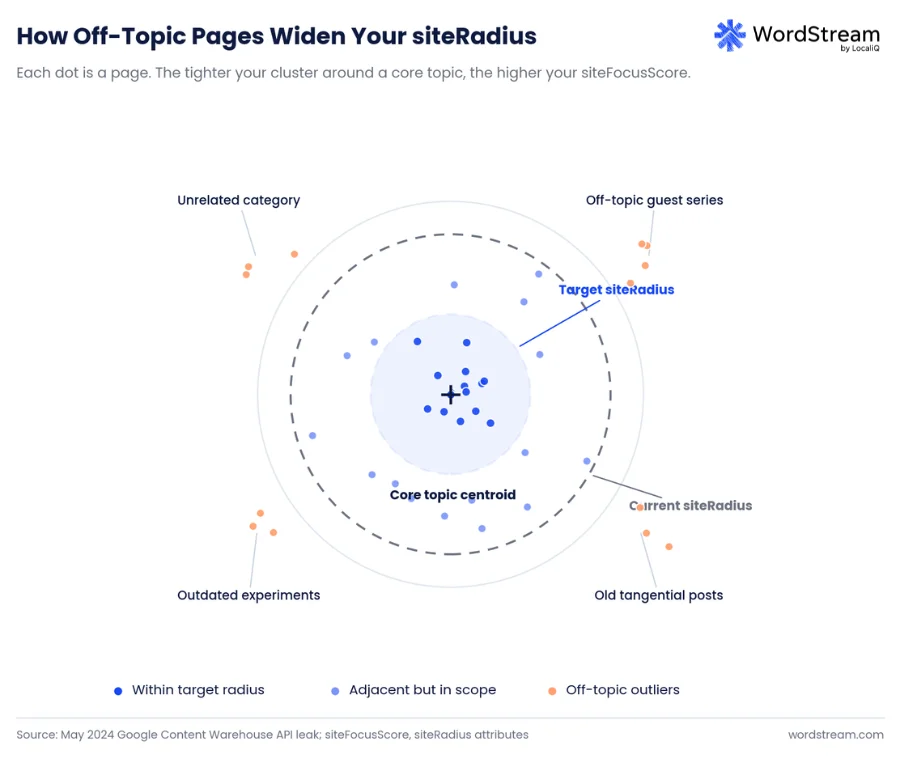
Internal attributes like siteFocusScore and siteRadius are believed to measure topical authority. siteFocusScore likely quantifies how concentrated a website’s content is around a particular topic, while siteRadius might indicate the breadth of related sub-topics a site covers within its primary focus. Google aims to understand if your site is a dedicated hub for a specific set of information, or if its content is spread too thinly across diverse, unrelated subjects.
Is This an Issue for Your Site?
Assessing topical authority is more nuanced than measuring domain authority. While tools exist that can map vector embeddings to identify content overlap and topical focus, their effectiveness can vary based on the size and scope of your website. Precisely measuring this against competitors at scale can be challenging. However, you can perform an audit of your content. If your site publishes across a wide array of unrelated topics, or if a significant portion of your pages receive fewer than 10 visits per quarter, it suggests a potential lack of topical focus. Similarly, if your strongest performing content falls outside your intended core subject area, it may indicate that your topical authority is not aligned with your business goals.
How Can You "Optimize" for Topical Authority?
The key to building topical authority is to define and commit to a core focus. Identify the primary subject matter that aligns with your business and audience needs. Then, create new content that deeply explores this core topic, covering various facets, sub-topics, and related questions. This consistent focus signals to Google that your site is a dedicated resource. You can also conduct an audit of underperforming pages, particularly those that are outside your core topical focus and are not driving significant traffic or engagement. Consider noindexing these pages or redirecting them to more relevant, authoritative content on your site. This process helps to tighten your siteRadius and enhance your siteFocusScore, reinforcing your expertise in your chosen niche.
Document Quality: The Substance of Content
Document quality is concerned with the inherent value, depth, and originality of the content on a specific page. It goes beyond mere keywords to evaluate the effort, expertise, and unique insights presented.
What Google is Measuring:
Attributes such as title and body match, contentEffort, titlematchScore, and pandaDemotion are indicative of document quality. title and body match and titlematchScore assess how well the content on a page aligns with its title and the user’s search query. contentEffort is a particularly significant indicator, utilizing AI to estimate the human effort and originality behind a piece of content, looking for elements like proprietary data, custom visuals, author expertise, and unique functionality. pandaDemotion likely relates to Google’s historical efforts to penalize low-quality content.
Is This an Issue for Your Site?
A simple test for document quality is to ask: "Could AI have generated this content?" If the answer is a resounding yes, it suggests a lack of originality and unique human input. Even if your content is human-written and comprehensive, if it doesn’t offer proprietary data, custom visuals, unique functionality, or demonstrable expertise, Google may not perceive it as "high effort." Consider the concept of "information gain." What can a visitor learn or obtain from your page that they cannot find elsewhere, especially from other sites ranking for the same query? If your content largely reiterates information readily available across the web, its quality may be lacking. Tools like the Content Effort Scorecard can help assess your content’s "effort" signal by analyzing text and providing suggestions for improvement, such as incorporating interactive elements, custom visuals, and demonstrating author expertise.
How Can You "Optimize" for Document Quality?
To enhance document quality, focus on baking in more "content effort" and "information gain." This involves incorporating proprietary data, research, or unique insights that cannot be found elsewhere. Clearly attribute authorship with named profiles that showcase the author’s expertise and credentials. Utilize custom visuals, such as original infographics, charts, or high-quality photography, rather than generic stock images. Embed interactive elements like calculators, quizzes, or configurators that provide a unique user experience. Include expert quotes or interviews from recognized figures in your field. When presenting research or data, make your methodology transparent. For title tags, use tools like the Title Tag Match Score Checker to ensure alignment with target queries, prioritizing clarity, keyword relevance, and character limits for optimal performance.
Freshness: The Currency of Current Information
Freshness, represented by attributes like lastSignificantUpdate, acknowledges that the relevance and value of content can diminish over time, especially for topics that evolve rapidly.
What Google is Measuring:
Google is evaluating how recently and how significantly a page has been updated. The lastSignificantUpdate attribute suggests that Google is capable of discerning genuine content revisions from superficial date changes. This means simply republishing an article without substantial new information or improvements may not trigger a freshness boost. The goal is to present users with the most current and accurate information available.
Is This an Issue for Your Site?
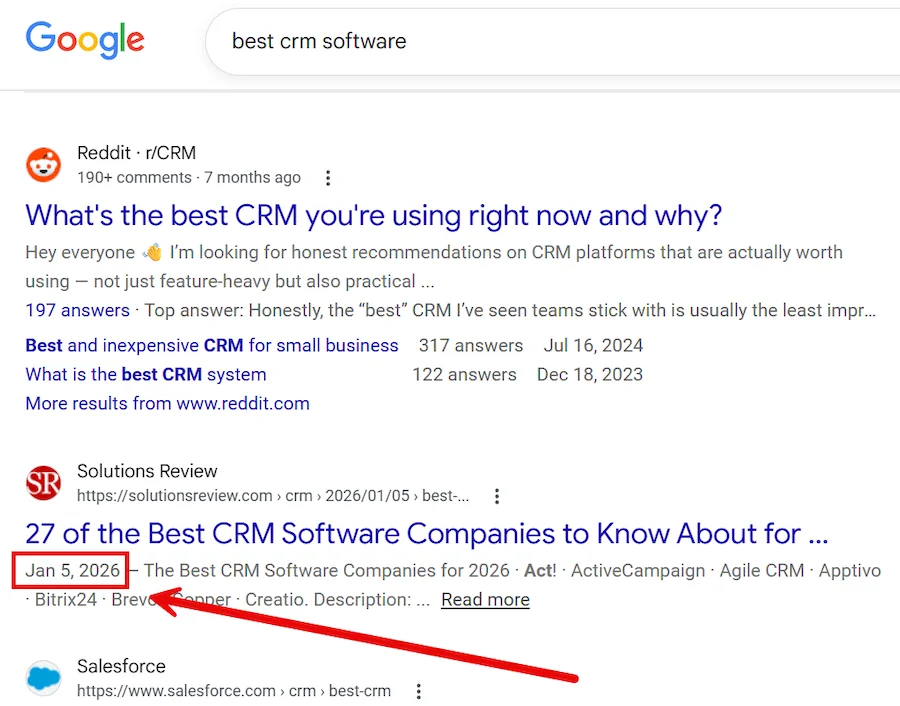
Observing the dates displayed in Google search results can offer clues about freshness. If competitors whose content is demonstrably newer or more recently updated are consistently outranking your pages, freshness might be a factor. If you have made updates to a page, but the date displayed in the SERP has not changed or reflects an older publication date, it may indicate that Google did not perceive your changes as "significant." Submitting updated pages for indexing via Google Search Console and using the URL inspection tool can help ascertain if Google has recognized and recrawled your recent modifications.
How Can You "Optimize" for Freshness?
To improve the freshness of your content, adopt a strategic approach to updates. For evergreen content, aim for a significant refresh roughly every 6-12 months, or as needed based on topic evolution. For time-sensitive topics, more frequent updates are essential. When updating, aim for a substantial change, often referred to as the "30% rule." This means incorporating at least 30% new material, such as updated statistics, new examples, expert opinions, or entirely new sections that provide added value. Treat each refresh as a focused content sprint, rather than a minor edit. For high-priority pages, establishing a quarterly refresh cadence can be a beneficial practice to ensure they remain relevant and competitive.
Engagement: User Interaction and Satisfaction
Engagement metrics, mapped by attributes like navBoost, clutterScore, and violatesMobileInterstitialPolicy, reflect how users interact with a website and their overall satisfaction with the experience. This is a critical indicator of whether a page truly meets user needs.
What Google is Measuring:
Google analyzes user behavior signals to understand how engaging and useful a website is. navBoost is a click-driven re-ranking system that considers user clicks – distinguishing between satisfied clicks (goodClicks) and those that lead users to immediately return to the search results (badClicks or "pogo-sticking"). A high clutterScore might indicate an overwhelming or distracting user interface, while violatesMobileInterstitialPolicy points to a poor mobile experience due to intrusive pop-ups or interstitials.
Is This an Issue for Your Site?
Measuring engagement against competitors can be challenging, as direct access to their analytics is not available. However, you can benchmark your own site’s key performance indicators (KPIs) such as bounce rate, time on site, and page load speed. Focus on improving these metrics, particularly on your most important pages and across your entire site. If your bounce rates are climbing, dwell time is decreasing, or conversion rates on key pages are low, it suggests potential engagement issues that could be negatively impacting your rankings.
How Can You "Optimize" for Engagement?
To enhance user engagement, aim to make your pages more useful, interactive, and sticky. This can be achieved by adding interactive elements such as filters, calculators, comparison tools, or configurators that allow users to actively engage with the content. Conduct thorough audits to identify and eliminate clutter, intrusive pop-ups, and any elements that detract from the user experience. Ensure your site is fully responsive and adheres to Google’s mobile-friendly guidelines to provide a seamless experience across all devices. Optimizing page load speed is also critical, as slow-loading pages can lead to user frustration and abandonment. By creating a user-centric experience, you encourage longer visits, deeper interaction, and ultimately, a more positive signal to Google’s ranking algorithms.
What to Fix First? A Strategic Prioritization
In the complex world of SEO, understanding where to focus efforts can be as important as knowing the ranking factors themselves. A structured approach to prioritizing fixes based on observed site symptoms can yield the most impactful results.
Domain Authority: If your branded search volume is stagnant or declining, if competitors with superior link velocity are consistently outranking you, or if your overall organic traffic is shrinking relative to your competitors, then addressing domain authority should be a priority. The recommended actions include investing in digital PR initiatives like HARO and Qwoted, developing data-led link bait, and engaging in traditional link-earning strategies.
Topical Authority: This factor becomes critical if your website publishes content across many unrelated topics, if a substantial portion of your pages receives very low traffic (fewer than 10 visits per quarter), or if your strongest content resides outside your intended core focus. The solution lies in identifying a core topic, pruning off-topic pages that dilute your authority, and concentrating new content creation and link acquisition efforts within that defined niche.
Document Quality: You should prioritize document quality if competitors with weaker link profiles are outranking you, if your content appears generic and easily replicable by AI, or if you lack demonstrable first-party evidence or expertise within your content. To improve, focus on integrating proprietary data, clearly identifying named authors, incorporating custom visuals, and showcasing first-person expertise.
Freshness: If your pages are experiencing rank decay after periods of stability, if Google’s displayed publication date consistently lags behind your content updates, or if recently updated competitors are consistently appearing above you in search results, freshness is likely a concern. Implement the "30% rule" for content updates and establish a quarterly refresh cadence for your most important pages.
Engagement: Prioritize engagement if your site ranks well but fails to convert traffic, if user dwell time is consistently short, or if bounce rates are increasing on your most critical pages. The proposed solutions involve adding interactive features like filters and calculators, and conducting audits to eliminate clutter and intrusive pop-ups.
The May 2024 Google Content Warehouse API leak, combined with Pandu Nayak’s DOJ antitrust testimony, has provided an unprecedented look under the hood of Google’s ranking algorithms. By understanding and strategically addressing these five core buckets – Domain Authority, Topical Authority, Document Quality, Freshness, and Engagement – businesses can build more resilient and effective SEO strategies, ensuring they are well-positioned to be found by their target audience in the evolving digital landscape of 2026 and beyond. Continuous monitoring of these factors and adaptation to Google’s ongoing refinements will be key to sustained search visibility.