The modern software development landscape has undergone a radical transformation over the last decade, shifting from monolithic "big bang" releases to a continuous delivery model that demands both speed and safety. At the heart of this evolution lies the feature flag—a powerful conditional logic tool that allows developers to toggle functionality on or off without redeploying code. However, despite their ubiquity, many engineering organizations treat feature flags as a simple "one-way door." In this traditional approach, a team ships a feature, flips the switch, and hopes for the best. If the system doesn’t crash, the flag is often left to languish in the codebase indefinitely, contributing to a growing mountain of technical debt.
Industry experts argue that the gap between merely using flags and using them effectively is vast. When managed with precision, feature flags transition from simple toggles into robust infrastructure that facilitates granular control over user experiences, instantaneous disaster recovery, and data-driven decision-making. To bridge this gap, organizations must adopt a comprehensive lifecycle approach that governs a flag from its initial creation to its eventual retirement.
The Strategic Importance of Feature Flag Categorization
One of the most common pitfalls in software engineering is the failure to distinguish between different types of feature flags at the moment of inception. Without clear categorization, a codebase quickly becomes cluttered with "zombie flags"—conditionals that remain in the system long after their purpose has been served. To maintain a clean and performant environment, teams must categorize flags into two primary buckets: temporary and permanent.
Temporary flags are designed for short-term objectives, such as a controlled rollout, an A/B test, or a specific experimental hypothesis. These flags should have a predefined expiration date and a clear owner. For instance, a flag titled checkout_v2_rollout carries significantly more context than a generic new_checkout label. By embedding intent and removal deadlines into the flag’s metadata, organizations can prevent the accumulation of dead code that obscures logic and complicates testing.
In contrast, permanent flags serve long-term operational needs. These include "kill switches" for mission-critical systems, access control toggles for premium subscription tiers, or configuration settings for region-specific compliance requirements (such as GDPR-related UI changes). By separating these types from day one, engineering leads can implement different governance models for each, ensuring that temporary flags are purged during routine maintenance while permanent flags receive the high-level security and auditing they require.
Proactive Risk Mitigation through Predefined Rollback Conditions
In the high-pressure environment of a production incident, human decision-making is often compromised. Most teams wait until a system begins to fail before discussing the criteria for a rollback. This reactive stance leads to "incident mode," where decisions are made based on intuition rather than empirical data.
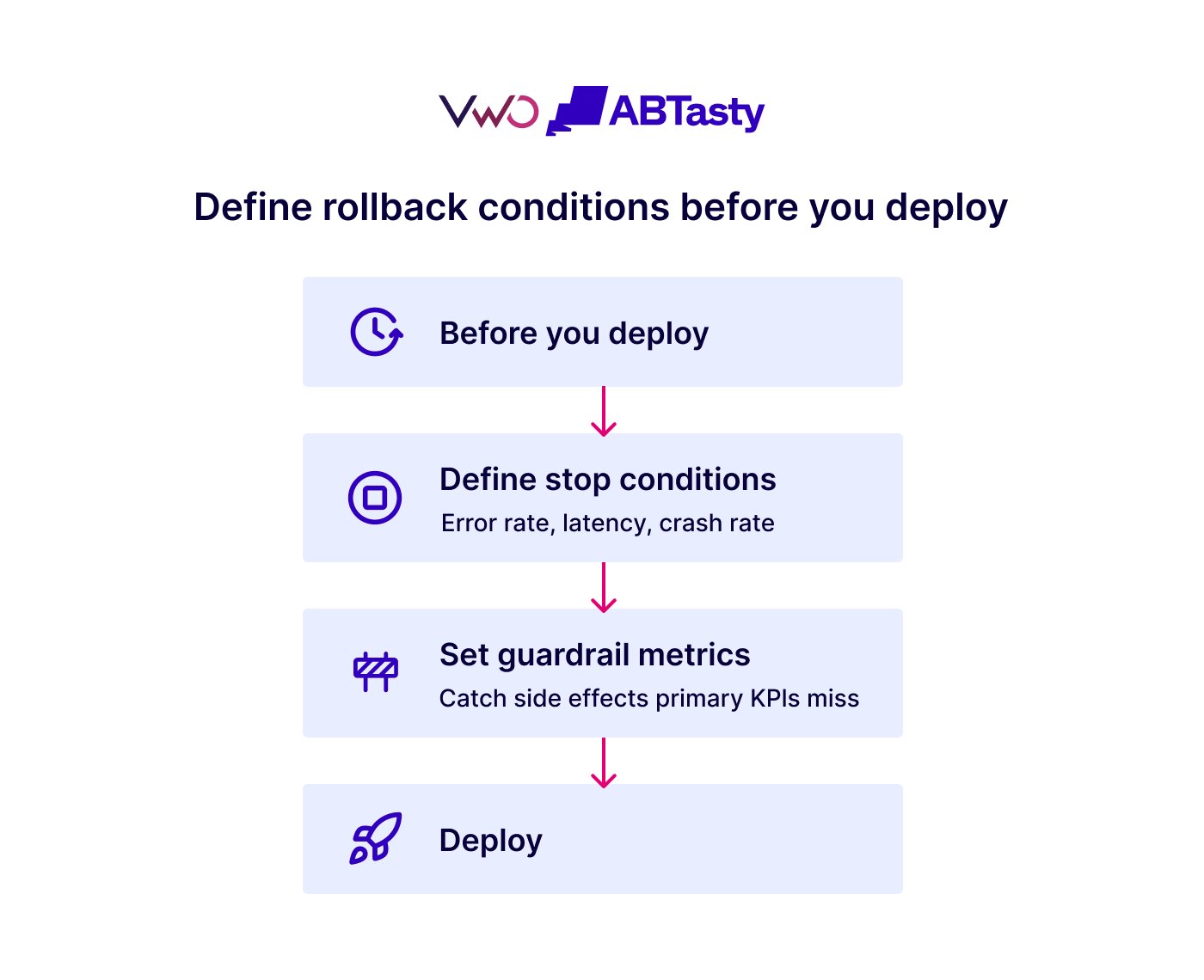
A professional journalistic analysis of high-performing DevOps teams reveals a common thread: they define their "stop conditions" before the deployment begins. A robust rollback plan requires specific, quantifiable thresholds. Instead of vague directives like "roll back if things look bad," teams should establish metrics such as:
- A sustained 1% increase in 5xx server errors over a five-minute window.
- A latency spike where the 95th percentile (p95) exceeds 300ms.
- A 5% drop in core conversion metrics compared to the control group.
Furthermore, teams should implement "guardrail metrics." These are secondary indicators that catch unintended side effects. For example, a new feature might successfully increase user engagement (the primary metric) but simultaneously cause a spike in battery consumption or memory usage on mobile devices (the guardrail). Without these secondary checks, a feature might be deemed a success while it is quietly degrading the overall user experience.
The Shift from Percentage-Based Rollouts to Targeted Canary Groups
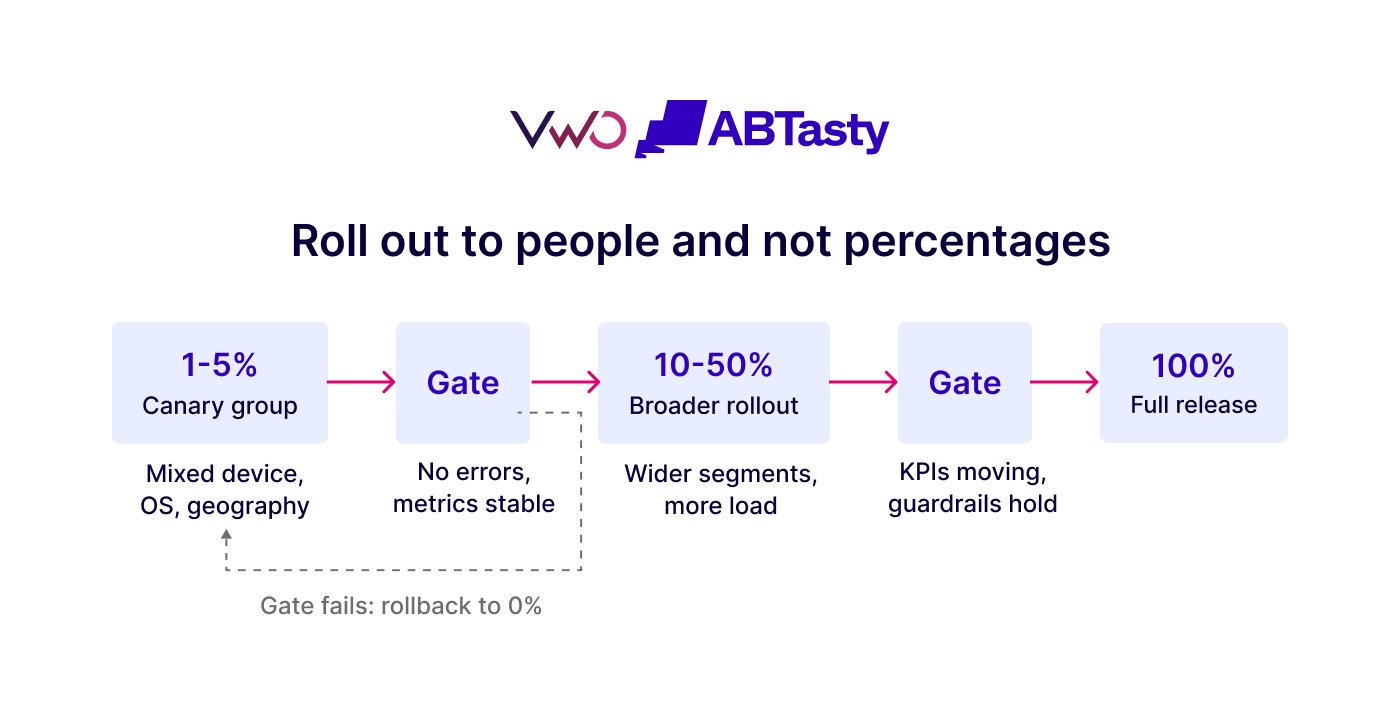
While "rolling out to 10%" is a common industry phrase, it is often a misleading metric for success. A random 10% slice of traffic may not be representative of the entire user base. If that 10% happens to consist primarily of high-end desktop users on fiber-optic connections, the team will fail to see how the feature performs for mobile users on latent 4G networks.
To achieve true confidence, rollouts must be targeted at "people," not just "percentages." This involves using custom attributes—such as device model, operating system version, geographic locale, and subscription tier—to create a diverse canary group. By passing this user context through a Software Development Kit (SDK), developers can ensure the feature is tested against the full spectrum of environmental variables.
Additionally, sophisticated organizations use feature dependencies to prevent "fragmented states." If a new front-end UI (Flag B) requires a specific backend API enhancement (Flag A) to function, the rollout rules should be linked. This ensures that the system never serves a broken experience where a user sees a button that connects to a non-existent service.
Kill Switches as Mission-Critical Infrastructure
A "kill switch" is a specialized feature flag designed to instantly disable a malfunctioning component across the entire network. However, a kill switch is only as reliable as its last test. Treating a kill switch as a "break glass in case of emergency" tool without regular validation is a recipe for disaster.
Engineering best practices dictate that kill switches should be subjected to "fire drills." Teams should periodically trigger these switches in staging, or even production during low-traffic periods, to ensure the system fails gracefully. A common failure point occurs when a kill switch disables a user interface but allows backend processes to continue running, leading to data corruption or orphaned API calls. A true kill switch must cover the entire "blast radius" of the feature, ensuring that both client-side and server-side components respond in unison to the shutdown command.
Automation and the Reduction of Human Dependency
Manual rollouts are inherently limited by the availability of human operators. An incident that occurs at 3:00 AM on a holiday weekend can escalate into a catastrophe if the rollout requires a manual intervention that no one is awake to perform.
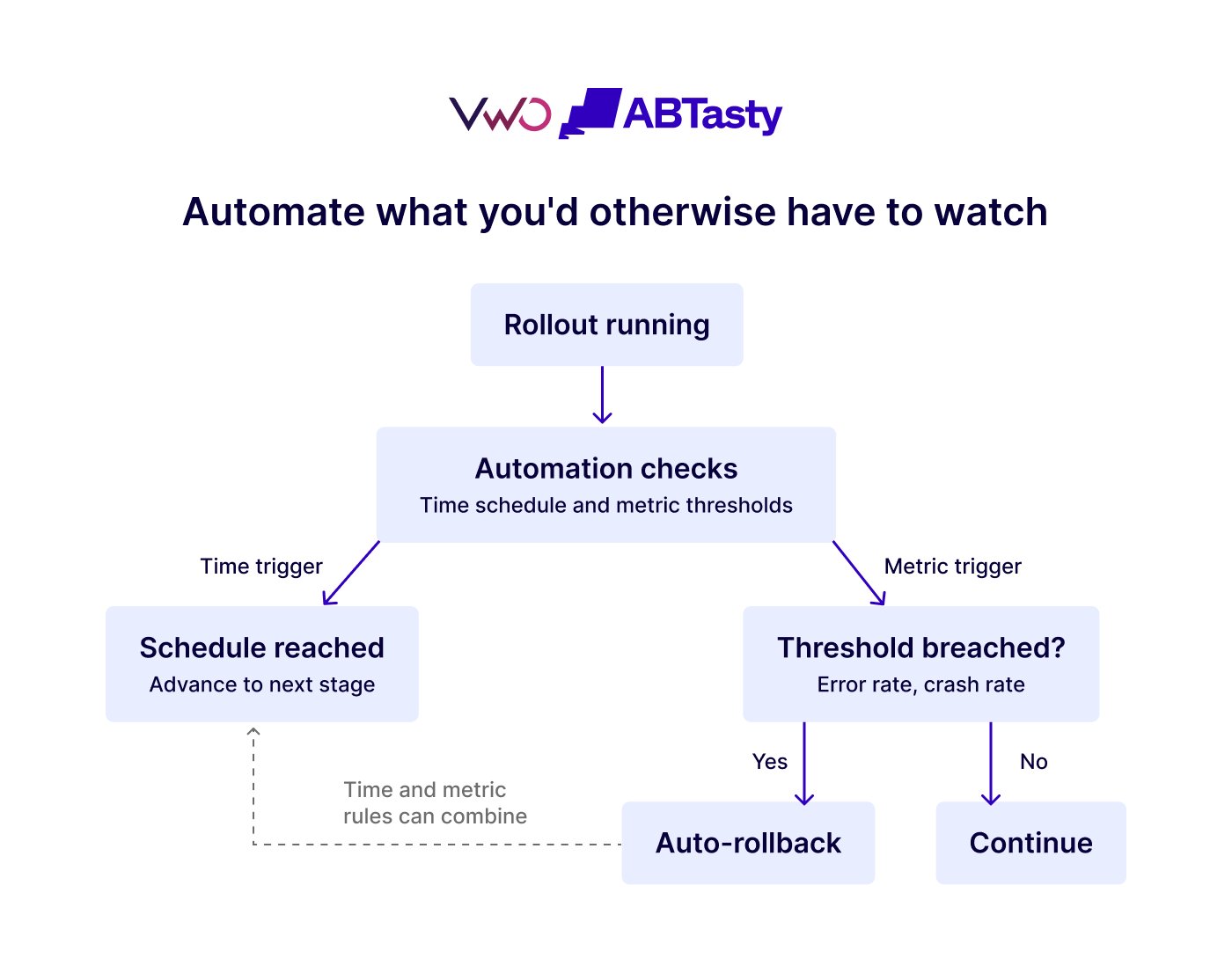
Modern feature management platforms now offer two layers of automation:
- Time-Based Automation: This allows teams to schedule the progression of a rollout. A feature can be programmed to scale from 1% to 10% on Monday, 10% to 50% on Wednesday, and 100% on Friday, provided no alerts are triggered.
- Metric-Based Automation: This creates a self-healing deployment pipeline. If a predefined threshold—such as a spike in crash rates—is met, the system automatically triggers a rollback without human intervention.
By closing the gap between the onset of a problem and the corrective action, automation reduces the Mean Time to Recovery (MTTR), a critical KPI for any modern enterprise.
Governance and Environment-Specific Access Control
As organizations scale, the "blast radius" of a single accidental flag flip increases. Therefore, access to feature flags should not be managed by a single, monolithic permission set. Instead, permissions should be decoupled by environment.
In a development or staging environment, engineers need the autonomy to toggle flags frequently for testing purposes. However, the production environment requires a "tightly governed" model. This includes:
- Role-Based Access Control (RBAC): Restricting production toggles to senior engineers or release managers.
- Approval Workflows: Requiring a peer review or a "second pair of eyes" before a flag state is changed in production.
- Audit Logs: Maintaining a chronological record of who changed which flag, when, and from what value. This transparency is vital for post-mortem analyses and regulatory compliance.
Dual-Front Monitoring: Stability versus Business Value
Monitoring a flagged feature requires a bifurcated approach. Most teams focus solely on stability—detecting errors and performance regressions. While essential, stability monitoring only answers the question, "Is it broken?" It does not answer the more important question, "Is it working?"
To truly understand a feature’s impact, organizations must monitor for value. This involves comparing the variation group (those with the flag on) against a control group (those with the flag off) across business-centric KPIs such as:
- Average Revenue Per User (ARPU)
- Feature adoption and retention rates
- Customer support ticket volume related to the new flow
By reviewing stability and value metrics in tandem, stakeholders can make an informed "go/no-go" decision. If a feature is stable but fails to move the needle on value, it should be killed just as readily as a feature that causes errors.
Transforming Rollouts into Continuous Experimentation
The final stage of feature flag maturity is the transition from "releasing" to "experimenting." A feature flag is, at its core, a controlled split of traffic. This mechanism is not limited to UI changes; it can be applied to any logic variable within the system.
Sophisticated teams use flags to test:
- Database Queries: Comparing the performance of a legacy SQL query against a new, optimized version.
- Recommendation Algorithms: Measuring which machine learning model drives higher click-through rates.
- Pricing Logic: Testing different discount structures or subscription bundles in real-time.
By treating every feature as an experiment, organizations shift their culture from one of "opinion-based" development to "evidence-based" engineering.
Conclusion: The Broader Impact on Business Agility
The implementation of these eight best practices—categorization, predefined rollbacks, targeted rollouts, tested kill switches, automation, environment governance, dual-front monitoring, and experimentation—represents a fundamental shift in how software is delivered.
For the modern enterprise, the stakes are high. Research suggests that high-performing organizations that leverage advanced feature management deploy code 208 times more frequently and have a change failure rate that is seven times lower than their peers. Furthermore, the ability to decouple deployment (moving code to production) from release (making features active for users) empowers product and marketing teams to move at their own pace, free from the constraints of the engineering release cycle.
Platforms like VWO Feature Experimentation have emerged to facilitate this transition, offering integrated SDKs, automated rollback triggers, and deep analytical suites that track the full funnel of user behavior. As software continues to eat the world, the organizations that master the full lifecycle of the feature flag will be the ones that define the future of digital innovation. The transition from a simple toggle to a strategic asset is no longer optional; it is a prerequisite for survival in the digital age.