The Bill and Melinda Gates Foundation recently unveiled its inaugural "Goalkeepers" report, a comprehensive data-driven study titled Goalkeepers 2017, designed to track progress toward the United Nations Sustainable Development Goals (SDGs). The report serves as a critical diagnostic tool, identifying urgent global problems while highlighting successful interventions that can be scaled to accelerate the fight against poverty and preventable disease. By synthesizing complex datasets into accessible narratives, the foundation aims to provide a roadmap for policymakers, NGOs, and the private sector to bridge the gap between current trends and the ambitious targets set for 2030.
Among the most pressing issues addressed in the report is the global maternal mortality rate, a metric that the foundation describes as a primary indicator of a society’s overall health and stability. The 2017 report utilizes high-fidelity information design—incorporating interactive charts, longitudinal data, and case studies—to demonstrate that while the challenge remains daunting, significant progress is being made in regions once considered unreachable by modern medical standards.
The Historical Context of Global Maternal Health Initiatives
The struggle to reduce maternal mortality has been a cornerstone of international development for decades. The journey began in earnest with the Millennium Development Goals (MDGs), established by the United Nations in 2000. MDG 5 specifically targeted a 75% reduction in the maternal mortality ratio (MMR) between 1990 and 2015. While the global community did not fully meet this ambitious target, the efforts resulted in a 44% decline in maternal deaths worldwide during that period.
Following the conclusion of the MDG era, the Sustainable Development Goals were adopted in late 2015. SDG Target 3.1 aims to reduce the global maternal mortality ratio to less than 70 per 100,000 live births by the year 2030. The Goalkeepers 2017 report acts as the first major status check in this new era, providing a baseline for the world to measure its success. According to UNICEF data, in 2015 alone, approximately 302,530 women died from complications related to pregnancy or childbirth. This equates to roughly 168.7 deaths per 100,000 live births globally, underscoring the distance still to be traveled to meet the 2030 objectives.
Case Study: Ethiopia’s Strategic Success in Reducing Mortality
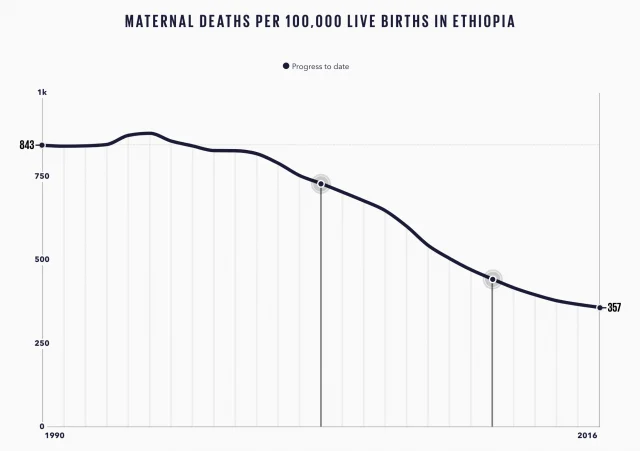
One of the most significant success stories highlighted in the Goalkeepers report is the transformation of maternal healthcare in Ethiopia. In 1990, Ethiopia faced one of the highest maternal mortality rates in the world, with 843 deaths per 100,000 live births. By 2015, this figure had plummeted to 357—a reduction of more than 50%.
Ethiopia’s progress is attributed to a robust, government-led strategy known as the Health Extension Program (HEP). Launched in 2003, the HEP focused on decentralizing healthcare and bringing services directly to rural communities. The government trained and deployed over 38,000 female health extension workers, who were tasked with providing essential health education, identifying high-risk pregnancies, and encouraging expectant mothers to give birth in medical facilities rather than at home.
This "last-mile" delivery of healthcare was supported by significant investments in infrastructure. Ethiopia expanded its network of primary health centers and improved the "referral pathway," ensuring that women experiencing complications could be transported to hospitals equipped for emergency obstetric care. The Gates Foundation emphasizes that Ethiopia’s model proves that even in resource-constrained environments, political will and strategic data application can yield life-saving results.
Statistical Analysis of UNICEF Maternal Mortality Data
To provide a broader context to the Ethiopia case study, an analysis of the UNICEF maternal mortality dataset reveals a complex global landscape characterized by extreme regional disparities. While the global average sits at 168.7 deaths per 100,000 live births, the data shows a sharp divide between high-income and low-income nations.
In many developed countries, maternal mortality rates have been reduced to single digits. Conversely, in Sub-Saharan Africa, the figures remain staggeringly high, despite the progress made over the last two decades. The UNICEF data, which is meticulously organized by country and region, indicates that the majority of maternal deaths are concentrated in just a few geographic areas. Two-thirds of all maternal deaths worldwide occur in Sub-Saharan Africa, with Southern Asia accounting for another significant portion.
The causes of death are largely preventable or treatable. According to clinical data supported by the World Health Organization (WHO) and UNICEF, the primary causes of maternal mortality include:
- Severe bleeding (hemorrhage): Often occurring after childbirth.
- Infections: Typically post-delivery (sepsis).
- High blood pressure during pregnancy: Preeclampsia and eclampsia.
- Complications from delivery: Obstructed labor or malpresentation.
- Unsafe abortions: Often resulting from a lack of access to reproductive health services.
The Goalkeepers report argues that by focusing on these five areas through improved clinical training and better access to essential medicines like oxytocin and magnesium sulfate, the global community can drastically lower the mortality rate.
Chronology of Progress and the Data Revolution
The timeline of maternal health tracking has evolved from sporadic surveys to real-time data analytics.
- 1990: Baseline year for the Millennium Development Goals; global MMR was estimated at 385 per 100,000 live births.
- 2000: The UN Millennium Declaration is signed, placing maternal health at the forefront of the global agenda.
- 2003: Ethiopia launches its Health Extension Program, serving as a pilot for rural health intervention.
- 2010: The UN Secretary-General launches the "Every Woman Every Child" movement to mobilize international action.
- 2015: Transition from MDGs to SDGs; UNICEF reports a global reduction in deaths to 302,530 annually.
- 2017: The inaugural Goalkeepers report is released, introducing a new level of data transparency and storytelling to the development sector.
The 2017 report is particularly notable for its use of "information design." By moving beyond static spreadsheets and into interactive media, the Gates Foundation has made it possible for non-specialists to interpret the "stories behind the data." This transparency is vital for maintaining public support and donor funding in an era of shifting political priorities.
Official Responses and Stakeholder Perspectives
The release of the Goalkeepers 2017 report prompted reactions from global health leaders and international organizations. Bill and Melinda Gates have been vocal about the moral imperative of this work. In the report’s opening, they state: “If you were trying to invent the most efficient way to devastate communities and put children in danger, you would invent maternal mortality.” This sentiment reflects the "multiplier effect" of a mother’s death; research shows that when a mother dies, her surviving children are significantly less likely to survive past the age of five, receive an education, or escape the cycle of poverty.
UNICEF officials have echoed these concerns, emphasizing that while the trends are positive, the pace of progress must accelerate to reach the 2030 targets. Public health experts suggest that the next phase of the fight will require more than just medical intervention; it will require addressing the "social determinants of health," such as gender inequality, lack of education for girls, and poor infrastructure that prevents women from reaching clinics.
In a disclosure regarding the data, analysts note that the reliability of maternal mortality statistics depends heavily on the quality of civil registration and vital statistics (CRVS) systems in individual countries. In many high-burden areas, deaths often go unrecorded, meaning the actual figures could be higher than those reported by UNICEF. This has led to a call for increased investment in data collection infrastructure.
Broader Implications and the Road to 2030
The implications of the Goalkeepers 2017 report extend far beyond the specific metric of maternal mortality. The report suggests that the health of mothers is a "bellwether" for the health of the entire global development project. If the world can successfully protect its most vulnerable women during their most vulnerable moments, it demonstrates the efficacy of the international cooperation model.
However, the analysis also warns of potential stagnation. Factors such as regional conflict, climate change, and shifts in international aid budgets pose significant risks to the progress achieved since 1990. The report emphasizes that "progress is possible, but it is not inevitable." It requires sustained funding, continued innovation in medical technology, and a commitment to data-driven policy making.
As the global community looks toward the 2030 deadline, the Goalkeepers initiative will continue to serve as an annual "report card." By highlighting successes like Ethiopia and identifying laggards through UNICEF’s rigorous data, the foundation hopes to create a culture of accountability. The ultimate goal is to move toward a world where the tragedy of maternal mortality is a historical relic rather than a daily reality for hundreds of thousands of families.
In conclusion, the Goalkeepers 2017 report and the accompanying UNICEF data provide a sobering yet hopeful view of global health. While the loss of over 300,000 women annually is a profound failure of the current system, the rapid decline in mortality rates in countries that prioritize health investment offers a clear path forward. The data confirms that with the right tools, the right information, and the right political will, the goal of ending preventable maternal deaths is within reach.