The affiliate marketing industry is currently navigating a period of significant upheaval following the removal of PayPal Honey, one of the world’s most prominent browser-based discount tools, from two of the largest affiliate networks in the United States. Within a single week in January 2026, both Rakuten Advertising and Impact.com took decisive action against the publisher, citing noncompliance with platform policies and “attribution manipulation.” These developments come six years after PayPal acquired Honey for approximately $4 billion, a deal that at the time represented one of the largest acquisitions of a technology startup in the e-commerce sector.
The removals were triggered by a series of high-profile investigations, most notably a detailed video report by tech investigator MegaLag and a technical analysis by Ben Edelman, a recognized expert in online advertising fraud and a former Associate Professor at Harvard Business School. The investigations alleged that Honey engaged in practices that bypassed “stand-down” rules—industry-standard protocols designed to ensure that browser extensions do not overwrite the cookies of other affiliates who may have contributed more significantly to a customer’s journey.
Chronology of Disciplinary Actions
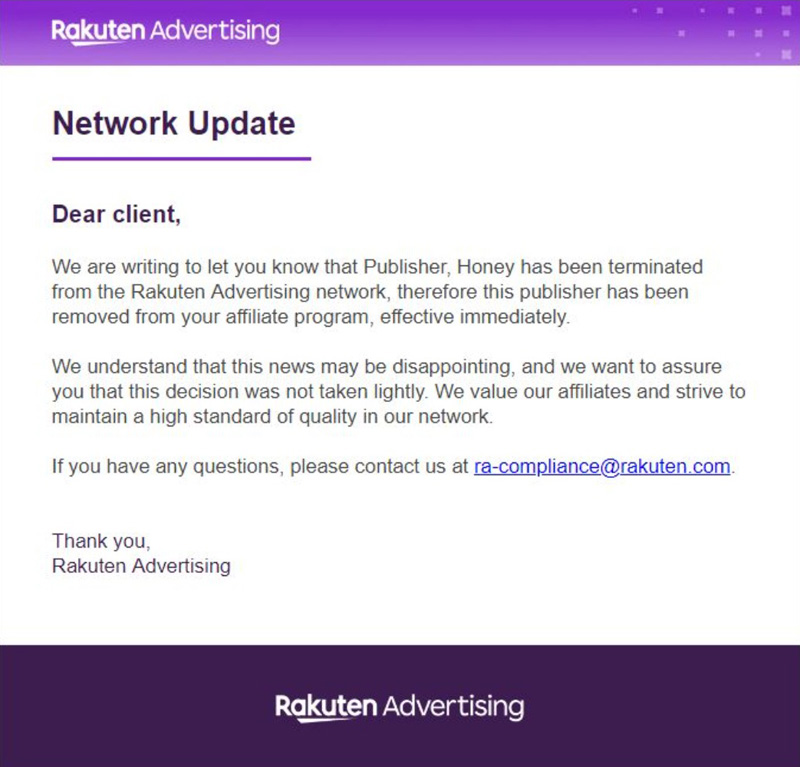
The timeline of events began on Monday, January 12, 2026, coinciding with the opening day of Affiliate Summit West, the largest affiliate marketing conference in the United States. Rakuten Advertising issued a formal announcement stating that Honey had been “terminated from the network.” The network characterized the move as a necessary step to “maintain a high standard of quality” within its ecosystem. The timing of the announcement, delivered as thousands of industry professionals gathered in Las Vegas, served as a significant focal point for discussions regarding publisher ethics and network integrity.
Following Rakuten’s lead, Impact.com announced its own disciplinary measures on Friday, January 16. The platform revealed that Honey was found to be “out of compliance” with its platform policies and had been removed from the Impact.com Discovery Marketplace. While Rakuten’s move appeared to be a permanent termination, Impact.com’s initial communication suggested a suspension, though the underlying cause remained consistent: the undermining of trust in the partnership economy. David A. Yovanno, CEO of Impact.com, explicitly identified “attribution manipulation” as the primary driver behind the suspension, marking a rare instance of a major platform publicly naming the technical cause of a top-tier publisher’s removal.
Understanding Attribution Manipulation and Stand-Down Violations
To understand the gravity of the allegations against PayPal Honey, one must examine the mechanics of the “last-click” attribution model, which remains the standard for most affiliate programs. Under this model, the last affiliate to “touch” or refer a customer before a transaction is completed receives 100% of the commission.
Browser extensions like Honey provide value to consumers by automatically finding and applying coupon codes at checkout. However, to maintain a fair ecosystem, networks implement “stand-down” rules. These rules dictate that if a customer has already been referred to a merchant by another affiliate—such as a content creator, a review site, or a social media influencer—the browser extension must not fire its own tracking link. If the extension ignores these rules, it “hijacks” the attribution, effectively stealing the commission from the affiliate who did the actual work of driving the customer to the brand.
The investigations by Edelman and MegaLag alleged that Honey used sophisticated methods to conceal these violations. By bypassing stand-down protocols, the extension could drop its own cookie at the final second of the checkout process, ensuring it was recorded as the “last click.” This practice not only unfairly penalizes other publishers but also inflates the perceived value of the extension to the merchant, who may end up paying commissions for sales that would have occurred regardless of the extension’s intervention.

The Financial and Strategic Context of PayPal Honey
PayPal’s acquisition of Honey in 2020 for $4 billion was seen as a strategic move to move “up-funnel.” By owning a tool that sits at the start of the shopping journey, PayPal aimed to influence consumer behavior before they reached the payment stage. At the time of the acquisition, Honey boasted over 17 million monthly active users and partnerships with approximately 30,000 retailers.
For PayPal, Honey represented a massive data asset, providing insights into what consumers were buying and where they were shopping. However, the recent removal from Rakuten and Impact.com poses a significant threat to the monetization of this asset. If Honey cannot participate in major affiliate networks, its ability to generate revenue through commissions is severely curtailed. Furthermore, the reputational damage to PayPal—a company that prides itself on security and trust—could have broader implications for its relationship with merchants and partners.
Technical Analysis and Industry Audits
The controversy has brought renewed attention to the technical complexities of affiliate tracking. A recent study by the Affiliate & Partner Marketing Association (APMA) in the United Kingdom highlighted the challenges of managing attribution in a multi-device, multi-publisher environment. The APMA performed an independent audit of 30 brands across 10 networks, focusing on the distinction between different technologies, such as “stand-down” rules versus “soft click” mechanics.
The APMA’s findings demonstrated that while networks have policies in place, the enforcement of these policies is often inconsistent. The study provided seven recommendations for the industry, emphasizing the need for greater transparency and more robust auditing tools for brands. Industry experts at AM Navigator, a leading affiliate management agency, have noted that while networks provide the infrastructure, the ultimate responsibility for policing affiliate behavior lies with the brands themselves. They argue that networks often face a conflict of interest, as they earn overrides on the commissions paid to large publishers like Honey.
Broader Implications for the Partnership Economy
The removal of a publisher of Honey’s scale sends a clear signal to the industry that “too big to fail” does not apply in the face of systemic policy violations. The implications of this event are expected to resonate across several sectors of the digital marketing landscape:
1. Increased Scrutiny of Downloadable Software Publishers (DSPs)
Browser extensions and other downloadable tools will likely face more rigorous vetting processes. Brands are expected to demand greater transparency regarding when and how these tools fire tracking links, particularly in the presence of other affiliate cookies.
2. Shift Toward Multi-Touch Attribution
The Honey case exposes the vulnerabilities of the last-click model. There is growing momentum within the industry to move toward multi-touch or fractional attribution models, where commissions are shared among all affiliates who contributed to the conversion funnel. This would reduce the incentive for “attribution hijacking” at the point of sale.
3. Brand-Led Compliance Monitoring
Marketing managers are being urged to move beyond relying solely on network-level compliance. The use of third-party monitoring tools that can simulate user journeys and detect unauthorized cookie-dropping is becoming a standard requirement for high-volume affiliate programs.
The Importance of Affiliate Base Diversification
One of the critical lessons highlighted by industry analysts following the Honey suspension is the danger of over-reliance on a single type of affiliate. Many brands discovered that a disproportionate amount of their affiliate revenue was tied to Honey. When the publisher was removed, these programs saw an immediate and substantial drop in referred sales.
To mitigate such risks, experts suggest that a healthy affiliate program should be diversified across a wide array of publisher types. AM Navigator identifies 28 distinct affiliate categories that brands should explore to ensure a balanced and resilient ecosystem:
- Content and Influence: Content producers, social media influencers, podcasters, and video marketers.
- Loyalty and Rewards: Cashback sites, affinity groups, and card-linked offer programs.
- Niche and Specialized: Educators, consultants, and ranking/review sites.
- Technological and Utility: Retargeting solutions, cart abandonment tools, and post-checkout platforms.
- Traditional Marketing: Email marketers, paid search affiliates, and sub-affiliate networks.
By spreading commissions across these diverse groups, brands protect themselves from the volatility associated with any single publisher’s removal or technical failure.
Official Responses and Future Outlook
As of the current reporting, PayPal has not issued a detailed rebuttal to the specific technical allegations of attribution manipulation, though the company has historically defended Honey’s value proposition as a tool for consumer savings and merchant conversion. Rakuten and Impact.com have maintained their positions, emphasizing that the integrity of their marketplaces is paramount.
The industry now waits to see if other networks, such as Awin or CJ, will follow suit. If Honey is systematically excluded from all major U.S. networks, PayPal may be forced to radically restructure the tool’s business model or seek direct integrations with merchants, bypassing the affiliate networks entirely.
The “Honey Affair,” as it is being termed in industry circles, marks a turning point for affiliate marketing in 2026. It underscores a transition from a “growth at all costs” mentality to one defined by transparency, technical compliance, and the protection of the “partnership economy.” For affiliate managers and brand owners, the event serves as a stark reminder that the quality of traffic is just as important as the volume, and that trust remains the most valuable currency in digital marketing.