In the rapidly evolving landscape of digital communication, where carefully crafted messages and sophisticated targeting are paramount, the foundational integrity of an email list often remains an overlooked, yet utterly critical, prerequisite for success. While many marketers mistakenly relegate email verification to a mere maintenance task, it must instead be elevated to a strategic imperative, serving as the launchpad for all subsequent marketing activities. Neglecting this crucial step can lead to an invisible ceiling on campaign efficacy, wasting valuable resources and severely undermining return on investment (ROI). By proactively verifying leads, organizations can minimize invalid data, accurately gauge campaign performance, and strategically allocate resources where they promise the greatest impact.
The Evolution of Email Marketing and the Growing Need for Data Purity
Email marketing has traversed a significant journey from its early days of mass-blast communications to today’s era of hyper-personalization, artificial intelligence (AI)-driven content, and intricate customer journeys. This evolution has, paradoxically, made the most basic element—the email address itself—more critical than ever. In the past, a certain percentage of invalid addresses was often tolerated as an unavoidable cost of doing business. However, with the rise of sophisticated analytics, stringent data privacy regulations like the General Data Protection Regulation (GDPR), the California Consumer Privacy Act (CCPA), and Canada’s Anti-Spam Legislation (CASL), and increasingly intelligent mailbox providers, the tolerance for poor data quality has evaporated.
The modern email ecosystem operates on a delicate balance of trust and reputation. Every email sent to an invalid or nonexistent address triggers a “hard bounce,” a clear signal to mailbox providers that a sender’s data management practices are subpar. A consistently high bounce rate can swiftly erode sender reputation, a critical metric that determines whether emails land in the inbox, the spam folder, or are blocked entirely. This isn’t merely a technical hiccup; it directly translates to lost opportunities, diminished brand visibility, and a compromised ability to connect with genuine leads. Proactive verification acts as a shield, managing this inherent risk and empowering marketers to scale their campaigns confidently without fear of suspension or deliverability issues.
The Downstream Fallacy: A Strategic Misdirection
A prevalent misstep in contemporary marketing strategy is what is often termed the “downstream fallacy.” This occurs when marketing teams pour disproportionate resources into the latter stages of the workflow—such as A/B testing subject lines, optimizing AI-generated copy, or designing visually stunning email templates—while neglecting the fundamental quality of their data from the outset. The pressure to demonstrate tangible results often pushes marketers towards visible output, but the analytical rigor required to evaluate these efforts becomes impossible if the underlying email list is riddled with invalid addresses.
Consider the promise of AI and hyper-personalization, technologies poised to revolutionize customer engagement. Their effectiveness hinges entirely on accurate data. Sending a perfectly personalized, AI-crafted message to a nonexistent email address is not just futile; it’s a profound waste of technological investment and creative talent. Moreover, this fallacy extends beyond marketing’s internal operations, often creating significant friction between marketing and sales teams. When marketing passes on unverified leads, sales teams waste valuable time pursuing “ghosts,” leading to mistrust and operational inefficiencies that undermine collaborative success.

Compounding this challenge are tightening marketing budgets. A 2025 Gartner report highlighted that marketing budgets have largely flatlined at 7.7 percent of overall company revenue, underscoring the urgent need for maximized resource utilization. In this environment, every dollar spent sending emails to invalid domains or nonexistent recipients is a direct drain on precious funds. Correcting the downstream fallacy necessitates a fundamental shift in focus, placing robust audience validity at the very top of the strategic hierarchy, recognizing it as the indispensable launchpad for all subsequent, impactful marketing endeavors.
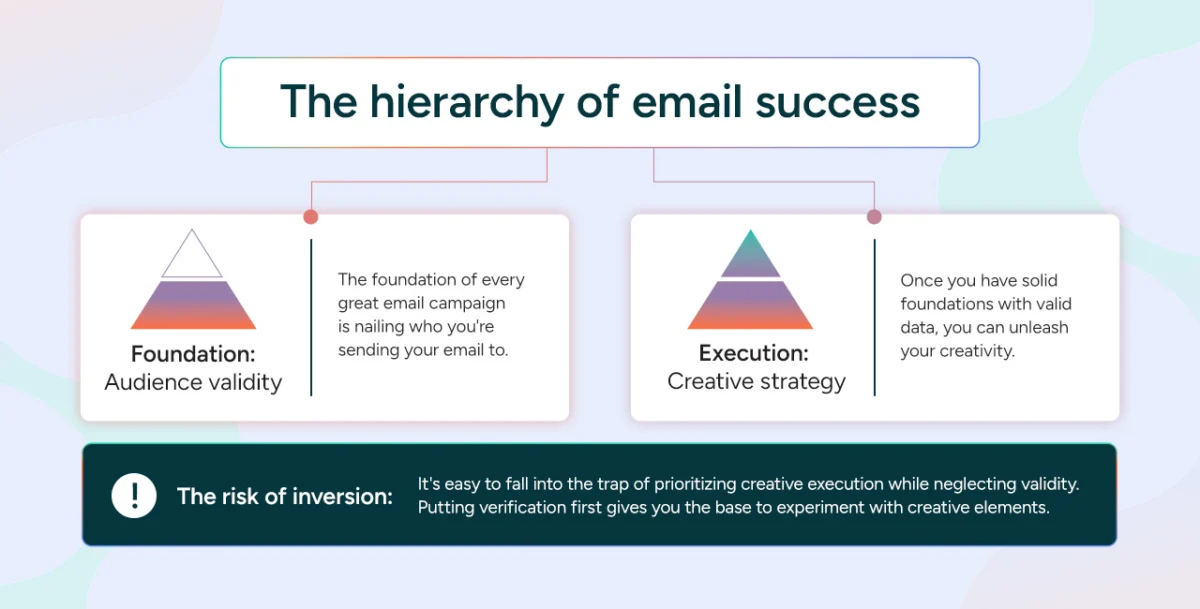
The Hierarchy of Email Success: A Blueprint for Effective Campaigns
Achieving email campaign success demands more than just compelling creative elements; it requires a structured, sequential approach that prioritizes foundational elements.
1. Foundation: Audience Validity
The absolute bedrock of any successful email campaign is the precise identification and validation of the recipient audience. This foundational step dictates the relevance of all subsequent creative assets and prevents marketers from “shouting into the void”—both in terms of message resonance and ensuring the message reaches an active inbox. By establishing a clean, verified list at the outset, organizations ensure that their valuable resources are deployed with maximum efficiency. This initial investment in data quality pays dividends immediately and sustainably, guaranteeing a healthy list capable of supporting ambitious growth strategies without succumbing to debilitating bounce rates.
2. Execution: Creative Strategy
With a solid foundation of valid data firmly in place, marketing teams are liberated to unleash their full creative potential. This layer encompasses the artistry of compelling copy, the precision of design, and the strategic implementation of personalization tactics. While the creative strategy is undeniably responsible for driving engagement and converting prospects, its effectiveness is entirely contingent upon the deliverability secured by rigorous email verification. Without the first step, the most brilliant creative work remains unseen and unheard.
3. The Risk of Inversion
The common pitfall is to invert this hierarchy, prioritizing creative execution and technological flair over the fundamental integrity of the recipient list. This inversion creates a false sense of security, where perceived campaign sophistication masks underlying inefficiencies and wasted effort. To rectify this, a profound cultural shift is often required within marketing teams, championing clean data metrics—such as low bounce rates and high deliverability—with the same fervor typically reserved for click-through rates or conversion rates. Only then can organizations move from making educated guesses to informed optimizations.
Understanding the Mechanics: How Email Verification Works
True email verification extends far beyond a rudimentary check for an “@” symbol. Modern verification processes are sophisticated, multi-layered technical undertakings designed to identify a spectrum of issues.
Beyond Basic Syntax: While syntax checks are essential for filtering out malformed addresses, they offer only a superficial validation. An address might “look” correct but be entirely inactive, have a full inbox, or belong to a server configured to reject external mail. Advanced verification delves deeper, performing a series of technical checks:
- DNS Lookup: Verifying that the domain exists and is properly configured.
- MX Record Validation: Confirming the mail exchange records are valid, indicating that the domain can receive emails.
- SMTP Handshake: Simulating a connection to the recipient’s mail server to ascertain if the address is active and capable of receiving mail. This often involves real-time server pings.
- Disposable Email Address (DEA) Detection: Identifying temporary email addresses often used for one-time sign-ups, which are unlikely to engage long-term.
- Role-Based Email Detection: Flagging addresses like
info@,sales@, oradmin@, which might be legitimate but often lead to lower engagement or are managed by multiple individuals. - Spam Trap Detection: Identifying known spam trap addresses—designed to catch spammers—to protect sender reputation.
- Greylisting Detection: Understanding servers that temporarily reject emails from unknown senders to filter out spam, requiring a second attempt.
By distinguishing between temporary issues (like a full mailbox, which results in a soft bounce) and permanent failures (like a nonexistent user, leading to a hard bounce), marketers can intelligently prune their lists, safeguarding their sender score and ensuring optimal deliverability.
Types of Bad Data and Their Implications:
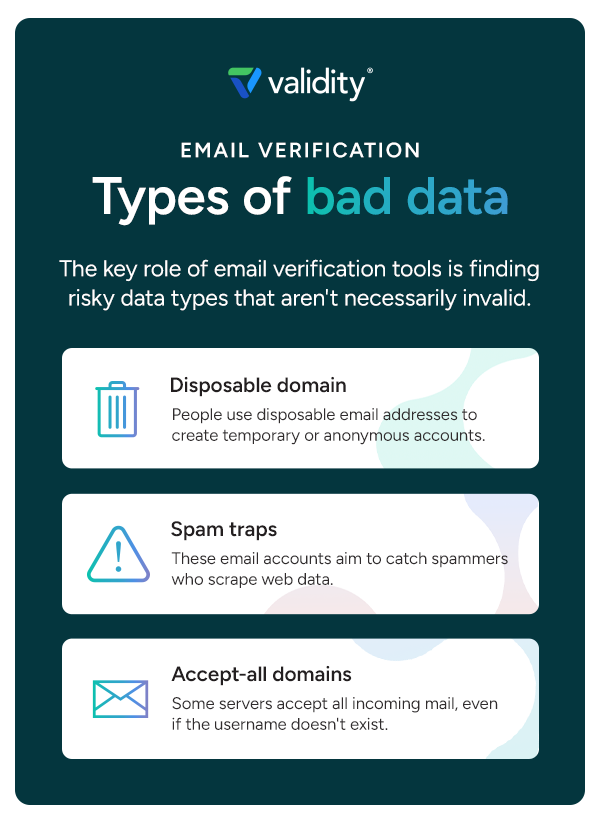
Email verification tools are instrumental in flagging various risky data types that, while not always “invalid” in a strict technical sense, can still severely harm an email program:
- Non-existent Emails: The most straightforward hard bounce, indicating the address does not exist.
- Spam Traps: These are critical. Pristine spam traps are real email addresses never used for legitimate correspondence, set up by anti-spam organizations. Recycled spam traps were once valid but have been repurposed. Hitting these can instantly black list a sender.
- Disposable Email Addresses (DEAs): Temporary addresses that expire after a short period. Sending to these inflates lists with non-engaging contacts.
- Catch-all Domains: Domains configured to accept all emails sent to them, regardless of whether the specific user exists. This makes direct validation difficult and carries a higher risk.
- Typographical Errors: Simple human mistakes during data entry (e.g.,
gamil.cominstead ofgmail.com). Real-time verification can often correct these at the point of entry. - High-Risk Domains: Domains associated with known fraudulent activities, bot networks, or purchased lists.
Beyond technical performance, identifying and removing spam traps or high-risk domains is a first line of defense against compliance violations, particularly regarding GDPR, CCPA, or CASL, which mandate strict consent and data hygiene practices.
The Real Cost of Bad Data: A Drain on Resources and Reputation
The financial and operational ramifications of poor email data hygiene are substantial, manifesting in direct, indirect, and opportunity costs.
Direct Costs:
Email Service Providers (ESPs) typically charge based on subscriber count or email volume. Every invalid or nonexistent contact in a database directly contributes to these charges, representing a tangible waste of marketing budget. By systematically purging these defunct entries, organizations can immediately improve data integrity and potentially reduce their ESP tier, leading to direct savings. For instance, if an ESP charges $500 for up to 50,000 subscribers and the next tier is $750 for up to 100,000, removing 10,000 invalid contacts from a 55,000-strong list could save $250 per month.
Indirect Costs:
The ripple effects of bad data extend far beyond direct financial outlays.
- Skewed Analytics: Invalid data skews crucial metrics like open rates, click-through rates, and conversion rates, making accurate A/B testing and campaign optimization nearly impossible. Marketers operate on flawed assumptions, leading to suboptimal strategies.
- Damaged Sender Reputation: Each hard bounce chips away at a sender’s reputation score. Over time, this degradation can lead to emails being consistently routed to spam folders or blocked entirely, severely impacting deliverability for legitimate campaigns. Rebuilding a tarnished sender reputation is a lengthy and costly process, involving meticulous list cleaning, gradual warm-up periods, and constant monitoring.
- Operational Drag: When marketing teams pass invalid leads to sales, sales representatives waste precious time chasing dead ends. This not only saps morale but also erodes trust between departments, hindering overall business efficiency and creating internal friction.
- Increased Storage Costs: Bloated databases, laden with stale and invalid entries, consume unnecessary storage space in CRMs, marketing automation platforms, and data warehouses. This increases cloud storage costs, slows down synchronization processes between platforms, and complicates data backups.
Opportunity Costs:
Perhaps the most insidious costs are the lost opportunities—the leads that could have been nurtured but were instead missed due to correctable errors.
- Lost Conversions at Point of Capture: Simple human typos in email addresses during form submission (e.g.,
yaho.cominstead ofyahoo.com) represent lost prospects. Real-time verification, by instantly prompting users to correct errors, creates a frictionless user experience, reinforcing brand professionalism and ensuring immediate information delivery. - Delayed Innovation: Time and resources spent on cleaning up existing bad data or troubleshooting deliverability issues detract from strategic initiatives like content development, audience segmentation, and true personalization. This diversion prevents teams from focusing on growth-driving activities.
Implementing a Robust Verification Strategy: A Multi-Pronged Approach
An effective email verification strategy integrates various methods to maintain data quality at every stage of the customer journey.
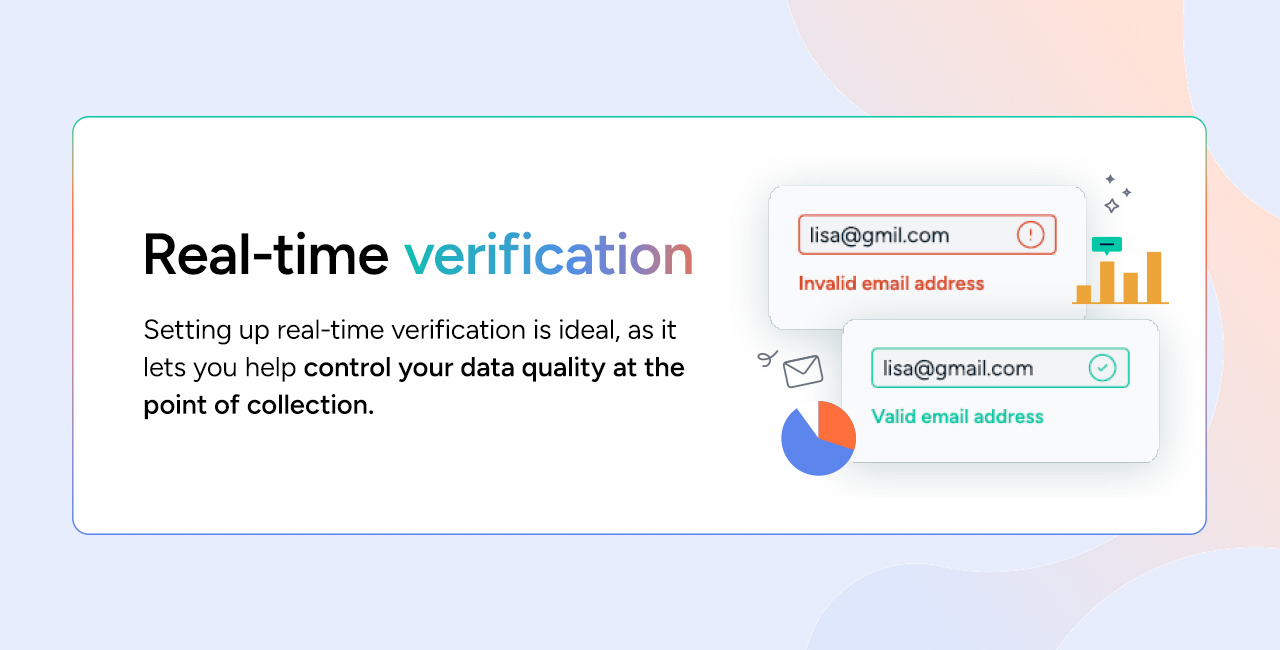
1. Real-Time Verification: This is the first line of defense. By integrating application programming interfaces (APIs) into web forms, landing pages, and point-of-sale systems, real-time verification tools instantly validate an email address as it’s entered. If a typo is detected, the user is prompted for correction immediately, preventing bad data from ever entering the CRM. This proactive approach minimizes bad data passed to sales, addressing potential hand-off anxieties and improving lead quality from the source.
2. Bulk Verification: Even with real-time checks, existing lists require periodic cleaning. Data decays naturally, with B2B email lists, for instance, often seeing a 20-30% decay annually due to job changes, company closures, or domain expirations. Bulk verification tools can process large volumes of existing email addresses, identifying and removing invalid, risky, or low-quality contacts from legacy databases. This is crucial for maintaining the integrity of historical data and ensuring that old lists remain viable assets.
3. Regular Maintenance: Data hygiene should be an ongoing process, not a one-off event. Establishing a regular cadence for verification—whether monthly, quarterly, or before significant campaigns—ensures that invalid addresses are caught before they can impact deliverability. This proactive maintenance helps maintain an accurate representation of the active audience, ensuring marketing efforts reach actual, engaged recipients. The ideal cadence depends on the industry’s velocity; high-churn sectors like SaaS or e-commerce may require more frequent checks.
4. Pre-Send Validation: For high-stakes campaigns, such as Black Friday promotions, new product launches, or critical announcements, a final verification sweep before sending is invaluable. These moments demand maximum deliverability, and an up-to-date, thoroughly verified list significantly boosts the chances of messages reaching their intended audience, thereby maximizing campaign success and ROI.
5. Managing Unknowns: Email verification tools sometimes return a small percentage of addresses with an “unknown” status, often due to server timeouts or stringent security settings. A common, yet risky, mistake is to treat these unknowns as valid. Instead, a best practice is to segment these contacts onto a “quarantine list.” They can then be tested with low-volume, text-only re-engagement emails sent from a secondary sending IP address. This strategy protects the primary sender reputation while attempting to recover potentially genuine leads. If these test emails bounce, the addresses can then be safely removed.
Validity BriteVerify: Setting the Industry Standard for First-Step Accuracy
When selecting an email verification partner, speed, accuracy, and comprehensive coverage are paramount. Tens of thousands of organizations globally rely on solutions like Validity’s BriteVerify, recognizing its ability to deliver superior customer data quality.
BriteVerify is engineered to handle massive volumes of data with minimal latency, ensuring that real-time verification APIs do not impede the user experience on web forms. Whether processing thousands of leads per hour or millions of records in a bulk batch, the platform scales dynamically to meet demanding requirements without compromising performance.
A key differentiator for BriteVerify is its accuracy, stemming from deep, established relationships with inbox providers and a vast global data network. This proprietary access and network intelligence enable more precise status checks than competitors who rely on less robust data scraping methods. By significantly reducing the number of “unknown” results in email lists, BriteVerify allows organizations to retain more valid leads while effectively purging bad data that could jeopardize sender reputation. Furthermore, BriteVerify’s seamless integration capabilities ensure a smooth onboarding process, minimizing IT overhead and accelerating time to value.
Maximizing Every Send: The Strategic Advantage of Proactive Verification
Ultimately, prioritizing email verification is not merely a technical checkbox; it is a strategic decision that empowers marketing teams to optimize their creative resources and focus on innovation. With trusted, clean data as a foundation, organizations can confidently invest in personalization, AI-driven content, and sophisticated segmentation, knowing that their efforts will reach real, engaged individuals.
Solutions like BriteVerify provide the flexibility to verify lists at the critical point of capture, through regular bulk validations, and even immediately before launching major campaigns. This multi-faceted approach safeguards sender reputation, enhances deliverability, and ensures that marketing messages resonate with the most interested and receptive leads, driving greater business impact and competitive advantage in an increasingly data-driven world.
To unlock the full potential of your email marketing efforts and ensure every send counts, exploring advanced verification solutions is a critical next step.