In the bustling landscape of digital marketing, the allure of crafting compelling email campaigns—with sharp copy and eye-catching designs—often overshadows the foundational mechanics required for their success. However, the most brilliantly conceived email is rendered useless if it fails to reach its intended recipient’s inbox, instead vanishing into the digital abyss of a spam folder. This critical, yet frequently underestimated, aspect of digital communication is governed by email infrastructure, the intricate behind-the-scenes plumbing that dictates the journey of every message. Establishing and meticulously maintaining this infrastructure is not merely a best practice; it has become an essential requirement, directly impacting campaign efficacy, brand reputation, and ultimately, a business’s bottom line.
The Evolution of Email Security and the Rise of Infrastructure’s Importance
Email, since its inception, has undergone significant transformations, evolving from a simple communication tool into a pivotal marketing and operational channel. Early email systems were relatively open, with fewer checks and balances. This openness, however, paved the way for the proliferation of unsolicited bulk email, commonly known as spam. The sheer volume of spam became a major problem for users and internet service providers (ISPs) alike, leading to the development of sophisticated anti-spam technologies and sender reputation systems.
Initially, email deliverability was largely dependent on the IP address reputation of the sending server. However, as spammers became more adept at circumventing these measures, the industry recognized the need for more robust, domain-level authentication. This marked a significant shift in focus towards verifying the legitimacy of the sender’s domain, rather than just the server. Over the past two decades, this evolution has led to the widespread adoption of standardized protocols designed to combat spoofing and phishing, fundamentally altering how emails are routed and delivered. The landscape has continuously tightened, culminating in recent mandates from major mailbox providers that have elevated email infrastructure from an optional enhancement to a non-negotiable prerequisite for successful email delivery.
Understanding Email Infrastructure: The Technical Backbone
At its core, email infrastructure encompasses the entire technical ecosystem responsible for sending, routing, and delivering emails. This complex system includes several key components: the sending domain itself, the dedicated servers that facilitate email transmission, essential security protocols that verify sender legitimacy, and the monitoring tools used to track and analyze delivery performance. Without a meticulously configured and well-maintained foundation in these areas, even the most strategically planned and aesthetically pleasing email campaigns are destined for obscurity, failing to achieve their objectives.
The Mandate for Authenticity: A Chronological Shift
The journey towards stringent email authentication has been incremental but definitive. While protocols like SPF, DKIM, and DMARC have existed for years, their enforcement has varied.
- Early 2000s: The Sender Policy Framework (SPF) emerged as an early attempt to combat email spoofing by allowing domain owners to publish a list of authorized sending servers in their DNS records.
- Mid-2000s: DomainKeys Identified Mail (DKIM) followed, providing a cryptographic signature to verify that an email had not been altered in transit and that it originated from the claimed domain.
- Early 2010s: DMARC (Domain-based Message Authentication, Reporting & Conformance) was introduced as an overarching policy layer that builds upon SPF and DKIM. DMARC enables domain owners to instruct mailbox providers on how to handle emails that fail authentication checks, offering policies like ‘none,’ ‘quarantine,’ or ‘reject,’ while also providing valuable feedback reports.
For a considerable period, implementing these protocols was considered “best practice”—highly recommended for improved deliverability but not strictly enforced to the point of outright blocking. However, this dynamic shifted dramatically in early 2024. Major mailbox providers, notably Google and Yahoo, announced and began enforcing stricter requirements for bulk senders. These mandates explicitly state that senders sending more than 5,000 emails per day to Gmail or Yahoo addresses must authenticate their emails with SPF, DKIM, and DMARC. Failure to comply with these updated standards no longer merely results in underperformance; it now frequently leads to outright email blocking, significantly impacting an organization’s ability to communicate with its audience. This pivotal change underscores the critical need for every organization to audit and fortify its email infrastructure.

Pillars of a Robust Email Infrastructure
Building a resilient email infrastructure involves several strategic steps, each contributing to a stronger sender reputation and improved inbox placement rates.
1. Strategic Selection of an Email Service Provider (ESP)
The Email Service Provider (ESP) serves as the engine powering an organization’s entire email program. The choice of an ESP is paramount, as a mismatch can lead to costly operational inefficiencies and deliverability challenges. When evaluating ESPs, organizations must look beyond basic sending capabilities and consider a comprehensive set of factors:
- Scalability: Can the ESP handle projected email volumes as the business grows? Does it offer dedicated IP options for high-volume senders?
- Deliverability Features: Does the platform offer advanced features like automated bounce handling, spam trap monitoring, and robust analytics that provide insights into inbox placement rates, not just delivery rates?
- Reputation Management: Does the ESP actively manage its shared IP addresses’ reputations, or does it provide tools for senders using dedicated IPs to monitor and maintain their own?
- Security and Compliance: How does the ESP handle data security? Is it compliant with global data privacy regulations such as GDPR, CCPA, and others? This is increasingly vital as data protection laws become stricter worldwide.
- Integration Capabilities: Can the ESP seamlessly integrate with existing CRM, e-commerce, and marketing automation platforms to create a unified customer view?
- Customer Support and Expertise: Does the ESP offer expert support on deliverability issues, helping troubleshoot and optimize sending practices?
According to industry reports, the global email marketing market size is projected to reach over $17 billion by 2027, with ESPs being central to this growth. Choosing an ESP with a strong track record and a proactive approach to deliverability can significantly differentiate a sender in a crowded inbox environment. A reputable ESP often has established relationships with major mailbox providers, which can indirectly benefit its clients’ deliverability.
2. Implementing a Dedicated Sending Domain
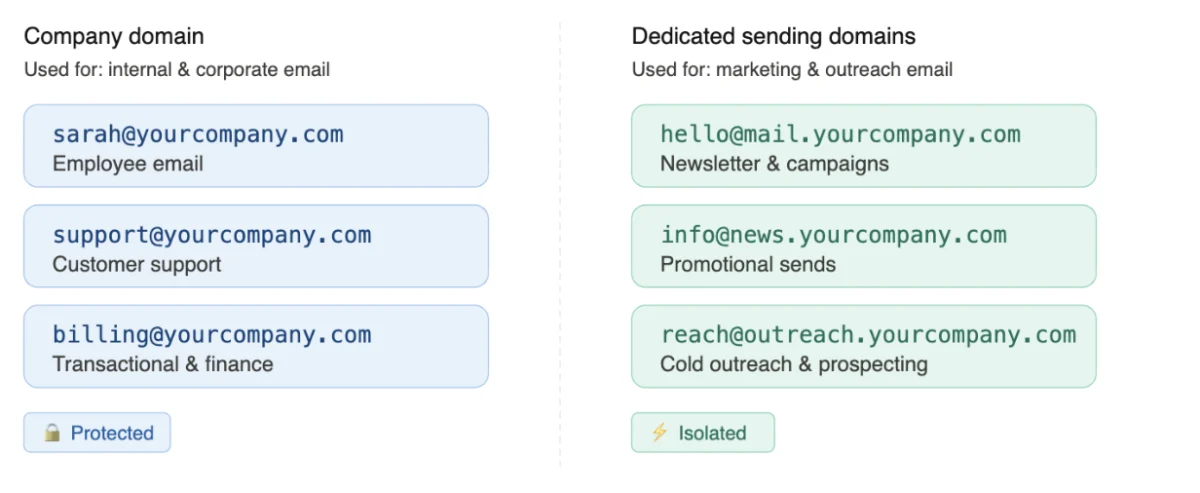
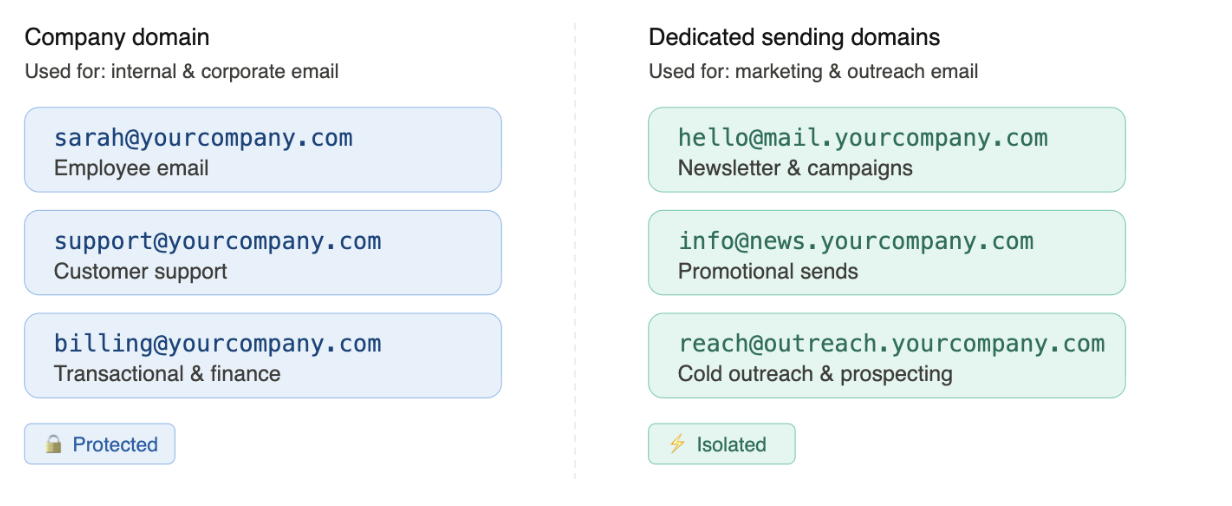
A fundamental tenet of robust email infrastructure is the separation of marketing email traffic from core business communications. Sending marketing emails from the main company domain (e.g., yourcompany.com) carries inherent risks. Should deliverability issues arise—such as a spike in spam complaints, a high bounce rate, or worse, a blocklisting by an ISP—the reputation of the main domain could be severely damaged. This could jeopardize critical business communications, including transactional emails, customer support correspondence, and internal communications, which rely on the pristine reputation of the primary domain.
To mitigate this risk, organizations are strongly advised to establish a dedicated sending domain or subdomain exclusively for marketing and bulk outreach. For instance, if the primary corporate domain is yourcompany.com, a marketing-specific subdomain like marketing.yourcompany.com, news.yourcompany.com, or even an entirely separate domain such as yourcompany-updates.com should be used. This strategy creates a controlled environment where sender reputation can be built from scratch, isolated from the corporate domain. This isolation ensures that any deliverability challenges encountered by marketing campaigns do not adversely affect the critical operational emails that keep the business running. It provides a clean slate for reputation building and a crucial layer of protection for the brand’s primary digital identity.
3. Configuring Authentication Protocols: SPF, DKIM, and DMARC
As highlighted by the recent mandates from major mailbox providers, configuring email authentication protocols is no longer optional; it is a non-negotiable requirement for bulk senders. These protocols are essential for proving the legitimacy of a sender and ensuring that emails are not spoofed or tampered with. Typically, an organization’s IT team or domain administrator is responsible for setting up these critical DNS records.
-
Sender Policy Framework (SPF): SPF allows a domain owner to specify which mail servers are authorized to send email on behalf of their domain. This is done by publishing an SPF record as a TXT entry in the domain’s DNS. When an email server receives an email, it checks the SPF record of the sender’s domain. If the email originates from a server not listed in the SPF record, it may be flagged as suspicious or spam. This acts as a basic gatekeeper, preventing unauthorized senders from using a domain.
-
DomainKeys Identified Mail (DKIM): DKIM adds a digital signature to outgoing emails, allowing the receiving server to verify that the email was indeed sent by the domain it claims to be from and that its content has not been altered in transit. The DKIM signature is generated using a private key by the sending server and verified using a public key published in the sender’s DNS records. This cryptographic verification offers a higher level of assurance regarding the email’s authenticity and integrity, protecting against content manipulation and sophisticated spoofing attempts.
-
Domain-based Message Authentication, Reporting & Conformance (DMARC): DMARC unifies the functionality of SPF and DKIM, providing a policy framework for domain owners. A DMARC record, also published in DNS, instructs receiving mail servers on how to handle emails that fail SPF or DKIM authentication (e.g., “none,” “quarantine,” or “reject”). Crucially, DMARC also provides reporting capabilities, allowing domain owners to receive aggregated feedback reports from mailbox providers. These reports detail authentication failures, providing invaluable insights into potential spoofing attempts or misconfigurations, enabling proactive adjustments to improve deliverability and security. The “reject” policy, for instance, ensures that any email failing DMARC authentication is simply not delivered, offering the highest level of protection against malicious actors attempting to impersonate a brand.
The explicit mandating of these protocols by Google, Yahoo, and other providers underscores a collective industry effort to combat spam, phishing, and email fraud more effectively. Without these in place, a sender risks having their emails rejected outright, regardless of their content quality or recipient engagement.
4. Patient Domain Warm-up
A brand-new sending domain, by definition, possesses no prior reputation with mailbox providers. Launching a large-scale email campaign from a fresh domain is one of the quickest ways to trigger spam filters and get flagged as an illegitimate sender. Mailbox providers interpret a sudden influx of emails from an unknown domain as suspicious behavior, often associated with spammers.
Therefore, a meticulous and patient domain warm-up process is essential. This involves gradually increasing email volume over several weeks, allowing mailbox providers to assess the sending behavior and build a positive reputation. A typical warm-up strategy might involve starting with a modest volume, such as 500-1,000 emails per day, directed solely to the most engaged segments of the contact list (e.g., recent openers or clickers). As long as key metrics like bounce rates and spam complaints remain exceptionally low, the volume can be incrementally doubled every few days. If these metrics show any undesirable spikes, it’s crucial to reduce the volume, address the underlying issues, and then slowly resume the ramp-up.
This process is not a sprint; it’s a marathon that often takes weeks, not days, to complete effectively. The sender reputation meticulously built through a careful warm-up forms the bedrock of all future email deliverability, ensuring that subsequent campaigns land reliably in the inbox. Rushing this phase can lead to long-term deliverability struggles that are far more difficult and time-consuming to rectify.
5. Proactive Deliverability Monitoring: Beyond the “Sent” Status
A common misconception among senders is that an email reported as “delivered” by their ESP has successfully reached the recipient’s inbox. However, this is frequently not the case. According to Validity’s 2024 Email Deliverability Benchmark report, a concerning statistic reveals that approximately 1 in 7 legitimate, permission-based marketing emails never actually reach the intended inbox, often ending up in spam folders or being silently dropped. This stark reality highlights why active, continuous monitoring of deliverability is not just a recommendation but an absolute necessity.
Monitoring goes beyond tracking open and click rates. It involves a deeper dive into how mailbox providers perceive a sender’s emails. Key metrics to vigilantly track include:
- Spam Complaint Rate: This is arguably the most critical metric. Industry best practices dictate keeping this rate below 0.3%, with an ideal target of 0.1% or less. High complaint rates are a significant red flag for ISPs and can quickly damage sender reputation.
- Hard Bounce Rate: A hard bounce indicates a permanent delivery failure (e.g., an invalid email address). Consistent high hard bounce rates signal a poorly maintained list and can negatively impact reputation.
- Blocklisting Status: Senders must regularly check if their IP addresses or domains have been listed on major spam blocklists (e.g., Spamhaus, CBL). Blocklisting can lead to widespread delivery failures across multiple ISPs.
To gain direct insights into how major inbox providers view a sender’s reputation, organizations should leverage free feedback loops and postmaster tools:
- Google Postmaster Tools: Provides data on sender reputation, IP reputation, spam rate, delivery errors, and DMARC failures specifically for Gmail recipients.
- Microsoft SNDS (Smart Network Data Services): Offers data on IP reputation, spam trap hits, and complaint rates for Outlook.com and other Microsoft-managed domains.
- Yahoo Sender Hub: Provides insights into sending reputation, blocklisting status, and complaint rates for Yahoo Mail users.
These tools offer invaluable, direct feedback from the gatekeepers of the inbox, providing a clear picture of a sender’s standing—not just whether emails were accepted at the gateway, but how they are actually being filtered. Proactive monitoring enables senders to identify and address issues promptly, adapting their sending practices to maintain a healthy sender reputation in an ever-evolving email ecosystem.
The Broader Impact: ROI, Brand Reputation, and Customer Engagement
Investing in robust email infrastructure might not be the most glamorous aspect of digital marketing, but its impact is profound and far-reaching, directly affecting an organization’s financial performance, brand image, and customer relationships.
- Return on Investment (ROI): Email marketing consistently ranks as one of the highest ROI marketing channels, often yielding an average of $36 for every $1 spent. However, this ROI is directly contingent on emails actually reaching the inbox. If a significant percentage of emails are diverted to spam or blocked, the potential revenue from those campaigns is lost, turning marketing spend into wasted effort. The 1 in 7 deliverability failure rate mentioned earlier translates directly into a substantial loss of potential engagement and revenue.
- Brand Reputation: Consistent failure to reach the inbox or, worse, landing in the spam folder, erodes customer trust and damages brand reputation. Recipients may perceive a brand as unprofessional or even spammy if its emails are unreliable. Conversely, consistently reliable inbox delivery reinforces professionalism and builds confidence with the audience.
- Customer Engagement: Inbox placement is the gateway to engagement. An email cannot be opened, clicked, or converted if it is never seen. By ensuring high deliverability, organizations maximize the opportunities for customers to interact with their content, leading to higher open rates, click-through rates, and ultimately, conversions. This fosters a stronger, more active customer base.
- Compliance and Trust: While not directly part of infrastructure, a strong infrastructure supports compliance with regulations like CAN-SPAM, GDPR, and CASL, which mandate legitimate sending practices. By ensuring proper authentication and minimizing spam complaints, brands demonstrate their commitment to ethical email practices, further building trust with both recipients and mailbox providers.
Conclusion: An Ongoing Commitment
The landscape of email deliverability is dynamic, with mailbox provider algorithms and security requirements continually evolving. What was considered “best practice” yesterday is often a “mandatory requirement” today. The gap between organizations that invest in their email infrastructure and those that neglect it is widening rapidly, leading to significant disparities in campaign performance and overall digital communication effectiveness.
Establishing the right foundation, meticulously warming up sending domains, and maintaining a vigilant eye on deliverability metrics are no longer optional extras but critical operational imperatives. By embracing these principles, organizations can significantly enhance their chances of reaching their intended audience, safeguarding their brand reputation, and maximizing the return on their email marketing investments. For those navigating the complexities of these technical requirements, seeking expert consultation can provide invaluable support in auditing existing setups, configuring authentication protocols, and maintaining optimal deliverability performance in an increasingly stringent digital environment.