The landscape of digital communication is undergoing a profound transformation, driven by an urgent need to combat the pervasive threats of spam, phishing, and email spoofing. At the forefront of this evolution is email authentication, a critical suite of digital security measures designed to verify the legitimacy of email senders and the integrity of messages. This once-technical consideration has now become an absolute mandate, as major mailbox providers (MBPs) like Gmail, Yahoo, and Microsoft have implemented stringent new requirements, effectively reshaping the rules for anyone sending email. Understanding and implementing these authentication protocols—SPF, DKIM, DMARC, ARC, and BIMI—is no longer merely a best practice but a fundamental prerequisite for successful email deliverability and maintaining sender reputation.
The Rising Tide of Email Fraud and the Need for Authentication
For years, email has been the primary vector for cyberattacks, with phishing and spoofing incidents escalating annually. Reports consistently show that email remains the number one threat channel, responsible for a significant percentage of data breaches and financial losses for businesses worldwide. For instance, the FBI’s Internet Crime Report frequently highlights Business Email Compromise (BEC) schemes, which heavily rely on email spoofing, costing billions of dollars annually. This alarming trend underscored the urgent necessity for more robust email security mechanisms beyond traditional spam filters.
The concept of email authentication emerged from collaborative efforts by various groups, including the IETF’s Anti-Spam Research Group, alongside industry giants like Yahoo and Cisco. Their foundational work sought to establish a framework that could digitally verify three core aspects of every email message:
- Authenticity: Confirming that the sender is indeed who they claim to be.
- Integrity: Ensuring the message has not been altered in transit.
- Authorization: Verifying that the sending server is permitted to send emails on behalf of the domain.
This collaborative development led to the creation of the core authentication technologies that safeguard email today. While initially voluntary, the escalating sophistication of cyber threats and the sheer volume of unsolicited and malicious emails forced mailbox providers to take a firmer stance, culminating in the current wave of mandatory authentication requirements.
A Chronology of Email Security Evolution
The journey to mandatory email authentication has been a gradual but persistent one:
- Early 2000s: The first widely adopted authentication protocols, Sender Policy Framework (SPF) and DomainKeys Identified Mail (DKIM), began to take shape. SPF (initially proposed in 2003) aimed to prevent sender address forgery, while DKIM (developed from Yahoo’s DomainKeys in 2004, finalized as DKIM in 2007) provided a cryptographic method to verify message integrity and sender identity. These were crucial first steps in giving receiving servers tools to vet incoming mail.
- 2012: Domain-based Message Authentication, Reporting & Conformance (DMARC) was introduced. DMARC built upon SPF and DKIM, providing a policy layer that instructed receiving servers what to do with messages that failed authentication (e.g., quarantine, reject) and offering reporting capabilities to domain owners. This marked a significant leap, giving senders actionable insights into email authentication failures and potential spoofing attempts.
- 2017: Authenticated Received Chain (ARC) emerged as a solution to a specific problem: preserving authentication results through intermediate mail servers (like mailing lists or forwarding services) that might legitimately alter an email, thus breaking its DKIM signature and causing DMARC to fail. ARC ensures the original authentication status is maintained.
- 22019-2021: Brand Indicators for Message Identification (BIMI) began to gain traction. BIMI allows organizations to display their verified brand logo next to their emails in supported inboxes, providing a visual trust signal to recipients. Its implementation requires a robust DMARC policy, reinforcing the importance of the underlying authentication standards.
- October 2023: Gmail and Yahoo jointly announced unprecedented new sender requirements, signaling a major shift in the email ecosystem. These mandates targeted bulk senders specifically, requiring strict adherence to SPF, DKIM, and DMARC.
- February 2024: The phased enforcement of these new requirements began, with some non-compliant traffic experiencing initial rejections or increased spam placement.
- April 2024: Gmail commenced progressively rejecting non-compliant emails, intensifying the pressure on senders to adopt proper authentication.
- Late 2025: A critical deadline for Gmail, where non-compliant senders will face temporary and eventually permanent rejections, severely impacting their ability to reach subscribers. Microsoft has also introduced similar stringent requirements, aligning with this industry-wide push for enhanced email security.
The New Mandates: A Unified Front for Inbox Security
The recent pronouncements from Gmail, Yahoo, and Microsoft are unequivocal: proper email authentication is no longer optional. These mandates represent a concerted effort by the world’s leading mailbox providers to create a safer, more trustworthy email environment for their users. For any sender, whether sending bulk emails or not, these requirements are now non-negotiable.
The core expectations for all senders now include:
- Implementation of SPF and DKIM: These foundational protocols must be correctly configured for the sending domain.
- DMARC Policy at p=none (minimum): Even a monitoring-only DMARC policy is now required for bulk senders, allowing domain owners to gather data on authentication failures.
- Consistent Sender Reputation: Senders must maintain a low spam complaint rate, typically below 0.3%.
- One-Click Unsubscribe (for bulk senders): Bulk senders must provide an easy, one-click method for recipients to opt out of future communications.
The consequences of non-compliance are severe and escalating. As noted, Gmail has been actively rejecting non-compliant traffic since April 2024, with Yahoo and Microsoft adopting similarly firm stances. Failure to adhere to these standards will not merely result in reduced deliverability but can lead to emails being outright blocked or permanently rejected, effectively severing a brand’s connection with its audience. This proactive enforcement marks a pivotal moment, shifting the burden of security more firmly onto email senders.

The Five Pillars of Email Authentication Explained
Navigating the technical jargon of email authentication can seem daunting, but breaking down each component reveals their crucial role in securing your email program.
1. Sender Policy Framework (SPF): The Guest List
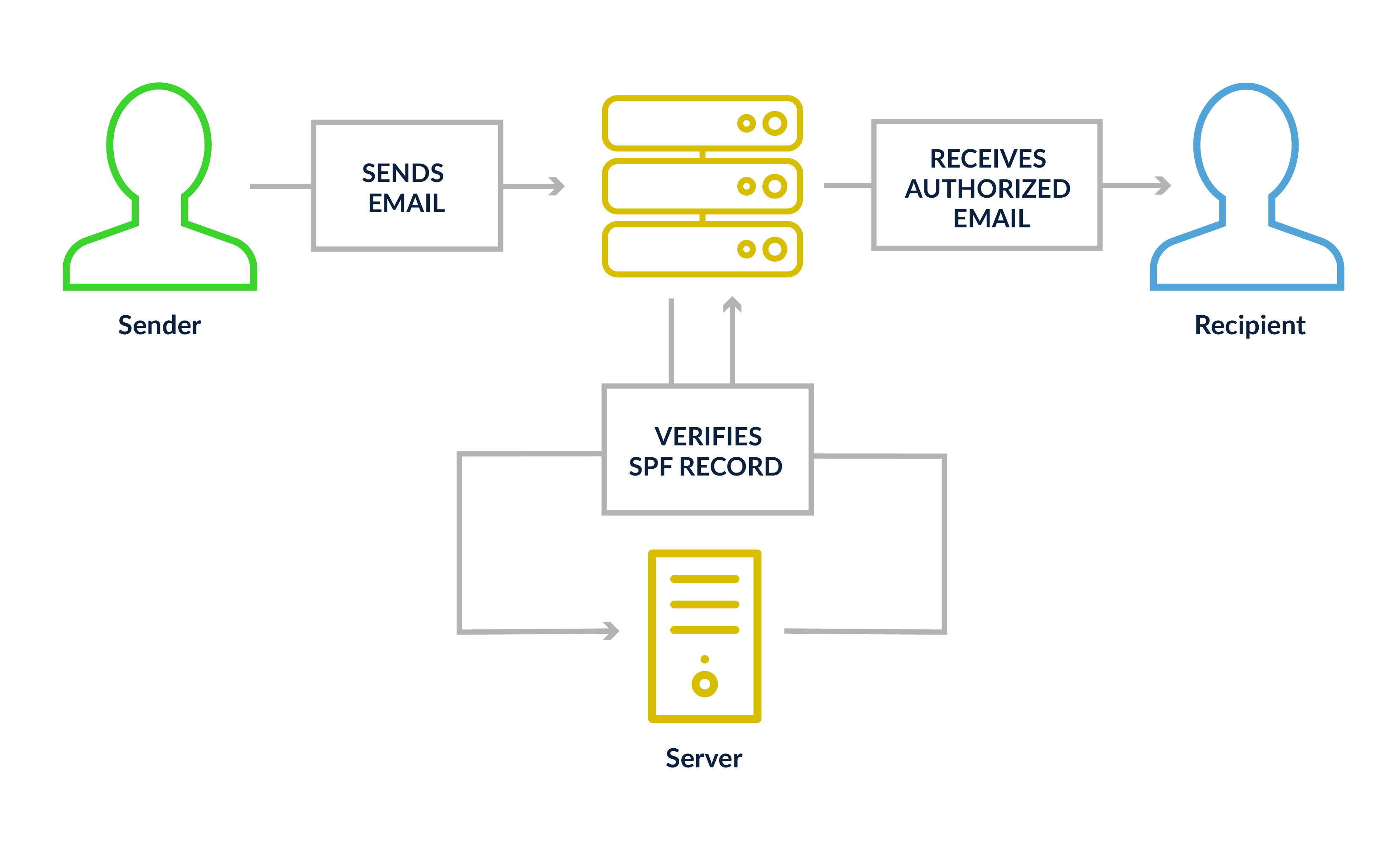
Imagine SPF as a bouncer at an exclusive club, checking a guest list. Your domain publishes a special DNS record (a TXT record) that explicitly lists all the IP addresses and mail servers authorized to send email on your behalf. When a receiving mail server gets an email from your domain, it consults your SPF record. If the email originates from an IP address not on your “guest list,” the receiving server immediately flags it as suspicious, indicating a potential spoofing attempt.
SPF records can include individual IP addresses, IP ranges, or references to third-party sending services (like your Email Service Provider, or ESP) using the include mechanism. It’s also possible to set enforcement levels:
+all: Pass (rarely used, essentially allows anyone).-all: Fail (strict, rejects emails from unauthorized IPs).~all: SoftFail (recommends marking as spam, common for initial deployment).
A common pitfall with SPF is the “permerror,” which occurs if an SPF record requires more than 10 DNS lookups. Each include statement counts as a lookup. Exceeding this limit can cause SPF to fail entirely, making meticulous management of your SPF record essential, especially when integrating multiple third-party senders.
2. DomainKeys Identified Mail (DKIM): The Tamper-Evident Seal
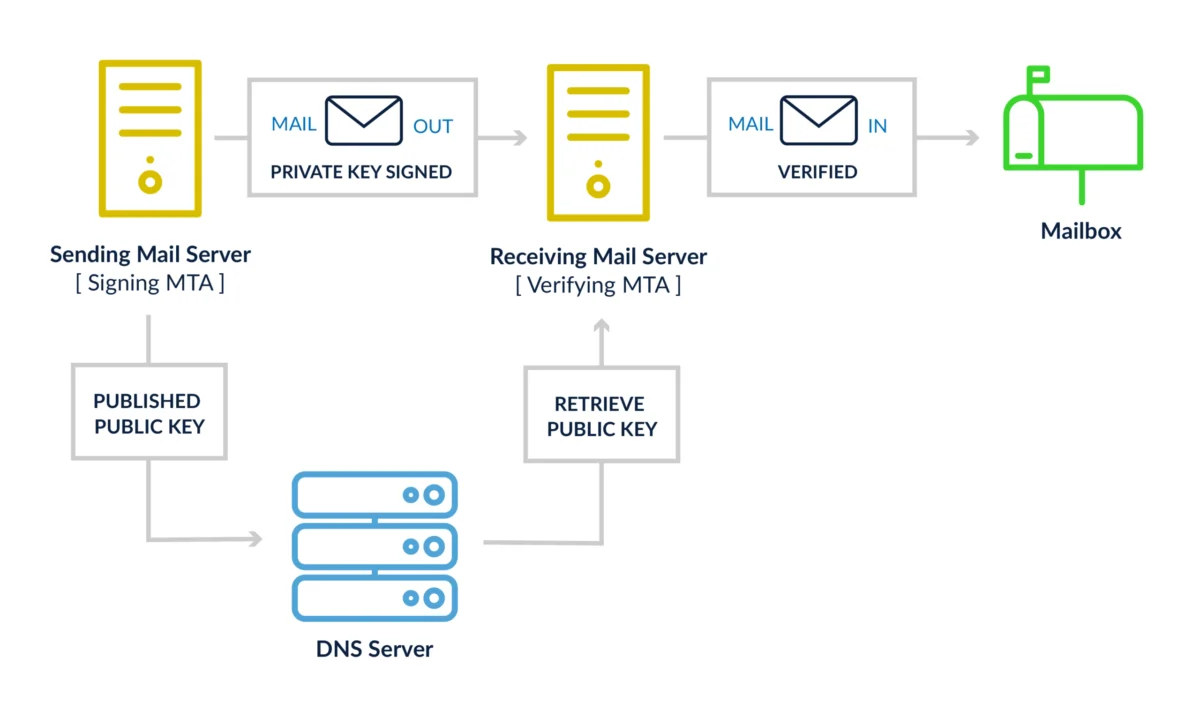
DKIM functions like a tamper-evident seal on a package, ensuring that the contents haven’t been altered during transit and that the sender is legitimate. When your mail server sends an email, it digitally signs specific parts of the message (like the header and body) using a private cryptographic key. This signature is then embedded into the email’s header. A corresponding public key is published in your domain’s DNS records.
Upon receiving the email, the recipient’s mail server retrieves the public key from your DNS and uses it to verify the digital signature. If the signature matches, it confirms two things:
- The email genuinely originated from your domain.
- The message content has not been tampered with since it was sent.
If the signature doesn’t match, DKIM fails, signaling a potential forgery or alteration.
A critical setup note for DKIM is the key length. Modern security standards mandate a minimum key length of 2048 bits. Older 1024-bit keys are considered less secure and may be rejected by some MBPs. While most ESPs handle DKIM key generation and management, it’s prudent for senders to confirm their keys meet current security benchmarks.
3. Domain-based Message Authentication, Reporting & Conformance (DMARC): The Policy Enforcer
If SPF is the guest list and DKIM is the tamper seal, DMARC is the comprehensive policy that orchestrates what happens when either of these checks raises a flag. It also introduces a crucial concept called “alignment.” DMARC requires that the domain in the “From” address (the one users see) aligns with the domain verified by SPF or DKIM. Without this alignment, DMARC will fail, even if SPF or DKIM technically passed for a different, underlying domain. This alignment check is critical in preventing brand impersonation.
DMARC policies dictate how receiving servers should handle emails that fail authentication and alignment:
p=none: Monitor only. Messages are delivered, but aggregate reports are sent to the domain owner, providing visibility into authentication failures without taking direct action. This is the minimum required for bulk senders under the new mandates.p=quarantine: Instructs receiving servers to treat failing messages as suspicious, typically sending them to the recipient’s spam or junk folder.p=reject: The strongest policy, instructing receiving servers to block and reject failing messages entirely, preventing them from reaching the inbox at all.
One of DMARC’s most valuable features is its reporting mechanism. MBPs send daily aggregate reports (RUA records) to the specified email address in the DMARC record. These XML-formatted reports detail which messages passed or failed authentication, the IP addresses involved, and whether alignment was achieved. This data is invaluable for identifying legitimate sending issues, detecting unauthorized senders, and catching sophisticated spoofing or phishing attempts against your domain. Progressing from p=none towards p=quarantine or p=reject is the recommended path for robust brand protection.
4. Authenticated Received Chain (ARC): The Trust Trail
ARC addresses a specific challenge in the email ecosystem: legitimate forwarding or processing by intermediate mail servers. When an email passes through a mailing list, a security gateway, or an email archiving system, these intermediate systems might legitimately modify the message (e.g., adding a footer, altering headers). Such modifications can inadvertently break the original DKIM signature, causing DMARC to fail, even though the email was perfectly legitimate and authenticated at its origin.
ARC acts as a “paper trail” or a chain of custody for email authentication. Each intermediate server that processes an email and supports ARC will record and cryptographically sign the authentication results it observed before any modifications were made. This creates a chain of authenticated results. When the email finally reaches its destination, the receiving server can examine this ARC chain. It can see that while the message might have been altered later, it started its journey properly authenticated, thereby preserving its deliverability and preventing false DMARC failures for legitimately forwarded emails. Unlike other standards, ARC is typically implemented by mail servers themselves, not directly by the sender, but understanding its function is crucial for diagnosing complex deliverability issues.
5. Brand Indicators for Message Identification (BIMI): The Visual Trust Signal
BIMI takes email authentication a step further by leveraging visual branding to enhance recipient trust and brand recognition. BIMI allows brands to display their official, verified logo directly in the recipient’s inbox, often before the email is even opened. This provides an immediate, visual trust signal that helps recipients quickly identify legitimate emails from a trusted brand, reducing the likelihood of them falling victim to phishing or mistaking legitimate emails for spam.
Implementing BIMI requires a strong foundation of email authentication:
- SPF and DKIM must be correctly configured.
- DMARC must be fully enforced, meaning the policy must be set to
p=quarantineorp=reject. Ap=nonepolicy is insufficient for BIMI.
Once these prerequisites are met, the brand publishes a BIMI DNS record pointing to a properly formatted SVG version of their logo.
BIMI offers two main certificate options for logo verification:
- Verified Mark Certificate (VMC): This is the original and most robust certification, requiring the brand to possess a registered trademark for the logo. VMCs are issued by authorized Certificate Authorities (e.g., DigiCert) and unlock full BIMI support, including logo display in Gmail, Apple Mail, and the highly coveted “blue checkmark” in Gmail, signifying an even higher level of verified identity.
- Common Mark Certificate (CMC): A newer, more accessible option introduced to broaden BIMI adoption. CMCs do not require a registered trademark but instead demand proof that the logo has been publicly displayed and in consistent use for at least 12 months. Google began accepting CMCs in 2024, making BIMI accessible to more brands. While CMC holders get their logo displayed in Gmail, they do not receive the blue checkmark, which remains exclusive to VMC holders.
MBP Support for BIMI at a Glance:
- Gmail: Supports BIMI with both VMC (including blue checkmark) and CMC (logo only).
- Yahoo Mail: Supports BIMI with VMC.
- Apple Mail: Supports BIMI with VMC.
- Fastmail: Supports BIMI with VMC.
- Outlook/Microsoft: Has shown interest and participated in BIMI discussions but currently does not widely support BIMI logo display in the same way as Gmail or Apple Mail.
Authentication: The Foundation, Not the Finish Line
While email authentication might appear to be a purely technical exercise, its impact extends far beyond the realm of IT. It is inextricably linked to a brand’s reputation, its relationship with subscribers, and its overall marketing effectiveness. In an era where digital trust is paramount, authentication builds a credible bridge between sender and recipient.
The stakes have never been higher. The unified enforcement of authentication requirements by Gmail, Yahoo, and Microsoft for bulk senders means that getting this wrong will not merely impact deliverability; it will actively erode the trust that brands have painstakingly built with their audience. Research from various cybersecurity firms consistently shows that robust authentication, particularly DMARC at an enforcement policy, significantly reduces the likelihood of successful phishing and spoofing attacks against a domain, protecting both the brand and its customers. Moreover, improved deliverability directly translates to higher engagement metrics, better ROI on email marketing efforts, and ultimately, a healthier customer lifecycle.
The journey begins with the diligent and correct configuration of SPF, DKIM, and DMARC. This foundational trio ensures that your emails are verifiable and your domain is protected. From this starting point, the strategic evolution involves moving your DMARC policy towards enforcement (p=quarantine or p=reject), consistently monitoring the aggregate reports for insights into sending behavior and potential threats, and eventually integrating BIMI to enhance visual trust and brand recognition.
Achieving a fully authenticated and optimized email program requires a concerted effort, often involving coordination between IT, marketing, and legal departments. It demands technical expertise, careful monitoring, and a commitment to ongoing best practices. However, the payoff is substantial: enhanced security, improved deliverability, bolstered brand reputation, and a more trusted communication channel with your valuable subscribers. Tools like Litmus, which offer infrastructure checks, can be invaluable partners in ensuring that every aspect of your email authentication is in perfect order, enabling brands to navigate this new era of email security with confidence and success. The future of email is secure, authenticated, and trustworthy, and brands that embrace this reality will thrive.