The digital marketing paradigm has fundamentally shifted, ushering in an era where knowing how to rank in traditional “blue link” search engine results and achieving visibility in AI-powered search outcomes are now distinct, yet interconnected, disciplines. This transformation, driven by the rapid evolution of large language models (LLMs) and generative AI, presents both challenges and unprecedented opportunities for content creators and businesses aiming to capture high-intent audiences.
The Rise of Generative AI in Search: A New Frontier for Discovery
The prevalence of AI in search has escalated dramatically. As of early 2026, research by BrightEdge indicates that AI Overviews, Google’s generative AI feature, now appear in approximately 48% of tracked Google searches. This figure climbs significantly, reaching up to 100% for highly sensitive queries such as those related to healthcare and medical treatments, underscoring AI’s critical role in information dissemination for vital topics. Beyond Google, platforms like ChatGPT are processing over a billion queries weekly, while Perplexity, Claude, and Gemini handle millions daily. A significant characteristic of these AI interactions is the phenomenon of “zero-click searches,” where users receive comprehensive answers directly from the AI without needing to navigate to an external website. This trend redefines user engagement and content consumption.
However, this shift also presents a unique opportunity: content can gain substantial AI visibility even if it doesn’t achieve top rankings in traditional blue-link results. This article, informed by extensive data analysis and collaboration with leading content marketers, outlines actionable strategies for optimizing content for AI search prompts, devoid of speculative advice.
Why AI Search Visibility is Paramount: Unpacking the High-Intent Audience
The value proposition of ranking in AI search results extends far beyond mere traffic volume; it’s about attracting highly qualified, pre-vetted prospects. Ahrefs, in an analysis of its own traffic data, revealed a striking disparity: while AI search visitors constituted a modest 0.5% of total site visitors, they were responsible for an astonishing 12.1% of all sign-ups. This translates to a conversion rate 23 times higher than that observed for visitors arriving from traditional organic search.
This pattern is corroborated by Semrush, which found that AI search visitors convert, on average, at a rate 4.4 times greater than standard organic visitors. The inherent qualification of these visitors stems from their interaction with AI. In many cases, they have already received the direct answer to their query from the AI and consciously chosen to click through for further detail, deeper understanding, or specific product/service exploration. This self-selection demonstrates a significantly higher level of intent and interest compared to users who might click through a traditional search result out of a broader exploratory need.
While the current volume of AI search traffic remains smaller than that of Google’s traditional search, its growth trajectory is steep and undeniable. Businesses and marketing teams investing in Artificial Intelligence Optimization (AEO) – sometimes referred to as Generative Engine Optimization (GEO) – are strategically building citation authority in an environment where competition is still relatively nascent. Should current SEO trends continue, this window of lower competition is unlikely to persist, making early adoption a distinct competitive advantage.
Optimizing Content for AI Search Prompts: A Strategic Framework
Achieving prominence in AI search results requires a multi-faceted approach that addresses technical accessibility, content structure, data organization, topical authority, and off-site credibility.
1. Ensuring Technical Accessibility for AI Crawlers
Before any content can be cited by AI, it must first be discoverable. Cloudflare’s recent report highlights the escalating presence of AI crawlers, which now account for 4.2% of all HTML requests across their network. Notably, OpenAI’s GPTBot alone experienced a staggering 305% growth between May 2024 and May 2025. If a website’s robots.txt file or server configurations inadvertently block these crawlers, even the most meticulously crafted content will remain invisible to AI knowledge bases.
Just as traditional search engines rely on crawlers, every major AI platform deploys its own user-agents to access and process web content. Key crawlers to be aware of include:
- OAI-SearchBot (ChatGPT Search): Primarily for real-time retrieval to answer user queries, not for model training.
- GPTBot (OpenAI): Used specifically for training OpenAI’s language models.
- PerplexityBot (Perplexity): Dedicated to real-time content retrieval.
- ClaudeBot (Anthropic/Claude): Used for both model training and real-time retrieval.
- GoogleBot (Google AI Overviews): Google’s long-standing crawler, now integral for indexing content utilized by AI Overviews.
For content creators holding intellectual property or proprietary information, selectively blocking certain crawlers (e.g., those for model training) might be a considered strategy. However, indiscriminately blocking all AI crawlers can be detrimental. Research from Rutgers Business School and Wharton found that publishers blocking AI crawlers via robots.txt experienced an average loss of approximately 7% of weekly traffic within a mere six weeks. This underscores the importance of a nuanced approach to crawler management.
Implementing an llms.txt File: A newer standard gaining traction, the llms.txt file is a site-specific document that acts as a guide for AI models, search agents, and autonomous web bots. Officially supported by Anthropic, it helps AI systems understand which content is safe to summarize and cite, providing a clearer directive than robots.txt for AI-specific interactions. Its implementation is a quick win, often taking less than an hour, and explicitly signals content intended for AI use.
Optimizing Page Speed and Resolving Crawl Errors: AI bots, much like human users, prioritize fast-loading servers. Aiming for a Time to First Byte (TTFB) under 200ms ensures frequent crawling and rapid content refreshing. Tools like HubSpot’s site speed dashboard can help identify and rectify performance bottlenecks. Furthermore, common technical SEO issues such as 404 errors, redirect chains, and invalid sitemaps can deplete crawl budget and hinder AI accessibility. Regular monitoring through platforms like Google Search Console is crucial for identifying and correcting these technical impediments.
Ensuring Bing Indexing: While Google remains dominant, ChatGPT Search is built upon Bing’s infrastructure. Consequently, content not indexed by Bing may not appear in ChatGPT’s search results. Establishing a presence in Bing Webmaster Tools and submitting sitemaps is a vital step for broader AI search visibility.
2. Adopting an Answer-Ready (or Answer-First) Content Structure
AI systems do not process content in the same linear fashion as human readers. Instead, they efficiently scan for easily extractable answers to user queries and underlying intents. If a web page doesn’t present these answers clearly and immediately, the AI is likely to move on to a competitor’s content that does.
The “answer-first” content structure is not merely a suggestion; it is the most reliable structural tactic for securing AI citations. This approach dictates that the direct answer to a heading’s implied question should be delivered upfront, without requiring the reader (or AI) to sift through extensive introductory context.
Example:
- Header: “How Does Content Marketing Drive Revenue?”
- Before Answer-Led: “In today’s competitive digital landscape, brands are increasingly looking for ways to connect with their audiences in more meaningful ways. Content marketing has emerged as one of the most discussed approaches…”
- After Answer-Led: “Content marketing drives revenue by attracting high-intent visitors through search and converting them with useful content before they ever talk to sales. Companies that blog consistently generate 67% more leads per month than those that don’t.”
AI writing tools, such as those found in HubSpot’s Content Hub, can significantly expedite the process of restructuring existing content into an answer-first format. By providing a simple prompt, marketers can quickly adapt sections to meet AI’s preference for immediate answers. Depending on the content type, integrating FAQ schema can further enhance this answer-led approach.
3. Leveraging Structured Data (Schema Markup)
Structured data, or schema markup, is arguably one of the most effective methods for explicitly communicating content meaning and value to AI systems. Schema provides a semantic layer that outlines the purpose and context of information on a page, removing ambiguity and reducing the need for AI to infer meaning. Without it, AI must rely solely on surface-level text analysis, which can be less precise.
However, schema is not a panacea. Key considerations include:
- Schema must accurately reflect the on-page content.
- It should be implemented consistently across relevant pages.
- Validation using tools like Google’s Rich Results Test is essential to catch errors.
Several schema types are particularly beneficial for improving AI search performance:
- FAQPage: Ideal for question-and-answer content found in blog posts and help articles, signaling a clear Q&A structure.
- Article: Essential for all editorial content, identifying author, publication date, and topic for enhanced clarity.
- Organization: Crucial for homepages and about pages, confirming brand identity and contact details.
- HowTo: Perfect for tutorial and guide content, structuring step-by-step instructions.
- Product: Vital for e-commerce, defining product details, pricing, and customer reviews.
For implementation, the JSON-LD format is universally recommended due to its clean separation from HTML, making it easier for AI crawlers to parse. Furthermore, incorporating data and comparison tables within content helps organize complex information in an AI-friendly manner, much like schema.
4. Organizing Content into Pillar Pages and Topic Clusters
Topic clusters are fundamental to building topical authority, a crucial signal that AI systems use to determine trustworthy sources on a given subject. A website that deeply covers a topic, typically through a comprehensive pillar page supported by numerous interconnected cluster content pieces, demonstrates an expertise that single, isolated blog posts cannot.

This approach is amplified by the AI concept of “fan-out,” where an AI system breaks down a user’s initial query into multiple related sub-queries before generating a holistic answer. For instance, if a user asks ChatGPT, “What’s the best CRM for a small sales team?”, the AI doesn’t just search for that exact phrase. It “fans out” into related sub-queries such as:
- “Key features of CRMs for small businesses”
- “CRM pricing for small teams”
- “CRM integration with existing sales tools”
- “User reviews of small business CRMs”
- “Comparison of top CRMs for sales”
This implies that even if a website doesn’t rank for the primary query, its content can still be cited if it thoroughly addresses these subtopics on its cluster pages. The internal linking within a topic cluster, connecting supporting articles to the main pillar and vice versa, creates a semantic web that AI systems can follow, reinforcing the site’s authority on the subject. HubSpot’s SEO tools can assist in identifying content gaps within clusters, guiding content creation efforts.
5. Adhering to Google’s E-E-A-T Framework
Google’s E-E-A-T (Experience, Expertise, Authoritativeness, and Trustworthiness) framework has evolved beyond a mere quality signal for human evaluators; it now functions as a critical AI citation filter. E-E-A-T is less about stylistic writing and more about verifiable proof. AI systems actively seek signals that indicate content originates from a credible individual or entity with genuine experience in the subject matter.
To enhance E-E-A-T signals on a website:
- Detailed Author Bios: Include qualifications, experience, and links to professional profiles (e.g., LinkedIn).
- Citations and References: Link to reputable sources, academic papers, and official studies.
- Testimonials and Case Studies: Feature real-world examples and customer success stories.
- “About Us” Pages: Provide comprehensive information about the organization, its mission, and its leadership.
- Security Measures: Ensure robust website security (HTTPS) and clear privacy policies to build trust.
6. Optimizing for Off-Site Authority
On-site content optimization, while crucial, only tells part of the story. AI systems, much like humans, validate claims of expertise through third-party endorsements. Airops 2025 research highlights this, finding that brands are 6.5 times more likely to be cited by AI through third-party sources than through their own domains.
Strategies for building off-site authority include:
- High-Quality Backlinks: Earn links from reputable, industry-relevant websites.
- Brand Mentions: Encourage mentions and citations across various online platforms, including news outlets, industry blogs, and social media.
- Online Reviews and Ratings: Maintain strong profiles on review sites (e.g., G2, Capterra, Yelp), as these contribute to perceived trustworthiness.
- Guest Posting: Contribute expert content to authoritative external publications.
- Wikidata Entity: Creating and maintaining a clean Wikidata entry for a brand provides AI systems with a machine-readable source of verified, factual information, serving as a powerful E-E-A-T signal for ChatGPT visibility.
7. Regular Content Refreshing
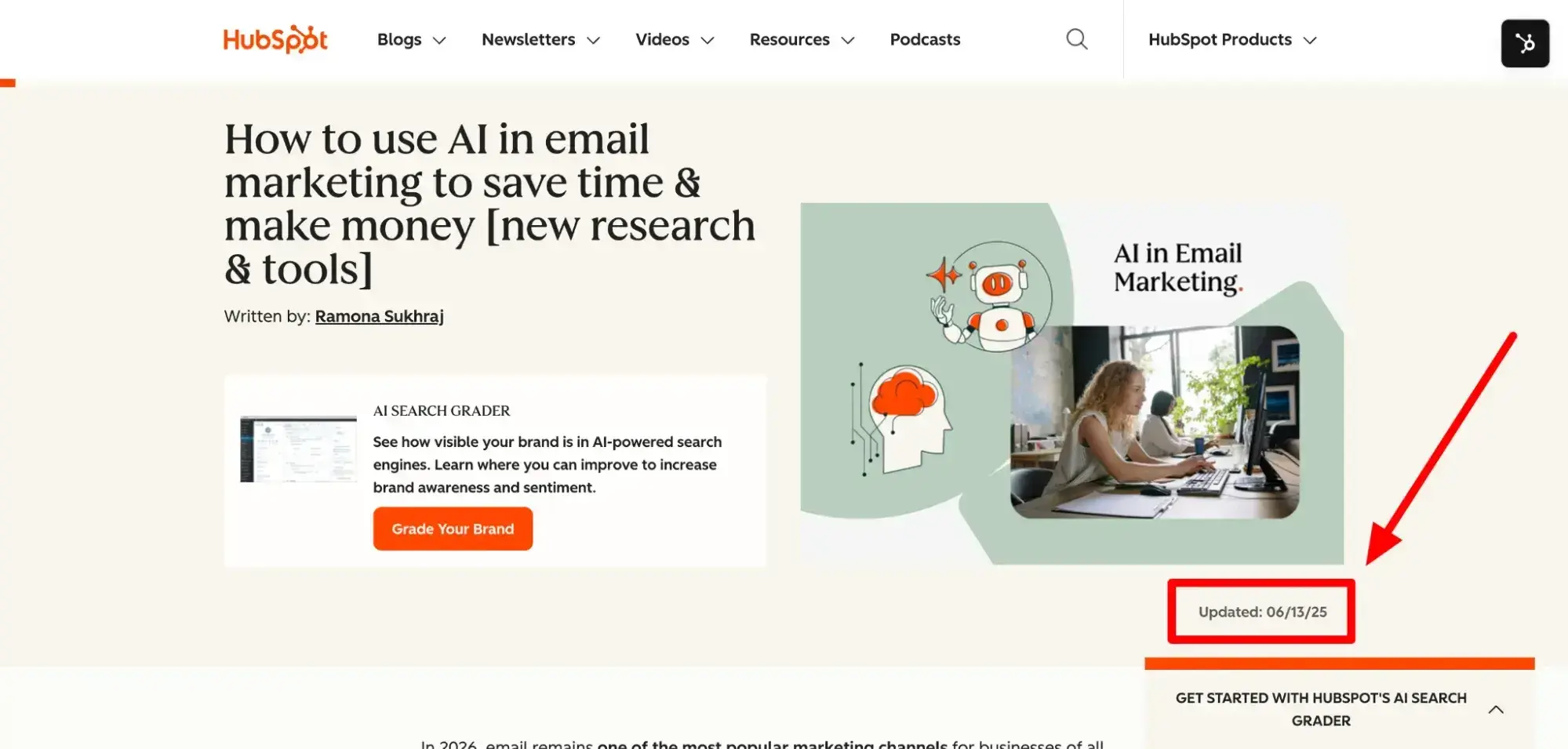
The timing of content refreshes depends heavily on the topic’s volatility. AI Overviews and Google’s RankBrain algorithm demonstrably favor recently updated content, recognizing that fresh information is often more relevant and accurate. A page updated in March 2025 will typically outperform an identical page last updated in 2022, even if the core content is similar.
A recommended refresh cadence includes:
- Pillar pages/cornerstone content: Quarterly review and update.
- Blog posts with statistics: Every six months, or immediately when key data becomes outdated.
- Product/feature pages: Within 30 days of any product change or update.
- FAQ sections: Quarterly, informed by new customer questions or evolving industry standards.
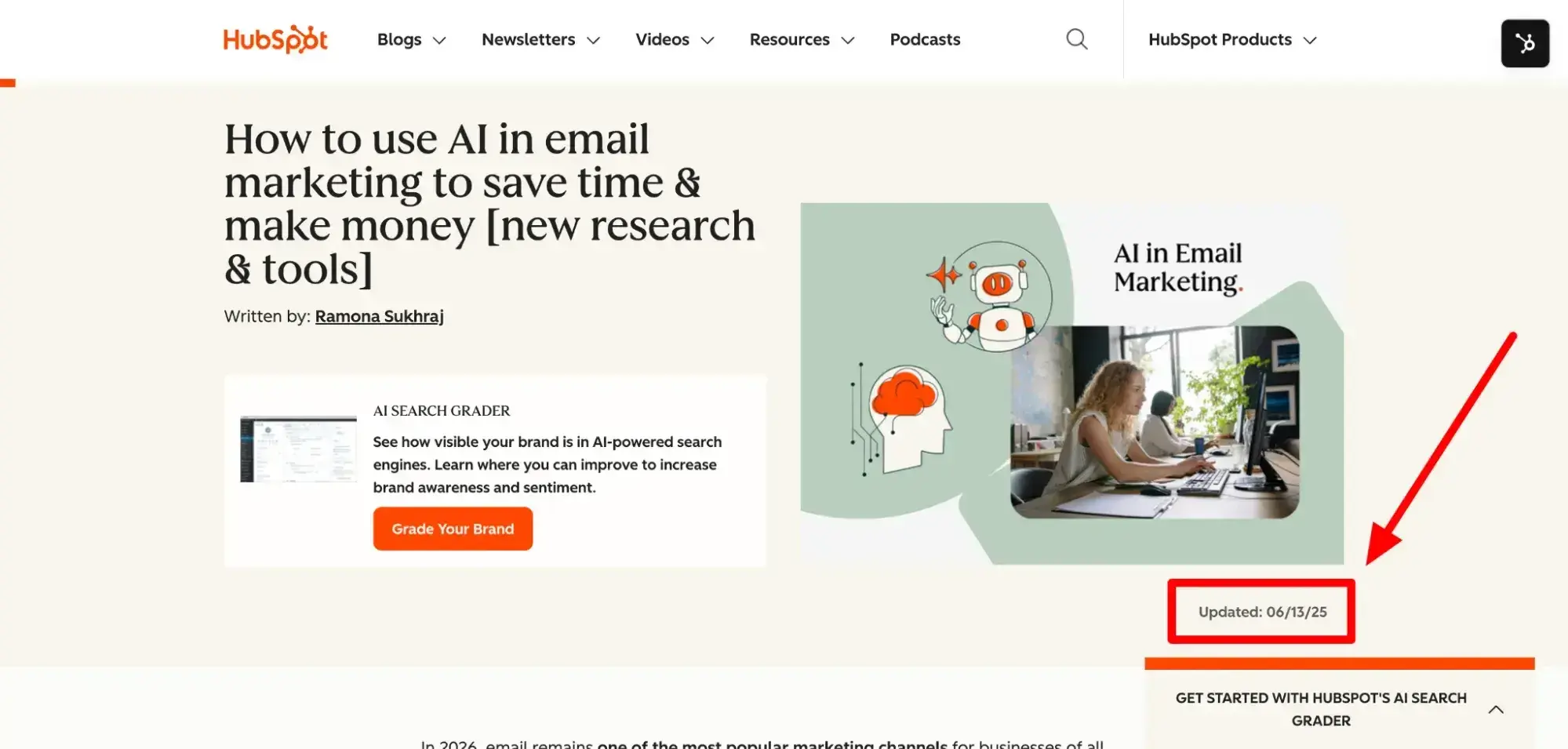
Crucially, when refreshing content, updating the publish date signals to AI systems that the information is current and relevant.
Tracking AI Search Ranking Performance: New Metrics for a New Era
Effective optimization hinges on accurate measurement. AI citation tracking, however, differs significantly from traditional rank tracking. A new framework is required to build a robust AI visibility measurement practice, focusing on three core metrics:
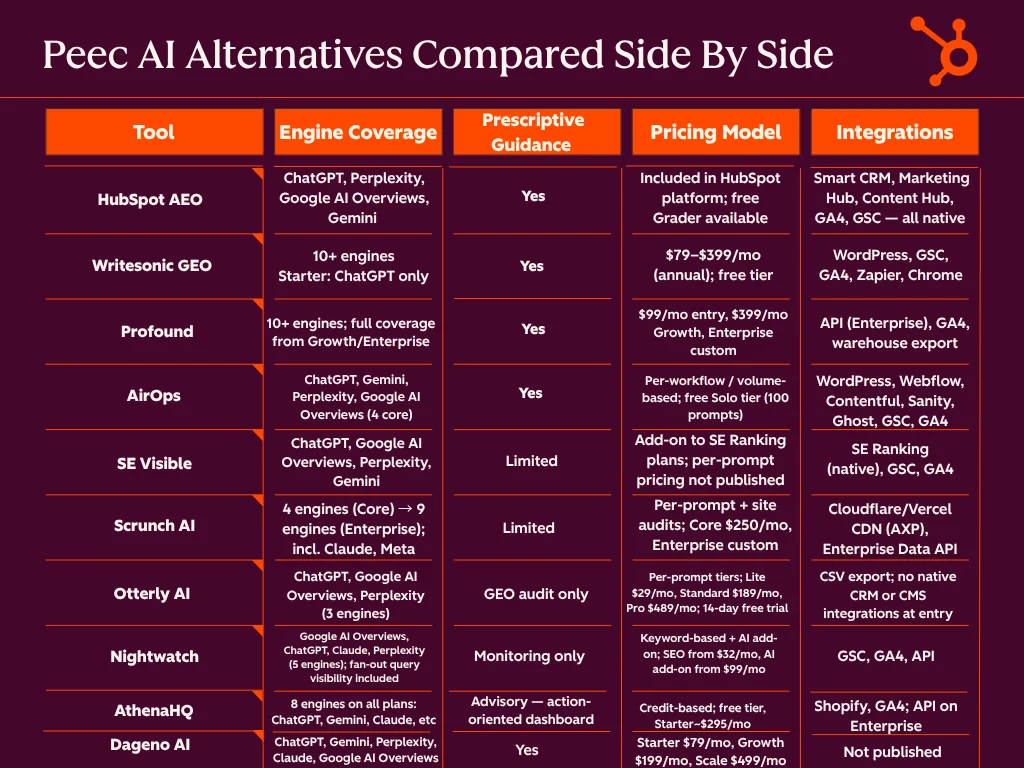
- Citation Presence (or Visibility): Measures whether AI platforms mention a brand or its content in their answers. Tracked using specialized tools like HubSpot AEO, Otterly.AI, or Semrush AI Toolkit.
- Share of Voice: Quantifies how often a brand appears in AI answers relative to its competitors. Monitored through tools like HubSpot AEO Sensor or manual brand-specific queries.
- AI-Referred Traffic Quality: Assesses the conversion rates and engagement metrics of visitors sourced from AI platforms. Tracked via GA4 session sources and CRM attribution.
Since these metrics are new for many organizations, establishing a baseline is critical. This involves:
- Benchmarking current AI citation rates and share of voice.
- Analyzing existing AI-referred traffic for conversion patterns.
- Conducting a competitive analysis to understand industry benchmarks.
Following baseline establishment, a 90-day target is a realistic goal, as AI search optimization typically yields initial results within two to three months of implementation.
Getting Started with AI Search Rank Optimization: A 3-Month Action Plan
Prioritizing actions that deliver the fastest impact and build a strong foundation is key. A recommended three-month plan includes:
- Month 1: Technical Foundation & Accessibility Audit:
- Review and adjust
robots.txtfiles for optimal AI crawler access. - Implement an
llms.txtfile. - Conduct a comprehensive technical SEO audit to fix crawl errors and improve page speed.
- Ensure Bing indexing is active.
- Review and adjust
- Month 2: Content Restructuring & Schema Implementation:
- Identify top 5-10 pillar pages and high-value blog posts.
- Restructure these pages to an answer-first format.
- Implement relevant schema markup (FAQPage, Article, HowTo) on target pages.
- Begin mapping out new topic clusters or refining existing ones.
- Month 3: E-E-A-T & Off-site Authority Enhancement:
- Enhance author bios and “About Us” pages to strengthen E-E-A-T signals.
- Review and update content with current statistics and authoritative citations.
- Initiate a strategy for building external brand mentions and high-quality backlinks.
- Create or optimize a Wikidata entity for the brand.
HubSpot Solutions in the AI Search Landscape
Platforms like HubSpot have integrated AI visibility and AEO tools directly into their ecosystems, enabling organizations to operationalize these strategies without needing to adopt disparate software solutions. HubSpot’s AEO tools, for instance, track AI citation presence and brand mentions across major AI platforms, offering a readiness snapshot via the AEO Grader and benchmarking performance against industry trends with the AEO Sensor. The crucial advantage lies in its connection of AI visibility directly to CRM data, allowing businesses to trace AI-referred visitors from initial engagement through to conversion and revenue generation. This direct attribution transforms AI citations from a vanity metric into a demonstrable business impact.
Frequently Asked Questions About AI Search Ranking
How long until AI citations improve?
For brands with established topical authority and active content distribution, improvements in AI citations can be observed within weeks of a major content refresh or strategic optimization. Consistency and patience remain key factors.
Do I need separate strategies for Google AI Overviews and ChatGPT?
While a universal foundation of technical accessibility, answer-first structure, schema, and E-E-A-T supports all platforms, some nuances exist. Google AI Overviews are deeply integrated with traditional Google Search rankings and the E-E-A-T framework, whereas ChatGPT’s search capabilities are built on Bing’s index, making Bing Webmaster Tools more critical for its visibility. Both, however, prioritize structured, clear, and authoritative content.
What if AI misrepresents my brand?
AI misrepresentation is a growing concern. The most effective defense is proactive content strategy: publish accurate, authoritative information that effectively crowds out misinformation. Ensure brand facts are consistent across all credible online platforms (website, LinkedIn, G2, Wikipedia, Crunchbase). AI systems draw from the most authoritative sources available; by owning these sources, brands can control their narrative. In severe cases, selective blocking of AI crawlers can be considered, but with caution regarding potential traffic loss.
Should I block AI crawlers?
In most scenarios, blocking AI crawlers is ill-advised as it directly impedes AI citation opportunities. The primary exception is when a brand possesses proprietary content or faces significant server cost concerns due to extensive crawling. In such cases, a selective approach, blocking only training crawlers (like GPTBot) while allowing retrieval crawlers (e.g., OAI-SearchBot, PerplexityBot) that power real-time AI answers, can be a balanced strategy.
What’s the best way to track AI citations over time?
A consistent tracking cadence is essential. This might involve weekly checks for top-priority content, monthly reports on overall citation presence and share of voice, and quarterly deep dives into AI-referred traffic quality and conversion rates. It is important to look for 90-day trends rather than panicking over week-over-week fluctuations, as AI citation rates can be volatile.
Conclusion
AI search is not a futuristic concept; it is the present reality of digital information discovery. Platforms like AI Overviews, ChatGPT, Perplexity, and Gemini are where a significant and growing portion of audiences are seeking and finding answers, often without ever clicking through to a website. Marketers who swiftly adapt to this new landscape, embracing Artificial Intelligence Optimization and building durable AI visibility advantages, will position themselves for sustained growth and relevance. The playbook for this transformation is clear; the time to act is now.