The trajectory of artificial intelligence research has, for the better part of a decade, been defined by the pursuit of scale. From the early iterations of GPT to the massive parameter counts of contemporary frontier models, the industry has operated under the assumption that larger datasets, more compute, and broader context windows would inevitably lead to artificial general intelligence. However, Sakana AI, a Tokyo-based research firm founded by former Google veterans, is challenging this monolithic approach. Their latest release, Sakana Fugu, represents a significant pivot in AI architecture, shifting the focus from individual model scaling to the collective intelligence of multi-agent systems. While Fugu appears to the end-user as a standard Large Language Model (LLM) through a single API call, it functions internally as a sophisticated orchestration layer that coordinates a “school” of specialized expert agents.
The Paradigm Shift: From Monoliths to Collective Intelligence
To understand the significance of Sakana Fugu, one must first look at the current state of the AI market. Most enterprises currently utilize single-model prompting, where a lone engine—such as GPT-4o or Claude 3.5 Sonnet—is tasked with everything from creative writing to complex code generation. While effective for general tasks, these monolithic models often struggle with multi-step reasoning, verification, and high-stakes accuracy.
Sakana AI’s philosophy is rooted in biomimicry. The name “Sakana” means “fish” in Japanese, a reference to the way schools of fish move in unison to solve problems that no individual fish could manage alone. Fugu follows this biological metaphor. By packaging multi-agent orchestration directly into a managed model API, Sakana AI is attempting to remove the friction associated with building autonomous agent workflows. In the traditional development stack, a team would need to use frameworks like LangGraph, AutoGen, or CrewAI to manually define planners, reviewers, and executors. Fugu automates this entire lifecycle, handling agent selection, role assignment, and result synthesis behind a standard OpenAI-compatible interface.
A Chronology of the Multi-Agent Movement
The development of Fugu did not happen in a vacuum. It is the culmination of several years of research into agentic workflows. In 2023, the AI community began moving toward “Chain-of-Thought” and “Tree-of-Thought” prompting, which encouraged models to break down problems into steps. This was followed by the rise of tool-augmented LLMs, which allowed models to interact with external APIs and databases.

By early 2024, the limitations of these methods became clear: the central reasoning engine remained a single point of failure. Sakana AI entered the scene with a focus on “evolutionary model merging” and collective intelligence, leading to the initial beta release of their orchestration product. The current release of Fugu and Fugu Ultra marks the transition from a research experiment to a commercial-grade product. It addresses the “orchestration tax”—the immense engineering effort required to manage state, retries, and communication between multiple models—by abstracting it into a single model ID.
The Architecture of a Managed Multi-Agent System
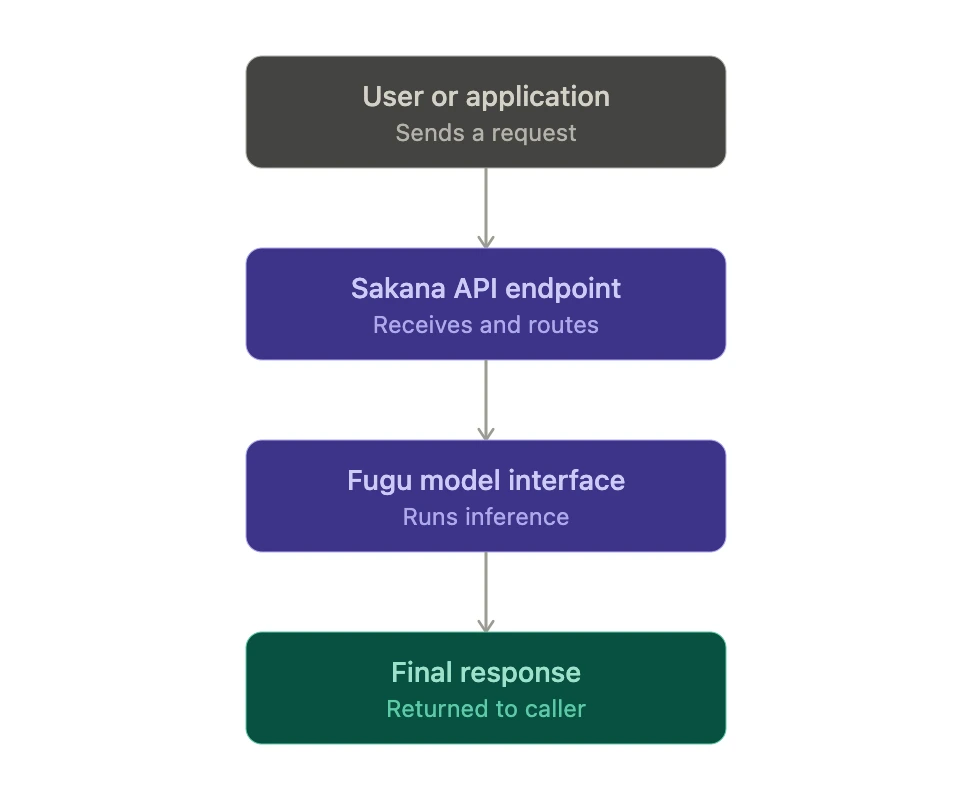
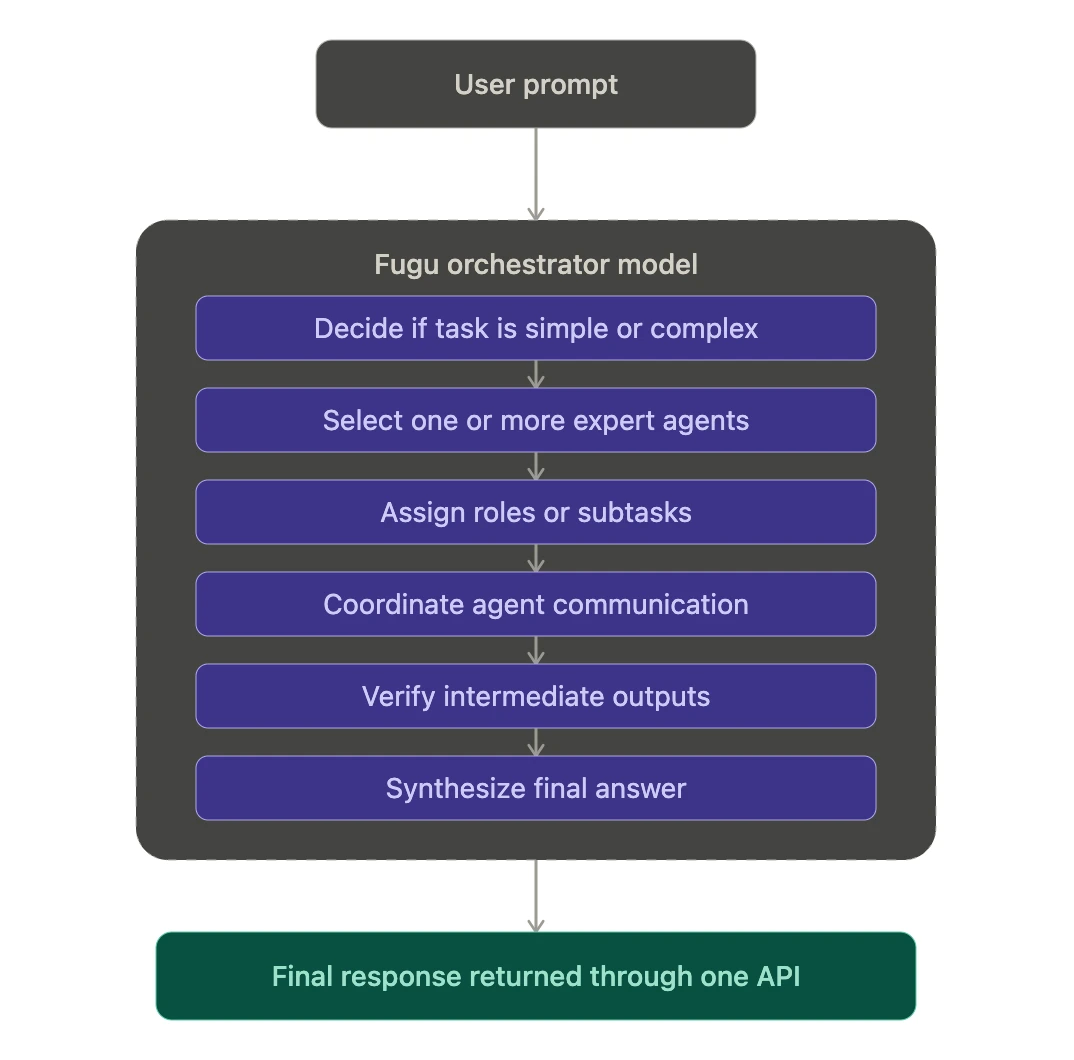
At its core, Fugu functions as a managed orchestration layer. When a developer sends a prompt to the fugu or fugu-ultra endpoint, a multi-stage internal process is triggered:
- The Orchestrator: An internal “master” model analyzes the intent of the prompt. It determines if the task is a simple query or a complex problem requiring decomposition.
- Dynamic Routing: Based on the task type—be it mathematical reasoning, Python coding, or scientific research—the orchestrator selects the most appropriate experts from a pool of frontier models.
- Delegation and Execution: The task is broken into sub-components. For instance, in a coding task, one agent might draft the logic while another prepares unit tests.
- Verification and Critique: Unlike standard models that provide a one-shot answer, Fugu utilizes a verification loop. A “reviewer” agent critiques the initial output, checking for hallucinations or logical inconsistencies.
- Final Synthesis: The results from various agents are synthesized into a single, coherent response and returned to the user.
This architecture effectively hides the complexity of the agent graph. The developer interacts with a familiar API surface, but the underlying system is performing a level of “thinking” and “checking” that far exceeds the capabilities of a single-pass model.
Comparative Analysis: Fugu vs. Fugu Ultra
Sakana AI offers two primary variants of the system to cater to different operational needs: Fugu and Fugu Ultra.
Fugu is designed for the modern developer’s daily workflow. It prioritizes a balance between high-quality output and manageable latency. It is particularly effective for interactive coding support, document analysis, and general-purpose chatbots. One of its standout features is “opt-out” support, allowing organizations to exclude specific underlying models from the agent pool to meet strict data privacy or compliance requirements.
Fugu Ultra is the “high-stakes” version of the service. It is optimized for maximum reasoning depth rather than speed. Ultra coordinates a deeper and more diverse pool of expert agents, often involving up to three specialized models for a single query. This variant is intended for scientific research, advanced cybersecurity analysis, and complex multi-step reasoning where the cost of an incorrect answer is high.
Data and Performance Benchmarking
While Sakana AI has released benchmark results showing that Fugu and Fugu Ultra perform competitively against frontier models like GPT-4o, the data reveals a more nuanced story. Fugu is not necessarily “smarter” in a raw parameter sense; rather, it is more “reliable” because of its internal verification loops.
In coding and mathematics—areas where “one-shot” models often hallucinate—the multi-agent approach shows a marked improvement in accuracy. However, this reliability comes with a “latency trade-off.” Because the system must coordinate multiple calls and synthesis steps, the time-to-first-token is naturally higher than that of a single model. Developers must therefore choose their model ID based on the specific needs of the application: fugu for speed and fugu-ultra for precision.
The Economics of Multi-Agent AI
One of the primary hurdles for multi-agent systems has historically been the cost. In a DIY setup, if an orchestrator calls three different models to solve a problem, the developer is billed for three separate API calls plus the orchestration overhead.
Sakana AI has introduced a pricing structure designed to mitigate this “stacking” of fees. In the Pay-as-you-go tier, Fugu pricing is tied to the active agent setup. If only one agent is required, the user pays the standard rate for that model. If multiple agents are involved, Sakana does not stack the fees; instead, they charge a single rate based on the top-tier model utilized in the workflow.
Fugu Ultra Pricing (fugu-ultra-20260615):
- Standard Input: $5.00 per 1M tokens.
- Standard Output: $30.00 per 1M tokens.
- Cached Input: $0.50 per 1M tokens.
- Large Context (>272K): Fees increase to $10.00 for input and $45.00 for output.
For individuals and small teams, Sakana also offers subscription plans ranging from a $20/month Standard tier to a $200/month Max tier, providing a predictable cost structure for high-volume research and development.
Industry Implications and Strategic Analysis
The release of Fugu signals a broader shift in the AI industry toward “Agentic AI.” For the past two years, the burden of making AI “work” has rested on the shoulders of prompt engineers and software developers who had to build complex wrappers around models. Sakana AI is moving that responsibility back into the model layer.
Implications for Enterprise:
For large organizations, Fugu reduces the “technical debt” associated with maintaining custom agent frameworks. Instead of updating a LangGraph implementation every time a new model is released, the enterprise can simply point to the Fugu API and let Sakana handle the underlying model migrations and routing logic.
The Observability Challenge:
A significant critique of the “black box” multi-agent approach is the loss of transparency. When using a manual framework, a developer can see exactly what the “Researcher” agent said to the “Writer” agent. With Fugu, that internal dialogue is hidden. Sakana will likely need to introduce better observability tools to help developers understand why the orchestrator made specific routing decisions.
Regional and Sovereignty Trends:
As a Japanese company, Sakana AI is also part of a growing trend of “sovereign AI.” While the market is dominated by US-based giants, Sakana provides a high-performance alternative that is culturally and operationally distinct. Their focus on efficiency and collective intelligence reflects a different philosophical approach to AI than the “brute force” scaling seen in Silicon Valley.
Conclusion: The Next Generation of AI Interaction
Sakana Fugu is more than just a new API; it is a preview of how AI will likely be consumed in the near future. The era of the “lone model” is giving way to the era of the “managed swarm.” By abstracting the complexity of agent coordination, Sakana is making sophisticated, multi-step AI reasoning accessible to a much broader range of developers.
While challenges remain—particularly regarding latency, regional availability, and the transparency of the internal “agent graph”—the value proposition is clear. Fugu offers a path to higher reliability and better reasoning without the astronomical engineering overhead of building an agentic system from scratch. As AI continues to evolve, the ability to coordinate specialized intelligence will likely become more valuable than the raw size of any single model. In the “school” of AI, Sakana’s Fugu is currently leading the way.


 Ali Ikhwan
 Dwi Wanna