The landscape of digital advertising on platforms like Meta has undergone a seismic shift. Gone are the days of meticulously segmenting audiences into dozens of micro-campaigns, each armed with a limited set of creative assets. This antiquated approach, characterized by algorithms starved for signals and campaign managers operating in a perpetual state of uncertainty, is largely a relic of the past. The modern algorithm, now empowered to handle audience segmentation, places an unprecedented emphasis on the creative itself. What is being shown to consumers has become paramount, overshadowing the precise demographic targeting of yesteryear. While this evolution signifies progress, it also places immense pressure on creative output, a reality many brands are still grappling to fully comprehend and address.
The traditional playbook for creative optimization, which involved incremental changes to a proven winner – tweaking copy, altering color schemes, or trimming video lengths – has reached its logical conclusion. This strategy, while initially effective, inevitably leads to diminishing returns on creative. The asset that once drove significant returns begins to plateau, and subsequent minor adjustments yield progressively smaller gains. This phenomenon, often an unspoken concern within media teams, stems not from the act of iteration itself, which is a valuable component of any campaign, but from the stagnation of creative exploration. When iteration becomes the sole strategy, the discovery of genuinely new creative directions ceases. This reliance on “squeezing the winner” leaves brands without a pipeline of fresh ideas, forcing them to start from scratch when the current winning asset eventually exhausts its potential. The imperative now is to establish a system that not only identifies new creative winners continuously but also safeguards the performance of existing successful assets.
Unearthing Hidden Signals: Beyond Platform Data
Meta provides a wealth of performance data, which is undeniably useful for understanding what has worked. However, this data often falls short of explaining why something succeeded and rarely offers clear guidance on what to pursue next. To bridge this gap, a deeper dive into consumer conversations, the platforms where these discussions occur, and the underlying drivers of engagement is essential.
This is where advanced tools like Sentiment Analysis become critical. By analyzing content at scale across platforms such as TikTok, Reddit, and broader web forums, these tools go beyond simply identifying what people are saying about a product or category. They decipher how people feel, categorizing sentiment as positive, neutral, or negative, and crucially, identifying the catalysts behind these sentiments. For a client in the spicy noodle market, this analysis unearthed a significant trend: consumers were creatively incorporating milk into the preparation process, a use case that had never been formally documented. This insight, resonating with a distinct audience segment, opened up entirely new creative avenues, including the development of influencer partnerships specifically tailored to this emerging behavior.
Similarly, early identification of emerging trends is paramount. Spotting a trend as it gains traction, rather than after it has peaked, transforms a brand from a reactive participant to a proactive shaper of cultural moments. For Adidas, the ability to identify a nascent visual trend and deploy relevant content within a three-day window resulted in over a million views and a 16% engagement rate within 24 hours. Such remarkable results are not solely attributable to outstanding creative but to the strategic deployment of that creative at precisely the right cultural moment.
Intentional Creation: Mapping Creative to Consumer Journeys
Once these nuanced signals are captured, the challenge lies in translating them into a creative strategy that aligns with how consumers actually encounter a brand. While the traditional marketing funnel remains a useful planning framework, the modern consumer journey is far from linear. Consumers may encounter a conversion-focused ad before a brand awareness piece, or discover creator content before ever actively searching for a product. Therefore, the creative assets at each touchpoint must convey a coherent brand narrative, even when viewed in isolation and out of sequence.
The approach to addressing this involves thinking in terms of contextual layers rather than sequential stages. High-fidelity brand creative establishes the brand’s visual identity and emotional resonance. Creator content fosters authenticity and trust in the mid-funnel, a role that polished brand advertising often struggles to fulfill. Promotional messaging and product catalog ads then serve to motivate audiences requiring a specific impetus to act. Each layer serves a distinct purpose, yet the collective output should present a unified brand identity, irrespective of a consumer’s entry point into the brand ecosystem.
A global beauty brand, for instance, adopted this layered strategy. Their creative journey spanned motion-designed brand content produced by an internal team to authentic creator-produced assets. The overarching objective was consistency: any single piece of content, viewed in isolation, should immediately communicate the brand’s essence. This coherence is the cornerstone of an effective, non-linear approach.

Structured Testing: The Key to Actionable Insights
The prevailing wisdom that more testing equates to better results is a misconception. The emphasis should be on smarter testing. Unstructured testing often yields data that is intriguing but ultimately inconclusive, hindering forward momentum. When multiple experiments are conducted simultaneously without clear variable isolation, the resulting data becomes difficult to interpret, and learnings fail to translate into actionable strategies.
Structured testing, conversely, necessitates a clear definition of test objectives before the test commences. This involves utilizing broad, overlapping audiences with suppressed overlaps to ensure each asset receives an unadulterated performance read, free from interference from adjacent targeting parameters. The principle of testing one variable at a time, consistently, while perhaps slower, yields findings that form a robust foundation for a creative strategy.
Furthermore, the method of testing is crucial. Many teams default to deploying creative directly into paid media, an often expensive approach to validating an asset’s efficacy. Organic channels offer a more cost-effective initial testing ground. If an asset fails to resonate organically, its likelihood of outperforming in paid environments diminishes significantly. Prioritizing organic testing ensures that media budgets are allocated to assets that have already demonstrated some level of organic pull, rather than relying on hope.
A practical consideration often overlooked is influencer contract stipulations. Before becoming invested in creator content, it is essential to review contracts. If paid amplification is not explicitly included, repurposing a top-performing organic asset may require renegotiation, a minor administrative hurdle that can become a significant bottleneck when agility is required.
Scaling with Speed: Closing the Creative Loop
Once an asset proves its effectiveness, the primary bottleneck becomes speed. The traditional cycle of analyzing performance, briefing creatives, production, and deployment could span days, sometimes longer. This extended window between identifying a successful asset and scaling its production often resulted in lost momentum.
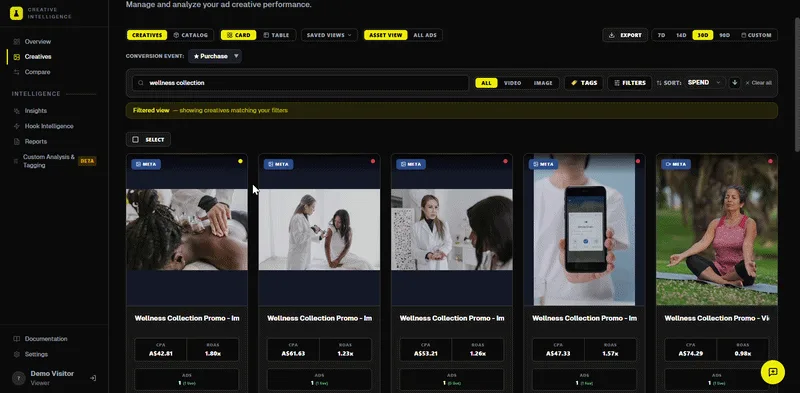
Tools like Creative Intelligence are designed to bridge this gap. Instead of manual performance data review and subsequent briefing, this tool automates the analysis. Upon opening an ad, a comprehensive breakdown is provided, detailing which hooks drove completion, where viewers dropped off, and which visual moments correlated with engagement spikes. In one instance, this tool identified that a spike in viewer engagement at the four-second mark was likely due to the appearance of a dog in the frame. This level of granular insight into the internal mechanics of creative performance, a feature not widely available, grounds creative briefs in empirical evidence rather than conjecture.
The broader dimension of scaling involves leveraging learnings across time and across clients. Experiments conducted within a single account provide valuable insights. However, anonymized and aggregated experiments across hundreds of accounts yield far more profound and universally applicable patterns. Proprietary systems, such as Hippocampus, which house data from over 35,000 experiments across a client base, reveal trends that would be virtually impossible to detect in isolation.
The Unseen Glue: Collaborative Synergy
Ultimately, the success of any sophisticated creative system hinges on a single, non-technical factor: seamless collaboration between creative, media, and data teams. This collaboration must be consistent and integrated, not relegated to occasional reviews or siloed handoffs. When these teams operate independently, the entire system falters. Creative iterations may occur without awareness of performance data, media optimization might proceed without insight into future creative directions, and valuable data insights may never reach the individuals tasked with acting upon them.
Addressing this fundamental challenge does not necessitate complex workflow architecture. It requires fostering the right conversations at the appropriate frequency. This is where many creative systems quietly fail, yet it is also the most readily solvable problem within the digital advertising ecosystem. The future of effective advertising lies in breaking down these internal barriers and building a unified, data-informed, and creatively agile approach.

 Basiran
 Lina Irawan