

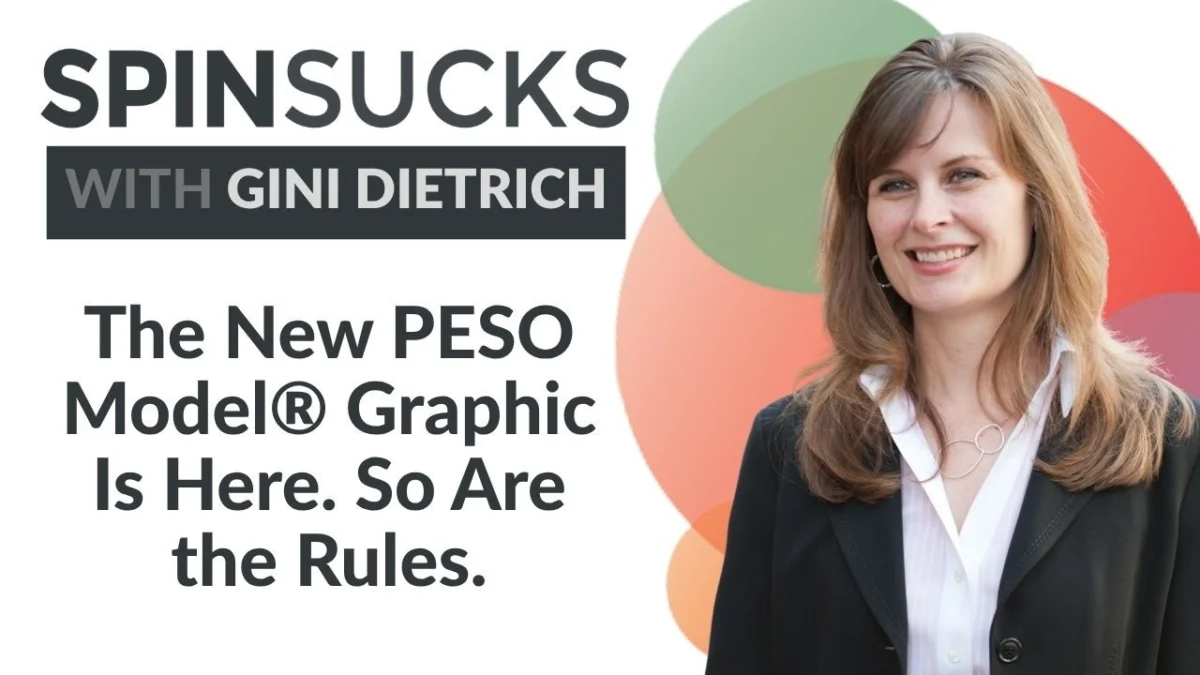
The PESO Model, a cornerstone framework in the professional communications and marketing industries for over a decade, has undergone a significant structural and visual transformation to align with the shifting demands of a data-driven, AI-integrated landscape. Announced by Spin Sucks and its founder, Gini Dietrich, the refresh moves the model away from tactical execution and toward an outcome-based “operating system” focused on four primary pillars: Authority, Credibility, Discovery, and Growth. Alongside this graphic update, Spin Sucks has formalized a new intellectual property (IP) policy, distinguishing between free educational use and required commercial licensing for those who profit from the framework.
The PESO Model—an acronym for Paid, Earned, Shared, and Owned media—was originally developed to help communicators understand how various media types should integrate to drive business results. For twelve years, it has served as the industry standard for breaking down silos between public relations, advertising, and digital marketing. However, as the digital ecosystem has evolved from simple social media platforms to complex generative AI environments, the creators of the model have identified a need for a more sophisticated approach to measurement and strategy.
The Chronological Evolution of PESO: From Tactics to Outcomes
The trajectory of the PESO Model reflects the broader evolution of the communications industry since the early 2010s. When the model was first introduced, the digital landscape was characterized by the rapid emergence of specific platforms. The earliest iterations of the PESO graphic were essentially tactical checklists. They featured specific, now-defunct platforms like Google+ and Vine, alongside traditional tactics such as news releases and blog posts. At that stage, the primary goal of the model was to define “what was in the box,” helping teams categorize their daily tasks.
By the late 2010s, as digital literacy grew, the model shifted from platform-specific lists to tactical categories. This version focused on the “what” rather than the “where,” recognizing that content could live across multiple platforms simultaneously. However, Dietrich notes that this version inadvertently led many professionals to view PESO as a purely tactical play—a series of boxes to check rather than a cohesive strategy.
In 2020, a third iteration was introduced to emphasize strategic integration. This version utilized four interlocking circles to demonstrate that Paid, Earned, Shared, and Owned media were not independent silos but rather interdependent disciplines that reinforced one another. This strategic overview became the dominant framework used by agencies in pitch decks and by internal teams for budget justifications.
The 2024/2026 refresh represents the fourth stage of evolution: the transition to an outcome-based operating system. This shift is driven by the changing requirements of corporate boards and C-suite executives. In the current economic climate, leadership is less interested in tactical volume and more concerned with specific business results, such as pipeline contribution, brand valuation, and visibility within AI-generated search results.
Technical Breakdown: The Four Pillars of the New Model
The redesigned PESO Model graphic replaces tactical labels with four high-level outcomes. Each media type is now tethered to a specific business objective:
- Owned Media (Authority): This category focuses on the content a brand creates and controls. In the new model, the primary outcome of owned media is the establishment of authority. This is measured by the brand’s ability to own a narrative and serve as the definitive source of information in its category.
- Earned Media (Credibility): Traditional media relations and third-party mentions fall under this pillar. The objective here is credibility. In an era of misinformation and AI-generated noise, third-party validation remains the most potent tool for building trust with an audience.
- Shared Media (Discovery): Social media and community-led platforms are categorized as shared media. The desired outcome is discovery—ensuring that the brand is visible where customers are congregating and that the content is being surfaced by algorithms and peer recommendations.
- Paid Media (Growth): Paid social, sponsored content, and search advertising are designated as drivers of growth. This pillar is focused on scalability and the ability to accelerate the reach of the other three categories to drive measurable increases in the sales pipeline.
The Power of Integration: The Six Compound Overlaps
The true strength of the refreshed PESO Model lies in the intersections of the four circles. Spin Sucks defines these overlaps as “compound outcomes,” representing the specific results achieved when two media types are integrated effectively.
- Paid + Owned (Demand Generation): When a brand uses paid media to amplify its owned content, it creates a robust engine for lead capture and demand generation.
- Owned + Earned (Trust): The combination of a brand’s own authoritative voice and third-party media validation creates a foundation of trust that is difficult for competitors to replicate.
- Earned + Shared (Validation): When earned media hits are shared and discussed across social platforms, it provides a “multiplier effect” of social proof and validation.
- Shared + Paid (Amplification): This intersection focuses on using paid budgets to ensure that highly engaging shared content reaches a broader, targeted audience.
- Paid + Earned (Influence): Using paid strategies to amplify earned media successes (such as “as seen in” campaigns) significantly boosts a brand’s influence over its target market.
- Shared + Owned (Engagement): The integration of owned content into shared community spaces fosters deep engagement and long-term brand loyalty.
At the very center of the graphic, where all four circles overlap, lies the “Operating System.” According to Dietrich, this is not a separate entity but the state of total integration where the compounding effects of all four media types work in unison to drive maximum business value.
Intellectual Property and the New Licensing Standards
A significant portion of the announcement focuses on the protection of the PESO Model® as a registered trademark. Over the past decade, the framework has been widely adopted, but also frequently plagiarized or repackaged by agencies and consultants without attribution. Spin Sucks has now established clear boundaries between “Free Use” and “Commercial Use.”
Free Use and Attribution:
The model remains free for non-commercial educational purposes. This includes internal team training, classroom instruction by professors, social media mentions, and journalistic references. However, even for free use, Spin Sucks now requires users to download the graphic from their official site, providing an email address to ensure they receive annual license updates. Proper attribution to Spin Sucks and the use of the registered trademark symbol (®) on first mention are mandatory.
Commercial Licensing:
Spin Sucks has formalized a requirement for a commercial license for any use that generates revenue. This includes:
- Paid courses or certifications built around the PESO Model.
- Books or published manuscripts that utilize the framework.
- Software products that integrate the model into their functionality.
- Paid workshops, training programs, or keynote speaking engagements where the model is taught as a primary methodology.
For many professionals, the organization suggests that the PESO Model Certification®—offered in partnership with the Newhouse School of Public Communications at Syracuse University—is the most efficient path to securing commercial rights while ensuring the model is implemented correctly.
Supporting Data and Industry Implications
The move toward an outcome-based model is supported by recent industry data regarding the efficacy of integrated marketing. According to research from Gartner and Forrester, integrated marketing campaigns that span multiple channels are up to 31% more effective at driving ROI than non-integrated efforts. Furthermore, as AI-driven search engines like Perplexity and Google’s Search Generative Experience (SGE) become the primary way consumers find information, “Authority” and “Credibility” (the outcomes of Owned and Earned media) have become critical SEO factors.
Industry analysts suggest that the tightening of IP controls by Spin Sucks reflects a broader trend in the professional services sector. As high-level frameworks become “commoditized” through AI and rapid digital sharing, creators are increasingly forced to protect their intellectual property to prevent brand dilution. Dietrich noted that when multiple parties teach conflicting versions of a framework, it “hurts the industry” by providing senior buyers with inconsistent advice, ultimately devaluing the work of communications professionals.
Future Outlook: The PESO Operating System Series
The release of the new graphic is the first part of a six-part series titled “The PESO Operating System,” which will run through the second quarter of 2026. The series aims to provide a deep dive into how the model must adapt to a world where AI is “quietly destroying” traditional content strategies.
By repositioning the PESO Model as an operating system rather than a tactical checklist, Spin Sucks is challenging the communications industry to elevate its role within the business hierarchy. The focus on Authority, Credibility, Discovery, and Growth provides a roadmap for professionals to move from being viewed as a cost center to being recognized as a primary driver of organizational value and valuation. As the series progresses, the industry will likely see a renewed focus on the technicalities of integration and the rigorous measurement of these four critical outcomes.









