

In the competitive landscape of modern communications, the quest for truly impactful public relations campaign ideas can be daunting. PR professionals often grapple with the twin challenges of cultivating innovative concepts and ensuring their efficacy in a saturated media environment. Beyond the initial spark of creativity, lies the critical hurdle of validating an idea’s potential and securing stakeholder buy-in. Fortunately, a strategic, research-intensive approach significantly elevates the probability of a PR campaign achieving widespread success, generating invaluable media coverage, high-quality backlinks, and robust social engagement. This article outlines a comprehensive, two-step methodology that leverages advanced research tools, specifically BuzzSumo, and draws inspiration from successful past campaigns to forge a path toward guaranteed PR wins.
The Foundational Role of Research in Modern PR
The digital age has fundamentally reshaped public relations. No longer is success solely dependent on intuition or a well-placed phone call. Today’s media environment is characterized by an unprecedented volume of information, intense competition for audience attention, and increasingly discerning journalists seeking data-backed, genuinely newsworthy stories. In this context, research transcends mere background work; it becomes the bedrock upon which all successful campaigns are built. It minimizes risk, maximizes impact, and transforms subjective hunches into objective, defensible strategies.
The journey begins not with a fully formed idea, but with a deep dive into the prevailing content landscape. Before any brainstorming session, it is imperative to understand the themes that consistently resonate with target audiences and the emotions that drive engagement. This foundational intelligence ensures that subsequent creative efforts are anchored in proven audience interests and media appetite. Studies by industry leaders often indicate that campaigns rooted in robust data analysis achieve significantly higher media pickup rates and greater return on investment compared to those based purely on creative speculation.
Step 1: Unearthing Resonant Content Themes and Emotional Drivers
To construct a PR campaign with a high probability of success, strategists must first identify content themes that demonstrate consistent popularity and strong engagement metrics. This involves pinpointing topics that are:
a) Regularly discussed and published across relevant media outlets.
b) Consistently shared, linked to, and commented upon by audiences on social platforms.
For the purpose of digital PR, “success” is primarily measured by securing high-quality media coverage and valuable backlinks from authoritative sites. Social engagement, while a secondary Key Performance Indicator (KPI), serves as a crucial indicator of audience interest and shareability, amplifying the campaign’s reach.
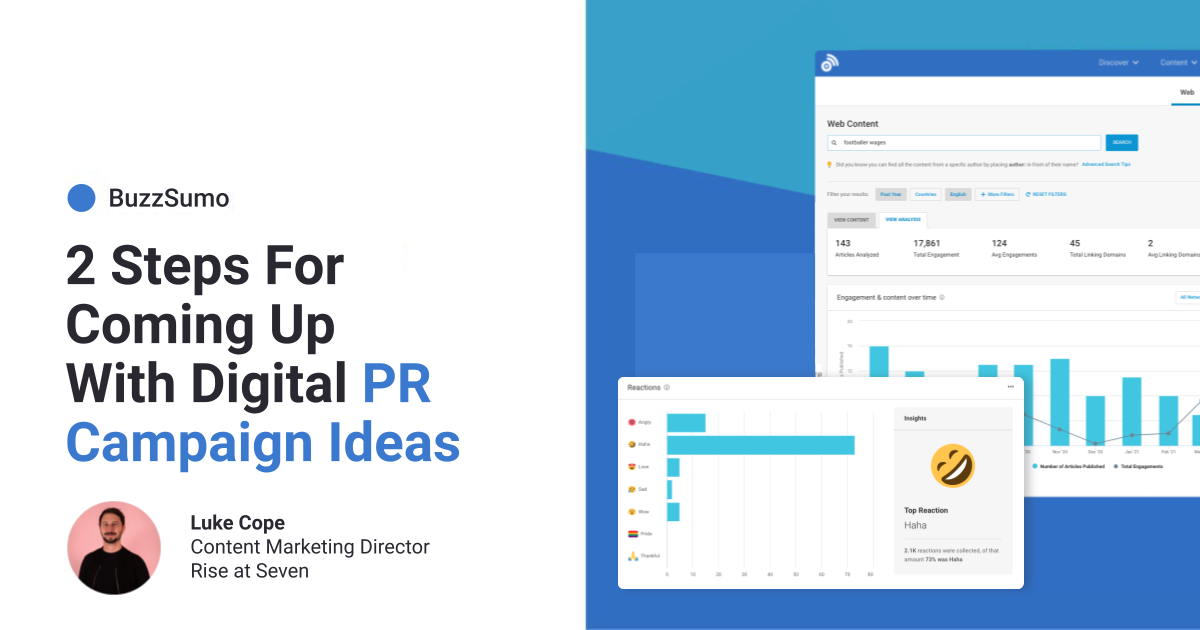
It is vital during this initial exploratory phase to resist the pressure of immediate ideation. A concrete campaign concept rarely materializes spontaneously. Instead, the focus should be on systematic discovery. Tools like BuzzSumo’s Content Analysis Report are indispensable here. This powerful platform allows PR professionals to analyze millions of articles, identifying trending topics, top-performing content formats, and the emotional sentiment associated with various keywords.
Consider a brand specializing in honeymoon packages. A direct search for “Honeymoons” in BuzzSumo provides a baseline understanding of the core product’s media presence. However, a truly insightful analysis requires expanding beyond the immediate offering. Investigating related, yet broader, themes such as “Engagement rings,” “Wedding planning,” “Romantic getaways,” or even “Marriage proposals” can reveal adjacent content ecosystems with significant engagement potential. The objective is to branch out strategically until the themes become too far removed from the client’s core offering, ensuring relevance while maximizing discovery.
Practical Application: Analyzing Content Performance and Emotional Resonance
Within the BuzzSumo Content Analysis Report, users can observe several critical metrics. For instance, analyzing the number of articles published over time for a given keyword reveals content velocity and potential saturation. A theme with a consistent, yet not overwhelming, volume of articles might indicate a sustained interest without excessive competition. Conversely, a rapidly rising trend suggests a nascent opportunity.
More importantly, the report highlights the average number of social shares across various platforms (Facebook, Twitter, Pinterest, Reddit) and the number of backlinks generated for content related to these themes. This data directly informs which topics are not only being covered by journalists but are also actively consumed and propagated by audiences. Research consistently shows that content eliciting strong emotional responses tends to be shared more frequently, with emotions like awe, joy, and anger often leading to viral distribution.
Beyond raw engagement numbers, BuzzSumo’s emotion analysis feature provides a granular understanding of audience sentiment. It categorizes the dominant emotions evoked by content – such as awe, laughter, joy, sadness, anger, or surprise. This insight is gold for PR professionals, as tapping into potent emotional responses is a proven driver of viral content and media attention. For example, content that elicits awe or amusement often enjoys higher share rates, while content sparking anger or sadness can ignite debate and draw significant attention, albeit with different strategic implications. Understanding these emotional triggers allows for tailored messaging and visual strategies.
Case Study 1: Illuminating the Impact of Light Pollution
A prime example of this research-driven approach in action is the “A world without light pollution” campaign developed for Under Lucky Stars. The initial product theme, “Star maps,” while relevant, lacked the breadth and inherent newsworthiness to sustain a broad PR campaign.
The research journey unfolded as follows:
- Product Theme: Star maps (Limited scope for a major campaign).
- Secondary Theme 1: Supermoons (High social engagement, recurring events offering reactive PR opportunities).
- Secondary Theme 2: Night sky (Consistent social engagement, broad appeal).
- Secondary Theme 3: Light pollution (Significant social engagement, highly topical, substantial scope for creative ideas).
The deep dive into “Light pollution” revealed a burgeoning topic. At the time of the campaign’s conception in 2020-2021, discussions around light pollution were reaching a crescendo. Public awareness was heightened by recent events, including SpaceX’s ambitious satellite launches, which raised concerns about increasing orbital light pollution, and the broader global conversation around environmental pollution during the COVID-19 pandemic. The lockdown periods saw an unusual phenomenon of clearer skies and increased visibility of stars in previously light-polluted urban areas, sparking a renewed public interest in the issue. This confluence of factors signaled that the timing for a campaign on light pollution was exceptionally opportune, aligning with a heightened public consciousness about environmental changes and space exploration.
Further analysis of articles related to light pollution in BuzzSumo indicated a strong emotional pull. Content often evoked either a sense of profound sadness regarding the loss of natural night skies or a powerful “wow” factor when showcasing images of clear celestial phenomena. This dual emotional response became critical in shaping the campaign’s outreach angles and visual execution. The objective became clear: to create a visually stunning and thought-provoking piece that would both lament the current state and inspire awe for what could be, thereby resonating deeply with journalists and their audiences.
Case Study 2: The Allure of Aspirational Lifestyles – Footballer Cars
Another successful campaign born from this methodology involved leveraging aspirational lifestyle themes. While the client’s core offering was “Private number plates,” which offered some humorous content opportunities, the potential for a large-scale campaign was limited.
Branching out, the research explored:
- Secondary Theme 1: Celebrity cars (High volume of articles, consistent interest).
- Secondary Theme 2: Footballers’ cars (Even higher content volume, but crucially, a significant volume of highly reactive and often impassioned comments).
A granular analysis of the comments sections on articles discussing footballers’ lavish car collections was particularly illuminating. It revealed a strong emotional undercurrent of frustration, envy, and competitiveness among readers. People were not just passively consuming content; they were actively comparing their own financial realities to the extravagant lifestyles of professional athletes. This insight sparked the core idea: why not create a tool that made this comparison explicit and literal? The resulting “Footballer Car Cost Calculator” allowed users to input their own salary and determine how many years it would take them to afford a footballer’s luxury vehicle. This campaign brilliantly tapped into emotions of indignation and aspirational envy, generating substantial media interest and engagement by allowing audiences to participate directly in the social commentary surrounding wealth and celebrity. The media’s response often centered on headlines highlighting the stark financial disparities, fueling widespread discussion.
This initial research phase, culminating in ideas linked to validated themes and potent emotions, is arguably the most critical step in campaign development. It provides an empirical foundation, moving ideation from subjective guesswork to a data-informed strategy.
Step 2: Optimizing Format and Injecting Depth into Narratives
Once a compelling theme and emotional angle have been identified, the next crucial step is to determine the optimal format for the campaign and to enrich it with sufficient depth and multiple outreach angles. A brilliant idea can fall flat if presented in the wrong medium. For instance, the “light pollution” campaign, with its emphasis on visual impact and “wow” factor, would have been significantly diluted as a simple blog post.
Selecting the Ideal Format:
The choice of format is paramount to how an audience experiences and interacts with the content. Different stories lend themselves to different presentations:
- Interactive Tools/Calculators: Excellent for personalized engagement and making complex data relatable (e.g., the footballer car calculator). These tools invite direct participation, increasing time on page and shareability.
- Data Visualizations/Infographics: Ideal for simplifying complex datasets, highlighting trends, and enhancing shareability. They are highly digestible and visually appealing for social media.
- Interactive Maps/Sliders: Powerful for before-and-after comparisons, showcasing change, or exploring geographical data (e.g., light pollution). They offer a dynamic way to convey information.
- Long-form Articles/Studies: Best for deep dives, original research, and establishing thought leadership. These formats are crucial for securing links from authoritative journalistic publications.
- Video Content: Highly engaging for storytelling, demonstrations, and emotional appeals, particularly effective on social media and for reaching younger demographics.
For the light pollution campaign, simply showing re-designed skylines might have worked, but the inclusion of an interactive “before-and-after” slider dramatically enhanced the user experience. This simple piece of code allowed audiences to actively engage with the transformation, making the impact of light pollution tangible and the “wow” factor undeniably powerful. Users could








