
In a significant shift for the digital marketing landscape, PayPal Honey, a titan of the browser extension and couponing space, has been removed or suspended from two of the most prominent affiliate networks in the United States: Rakuten Advertising and impact.com. This development follows a series of high-profile investigations into the extension’s technical practices, sparking a broader conversation regarding attribution integrity and the enforcement of compliance standards within the multi-billion-dollar affiliate marketing industry.
The removal of a publisher of this magnitude—Honey was acquired by PayPal in 2020 for approximately $4 billion—is an exceedingly rare occurrence in the affiliate sector. However, the move by Rakuten and impact.com signals a potential turning point in how networks manage large-scale software publishers. The actions taken by these platforms suggest a heightened focus on “attribution manipulation,” a practice that undermines the “last-click” attribution model upon which most affiliate programs are built.
Chronology of the Removal and Industry Response
The sequence of events leading to the current status of PayPal Honey began with mounting scrutiny from independent researchers and digital investigators. The catalyst for the network-level actions appears to be a combination of a detailed investigative video by the creator MegaLag and a technical report published by Ben Edelman, a well-known expert in online fraud and affiliate marketing practices. Edelman’s investigation focused on how Honey allegedly bypassed “stand-down” rules—industry-standard protocols designed to prevent browser extensions from claiming credit for a sale when another affiliate has already referred the customer.
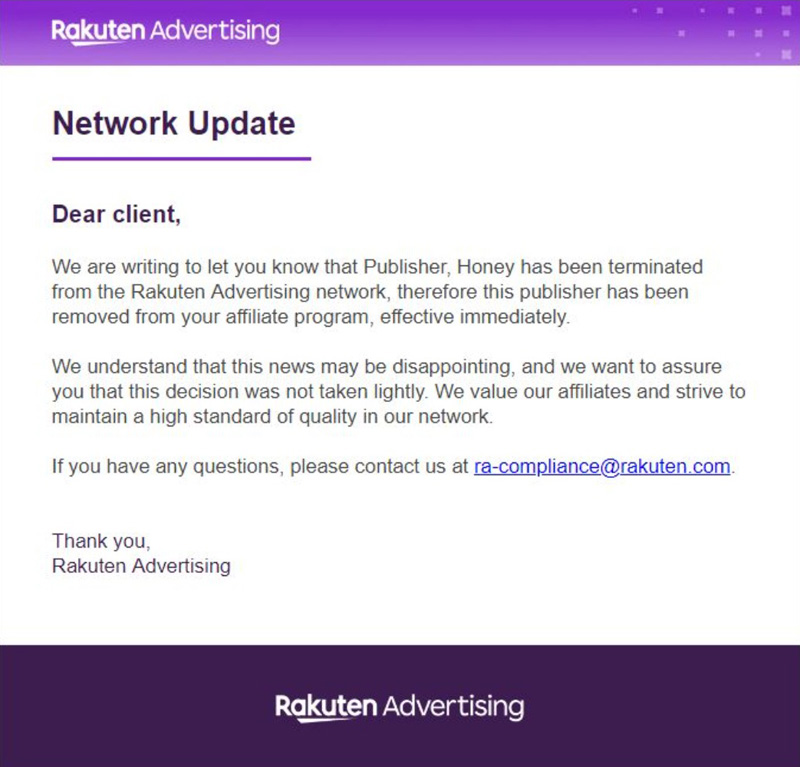
On Monday, January 12, Rakuten Advertising officially announced that Honey had been “terminated from the network.” The timing of the announcement was particularly notable, occurring on the first day of Affiliate Summit West, the largest affiliate marketing conference in the United States. Rakuten’s statement characterized the termination as a necessary measure to “maintain a high standard of quality” within its ecosystem.
Following Rakuten’s lead, impact.com took action later that week. On Friday, January 16, the platform confirmed that Honey was found to be “out of compliance” with its platform policies. Consequently, Honey was removed from impact.com’s “Discovery Marketplace.” David A. Yovanno, CEO of impact.com, addressed the situation by explicitly citing “attribution manipulation” as the primary cause for the suspension. While impact.com’s move was described as a suspension rather than a permanent termination, it effectively halted Honey’s ability to participate in the platform’s broader marketplace for new partnerships.
Technical Context: Attribution Manipulation and Stand-Down Violations
To understand the severity of these network actions, it is necessary to examine the technical mechanics of affiliate attribution. Most modern affiliate programs operate on a “last-touch-wins” basis. This means the commission for a sale is awarded to the last affiliate whose link was clicked by the consumer before the purchase was finalized.

Browser extensions like Honey provide value to consumers by automatically finding and applying coupon codes at checkout. However, because these extensions operate within the user’s browser during the final stages of a transaction, they are uniquely positioned to “overwrite” the cookies of previous affiliates. To prevent this, many programs implement “stand-down” rules. These rules mandate that an extension must not fire its affiliate link—and thus must not claim the commission—if the consumer was already referred to the site by another affiliate, such as a content creator, a review site, or a social media influencer.
The investigations into PayPal Honey alleged that the extension engaged in intentional stand-down violations. More critically, the reports suggested a level of “concealment,” where the extension allegedly used technical workarounds to hide its activity from the policing tools used by affiliate managers and networks. By claiming credit for sales that were already “won” by other affiliates, such practices drain marketing budgets and demoralize the creators who provide top-of-funnel discovery.
Strategic Implications for Affiliate Program Management
The Honey controversy serves as a seminal case study for affiliate managers and digital marketers. The fallout highlights several critical vulnerabilities in the current partnership economy and provides five essential lessons for brands looking to protect their marketing investments.
1. The “Bad Apple” Effect on Program Ecosystems
The presence of a non-compliant affiliate does more than just cause financial leakage; it can degrade the quality of the entire program. High-value affiliates, such as niche content creators and reputable review sites, often perform extensive due diligence before joining a brand’s program. If these creators see that a brand allows “cookie-sniping” extensions to operate without oversight, they may choose to promote a competitor instead. A single affiliate that violates attribution rules effectively “spoils” the program for honest partners who cannot compete with automated software that intercepts the customer at the one-yard line.
2. The Necessity of Independent Policing
While affiliate networks like Rakuten and impact.com provide the infrastructure for tracking and payments, this incident underscores that brands cannot rely solely on network compliance departments. Networks often face a conflict of interest, as they generate revenue based on the volume of transactions processed through their platforms. Consequently, they may be slower to remove high-volume publishers. Brand managers must take ownership of their own “Terms and Conditions” (Ts & Cs) and utilize third-party monitoring tools to enforce compliance at the program level, rather than waiting for network-wide interventions.
3. Understanding Technical Nuances: Stand-Down vs. Soft Click
The Honey case highlights the complexity of modern attribution. Affiliate managers must distinguish between different types of software behavior. For instance, “soft clicks” and “stand-down” rules are distinct technical implementations. Organizations like The Affiliate & Partner Marketing Association (APMA) in the UK have recently conducted audits of these rules across various networks. Their research suggests that attribution rules are often inconsistently applied. Managers who fail to understand these nuances are ill-equipped to identify when an extension is providing incremental value versus when it is simply capturing existing demand.
4. Avoiding Over-Generalization of Software Publishers
While the Honey situation has cast a shadow over browser extensions, industry experts warn against banning entire classes of affiliates. Not all Downloadable Software Publishers (DSPs) engage in prohibited behavior. Many extensions, including those focused on loyalty, card-linked offers, or specific “closed user groups” (CUGs), operate with high transparency and provide genuine incremental growth. The lesson for brands is to evaluate each partner on an individual basis, looking at data-driven performance metrics rather than applying blanket bans that might stifle innovation.
5. The Critical Importance of Base Diversification
The most significant takeaway from the Honey suspension is the risk of over-reliance on a small group of publishers. Audits of many underperforming affiliate programs often reveal that upwards of 80% of revenue is driven by a handful of “coupon and deal” affiliates. If one of those partners is removed for non-compliance, the program’s revenue can collapse overnight.
To build a resilient program, brands must diversify across a wide spectrum of affiliate types. A healthy mix should include:
- Content Producers: Bloggers and media houses that drive brand awareness.
- Social Media Influencers: Creators who build trust with specific demographics.
- Mass Media Partners: Large-scale digital publications.
- Niche Educators: Consultants and service providers who recommend products to their clients.
- Technological Partners: Retargeting and cart-abandonment solutions that offer specialized value.
Industry Impact and the Path Forward
The removal of PayPal Honey from major marketplaces represents a “shot across the bow” for the entire affiliate industry. It suggests that the era of “growth at any cost” is being replaced by a demand for transparency and incremental value. As brands move into 2026, the focus is shifting toward “holistic” affiliate management, where the quality of the referral is valued as much as the volume.
For PayPal, the suspension of Honey on major networks represents a significant challenge to the ROI of its $4 billion acquisition. For the networks, it is an opportunity to reclaim their reputation as neutral arbiters of fair play. For the broader industry, it is a reminder that in the partnership economy, trust is the most valuable currency.
In the coming months, it is expected that other networks may follow suit or implement more stringent monitoring requirements for all browser-based extensions. Brands are encouraged to conduct comprehensive audits of their current affiliate rosters, ensuring that their partners are not only driving sales but are doing so in a manner that respects the integrity of the marketing ecosystem. The fallout from the Honey investigation will likely lead to a more robust, albeit more regulated, future for affiliate marketing.