

In the intricate ecosystem of digital advertising, where every click represents a potential customer and every dollar is meticulously tracked, a critical juncture often determines the success or failure of Pay-Per-Click (PPC) campaigns: the landing page. While ad copy and keyword targeting receive significant attention, the humble landing page frequently becomes the silent graveyard of well-intentioned advertising efforts. Businesses are increasingly discovering that a one-size-fits-all approach to landing pages is not only ineffective but actively detrimental to conversion rates.
The fundamental disconnect arises when a user, having performed a specific search and clicked on a targeted advertisement, arrives at a page that fails to meet their immediate expectations. This can manifest as pages that are overly broad, frustratingly generic, or entirely disconnected from the promise of the ad. The consequence is a swift and often irreversible loss of potential customers, as the opportunity for conversion evaporates in the face of user confusion or disappointment. As digital marketing strategies become more granular, so too must the corresponding landing page experiences. This necessitates a shift from relying on a single, generalized page to support a multitude of campaigns, audiences, and search intents, towards creating multiple, highly tailored landing pages. Each page should be meticulously designed to resonate with specific search queries, distinct audience segments, and varying stages of buyer intent, thereby fostering immediate trust and guiding users seamlessly toward conversion.
The Pervasive Problem: A Single Page for All Journeys
A recurring pitfall observed across a vast spectrum of PPC campaigns is the tendency for businesses to consolidate multiple audiences, intents, and campaign objectives onto a single landing page. This often results in the repurposing of homepages, broad service pages, or generic “book a demo” pages to serve every conceivable advertising initiative. The underlying question, however, is whether such a page genuinely supports the specific intent behind each individual click.
Consider a hypothetical scenario: a user searches for a discount on vegan meal subscription boxes. The advertisement is clear and specific, promising a tangible offer. Upon clicking, however, the user is directed to a generic homepage with no discernible mention of the advertised discount. While seemingly a minor oversight, this example underscores a significant challenge: users should not be compelled to expend effort deciphering whether they have arrived at the correct destination. The greater the cognitive load required after a click, the higher the probability of user attrition.
This friction is precisely why many businesses underestimate the actual number of landing pages they require. Each unique search query, even when related to the same product or service, evokes distinct user expectations. An individual searching for pricing information seeks a vastly different experience than someone comparing solutions or conducting initial research into available options. Attempting to funnel all these diverse user needs through a single, undifferentiated page invariably creates friction, as the content becomes too diluted to adequately address any single specific requirement.
A more strategic approach involves developing landing pages that are purpose-built around key user segments and their corresponding needs. Instead of directing all traffic to a solitary generic service page, businesses can create distinct landing pages tailored to specific offerings or customer pain points. For instance, a company offering CRM software might create:
- A landing page specifically for “CRM for recruitment agencies,” detailing industry-specific benefits and case studies.
- A separate page focused on “CRM software pricing,” providing transparent cost breakdowns and plan comparisons.
- Another page dedicated to “CRM comparison tools,” offering in-depth feature matrices and expert reviews for users in the evaluation phase.
The objective here is not merely to inflate the number of web pages but to engineer a post-click journey that feels intuitively relevant and highly personalized.
Leveraging Search Intent to Sculpt Landing Pages
Before delving into the specifics of headlines, page structure, or aesthetic design, the foundational element in crafting effective landing pages is an understanding of user intent. This intent directly shapes user expectations, which in turn dictates their subsequent behavior. Search intent emerges as an indispensable tool in determining the necessary types of landing pages.
Many businesses recognize the need for more specialized landing pages but struggle with structuring them or identifying a starting point. The most accessible method to address this is by meticulously analyzing the intent behind keywords and entire campaigns.
For example, a user searching for “best CRM for recruitment agencies” possesses fundamentally different expectations from someone searching for “CRM software pricing.” The former is likely in the evaluation stage, comparing providers and seeking reassurance, proof of efficacy, feature comparisons, and information regarding suitability for their specific industry. Conversely, the latter user is significantly closer to making a purchase decision and is primarily interested in immediate access to costs, available plans, and the next steps in the acquisition process. Directing both users to the same page inevitably creates friction, as one party will inevitably face a more arduous task in locating the information they seek.
This underscores the recommendation to conceptualize landing pages through the lens of the buyer’s journey, rather than relying on a single, overarching “master page” and hoping it suffices for every campaign.

The Three Pillars of Search Intent in PPC Landing Page Design
Broadly categorizing search intent reveals three principal stages that are paramount when designing PPC landing pages:
1. Transactional Intent: Ready to Act
Users exhibiting transactional intent are on the verge of taking a definitive action. Their primary objective is to complete a purchase, sign up for a service, or finalize a specific transaction.
Key User Needs:
- Clear and concise product or service information.
- Direct pathways to purchase or sign-up.
- Information on pricing, availability, and delivery.
- Assurances of security and a smooth checkout process.
Effective Landing Page Elements:
- Prominent calls-to-action (CTAs) that are unambiguous and action-oriented (e.g., “Buy Now,” “Sign Up Today,” “Get Your Quote”).
- Streamlined forms with minimal fields required for completion.
- Trust signals such as customer testimonials, security badges, and satisfaction guarantees.
- High-quality product images or service demonstrations.
- A clear and direct path to the conversion point, avoiding unnecessary steps or distractions.
What Works Well Here: Users in this stage do not desire lengthy explanations or extensive scrolling. They seek to understand the offering and initiate the next step with speed and efficiency.
2. Commercial Investigation Intent: Comparing and Contrasting
Users with commercial investigation intent are actively comparing different solutions and aim to mitigate risk before committing to a decision. They are in the research phase, evaluating options and seeking information that will help them make an informed choice.
Key User Needs:
- Detailed product or service comparisons.
- In-depth feature breakdowns and specifications.
- Information on pricing tiers and value propositions.
- Reviews, testimonials, and case studies demonstrating success.
- Expert insights and guidance.
Effective Landing Page Elements:
- Comparative charts and tables highlighting key differences between offerings.
- Detailed descriptions of features and benefits, tailored to address specific pain points.
- Customer success stories and industry-specific use cases.
- Downloadable resources such as white papers, e-books, or webinars that offer deeper insights.
- Clear contact information for sales inquiries or personalized consultations.
What Works Well Here: A common error is directing these users directly to a hard-conversion page before establishing sufficient trust and providing adequate comparative information. Landing pages that offer value through educational content and transparent comparisons are highly effective.
3. Informational Intent: Early-Stage Research
Users in the informational intent stage are at the earliest point of their journey, primarily engaged in research. They are seeking to understand a problem, explore potential solutions, or learn more about a particular topic.
Key User Needs:
- Educational content that addresses their queries.
- Explanations of concepts and definitions.
- Guidance on how to approach a problem.
- Overviews of available solutions without immediate pressure to commit.
Effective Landing Page Elements:

- Informative blog posts, articles, or guides.
- FAQs and glossary sections.
- Infographics and visual aids that simplify complex information.
- Video content explaining concepts or introducing topics.
- Subtle CTAs that encourage further engagement, such as signing up for a newsletter or downloading a free guide.
What Works Well Here: Pushing these users immediately towards a hard conversion can be perceived as overly aggressive, as they are not yet ready for such a commitment. Providing valuable, educational content that addresses their immediate needs builds rapport and positions the business as a helpful authority, paving the way for future conversions. Not every click is an immediate lead; some clicks are simply the beginning of a relationship.
Continuous Optimization: The Key to Sustained Landing Page Performance
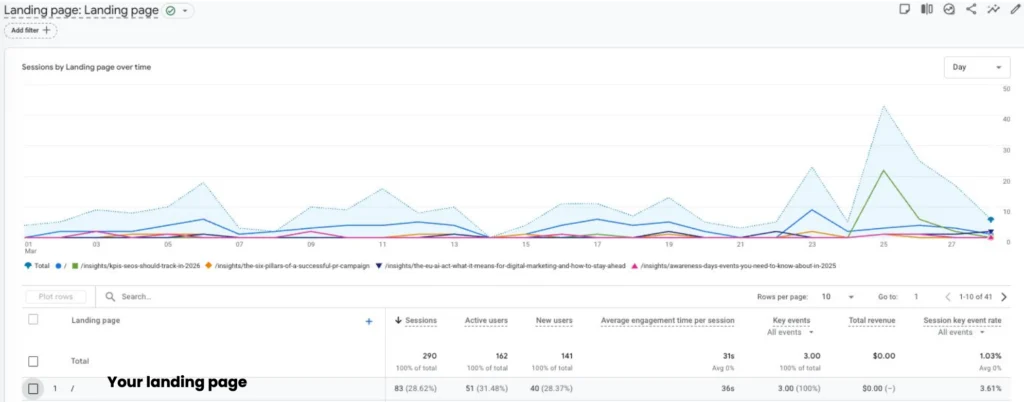
A pervasive misconception surrounding landing pages is that their creation marks the endpoint of the effort. In reality, high-performing landing pages are the product of ongoing, iterative optimization. This is where analytical tools like Google Analytics 4 (GA4) and behavioral analytics platforms such as Microsoft Clarity become indispensable.
GA4 offers profound insights into user behavior on landing pages, including:
- Traffic sources: Identifying which channels are driving the most relevant visitors.
- Engagement rates: Measuring how users interact with page content.
- Bounce rates: Understanding how many users leave the page without taking further action.
- Conversion rates: Tracking the ultimate success of the page in achieving its objectives.
For instance, if paid traffic consistently lands on a page with low engagement rates, it strongly suggests a mismatch between the ad’s perceived intent and the actual landing page experience.
Behavioral analytics tools like Microsoft Clarity provide even deeper qualitative insights. Session recordings and heatmaps can vividly illustrate moments of user frustration, confusion, or disengagement. Common indicators include:
- Excessive scrolling: Users are not finding what they need within the initial view.
- Repetitive clicking on non-interactive elements: Users expect something to happen that doesn’t.
- Hesitation or rage clicks: Signals of frustration or confusion.
- Sudden exits from specific sections: Users may be getting lost or encountering barriers.
These signals often reveal friction points that standard analytics might overlook, emphasizing that optimization should focus as much on friction reduction as on aesthetic enhancement.
Some of the most impactful landing page improvements are often surprisingly straightforward:
- Clarity of headline: Ensuring it directly reflects the ad’s promise.
- Streamlined navigation: Making it easy for users to find what they need.
- Visible and compelling CTAs: Guiding users towards the desired action.
- Mobile responsiveness: Guaranteeing a seamless experience across all devices.
- Fast page load speeds: Minimizing wait times.
The goal is not to complicate landing pages but to make them more navigable and, critically, more trustworthy. Moreover, optimization efforts should never be solely based on assumptions. The disconnect between what businesses believe users want and what users actually respond to is frequently significant.
Final Reflections: Integrating Landing Pages into the PPC Journey
If landing pages are not yielding the desired conversion rates, the initial step should be to simplify the user experience and prioritize relevance over an exhaustive information dump. A strategic starting point involves:
- Auditing existing landing pages: Assessing their alignment with current PPC campaigns and target audience intent.
- Mapping search intent to specific pages: Ensuring each page serves a clearly defined user need.
- Prioritizing clarity and directness: Eliminating ambiguity and making the next step obvious.
Most importantly, landing pages should not be viewed as isolated entities. They are integral components of the broader PPC journey, seamlessly connecting the user’s search query with the business’s ultimate objective. By meticulously aligning ad campaigns with hyper-specific, intent-driven landing pages and committing to continuous optimization, businesses can transform their advertising efforts from promising initial clicks into tangible, valuable conversions.









