rifanmuazin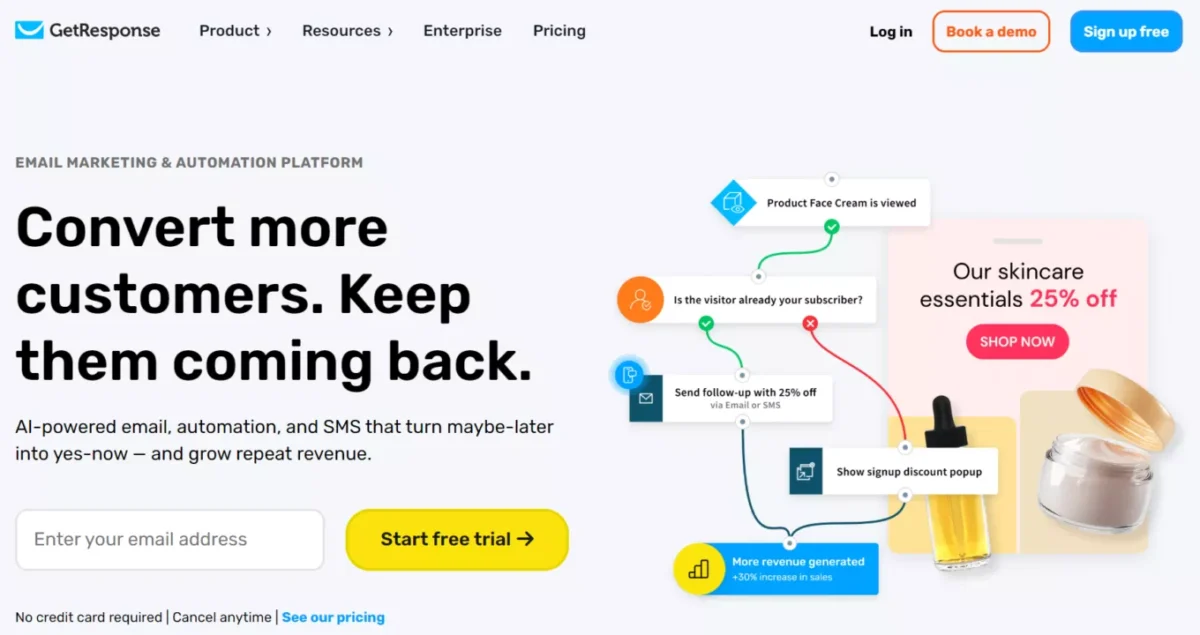
In the rapidly evolving landscape of digital commerce, the strategic deployment of email marketing automation has transitioned from a beneficial addition to an indispensable cornerstone for businesses aiming to scale, enhance customer relationships, and drive revenue. As competition intensifies and customer expectations for personalized interactions rise, manual email outreach becomes not only inefficient but also a significant impediment to growth. The advent of sophisticated email automation tools has empowered e-commerce platforms to streamline communications, improve conversion rates, and significantly reduce the labor associated with managing extensive customer databases. This article provides an in-depth analysis of the top email automation tools, examining their capabilities, ideal applications, and how they collectively shape the future of digital retail.
The Indispensable Role of Email Automation in Modern E-commerce
The journey of a modern consumer is multifaceted, often involving multiple touchpoints across various channels before a purchase is made. Email marketing, despite the rise of social media and other digital channels, consistently delivers one of the highest returns on investment (ROI) for businesses. A 2023 study by Litmus found that for every $1 spent on email marketing, businesses could expect an average return of $36, underscoring its enduring efficacy. For e-commerce, this translates into direct sales opportunities through targeted promotions, abandoned cart recovery sequences, post-purchase follow-ups, and loyalty programs.
Email automation tools are designed to execute these complex, multi-stage communication flows automatically. They leverage customer data—such as browsing history, purchase behavior, demographic information, and engagement with previous emails—to deliver highly relevant messages at optimal times. This personalization is not merely a nicety; it is a fundamental expectation of today’s consumers. Research indicates that personalized emails can generate six times higher transaction rates than non-personalized emails. Without automation, achieving this level of tailored communication across a growing customer base would be logistically impossible for most businesses.
A Brief History and Evolution of Email Marketing Automation
Email marketing, in its nascent form, began with simple newsletters and mass broadcasts in the early days of the internet. The concept of “automation” was initially limited to scheduled sends or basic list segmentation. However, as e-commerce platforms grew in complexity and data collection capabilities advanced, the demand for more intelligent and responsive communication systems surged.
The late 2000s and early 2010s saw the emergence of more sophisticated tools that could trigger emails based on specific user actions, like signing up for a newsletter or making a purchase. The mid-2010s marked a significant leap with the introduction of visual workflow builders, allowing marketers to design intricate customer journeys with conditional logic and multi-channel integration (SMS, push notifications). Today, the cutting edge involves AI-driven personalization, predictive analytics to anticipate customer needs, and seamless integration across an entire marketing technology (MarTech) stack, enabling true omnichannel customer experiences. This chronological progression highlights a continuous drive towards greater efficiency, personalization, and measurable impact on the bottom line.
Key Features Defining Superior Email Automation Software
When evaluating email automation platforms, several core features stand out as critical for e-commerce success. These capabilities directly influence a tool’s ability to drive conversions, foster customer loyalty, and streamline marketing operations:
- Advanced Automation Workflows: The ability to create sophisticated, multi-step email sequences triggered by specific customer behaviors (e.g., cart abandonment, product views, wishlist additions, subscription renewals) is paramount. Visual workflow builders simplify this process, allowing marketers to map out complex journeys intuitively.
- Robust Segmentation Capabilities: Segmenting customers based on demographics, purchase history, engagement levels, and browsing behavior allows for hyper-targeted messaging. The more granular the segmentation, the more relevant the communication, leading to higher open rates, click-through rates, and conversions.
- Native E-commerce Integrations: Seamless integration with popular e-commerce platforms (Shopify, WooCommerce, Magento, etc.) is essential for data synchronization and enabling e-commerce-specific triggers and personalization.
- Multichannel Support: Beyond email, the ability to integrate SMS, web push notifications, and even social media into automated workflows creates a cohesive and impactful omnichannel experience, reaching customers where they are most receptive.
- Personalization and Dynamic Content: Tools that allow for dynamic content insertion based on customer data (e.g., product recommendations, personalized discounts, localized offers) significantly enhance engagement.
- A/B Testing and Analytics: Comprehensive reporting and analytics dashboards provide insights into campaign performance, while A/B testing features enable continuous optimization of subject lines, content, and call-to-actions.
- Ease of Use: A powerful tool is only effective if marketers can utilize it efficiently. An intuitive user interface, drag-and-drop editors, and pre-built templates reduce the learning curve and accelerate time to value.
- Scalability and Pricing: The tool should be able to grow with the business, offering plans that accommodate increasing contact lists and sending volumes without prohibitive costs.
Comprehensive Comparison of Leading Email Automation Tools for E-commerce
Our evaluation of email automation tools considered a balance of ease of use, robust e-commerce capabilities, integration potential, and pricing structures. Each platform brings unique strengths to the table, catering to diverse business needs—from burgeoning startups to established enterprises.
1. Omnisend
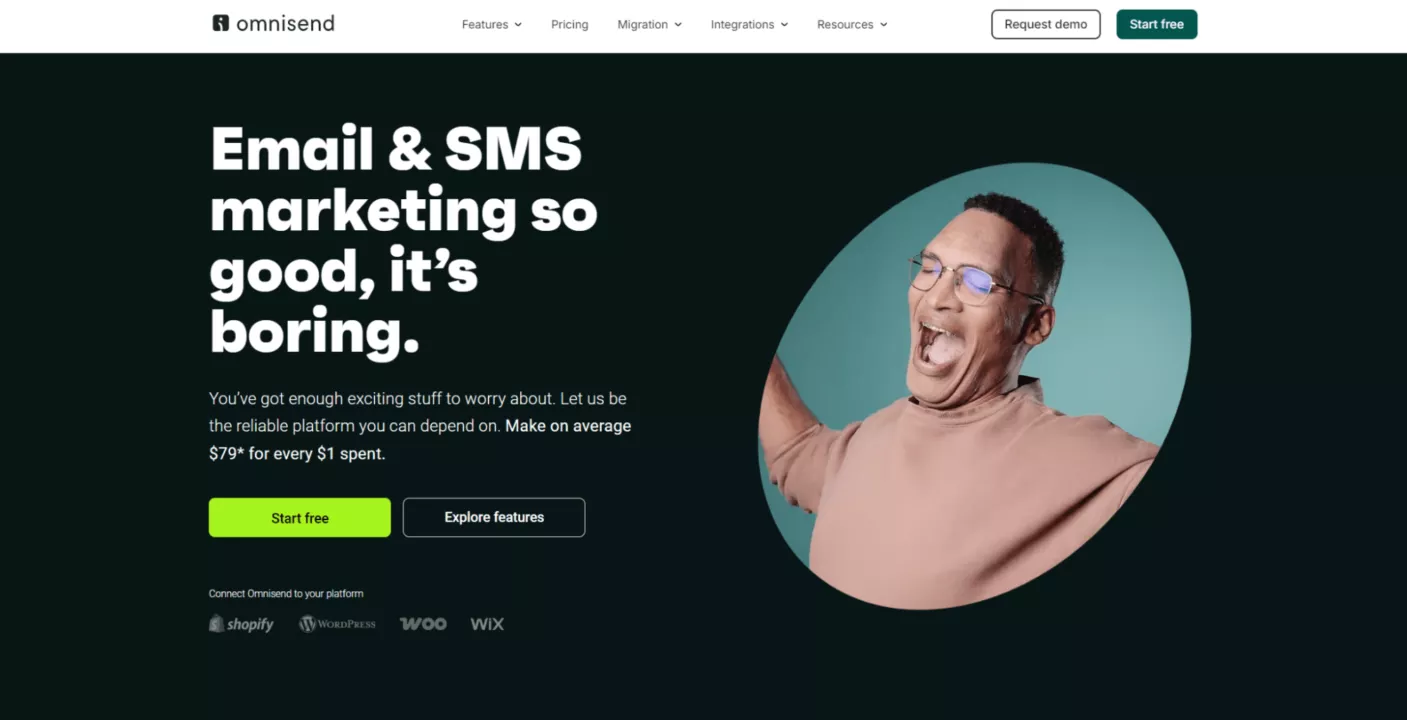
Omnisend distinguishes itself as an email automation tool meticulously crafted for omnichannel marketing within the e-commerce sphere. It empowers businesses to orchestrate coordinated campaigns across email, SMS, and push notifications, directly addressing e-commerce challenges such as abandoned carts, personalized product recommendations, and customer retention. The platform’s strong emphasis on ROI is frequently cited by users, with claims of significant returns for marketing spend. Omnisend is particularly well-suited for e-commerce stores of any size seeking high-impact multichannel automations without the complexities often associated with advanced marketing setups. Its visual workflows are designed specifically for e-commerce triggers and templates, facilitating a straightforward implementation process. Native integrations with major e-commerce platforms and a wide array of other applications further solidify its position as a dedicated e-commerce solution.
2. Sender
Sender enters the market with a highly competitive offering, particularly noteworthy for its generous free plan, which makes it an attractive option for budget-conscious ventures. The platform is optimized for mass email campaigns, providing a straightforward, user-friendly interface that allows for rapid deployment of email initiatives. While it may not possess the advanced multi-channel capabilities or the deep automation features of some higher-tier competitors, Sender excels in delivering essential email automation and a drag-and-drop builder for simple campaign creation. It integrates with many standard applications and e-commerce platforms, proving a reliable choice for newsletters and businesses prioritizing email volume and simplicity above complex, multi-layered marketing strategies.
3. Klaviyo
Klaviyo has cemented its reputation as a powerhouse in email automation, celebrated for its profound focus on customer segmentation and the intelligent utilization of rich customer data. This platform provides retention-focused marketing teams with exceptional granular control over every customer touchpoint, enabling highly targeted and personalized campaigns. Its strength lies in deep e-commerce integrations, which facilitate sophisticated segmentation, predictive analytics, and robust reporting capabilities. While offering a wealth of features, Klaviyo does come with a steeper learning curve and a higher price point, making it an ideal choice for mid-to-large e-commerce brands with dedicated marketing teams capable of leveraging its advanced functionalities to their fullest extent.
4. Mailchimp
Mailchimp has evolved significantly beyond its origins as a mere email automation tool, now positioning itself as a comprehensive all-in-one marketing suite. It offers features for website building, social media scheduling, and content creation, appealing to small teams seeking a broad range of marketing functionalities from a single provider. For e-commerce businesses requiring highly specialized or advanced automation workflows, Mailchimp’s options might be perceived as somewhat limited compared to dedicated e-commerce platforms. However, its user-friendly drag-and-drop builder, solid automation capabilities with behavioral triggers (especially on higher-paid tiers with up to 200 steps), and a generous free plan for up to 250 contacts make it an excellent universal choice for general marketing needs, particularly for those not exclusively focused on deep e-commerce integrations.
5. ActiveCampaign
ActiveCampaign is recognized for its potent combination of email and WhatsApp automation alongside comprehensive CRM capabilities and advanced customer segmentation. Designed for flexible application across various industries, it offers powerful visual automation and predictive triggers on higher tiers. Its integrated CRM functionality allows businesses with complex sales cycles and multi-channel customer journeys to manage interactions effectively. While highly capable, its extensive feature set can present a significant learning curve, particularly for those seeking purely e-commerce-specific solutions. However, for mid-sized businesses looking to consolidate their CRM and marketing automation efforts and explore diverse customer channels, ActiveCampaign presents a compelling, albeit complex, solution.
6. HubSpot Email Marketing
HubSpot is a dominant force in the CRM space, and its email marketing features are tightly integrated within its broader marketing, sales, and service hub ecosystem. For e-commerce brands already utilizing HubSpot’s comprehensive CRM, its email marketing tools offer seamless data flow and unified customer views. The platform provides omnichannel marketing capabilities and journey analytics, with role-based access on higher tiers. Automation across email, ads, and social media is particularly effective when deeply tied into the HubSpot CRM. However, for businesses not already invested in the HubSpot ecosystem, the platform can be complex and time-consuming to onboard, and its email multichannel capabilities might appear less specialized compared to e-commerce-first solutions.
7. GetResponse
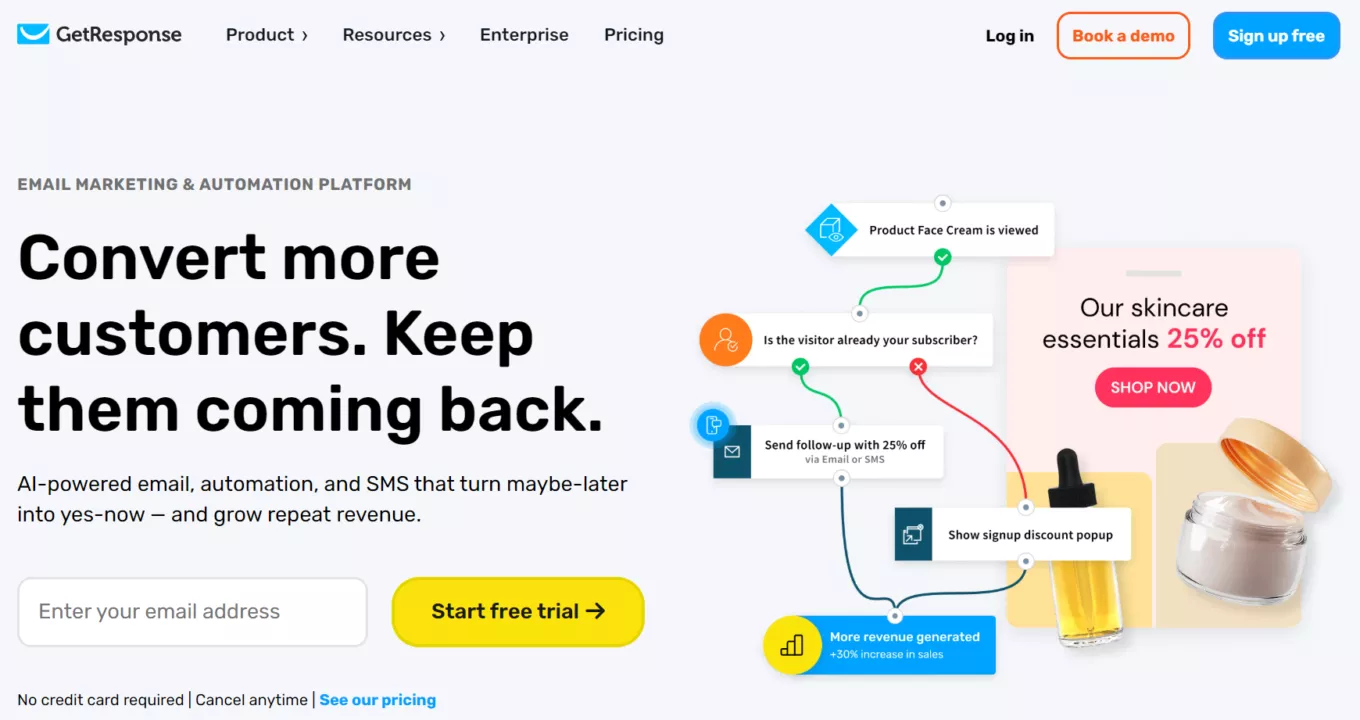
GetResponse serves as a robust marketing tool that proficiently connects email automation and sales funnels with diverse content monetization features. Its utility extends beyond typical e-commerce functions, enabling the creation of landing pages, webinars, online courses, and sophisticated conversion funnels. For small to mid-sized e-commerce brands that also engage in content creation and seek to monetize their audience through various channels, GetResponse offers a compelling suite. Essential e-commerce functionalities are covered within its mid-tier plans, which also bundle additional marketing options. While mastering its advanced funnels may take time, GetResponse stands as a worthy option for integrating disparate marketing channels into a cohesive strategy.
8. Brevo (formerly Sendinblue)
Rebranded from Sendinblue, Brevo focuses on delivering essential email and basic automation capabilities at an affordable price, particularly for small and medium businesses managing large contact lists. It emphasizes multi-channel support and includes a basic CRM in all plans, alongside a visual workflow builder. Brevo offers a comfortable learning curve, making it accessible for non-technical users to quickly set up and run campaigns. While it provides flexible visual workflows and basic e-commerce templates, it is not an e-commerce-first tool, and businesses requiring highly advanced e-commerce-specific features might find its offerings lighter in comparison to more specialized platforms. It remains an excellent choice for businesses needing scalable and affordable email automation for contact lists in the tens of thousands.
9. Drip
Drip is purpose-built for e-commerce businesses, providing advanced automation solutions across all its plans. It leverages an intuitive visual workflow builder, significantly simplifying the setup and initiation of email automation sequences. Drip’s strength lies in its strong e-commerce automation capabilities, driven by behavior-based segments and pre-built workflows designed to address common e-commerce scenarios. The trade-off for its specialized focus and robust features is a relatively higher entry price, which might be a consideration for very small e-commerce businesses. Additionally, the tool has historically been more US-focused. However, for mid-sized and large companies with established e-commerce platforms and mailing lists that require sophisticated, contact-based automation, Drip stands as a top-tier consideration.
10. Kit (formerly ConvertKit)
Kit, previously known as ConvertKit, has strategically positioned itself as an email-first marketing system tailored for content creators, including bloggers, YouTubers, and newsletter publishers. It provides numerous features designed to help creators implement e-commerce-like flows for monetizing digital products. The platform offers website-style elements, landing page builders, and visual automation optimized for the creator economy. While exceptionally easy to use for creators, its capabilities for complex e-commerce workflows involving physical products might be limited compared to platforms built specifically for traditional online stores. For those selling digital products or integrating marketing with extensive newsletters, Kit offers a highly effective and specialized alternative.
Strategic Selection: Choosing the Right Email Automation Tool
The process of selecting the optimal email automation tool is a strategic decision that should align closely with a business’s specific goals, operational scale, and budget. A small WooCommerce store, for instance, might prioritize robust abandoned cart recovery features and ease of integration, whereas a large Shopify enterprise might require deep segmentation, predictive analytics, and extensive API access for custom integrations.

Key considerations for selection include:
- Business Size and Growth Stage: Startups may benefit from generous free plans and user-friendly interfaces, while growing enterprises require scalable solutions with advanced features.
- Budget Constraints: Pricing models vary significantly, from free tiers with limitations to high-tier plans based on contact volume, sending limits, or feature sets.
- E-commerce Platform Compatibility: Native, seamless integrations with the existing e-commerce platform are crucial for data synchronization and trigger-based automations.
- Required Automation Depth: Assess whether basic email sequences suffice or if complex, multi-channel customer journeys with conditional logic are necessary.
- Team Expertise: Consider the learning curve associated with a tool. Simpler interfaces accelerate adoption, while more complex platforms might require dedicated marketing specialists.
- Multichannel Needs: Determine if email alone is sufficient, or if integrated SMS, push notifications, or other channels are essential for a comprehensive strategy.
Ultimately, the best tools are those that seamlessly integrate into existing workflows, deliver measurable ROI, and allow businesses to focus on growth rather than administrative overhead.
Broader Impact and Future Implications
The proliferation and increasing sophistication of email automation tools are profoundly impacting the e-commerce landscape. They are democratizing advanced marketing strategies, enabling small businesses to compete with larger enterprises by delivering personalized customer experiences. This trend fosters greater customer loyalty, reduces churn, and drives consistent revenue growth.
Looking ahead, the integration of artificial intelligence (AI) and machine learning (ML) will further refine email automation. AI will enable hyper-personalization at an unprecedented scale, predicting individual customer preferences and tailoring content, offers, and send times with even greater precision. The convergence of email automation with other MarTech solutions, such as CRM, customer data platforms (CDPs), and advanced analytics, will create truly unified customer profiles, allowing for holistic and consistent communication across every conceivable touchpoint. The ongoing emphasis on data privacy and compliance will also continue to shape the development and features of these tools, ensuring responsible and ethical data utilization.
Conclusion
Email automation is no longer a luxury but a fundamental necessity for any e-commerce business striving for sustainable growth and competitive advantage. The market offers a diverse array of tools, each with distinct strengths tailored to different business sizes, budgets, and strategic objectives. From comprehensive multichannel platforms like Omnisend and Klaviyo that cater to deep e-commerce needs, to versatile marketing suites like Mailchimp, and specialized solutions for creators such as Kit, the options are extensive. Investing the time to thoroughly evaluate and test various platforms will yield significant returns, empowering businesses to automate critical communication, enhance customer engagement, and ultimately, drive sales more effectively. The right email automation tool will serve as a powerful engine for growth, transforming customer interactions into lasting relationships and revenue.