rifanmuazin
The trajectory of a corporate experimentation program often begins with a surge of optimism followed by a quiet, bureaucratic expiration. Consider the case of a mid-sized enterprise team, led by a manager we will call Alex. After months of internal advocacy, Alex finally secured the executive mandate and budget to launch an official A/B testing initiative. The leadership’s expectations were high, and the consensus was clear: the first test had to be a “game-changer.” They bypassed minor optimizations in favor of a massive, transformative redesign of the core user journey, believing that only a high-stakes project could justify the program’s existence.
The reality of the execution, however, told a different story. Three months into the project, the “first test” was still caught in the friction of design reviews and stakeholder revisions. Six months in, the development team was struggling with the technical complexity of the implementation. By the one-year mark, the initial momentum had vanished, the budget was scrutinized, and the experimentation program was quietly shuttered before it ever truly launched.
This narrative is not an anomaly; it is a systemic pattern in the digital optimization industry. Lucia van den Brink, the founder of the consultancy The Initial, has observed this “big test trap” across dozens of organizations. In a recent appearance on the VWO Podcast, van den Brink detailed how the pursuit of immediate, massive wins often serves as the primary catalyst for the failure of Conversion Rate Optimization (CRO) initiatives. To counter this, she proposes a rigorous four-step framework designed to prioritize habit-building, technical agility, and strategic portfolio management.
The Psychology and Mechanics of the Big Test Trap
The inclination to “go big” is rooted in understandable, albeit flawed, corporate logic. When a company invests in experimentation software and dedicated personnel, there is significant pressure to prove ROI (Return on Investment) quickly. Large projects naturally attract the attention of senior leadership, and there is an implicit assumption that the magnitude of a website or app change is directly proportional to the magnitude of the resulting impact.
However, large-scale experiments introduce several layers of risk that can destabilize a nascent program. First, they require extensive cross-departmental coordination, which increases the likelihood of “scope creep” and internal politics. Second, the technical debt and development time required for a massive overhaul mean that the team is not actually “experimenting”—they are simply performing a traditional product launch under the guise of a test. Third, when a massive redesign is tested against an original version and yields a result, it is often impossible to isolate which specific variable drove the change. This lack of granularity prevents the team from gaining actionable insights that can be applied to future projects.

Van den Brink notes that she recently encountered a product owner whose first proposed experiment was a complete overhaul of a fraud detection system. Another client attempted to launch a full redesign of their primary landing page as their inaugural test. In both instances, the complexity of the projects far outweighed the team’s experimental maturity, leading to stagnation.
Step 1: Breaking the Cycle of Over-Ambition
The first step in van den Brink’s framework is the conscious recognition of the big test trap. Organizations must shift their internal definition of success from “winning big” to “learning fast.” This requires a cultural recalibration where leadership understands that experimentation is a compounding interest game, not a lottery.
The primary goal of a new experimentation program should be the establishment of infrastructure and habits. This includes setting up clean data pipelines, defining clear Key Performance Indicators (KPIs), and familiarizing the development team with the testing platform. By acknowledging that the first six months are about building a “testing muscle,” companies can avoid the paralysis that comes with high-stakes, high-complexity projects.
Step 2: The Strategic Value of “Small” Wins
The second phase of the framework focuses on high-velocity, low-complexity tests. Contrary to popular belief, modest changes—such as altering a call-to-action (CTA) hierarchy, refining headline copy, or adjusting the placement of social proof—can produce substantial lifts in conversion rates.
Small tests offer several structural advantages:
- Speed to Market: These tests can often be designed and deployed within days rather than months.
- Risk Mitigation: Because they do not fundamentally alter the core user experience, the downside of a “losing” test is minimal.
- Isolating Variables: By changing only one or two elements, teams can be statistically certain about what caused the shift in user behavior.
- Cultural Buy-in: Frequent “wins,” even small ones, create a regular cadence of positive news that keeps stakeholders engaged and supportive.
For instance, a B2B SaaS company might spend three months building the infrastructure for experimentation. Rather than testing a new pricing model immediately, they might run a series of tests on their lead-generation forms. By experimenting with the number of fields or the micro-copy on the submit button, they can generate immediate data. Over six months, a team running 20 small tests will possess far more behavioral evidence and institutional knowledge than a team that spent that same period struggling to launch one massive redesign.

Step 3: Portfolio Balancing and Risk Management
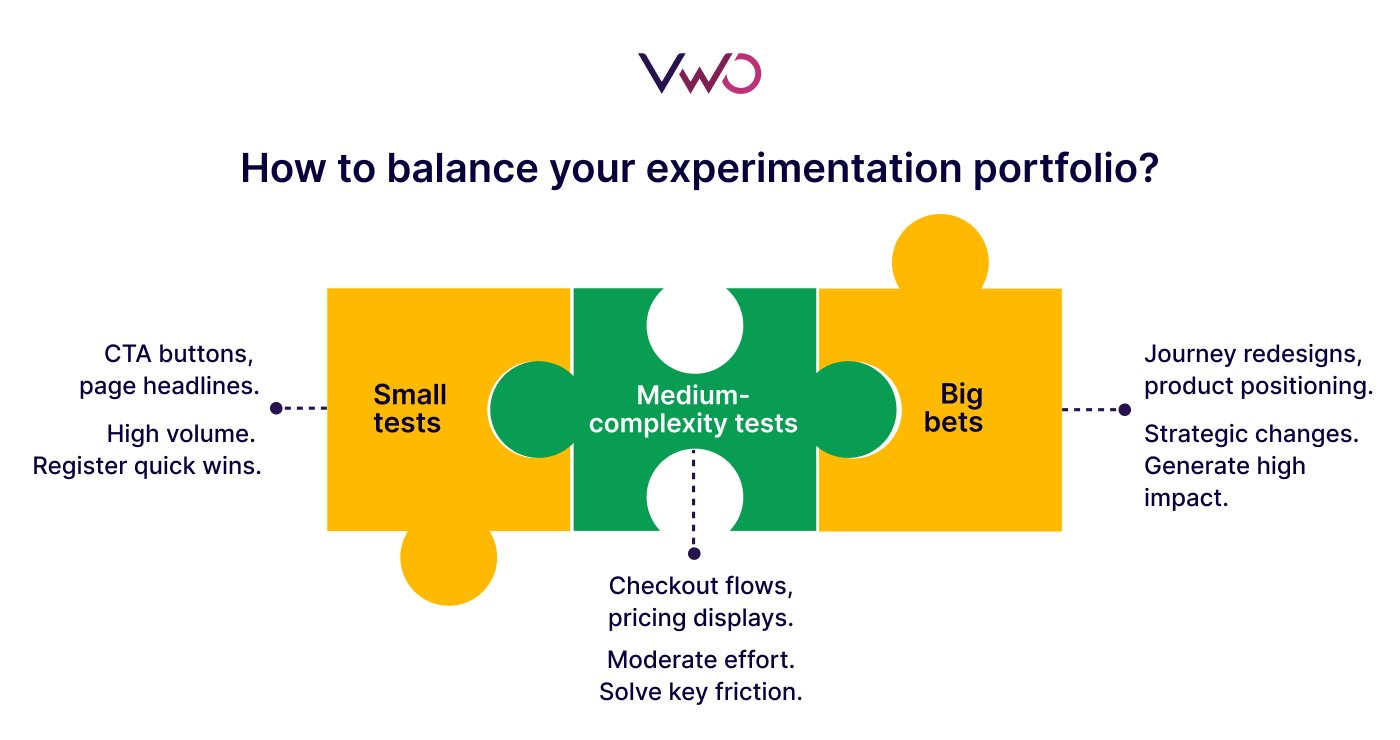
Once a team has established a consistent testing cadence, the focus must shift to portfolio management. Van den Brink suggests that an experimentation program should be managed much like a financial investment portfolio, balancing risk and reward across different categories.
A healthy experimentation portfolio typically includes:
- Iterative Tests (Low Risk): Small tweaks to existing high-traffic pages to optimize current performance.
- Substantial Changes (Medium Risk): Testing new features or significant layout changes on specific sub-sections of the site.
- Disruptive Experiments (High Risk): Testing entirely new business models, pricing structures, or radical brand pivots.
By categorizing experiments this way, teams ensure that they are not only “playing it safe” with minor tweaks but are also allocating a specific percentage of their resources to the “big swings” that leadership desires. This balanced approach prevents the program from becoming either too stagnant or too volatile.
Step 4: Using Big Tests for Validation, Not Exploration
The final step in the framework redefines the role of large-scale experiments. In a mature program, “big tests” are not used to explore unknown territory; they are used to validate hypotheses that have already been supported by smaller, preliminary tests.
Strategic decisions, such as a full site redesign or a change in the product flow, should be the culmination of a series of smaller experiments. For example, if multiple small tests indicate that users respond more favorably to benefit-driven messaging rather than feature-driven messaging, that insight becomes the foundational logic for a larger redesign.
This evidence-based approach significantly reduces the risk of a major project failing. Instead of guessing what might work on a large scale, the team uses “big tests” to compound previous wins. As van den Brink emphasizes, starting small allows a team to gather the necessary evidence to justify the case for data-driven decision-making, gradually bringing more skeptical stakeholders on board as the evidence of success becomes undeniable.
The Role of Technology and AI in Scaling
The evolution of experimentation platforms has played a critical role in enabling this framework. Tools like VWO have introduced features such as AI-powered assistants (VWO Copilot) that allow teams to set up variations, track metrics, and define target audiences using natural language prompts. This reduces the technical barrier to entry, allowing non-technical team members to propose and run small tests without taxing the development department.
Furthermore, centralized platforms allow for the rigorous documentation of every insight and hypothesis. This creates a “knowledge repository” that prevents the organization from testing the same ideas repeatedly and ensures that every experiment—regardless of whether it “won” or “lost”—contributes to the company’s strategic intelligence.
Broader Implications for Corporate Culture
The shift toward sustainable experimentation represents a broader movement in corporate management away from “HiPPO” (Highest Paid Person’s Opinion) decision-making. When a company adopts van den Brink’s framework, it essentially democratizes the product roadmap. Decisions are no longer based on who has the loudest voice in the room, but on what the data reveals about actual user behavior.
The long-term impact of this shift is profound. Companies with mature experimentation cultures are more resilient to market changes because they have a system for constantly probing and responding to user needs. They avoid the “sunk cost fallacy” that often plagues large-scale projects because they have the data to pivot before millions of dollars are wasted on an ineffective strategy.
In conclusion, the failure of many CRO programs is not a failure of intent, but a failure of methodology. By avoiding the “big test trap” and focusing on a balanced, evidence-based framework, organizations can transform experimentation from a sporadic series of projects into a sustainable engine for growth. The path to transformative change, paradoxically, begins with the commitment to starting small, learning fast, and building a foundation of consistent, data-driven habits.