rifanmuazin
In a rapidly evolving digital marketplace, the landscape of e-commerce is set for a transformative year in 2026, marked by the pervasive influence of artificial intelligence, geopolitical shifts impacting trade, and a widening economic disparity. These insights emerge from the annual predictions shared by Bill D’Alessandro and his collaborator, offering a comprehensive outlook on the forces that will shape online retail and business operations in the coming year. The stakes are high for these forecasts, with the creators themselves committed to an AI-driven evaluation of their accuracy, promising a public reckoning for the less prescient predictor.
The Telepathic Reach of AI-Powered Advertising
One of the most significant predictions centers on the imminent disruption of advertising by advanced AI. The current capabilities of platforms like Meta, which already leverage user data for targeted advertising, are poised to be dwarched by the generative and analytical power of AI models. Imagine a scenario where AI not only understands your purchasing habits but also infers your emotional state, your business anxieties, and your personal struggles. OpenAI’s potential entry into the advertising arena is anticipated to redefine precision targeting, moving beyond demographic and interest-based segmentation to a level that feels almost telepathic.
This prediction is grounded in the accelerating development of AI language models and their increasing capacity for nuanced understanding and generation. Tools like ChatGPT can already process vast amounts of text and infer context and sentiment. When integrated into advertising platforms, this capability could allow for the creation of highly personalized ad creatives, messaging, and even product recommendations that resonate with consumers on a deeply individual level. Early adopters of these AI-driven advertising strategies are expected to gain a substantial competitive advantage, capturing market share through unprecedented engagement rates. The implications for businesses are profound: a shift from broad-stroke campaigns to hyper-personalized, AI-curated customer journeys. This necessitates a reevaluation of marketing budgets, skill sets, and the very definition of effective advertising.
Navigating the Shifting Sands of Tariffs
The global trade environment, particularly concerning commerce with China, is another critical area of focus. Predictions suggest that tariffs on goods imported from China will likely stabilize within a range of 30% to 50% in 2026. This forecast is influenced by the current economic climate, characterized by rising inflation and subdued economic growth. Political responses to market fluctuations, particularly the bond market’s reaction to trade policies, have historically led to swift adjustments.

The reasoning behind this prediction is rooted in the pragmatic responses of political actors to economic realities. A fragile economy is unlikely to withstand the shock of significantly higher tariffs, which could exacerbate inflationary pressures and further dampen consumer spending. For e-commerce businesses heavily reliant on Chinese manufacturing, this stabilization, while potentially high, offers a degree of predictability. However, it still represents a substantial cost increase that will need to be absorbed or passed on to consumers, potentially impacting price-sensitive segments of the market. Businesses will need to continue to explore diversification of supply chains and consider the long-term implications of geopolitical trade policies on their operational costs and pricing strategies.
The Unyielding Ascent of the AI Bubble
Contrary to some prevailing opinions, the AI bubble is not expected to burst in 2026. The current valuation of the NASDAQ, with a forward price-to-earnings ratio around 27x, is significantly lower than the over 100x seen during the dot-com bubble of the early 2000s. Furthermore, government investment in AI, adjusted for inflation, is approximately five times what tech spending was in 2000. These fundamental indicators suggest a more sustainable growth trajectory for the AI sector.
This perspective is supported by the tangible advancements and widespread adoption of AI technologies across various industries. AI is no longer a theoretical concept; it is actively driving innovation, improving efficiency, and creating new markets. The substantial government investment signals a strategic commitment to AI development, recognizing its potential to bolster national competitiveness and address complex societal challenges. For e-commerce, this sustained AI growth means continued integration of AI tools for everything from customer service chatbots to inventory management and personalized product discovery. Businesses that fail to embrace AI risk being left behind in an increasingly automated and intelligent marketplace.
The Imperative of Verifying Human Content
As AI-generated content proliferates, a significant concern for major online platforms will be the erosion of trust. The observation that a substantial portion of content on social media feeds appears to be AI-generated underscores this growing issue. In response, it is predicted that major platforms will begin testing “verified human content” badges. This initiative aims to distinguish authentic human creations from AI-generated material, thereby restoring a measure of credibility to online discourse and content consumption.
The implications of this shift are far-reaching. For content creators, it presents an opportunity to differentiate themselves and build trust with their audience. For consumers, it offers a clearer path to identifying reliable and authentic information. Businesses will need to consider how this distinction impacts their content marketing strategies. Transparency regarding content origin will become increasingly important, and brands that can authentically demonstrate human oversight and creativity may find themselves at an advantage. This move also highlights the ongoing arms race between AI generation and AI detection, a dynamic that will continue to shape the digital content landscape.

Automation Revolutionizes Content Creation
The quality and accessibility of video and audio editing are poised for a dramatic leap forward. By the end of 2026, it is anticipated that video and audio editing will be largely automated, achieving a respectable 7 out of 10 quality. Tools are already emerging that can perform many of these functions, with the expectation that future iterations will allow users to input raw footage and simply instruct the AI on desired outcomes, resulting in polished edits.
This prediction signifies a democratization of content production. Founders and small businesses, who previously required dedicated production teams and significant budgets, will be able to generate professional-looking content with ease. This will level the playing field, allowing for more dynamic and engaging marketing materials to be produced at a fraction of the cost. The impact on the creator economy and small business marketing will be immense, enabling a surge in high-quality, personalized video and audio content across all digital channels.
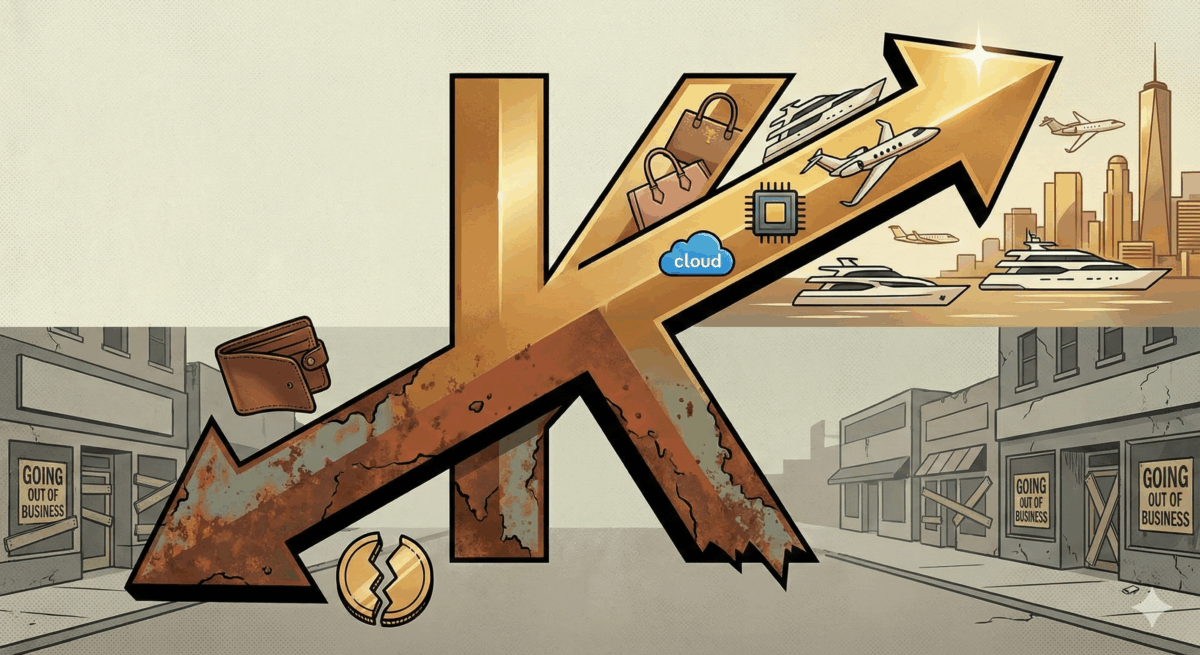
The K-Shaped Economy and the Bifurcation of Consumer Spending
Bill D’Alessandro’s predictions offer a starker view of the economic future, forecasting 2026 as the year of the “K-shaped economy.” This phenomenon describes a divergence where certain sectors, like big tech and top-performing companies, continue to thrive and grow, while the broader economy and average consumers struggle. This disparity will likely manifest as continued growth for major technology firms, potentially in the range of 20% or more, while the real economy experiences stagnation.
For e-commerce businesses, this economic bifurcation presents a strategic challenge. The prediction suggests that businesses will need to cater to either the affluent consumer at the higher end of the market or focus on providing essential goods at highly competitive prices to the lower end. The middle ground is identified as a particularly dangerous territory, where businesses may struggle to attract both price-sensitive shoppers and those seeking premium experiences. This necessitates a deep understanding of target customer segments and a tailored approach to product offerings, pricing, and marketing. Businesses might need to re-evaluate their brand positioning and consider specializing in either luxury or value propositions.
Persistent Inflation and its Economic Ramifications
Inflation is predicted to remain a persistent challenge, with rates expected to be north of 3% in 2026. This outlook is attributed to a lack of political will to curb government spending, leading to continued deficit spending. The expectation is that this inflationary environment is not a temporary phase but a long-term trend that could persist for the next decade.

The implications for businesses and investors are significant. A sustained period of inflation erodes purchasing power and increases the cost of goods and services. Businesses will need to strategize for a persistent inflationary environment, which may involve adjusting pricing models, managing supply chain costs, and optimizing operational efficiencies. For investors, this means considering assets that can perform well in an inflationary climate, such as real estate or certain commodities, and potentially adjusting portfolio allocations away from assets that are highly sensitive to inflation.
AI’s Full Integration into Meta Advertising
Echoing the broader AI trends, it is predicted that AI will completely take over the content generation for Meta advertisements. Evidence suggests that large brands are already implementing AI-driven pipelines capable of producing hundreds of novel ad variations daily. These systems can analyze customer reviews, leverage brand assets, and generate static images and, increasingly, video content, which can then be directly launched through APIs.
This prediction signals a complete paradigm shift in digital advertising on major social platforms. The ability of AI to rapidly generate and test diverse ad creatives at scale will allow for unprecedented optimization and personalization. Businesses will need to adapt to a landscape where AI is not just a tool for targeting but also for the creative execution of advertising campaigns. This also raises questions about the future role of human advertisers and creatives, suggesting a shift towards roles involving AI oversight, strategy, and prompt engineering.
The Demise of the Lifestyle Brand
A stark prediction for the e-commerce landscape is the anticipated demise of the traditional lifestyle brand, particularly for businesses with annual revenues in the single-digit millions. Unless these businesses possess strong intellectual property protection or a brand recognition within the top 5-10% of the market, they are expected to face immense pressure. Larger competitors, equipped with AI-powered operational machinery, will be able to outspend, out-test, and tolerate higher customer acquisition costs, ultimately outcompeting smaller, less technologically advanced brands.
This forecast highlights the intensifying competitive pressures within the e-commerce sector. The era of building lifestyle brands through organic growth and broad marketing may be drawing to a close, necessitating a more strategic and technologically driven approach. Businesses will need to focus on building defensible moats, whether through unique product innovation, robust IP, or deep customer loyalty that AI-driven competitors cannot easily replicate. The emphasis will likely shift from brand narrative alone to a combination of brand strength and operational efficiency powered by advanced technology.
A Bifurcated Mergers and Acquisitions Market
The mergers and acquisitions (M&A) landscape in e-commerce is projected to become increasingly polarized. Deals exceeding $1 billion have seen a significant increase, up 19% year-over-year, while transactions in the small and mid-size range have declined by 18%. This trend is expected to continue, with top-tier businesses commanding premium valuations, while typical e-commerce brands may struggle to find buyers or transact at all.
This divergence in M&A activity reflects the broader economic trends and the increasing importance of scale and technological sophistication. Larger, well-established companies with strong market positions and robust technological infrastructure will remain attractive acquisition targets, commanding high multiples. Conversely, smaller businesses may find it more challenging to demonstrate sufficient growth potential and competitive advantage to warrant significant investment, leading to a more anemic M&A market for this segment. Entrepreneurs considering an exit will need to position their businesses for appeal to larger strategic buyers or consider alternative growth strategies.
Bitcoin’s Volatile Ascent
In the realm of digital assets, Bitcoin is predicted to experience a period of volatility in the first half of 2026, dipping below $70,000, before recovering and finishing the year above $100,000. This forecast is driven by competing economic forces. A struggling consumer economy typically dampens demand for risk assets like Bitcoin, while persistent inflation bolsters its appeal as a hedge against currency devaluation, akin to “digital gold.”
The predicted pattern suggests an initial market correction as broader economic headwinds take hold, followed by a resurgence as the narrative of inflation and the search for alternative stores of value gain traction. This volatility underscores the complex interplay of macroeconomic factors influencing the cryptocurrency market. For investors, it highlights the importance of a long-term perspective and the potential for significant fluctuations within a single year.
In conclusion, 2026 promises to be a pivotal year for e-commerce, shaped by the relentless advance of artificial intelligence, dynamic geopolitical trade policies, and a widening economic divide. Businesses that can adapt to these transformative forces, embrace technological innovation, and strategically navigate the evolving consumer landscape will be best positioned for success. The pursuit of staying ahead of the curve in this rapidly changing environment underscores the value of continuous learning and engagement with the leading minds and communities shaping the future of online commerce.