rifanmuazin
The Black Friday and Cyber Monday (BFCM) period of 2025 has once again underscored its critical importance in the global retail calendar, transforming from a mere sales event into the ultimate crucible for digital communication strategies. With Adobe reporting an unprecedented $137.4 billion in revenue across November 2025, marking a robust 7.2% year-over-year increase, the stakes for email marketers and broader digital communication channels have never been higher. This monumental surge in consumer spending, primarily driven by online transactions, placed immense pressure on brands to not only capture attention but also to ensure flawless deliverability of both promotional and essential transactional messages. The success of this period, therefore, was not solely measured by the volume of promotional emails sent, but by the seamless flow of critical updates—such as order confirmations, shipping alerts, and customer service communications—which consumers increasingly rely on for a transparent and reassuring post-purchase experience.
BFCM 2025: A Landscape of Record-Breaking Digital Commerce
The 2025 holiday shopping season, particularly the BFCM weekend and the broader November period, solidified its position as a pivotal revenue driver for retailers worldwide. The Adobe Analytics figure of $137.4 billion in November 2025 revenue represents not just growth but a testament to the enduring power of digital commerce. This figure encapsulates sales across various product categories, from electronics and apparel to home goods and toys, highlighting a consumer base increasingly comfortable and reliant on online purchasing. The 7.2% year-over-year increase is particularly significant, demonstrating continued resilience and expansion in the e-commerce sector despite potential economic headwinds, and setting a new benchmark for future holiday seasons.
This impressive financial performance was mirrored by intense digital activity. Data from communication platforms like Sinch Mailgun and Mailjet revealed the scale of digital outreach employed by brands. The sheer volume of emails, SMS messages, and voice interactions during this period provides a granular view into the operational demands placed on marketing and customer service infrastructures. The pressure to reach the inbox amidst a deluge of competing offers meant that deliverability was not just a technical metric but a direct determinant of revenue and customer satisfaction.
The Unrivaled Reign of Email in the Digital Shopper’s Journey
Despite the proliferation of new communication channels, email continued to assert its dominance as the preferred medium for both promotional offers and critical transactional updates during BFCM 2025. Sinch’s pre-holiday survey of 3,180 consumers, a consistent annual barometer of shopper preferences, unequivocally confirmed this trend. A significant 56.5% of consumers expressed a preference for email for receiving Black Friday and Cyber Monday promotions, underscoring its enduring effectiveness as a direct marketing tool. More strikingly, an overwhelming 73.9% of consumers indicated their reliance on email for crucial transactional updates, such as order confirmations and shipping notifications. This dual role—as both a marketing powerhouse and a customer service backbone—highlights email’s indispensable position in the modern retail ecosystem.
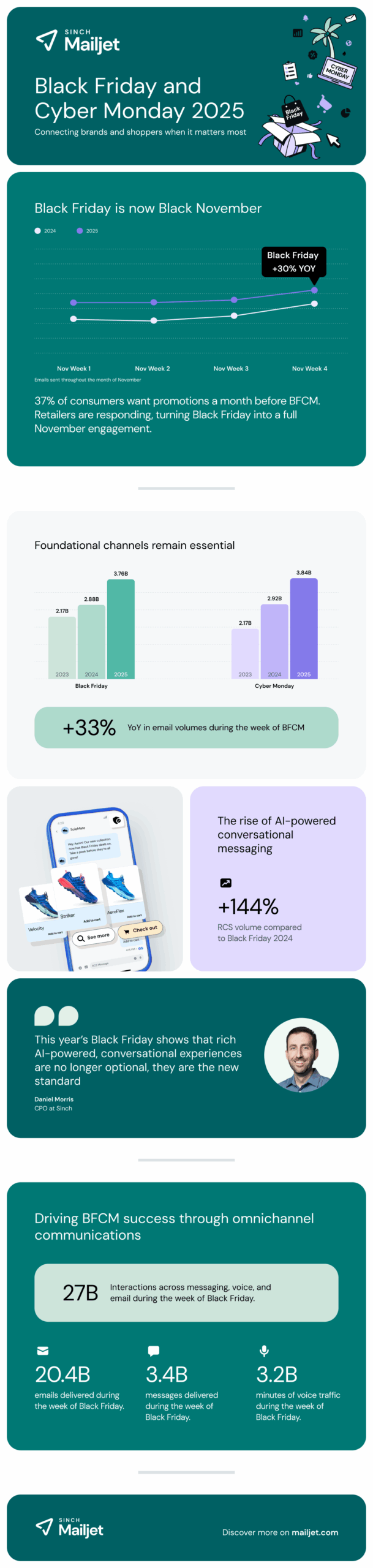
Brands, in turn, demonstrated a clear alignment with these consumer preferences. Analysis of billions of emails sent through Sinch Mailgun and Mailjet platforms throughout November showed a steady climb in email volume, culminating in a peak during Cyber Week. Sinch’s email platform alone delivered a staggering 20.4 billion emails during this critical week, reflecting the intense promotional campaigns launched by retailers. This represented a 30% year-over-year increase in email volume on Black Friday alone, indicating a concerted effort by brands to leverage email at the peak of the shopping frenzy.
The critical question for marketers during such a high-volume period is always: do these emails actually get noticed? The data provides a reassuring answer. Engagement levels, as measured by average open rates, remained robust at 13% (excluding bot activity), consistent with performance outside the peak season. This finding strongly suggests that consumers are not experiencing email fatigue but are actively seeking out deals and information. It debunks the notion that high volume inherently leads to diminished engagement, provided that campaigns are well-targeted, relevant, and adhere to best practices for deliverability. A strong sender reputation, proper authentication (like DMARC, DKIM, SPF), and segmenting audiences effectively were crucial in cutting through the noise and ensuring messages landed in the primary inbox, rather than spam folders.

“Black November”: The Evolution of a Shopping Sprint into a Month-Long Marathon
The traditional concept of Black Friday as a single-day shopping event, followed by Cyber Monday, is now firmly a relic of the past. BFCM 2025 cemented the “Black November” phenomenon, where promotional cycles extend throughout the entire month, sometimes even beginning in late October. Sinch’s consumer survey reinforced this shift, revealing that 45.9% of consumers desired promotions at least a full month before Black Friday itself. This proactive consumer behavior has compelled brands to adapt, transforming the intense weekend sprint into a sustained, month-long engagement marathon.
The data from email sending volumes clearly illustrates this strategic shift. A substantial 32% year-over-year surge in email volume was observed across November 2025, with the most significant growth occurring in the week before Cyber Week. This proactive approach allowed brands to capture early-bird shoppers, spread out their marketing efforts, and manage potential infrastructure strain. The sustained campaign approach throughout November drove an astonishing 27 billion customer interactions across all channels during Black Friday week alone, demonstrating the comprehensive and continuous nature of modern holiday marketing.
This extended promotional period offers several strategic advantages for retailers. It allows for more nuanced storytelling, drip-feeding offers, and building anticipation rather than relying on a single, high-stakes burst. From a logistical standpoint, it helps manage website traffic spikes and order fulfillment, potentially leading to a smoother customer experience. However, it also demands more sophisticated campaign planning, continuous content creation, and a robust, scalable communication infrastructure capable of sustaining high volumes over an extended period without compromising deliverability or performance.
Omnichannel Integration: The Indispensable Strategy for Modern Retail
In the increasingly fragmented digital landscape, relying on a single communication channel is no longer a viable strategy for retail success. BFCM 2025 provided compelling evidence that an integrated omnichannel approach is not just a trend but the new standard for customer engagement. Sinch’s 2025 consumer survey revealed that nearly 77.9% of customers expect to hear from brands across multiple channels during major shopping events, underscoring the demand for a cohesive and consistent brand experience regardless of the touchpoint.
Brands demonstrated a clear understanding of this imperative. During the BFCM weekend, Sinch powered an incredible 27 billion interactions across a diverse range of channels, including SMS, MMS, RCS, WhatsApp, email, and voice. This multi-channel symphony allowed retailers to tailor their messages and reach consumers where they were most receptive, at the most opportune moments.
SMS, in particular, proved to be an essential channel for cutting through the noise with time-sensitive and urgent offers. Sinch delivered 3.4 billion SMS messages globally during the BFCM weekend, cementing its role as the go-to channel for last-minute deals, flash sales, and high-priority alerts. Its immediacy and high open rates make it invaluable for driving urgent action and providing instant updates.
Beyond digital text-based communications, the human element of voice communication remained critical, especially when stakes were high. For complex inquiries, sensitive issues, or urgent customer support, consumers overwhelmingly turned to phone conversations for real-time assistance. This was evident on Black Friday alone, where Sinch handled 3.2 billion minutes of voice traffic. This metric highlights the vital role of voice for urgent customer care, service escalation, and providing personalized support when it matters most, particularly during periods of intense transaction volume and potential delivery complexities. The integration of voice into the omnichannel strategy ensures that customer needs are met across the entire spectrum of urgency and complexity.
Challenges and Strategic Imperatives for Future Success
While BFCM 2025 set new records and showcased the power of digital communication, it also illuminated critical challenges and strategic imperatives for brands moving forward. The sheer scale of operations demanded by Black November and omnichannel strategies places immense pressure on backend infrastructure, data analytics capabilities, and human resources.
One primary challenge remains deliverability. With billions of emails sent, the competition for inbox space is fierce. Internet Service Providers (ISPs) and mailbox providers employ sophisticated algorithms to filter out spam and prioritize legitimate messages. Brands that fail to adhere to email deliverability best practices—such as maintaining clean mailing lists, segmenting audiences, personalizing content, and authenticating senders—risk their messages being routed to spam folders or even blocked entirely. The implications of poor deliverability during peak season are severe, directly impacting sales, customer satisfaction, and long-term brand reputation.
Another critical aspect is personalization and relevance. In a crowded inbox, generic messages are easily overlooked. Leveraging customer data to send highly targeted and personalized offers is paramount. This requires robust customer data platforms (CDPs) and sophisticated marketing automation tools that can analyze purchasing history, browsing behavior, and stated preferences to deliver messages that resonate with individual consumers.
Furthermore, scalability and reliability of communication platforms are non-negotiable. The ability to handle sudden, massive spikes in email volume, SMS traffic, and voice calls without service interruptions is crucial. Downtime or slow delivery during BFCM can lead to lost sales, frustrated customers, and damaged brand loyalty. Brands need to partner with communication providers that offer enterprise-grade infrastructure designed for peak performance under extreme load.
Looking Ahead to 2026 and Beyond
As 2025 draws to a close, the insights gleaned from this record-breaking BFCM period provide a clear roadmap for 2026 and beyond. The holiday shopping season continues to present both unparalleled opportunities and significant challenges for digital marketers. Success will increasingly hinge on a synergistic combination of factors: the right communication partners, deep expertise in email deliverability, sophisticated data analytics, and a relentless focus on customer experience across all touchpoints.
Industry observers suggest that the trend of “Black November” will only intensify, requiring brands to adopt year-round strategic planning for their peak season campaigns. This includes nurturing subscriber lists, building sender reputation proactively, and continuously refining their omnichannel strategy. The integration of emerging channels like RCS and advanced WhatsApp business features will likely grow, offering richer, more interactive customer experiences.
For brands, the message is clear: invest in robust, scalable communication infrastructure and cultivate a deep understanding of deliverability best practices. Platforms like Sinch Mailjet are designed to offer the comprehensive support needed to navigate these complexities, providing easy-to-use email solutions that enable senders to design, send, and track impactful email campaigns. Whether a business is sending thousands or billions of messages, the underlying technology must ensure messages reach the inbox, drive sales, and foster engagement. The ability to seamlessly integrate email with other critical channels like SMS and voice will be the hallmark of leading retailers in the years to come, ensuring that customer communication remains a competitive advantage rather than a point of vulnerability.