rifanmuazin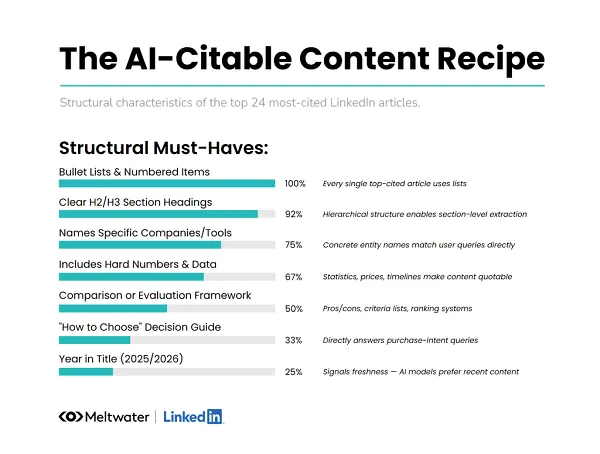
A groundbreaking report from Meltwater reveals that LinkedIn content is increasingly cited by artificial intelligence chatbots, marking the professional networking platform as a pivotal source for AI-powered queries, particularly those related to business and professional domains. This ascendancy highlights a significant shift in how AI models source information, prioritizing credible, expert-driven content often found in personal profiles over traditional corporate communications.
The professional social network, which has actively shared insights into its AI search optimization approach and efforts to enhance content discoverability for AI tools, solidified its position as one of the most-cited sources for AI chatbot answers. This development underscores the growing importance of structured, expert-led content in the era of generative AI, where chatbots are becoming primary interfaces for information retrieval.
The Evolving Landscape of Information Retrieval and AI
The rapid proliferation of AI chatbots, such as ChatGPT, Google Bard, and Anthropic’s Claude, has fundamentally reshaped the digital information landscape. Users are increasingly turning to these conversational AI tools for quick, synthesized answers across a vast array of topics, from complex business strategies to technical explanations. This shift represents a departure from traditional keyword-based search engines, where users navigate lists of links, towards a more direct, interactive question-and-answer paradigm.
In this new environment, the provenance and credibility of information are paramount. AI models are trained on vast datasets of text and code, but their ability to generate accurate, contextually relevant, and non-hallucinatory responses depends heavily on the quality and authority of their source material. Consequently, platforms that host verifiable, expert-authored content naturally gain prominence. LinkedIn, with its foundation built on professional identities and verified experience, presents a unique advantage in this evolving ecosystem. The platform’s strategic efforts to make its content more accessible and understandable to AI models have clearly paid dividends, positioning it at the forefront of AI-powered information discovery.
Meltwater’s Comprehensive Analysis: LinkedIn’s Dominance Unpacked
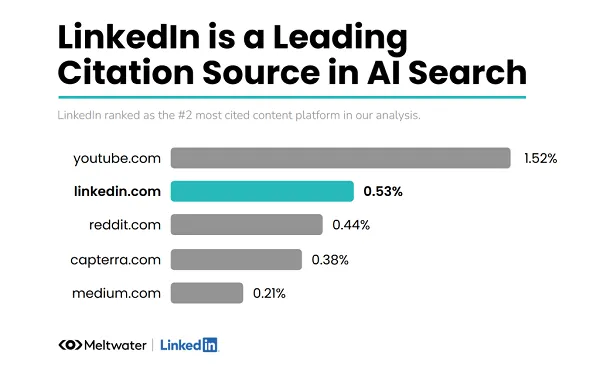
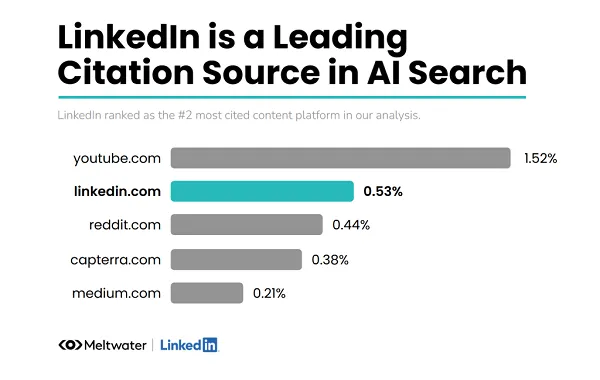
The new report from Meltwater, a leading media intelligence company, provides granular detail into LinkedIn’s burgeoning influence. Based on an extensive analysis of 9.5 million AI citations drawn from six major AI models, the study identified LinkedIn as the second most-cited domain across all AI chatbots. This places the professional network in an elite category of online resources that AI models frequently consult and reference, surpassed only by YouTube, which often serves as a primary source for tutorials and visual explanations.
The findings are not merely a testament to LinkedIn’s overall content volume but more importantly, to the perceived quality and relevance of its information by AI algorithms. LinkedIn’s vast repository of expert contributors, who are inherently motivated to showcase their knowledge and often share first-hand professional experiences, creates a rich data pool that AI tools find particularly valuable for generating authoritative responses. This dynamic highlights a preference for content that reflects genuine expertise and practical application, a hallmark of LinkedIn’s professional ecosystem.
The Power of the Individual: Personal Profiles Outperform Company Pages

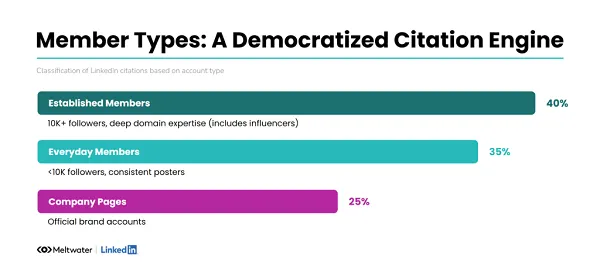
One of the most compelling insights from the Meltwater report is the distinct preference AI models show for content originating from individual user profiles over official company updates. The analysis unequivocally demonstrated that posts and articles published by individual users are cited far more frequently than content from corporate pages. This nuance carries significant implications for content strategy and brand presence in the AI era.
The report explicitly states, “AI models prefer content written by credible people who share their domain expertise with examples, data, and specific details.” This preference underscores the AI’s algorithm’s ability to discern authenticity and depth of knowledge. Individual experts, unconstrained by corporate messaging guidelines, often provide more candid, detailed, and experience-backed insights. Their content frequently includes specific examples, real-world data, and granular details that are highly digestible and valuable for AI models seeking to construct comprehensive and precise answers.
For businesses, this finding necessitates a strategic pivot. Rather than solely investing in branded company page content, organizations must now recognize the immense value of empowering and promoting their internal experts. By encouraging employees, executives, and thought leaders to share their knowledge and perspectives on LinkedIn, companies can significantly boost their overall brand presence and authority within AI-generated responses. This approach not only leverages the credibility of individual expertise but also humanizes the brand, fostering trust and authenticity that AI models, in turn, appear to favor.
Content Structure and Format: The Key to AI Discoverability
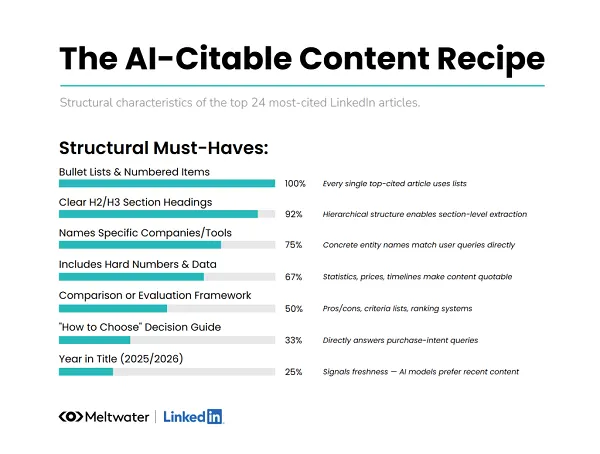
Beyond the source, the Meltwater analysis also sheds light on the types of content and structural elements that AI models prioritize. The report indicates that LinkedIn articles and plain text posts are the most frequently cited content types, collectively accounting for an overwhelming 83% of all citations. This suggests that AI models favor structured, textual content that is easy to parse and extract information from.
Crucially, the study highlighted specific formatting techniques that significantly enhance content’s discoverability by AI. “Every top-cited article in the study used bulleted or numbered lists, and clear headings were present in 92% of the most successful posts.” This hierarchical structure is not merely for human readability; it is a critical enabler for Large Language Models (LLMs). Clear headings allow AI to quickly identify and extract specific sections relevant to a user’s direct query, while bulleted and numbered lists facilitate the distillation of key points, processes, or data into concise, actionable answers.
These structural considerations offer invaluable guidance for content creators and marketers. Optimizing content for AI discoverability now means adopting practices akin to traditional SEO but with a focus on machine readability and semantic understanding. This emerging discipline, often referred to as Generative Engine Optimization (GEO) or AI Search Optimization (AISO), emphasizes clarity, conciseness, and structured data presentation. Content creators who integrate these structural best practices are more likely to see their work referenced by AI chatbots, thereby amplifying their reach and influence.
LinkedIn’s Unrivaled Dominance in B2B Queries
The report further solidifies LinkedIn’s unique position in the business-to-business (B2B) sector. The data explicitly showed that LinkedIn dominates B2B queries, consistently ranking among the top five sources across key industries. This means that when a user asks an AI chatbot about specialized topics such as “digital marketing trends,” “supply chain optimization strategies,” or “attribution models,” LinkedIn articles and posts are highly probable source material for the AI’s response.
This B2B supremacy is a natural extension of LinkedIn’s core mission as the world’s largest professional network. The platform inherently attracts professionals, industry experts, and businesses seeking and sharing specialized knowledge. This creates a dense ecosystem of high-quality, relevant B2B content that is difficult for other general-purpose platforms to replicate. For B2B marketers, this finding is a clear directive: LinkedIn is not just a networking tool or a recruitment platform; it is a critical channel for establishing thought leadership, disseminating expert insights, and ensuring brand visibility in the AI-powered information era.
Implications for Content Strategy and Digital Marketing
The Meltwater report’s findings carry profound implications for content creators, marketers, and businesses navigating the evolving digital landscape:
- Prioritizing Expert Voices: Businesses must shift their focus from purely corporate messaging to empowering and promoting the individual expertise within their organizations. Cultivating internal thought leaders and encouraging them to share their knowledge on LinkedIn through articles and posts will be crucial for AI visibility.
- Authenticity Over Polish: AI models appear to value authentic, detailed, and experience-backed content more than heavily curated, generic corporate statements. Content that offers genuine insights, specific examples, and data-driven perspectives will resonate more effectively with AI algorithms.
- The Rise of Generative Engine Optimization (GEO): Content creators must now consciously design their content for AI readability. This includes meticulous use of clear headings, bulleted/numbered lists, and a logical hierarchical structure that allows LLMs to easily extract and synthesize information. This is a new frontier in optimization, distinct from traditional SEO but equally vital.
- Strategic Investment in LinkedIn Content: For B2B companies, LinkedIn content strategy becomes even more critical. It’s not just about engagement on the platform but about ensuring that their expert-driven content is discoverable and cited by AI models, influencing a wider audience beyond direct platform users.
- Personal Branding Takes Center Stage: For individual professionals, the report validates the importance of building a robust personal brand on LinkedIn. Sharing expertise, engaging in thoughtful discussions, and publishing well-structured content directly contributes to their professional visibility and influence in the AI-driven information ecosystem.
- Combating Misinformation: In an era where AI-generated content can sometimes lack verifiable sources or accuracy, LinkedIn’s emphasis on professional identities and expert-vetted content could position it as a bastion of credible information, helping AI models deliver more reliable responses.
Challenges and Future Considerations
While LinkedIn’s ascendance in AI citations presents significant opportunities, it also introduces new challenges. As more creators attempt to optimize for AI, maintaining the quality and credibility of content will be paramount. The platform and its users must guard against the proliferation of superficial or AI-generated content designed solely to game algorithms, which could dilute the very value AI models currently find in LinkedIn.
Furthermore, the evolving relationship between AI models and source attribution will continue to be a critical area of development. Ensuring that content creators receive fair credit and that AI responses transparently cite their sources is essential for fostering a healthy digital information ecosystem. LinkedIn’s role in this will be pivotal, potentially setting new standards for how professional content is valued and referenced by AI.
Conclusion
The Meltwater report unequivocally marks a transformative moment in the digital content landscape. LinkedIn is no longer just a platform for professional networking and career development; it has become an indispensable source of credible, expert-driven information for artificial intelligence. The preference shown by AI chatbots for content from individual profiles, alongside the emphasis on structured textual formats and B2B expertise, provides a clear roadmap for content creators and businesses. In the age of AI, authenticity, expert insight, and intelligent content structuring are the new currencies of influence, firmly establishing LinkedIn as a crucial player in shaping the future of information discovery.