rifanmuazin
In the dynamic landscape of digital advertising, particularly within the realm of Pay-Per-Click (PPC) campaigns, advertisers are perpetually seeking effective methods to optimize their ad spend and enhance return on investment (ROI). One often-underestimated yet remarkably potent strategy is ad scheduling, a technique that allows businesses to precisely control when their advertisements appear across various platforms. This approach, while seemingly restrictive, offers significant advantages by aligning ad visibility with peak customer engagement periods, thereby reducing wasted expenditure and boosting conversion rates. This comprehensive guide delves into the intricacies of ad scheduling, exploring its fundamental principles, strategic benefits, and practical implementation across major advertising platforms like Google Ads, Microsoft Ads, and Meta Ads.
Understanding the Core of Ad Scheduling
At its most basic, ad scheduling is the practice of dictating the specific days and times when your digital advertisements will be active and visible to potential customers. By default, most advertising campaigns are set to run 24 hours a day, seven days a week. However, this indiscriminate approach often leads to significant budget depletion on clicks and impressions that are unlikely to yield conversions. Ad scheduling intervenes by enabling advertisers to strategically pause campaigns during periods of low user activity or low conversion potential and to amplify their presence during prime engagement hours.
Historically, this strategy was known as “dayparting,” a term that reflects its origin in traditional media like radio and television, where specific time slots were designated for different types of programming and advertisements. In the digital age, ad scheduling has evolved into a sophisticated tool that leverages granular data analytics to pinpoint the most opportune moments for ad deployment. The fundamental principle remains the same: maximize advertising impact by appearing when your target audience is most receptive and actively seeking the products or services you offer.

The Strategic Imperative of Ad Scheduling
The adoption of ad scheduling is driven by a clear objective: to achieve a more efficient allocation of advertising resources. By understanding when your target audience is most likely to engage with your ads, businesses can ensure their budget is being spent on high-potential impressions and clicks. This targeted approach can lead to a substantial reduction in wasted ad spend, a common pitfall for many PPC campaigns.
Consider a business that sells professional software. Data analysis might reveal that their ideal clients, primarily B2B decision-makers, are most active online during standard business hours, from Monday to Friday, 9 AM to 5 PM. Conversely, clicks received during late-night hours on weekends might show a significantly lower conversion rate. In such a scenario, an ad schedule that limits ad display to weekdays within the identified peak hours would prevent expenditure on less productive periods, redirecting those funds to moments with a higher probability of conversion. This strategic reallocation of budget is a cornerstone of effective PPC management.
Furthermore, ad scheduling can play a crucial role in enhancing conversion rates. When ads are shown during times when users are actively searching for solutions or are more inclined to make a purchase, the relevance and timeliness of the advertisement increase. This heightened relevance can lead to better engagement metrics, including higher click-through rates (CTR) and, ultimately, more valuable conversions.
Ad Scheduling Across Major Advertising Platforms
The implementation of ad scheduling varies slightly across different advertising platforms, each offering its own set of features and considerations.
Google Ads: Precision and Control
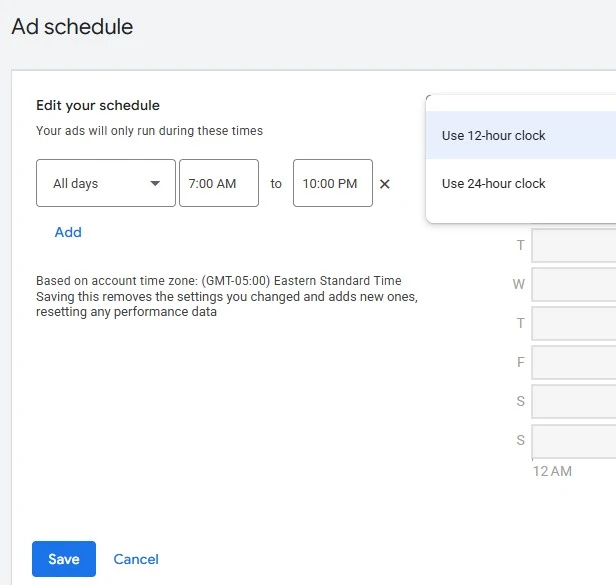
Google Ads, the dominant force in search engine marketing, offers robust ad scheduling capabilities that can be applied at the campaign level. This applies to all campaign types, including automated campaigns like Smart campaigns and Performance Max (PMax). While automated campaigns are designed to optimize performance based on Google’s algorithms, ad scheduling provides advertisers with a crucial layer of manual control, allowing them to influence campaign behavior even within these automated systems. In fact, for certain campaign types like PMax, assigning a schedule is often a mandatory step during the setup process, underscoring its importance.
A significant advantage of Google Ads ad scheduling is its ability to unify ad groups and simplify management at a high level, as it’s set at the campaign level. This consistency streamlines the process of overseeing multiple campaigns and ensures a cohesive advertising strategy.
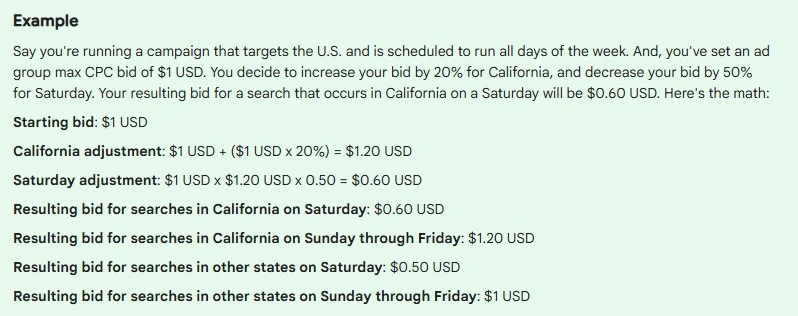
Even for advertisers who prefer to run ads 24/7, ad scheduling offers a valuable workaround through bid adjustments. Both Google Ads and Microsoft Ads allow advertisers to modify their bids based on specific days and hours. This means an advertiser can maintain a continuous ad presence while simultaneously increasing bids during peak performance times and decreasing them during less optimal periods. For instance, if data suggests that ad performance significantly improves on weekday mornings, an advertiser could set a higher bid multiplier for those specific hours.
It is important to note that bid adjustments within ad scheduling are only considered if the campaign is utilizing a manual bidding strategy. This requirement ensures that the advertiser retains direct control over their bidding decisions. For campaigns employing automated bidding strategies, the platform manages bids automatically, and manual bid adjustments tied to ad schedules may not be applicable.
A critical consideration when setting up ad schedules in Google Ads is understanding time zone implications. Google Ads operates based on the time zone of the advertising account. If a campaign targets audiences in multiple time zones, advertisers must carefully calculate their schedules to ensure ads appear during desired local times. For example, targeting both the East Coast (ET) and West Coast (PT) of the United States from 1 PM to 4 PM in each zone would require a schedule that spans from 1 PM ET to 7 PM ET (which is 4 PM PT). This can lead to unavoidable wasted spend if ads run beyond the desired local time in one of the zones. To mitigate this, advertisers might consider creating separate campaigns for different time zones, though this can add complexity to account management.
Steps for Setting Up Ad Scheduling in Google Ads:
-
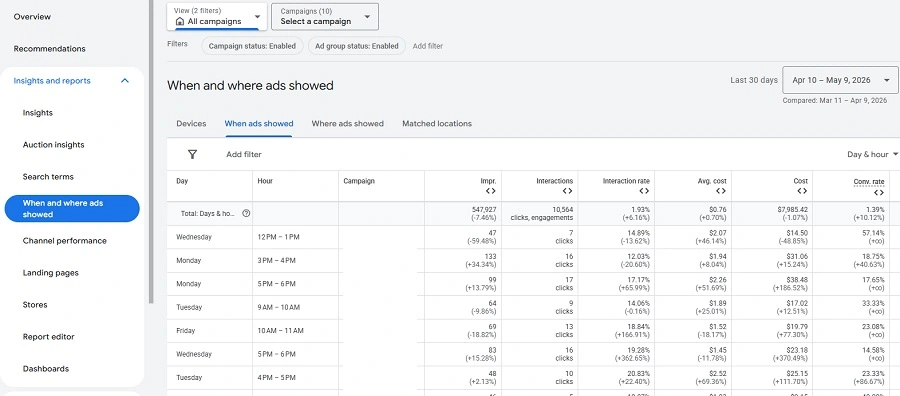
Analyze Historical Data: Before implementing any schedule, thoroughly review historical performance data. Navigate to the “Reports” section and select “Where and when ads showed,” or go to “Ad schedules” within the “Audiences, keywords, and content” section. This report provides insights into ad performance by day and hour, highlighting periods of high and low conversion rates, cost per conversion, and impression volume.
- Key Insights from Data:
- Performance by Day of Week: Identify which days yield the best results.
- Performance by Hour of Day: Pinpoint the most effective hours for ad visibility.
- Cost per Conversion: Understand which time slots are most cost-efficient for acquiring customers.
- Conversion Volume: Determine when the majority of conversions occur.
- Impression and Click Volume: Gauge audience activity throughout the day and week.
- Key Insights from Data:
-
Consider Additional Factors: Beyond historical data, incorporate qualitative factors. If your business has specific operating hours, promotions that run only on certain days, or known industry trends that influence customer behavior, these should inform your scheduling decisions. For instance, a retail business might want to ensure ads are active during typical shopping hours, even if historical data is less conclusive for those specific times.
-
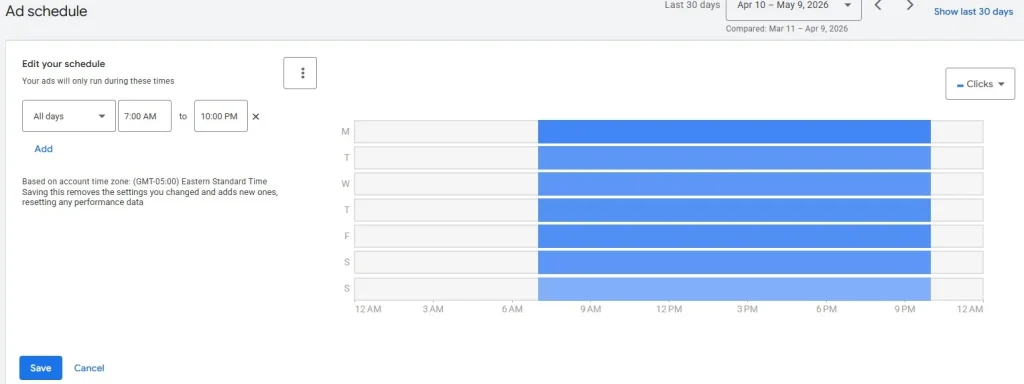
Select Your Schedule: Once the optimal days and times are identified, navigate to the ad schedule subsection within your campaign settings. Click the edit pencil icon to access the scheduling interface. Here, you can select specific days and time blocks for your ads to run. Google Ads allows for granular control, enabling you to schedule ads for specific hours within a day or even create breaks during less productive periods, such as lunch hours. Experimenting with different combinations is encouraged to find the most effective schedule for your business.
Microsoft Ads: Enhanced Flexibility and Localized Targeting
Microsoft Ads (formerly Bing Ads) offers a robust ad scheduling system that mirrors the functionality of Google Ads but provides additional flexibility. Ad schedules can be applied at both the campaign and ad group levels, offering a more granular approach to campaign management. This dual-level control allows for tailored scheduling strategies based on the specific performance characteristics of individual ad groups.
A significant advantage of Microsoft Ads is its dynamic time zone adjustment. Unlike Google Ads, where the account’s time zone dictates the schedule, Microsoft Ads automatically adjusts the ad schedule to the viewer’s local time zone. This feature simplifies the process of targeting diverse geographical audiences, eliminating the need for complex manual calculations to ensure ads appear at the right local times. This inherent localization is a considerable benefit for businesses with a broad customer base.
For advertisers migrating campaigns from Google Ads to Microsoft Ads using import tools, it’s advisable to manually manage ad schedules on both platforms. Due to the differences in how time zones are handled and the potential for campaign-level versus ad-group-level scheduling, an imported schedule might not translate perfectly and could lead to suboptimal performance.
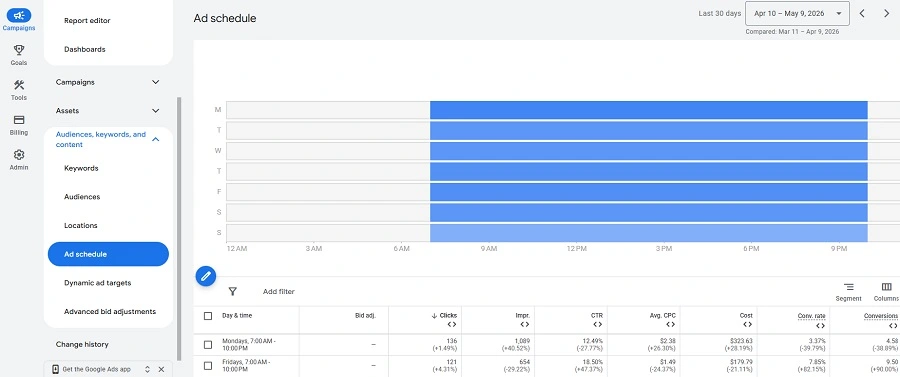
Microsoft Ads provides two primary locations for creating and adjusting ad schedules: within the campaign settings and in a dedicated “Ad Schedule” section accessible from the left-hand navigation panel. The setup process is similar to Google Ads, allowing users to select and layer specific days and times for ad activation. As with Google Ads, reviewing day and hour data within the Ad Schedule section is crucial for informed decision-making.
Meta Ads (Facebook & Instagram): Budget-Centric Scheduling
Meta Ads, encompassing platforms like Facebook and Instagram, offers ad scheduling capabilities, though it is exclusively available when utilizing a lifetime budget for your campaigns, rather than a daily budget. This feature is integrated within the ad set settings under the “Budgets & Schedule” section.
To access ad scheduling in Meta Ads, advertisers must first select the “Lifetime budget” option. Within the “Show More Options” portion of the Budgets & Schedule editor, the ad scheduling functionality becomes visible. This allows advertisers to select specific days and times for their ads to run, similar to Google and Microsoft Ads. Given the vast reach of Meta’s platforms, this scheduling feature is particularly valuable for ensuring ads are displayed during periods when the target audience is most likely to engage, thus optimizing the value derived from the lifetime budget.
Broader Implications and Strategic Advantages
The strategic implementation of ad scheduling extends beyond mere cost savings; it is a fundamental component of a mature digital marketing strategy.
- Enhanced Customer Experience: By showing ads when users are actively looking for solutions, businesses can provide a more relevant and less intrusive advertising experience. This can foster goodwill and improve brand perception.
- Improved Campaign Performance Metrics: When ads are served to a more receptive audience, metrics like CTR, conversion rate, and quality score often see significant improvements. This positive feedback loop can lead to better ad rankings and lower costs per acquisition over time.
- Competitive Advantage: In a crowded digital marketplace, businesses that intelligently schedule their ads gain an edge by focusing their resources on the most profitable moments, outmaneuvering competitors who may be spending indiscriminately.
- Adaptability to Business Cycles: Ad scheduling allows businesses to align their advertising efforts with their operational realities. For example, seasonal businesses can ramp up ad presence during peak seasons and scale back during slower periods.
Conclusion: A Cornerstone of PPC Optimization
Ad scheduling is not merely a feature; it is a strategic imperative for any business serious about maximizing its return on investment in paid advertising. Whether you are a small business managing a limited budget or a large enterprise seeking to refine its global campaigns, the ability to control when your ads appear is a powerful lever for success. By leveraging data-driven insights, understanding platform-specific functionalities, and considering the unique needs of your target audience and business, ad scheduling can transform your PPC campaigns from a cost center into a highly efficient revenue-generating engine. Mastering this technique is a critical step towards achieving sustainable growth and a superior return on ad spend in today’s competitive digital environment.