rifanmuazin
The Black Friday and Cyber Monday (BFCM) period in 2025 solidified its position not merely as a pinnacle of consumer spending but as the ultimate crucible for email marketers, testing the resilience and efficacy of their deliverability strategies. With Adobe reporting a colossal $137.4 billion in revenue generated during November 2025, marking a significant 7.2% year-over-year increase, the imperative for brands to not only reach but also resonate within overflowing inboxes was unprecedented. This financial landmark underscored the immense pressure on email channels, transforming what was once a sales opportunity into a critical stress test for digital communication infrastructure. Success in this hyper-competitive landscape extended beyond the sheer volume of promotional emails; it critically hinged on the instantaneous and reliable delivery of essential transactional messages—such as order confirmations, shipping updates, and customer service alerts—messages upon which modern consumers increasingly rely for a seamless post-purchase experience.
The Evolving Landscape of Holiday Shopping: A Chronology
The evolution of BFCM from a frantic single-day sales event into a sprawling, month-long engagement marathon, colloquially dubbed "Black November," has fundamentally reshaped retail strategies. Historically, Black Friday emerged in the United States as the day after Thanksgiving, signaling the start of the Christmas shopping season and traditionally being a day when retailers turned a profit, moving "into the black." Cyber Monday followed, conceived in 2005 to encourage online shopping when internet penetration was less ubiquitous. Over the past decade, however, these distinct days have blurred into a continuous period of discounts and promotions, extending earlier into November and often through the first week of December.
For 2025, this trend accelerated dramatically. Sinch’s extensive survey of 3,180 consumers prior to the holiday season revealed a compelling shift in expectations: 45.9% of shoppers desired promotions to begin at least a full month before Black Friday itself. Brands, keen to capture early spending and mitigate the intense competition of Cyber Week, adapted their strategies accordingly. This meant a strategic rollout of deals throughout November, culminating in the peak activity of the traditional BFCM weekend. This protracted sales window not only spreads consumer purchasing power but also intensifies the demand on marketing channels for a longer duration, presenting a sustained challenge for email deliverability and overall communication infrastructure.
BFCM 2025 in Numbers: A Data-Driven Insight
Sinch, through an exhaustive analysis of billions of emails processed via its Mailgun and Mailjet platforms throughout November 2025, provided a granular look into brand communication strategies versus consumer preferences. The findings painted a clear picture of email’s enduring dominance and the critical role of robust deliverability.
Key statistical highlights from Sinch’s analysis include:
- Total Revenue: Adobe reported $137.4 billion in online revenue for November 2025, a 7.2% increase year-over-year, showcasing sustained e-commerce growth. This figure represents the collective purchasing power harnessed by retailers leveraging various digital channels.
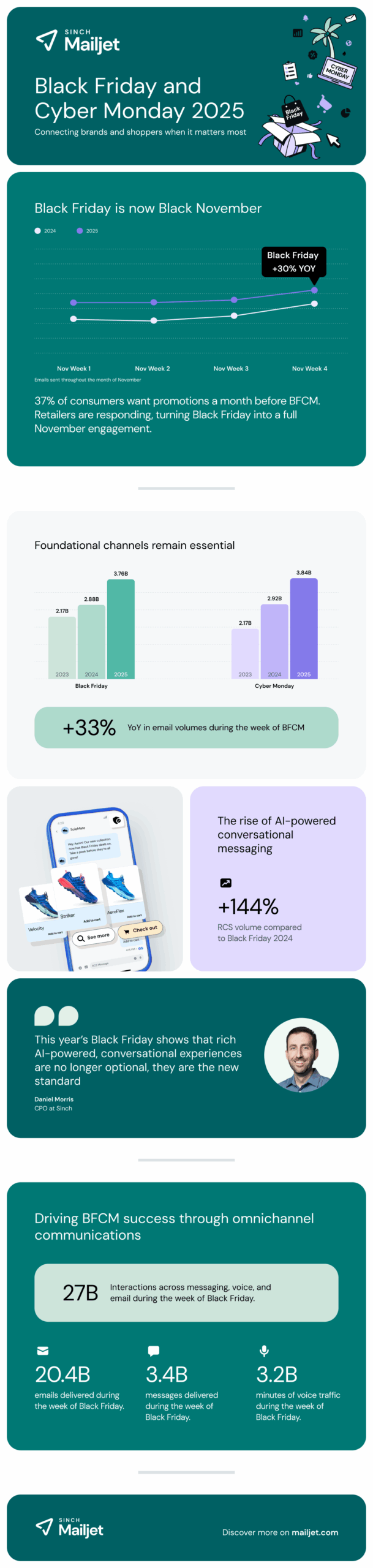
- Email Volume Peak: Sinch’s email platforms delivered an staggering 20.4 billion emails during Cyber Week alone. This monumental volume underscored email’s central role in promotional outreach during the most critical shopping days.
- Black Friday Specific Growth: Email volumes on Black Friday 2025 surged by 30% year-over-year, indicating a substantial increase in brand reliance on email for this pivotal sales day.
- Overall November Email Surge: Across the entire month of November, a 32% year-over-year increase in email volume was observed, with significant growth occurring even in the week before Cyber Week. This data firmly supports the "Black November" phenomenon, illustrating brands’ proactive approach to extending the sales period.
- Consistent Engagement: Despite the deluge of messages, average email open rates (excluding bot activity) held steady at 13% during the peak period. This figure, while appearing modest in isolation, is highly significant given the competitive inbox environment and demonstrates active consumer engagement.
- Omnichannel Interactions: Beyond email, Sinch powered an astounding 27 billion customer interactions across all channels (email, SMS, MMS, RCS, WhatsApp, and voice) during Black Friday week, highlighting the integral role of an integrated communication strategy.
- SMS Dominance for Urgency: 3.4 billion SMS messages were delivered globally during the BFCM weekend, positioning SMS as a critical channel for time-sensitive offers and immediate alerts.
- Voice Traffic for Critical Support: Sinch handled 3.2 billion minutes of voice traffic on Black Friday alone, underscoring the indispensable role of direct human conversation for complex customer service issues and high-stakes inquiries.
These figures not only quantify the scale of the holiday shopping period but also reveal the intricate interplay between consumer behavior, brand strategy, and the technological infrastructure that facilitates these interactions.

Email’s Enduring Primacy: Consumer Preference Meets Brand Strategy
The 2025 pre-holiday consumer survey conducted by Sinch unequivocally reaffirmed email’s status as the cornerstone of holiday communication. A substantial 56.5% of consumers expressed a preference for receiving Black Friday and Cyber Monday promotions via email. Even more strikingly, an overwhelming 73.9% cited email as their preferred channel for crucial transactional updates such as order confirmations and shipping notifications. This data highlights email’s dual role: a primary conduit for marketing messages and an indispensable tool for customer service and trust-building post-purchase.
Brands clearly heeded this consumer preference. The steady climb in email volume throughout November, culminating in the 20.4 billion emails delivered during Cyber Week by Sinch’s platforms, demonstrated a clear alignment between business strategy and consumer expectations. This surge in volume, particularly the 30% YoY increase on Black Friday, indicated that marketers actively leaned into email as their primary outreach mechanism.
However, the sheer volume raises a perennial question for marketers: do these emails actually cut through the noise? The data provided a reassuring answer: "yes." Despite the hyper-competitive environment, average open rates remained robust at 13% (excluding bot clicks). This consistent engagement level challenges the notion of "email fatigue" during peak seasons, suggesting instead that consumers are actively seeking out deals and information. The implication for marketers is clear: a well-targeted, relevant email campaign, backed by strong deliverability, will capture attention even amidst a crowded inbox.
The sustained engagement underscores the non-negotiable importance of email deliverability best practices during such a critical period. Factors like sender reputation, IP warming, content quality, authentication protocols (SPF, DKIM, DMARC), and list hygiene become paramount. A robust email infrastructure, capable of scaling under immense pressure without compromising delivery rates, is not merely advantageous but essential. Losing out on inbox placement during BFCM means losing out on sales and potentially damaging long-term customer relationships.
The "Black November" Phenomenon: A Strategic Shift
The transformation of Black Friday from a singular event into a month-long sales period is a strategic evolution driven by both consumer demand and competitive pressures. Consumers, increasingly accustomed to year-round promotions, now expect early access to deals, with nearly half desiring promotions a full month in advance. This anticipation forces brands to front-load their marketing efforts, extending the promotional window and creating a more sustained engagement marathon rather than a short sprint.
The data from Sinch’s platforms unequivocally validated this shift. The 32% year-over-year surge in email volume across November, with the most significant growth preceding Cyber Week, illustrated brands’ proactive deployment of early-bird promotions. This sustained campaign approach was instrumental in driving an unprecedented 27 billion customer interactions across all digital channels during Black Friday week alone. This intense activity was not confined to a single channel; rather, brands orchestrated sophisticated, multi-channel outreach encompassing email, messaging, and voice. The implication is profound: holiday success is no longer about a two-day burst of activity but about building sustained, multi-channel momentum throughout the entire month. This necessitates a comprehensive marketing calendar, dynamic segmentation, and a unified view of the customer journey across various touchpoints.
Email as Part of an Omnichannel Strategy: The New Standard
In the contemporary retail landscape, a single-channel approach is increasingly obsolete. Sinch’s 2025 consumer survey revealed that 77.9% of customers expected to engage with brands across multiple channels during major shopping events. This consumer expectation has firmly established an integrated omnichannel approach as the new benchmark for effective holiday communication.
Sinch’s infrastructure proved pivotal in facilitating this omnichannel imperative during BFCM 2025, powering an incredible 27 billion interactions across SMS, MMS, RCS, WhatsApp, email, and voice. This comprehensive engagement showcased how different channels serve distinct, yet complementary, roles in the customer journey:
- SMS for Urgency and Immediacy: With 3.4 billion SMS messages delivered globally during the BFCM weekend, SMS cemented its role as the go-to channel for time-sensitive offers, flash sales, and high-priority alerts. Its high open rates and immediate delivery make it invaluable for cutting through the digital clutter with urgent calls to action.
- Voice for Critical Support: When stakes are highest, human connection remains irreplaceable. Sinch handling 3.2 billion minutes of voice traffic on Black Friday alone highlighted the vital role of phone support for complex inquiries, order issues, or service escalations. This channel ensures that critical customer care is readily available, reinforcing trust and loyalty during periods of heightened activity.
- Email for Rich Content and Sustained Engagement: While SMS handles urgency, email provides the canvas for rich content, detailed product information, personalized recommendations, and ongoing nurture campaigns. Its ability to host images, videos, and detailed descriptions makes it ideal for showcasing a broader range of promotions and building brand narratives over time.
The successful orchestration of these channels demands sophisticated integration and a unified customer data platform. Brands that excelled in BFCM 2025 understood that each channel offers unique strengths, and leveraging them synergistically creates a more cohesive and impactful customer experience. For instance, an email announcing a major sale might be followed by an SMS reminder of a limited-time offer, with voice support available for any immediate queries, all contributing to a seamless customer journey.
Implications and Preparing for 2026
As 2025 draws to a close, the lessons from BFCM are invaluable for preparing for future peak seasons. The sustained growth in e-commerce, the elongation of the holiday shopping period, and the increasing sophistication of consumer expectations all point towards an even more competitive landscape in 2026.
Key Implications for Marketers:
- Prioritize Deliverability: With email volume reaching unprecedented levels, invest in robust email infrastructure and adhere strictly to deliverability best practices. Sender reputation, IP health, and email authentication are not optional but foundational to success.
- Embrace "Black November": Shift from a short-term sprint to a month-long marathon. Plan campaigns that span the entire month of November, offering early-bird deals and staggered promotions to capture attention and spending throughout the period.
- Master Omnichannel: A truly integrated omnichannel strategy is no longer a luxury but a necessity. Understand the unique strengths of each communication channel (email, SMS, voice, etc.) and deploy them strategically to create a cohesive and engaging customer journey.
- Personalization and Segmentation: In a crowded inbox, generic messages get lost. Leverage data for hyper-personalization and precise segmentation to ensure messages are relevant and resonate with individual consumer preferences.
- Focus on Transactional Excellence: While promotional emails drive sales, flawlessly executed transactional emails build trust and customer loyalty. Ensure these critical messages are delivered instantly and reliably, as they are a key touchpoint in the post-purchase experience.
- Leverage Data Analytics: Continuously monitor campaign performance, engagement metrics, and deliverability rates. Use these insights to optimize strategies in real-time and inform future campaigns.
The record-setting BFCM 2025 served as a powerful testament to email’s enduring power and the growing complexity of holiday marketing. Success in this evolving environment demands a combination of the right technology partner, deep email expertise, and an unwavering focus on customer experience across all touchpoints. Platforms like Sinch Mailjet, offering comprehensive email solutions from design and sending to tracking and deliverability support, are positioned to provide the critical infrastructure and guidance needed to navigate the challenges and opportunities of future peak seasons. As consumer expectations continue to rise, only brands equipped with world-class delivery capabilities and a truly integrated communication strategy will be able to consistently hit the inbox, drive sales, and build lasting customer relationships.