rifanmuazin
The landscape of B2B marketing is undergoing a seismic shift, driven by the rapid integration of artificial intelligence into the buyer’s journey. For years, the focus of search engine optimization (SEO) was centered on keywords, rankings, traffic, and conversion paths, all designed to capture the attention of human researchers. However, a fundamental change is underway: buyers are no longer primarily "searching" in the traditional sense. Instead, they are "asking" and increasingly delegating their research to AI tools that synthesize information and provide direct answers, rather than simply returning a list of links. This evolution demands a new paradigm for B2B marketers, one where content must not only be discoverable but also demonstrably understandable by artificial intelligence.
This transition, characterized by the rise of AI-driven discovery, necessitates a profound reevaluation of how B2B brands present themselves. As buyers leverage AI to streamline their decision-making processes, the ability of AI systems to accurately interpret and represent a company’s offerings becomes paramount. If AI cannot comprehend your brand’s value proposition, your organization risks becoming invisible to potential customers at the very moment they are evaluating solutions.
From Search Engines to Answer Engines: The Dawn of AI-Driven Discovery
The traditional B2B marketing playbook was built on the premise of guiding human users through a series of search queries to find relevant information. This involved meticulous keyword research, optimizing for high search engine rankings, driving traffic to websites, and designing clear conversion funnels. The advent of AI, however, has fundamentally altered this dynamic. Buyers are now interacting with sophisticated AI models that can process natural language queries, aggregate information from vast datasets, and generate comprehensive answers.
A significant report, "The 2026 State of B2B AI Visibility," highlights this trend, indicating that buyers are increasingly relying on AI systems to consolidate research. These systems don’t just present links; they interpret and synthesize information to deliver direct answers. Consequently, B2B brands are no longer solely competing for a top spot on a search results page. Instead, they are now in a crucial competition to be included, or conversely, to avoid being excluded, from AI-generated responses. This subtle yet critical shift means that a brand’s presence is determined not just by its content’s existence but by its AI’s comprehension.
The implications of this are stark: most B2B organizations are currently unprepared for this new reality. The core of the challenge lies in the fact that marketing content has historically been crafted for human readers, focusing on persuasion, narrative, and emotional connection. While these elements remain important for human engagement, AI systems process information differently. They prioritize factual extraction, looking for structured data, clear definitions, and explicit relationships between concepts. This divergence, termed a "narrative disconnect" by the AI Visibility report, leads to AI systems struggling to extract accurate facts from content optimized for storytelling.
The Narrative Disconnect: Content Built for Readers, Not Machines
The current state of B2B marketing content is largely optimized for human consumption. Marketers have excelled at crafting compelling narratives, building emotional resonance, and persuading potential customers through storytelling. While these strategies have proven effective for years, AI models do not "read" or "understand" content in the same way humans do. AI systems are designed to extract specific types of information, including:
- Structured data: Facts, figures, specifications, and quantifiable metrics.
- Explicit relationships: Clear connections between products, services, features, and benefits.
- Keywords and concepts: Identifying and understanding the core terminology relevant to a domain.
- Authoritative sources: Recognizing and prioritizing information from trusted entities.
This fundamental difference in information processing creates a "narrative disconnect." Companies are writing for human readers, while AI systems are attempting to extract factual data. This disconnect can result in several detrimental outcomes for B2B brands:
- Inaccurate representation: AI may misinterpret or omit crucial information, leading to a distorted understanding of the brand’s offerings.
- Exclusion from answers: If content lacks the clarity and structure AI requires, it may simply not be included in AI-generated responses.
- Lost opportunities: Without accurate representation, potential buyers may never discover or consider a brand’s solutions, even if they are a perfect fit.
Compounding this issue, these problems often go unnoticed in traditional analytics. Website traffic, conversion rates, and engagement metrics may appear stable, masking the underlying issue of AI-driven invisibility. This makes the problem particularly insidious, as it doesn’t manifest in the readily available performance indicators that marketing teams typically monitor.
The "Authority Trap": False Security in Established Brands
One of the more perplexing findings from the AI Visibility research is the "authority trap." Established and well-known brands often continue to appear in AI-generated answers, not necessarily because their content is optimized for AI, but because they were included in the massive datasets used to train these AI models. This creates a deceptive sense of visibility, leading to a false sense of security. While these brands may appear to have visibility, they lack control over how their information is interpreted and presented by AI.
As AI systems evolve towards real-time data retrieval and more sophisticated agent-based workflows, this advantage derived from historical inclusion will inevitably erode. What will matter more is the explicit readiness of a brand’s content for AI interpretation. This includes:
- Data clarity: Information presented in a clear, structured, and easily digestible format.
- Contextual richness: Providing sufficient context for AI to understand nuances and relationships.
- Machine readability: Ensuring content is structured in a way that AI can parse and process efficiently.
- Accuracy and consistency: Maintaining a high degree of factual correctness and uniformity across all published information.
This is precisely where a significant number of B2B organizations are currently lagging. The "authority trap" can obscure the immediate need for AI-specific content optimization, leading to a dangerous complacency.
Beyond Internal Efficiency: The Strategic ROI of External AI Visibility
Much of the current discussion around AI in B2B marketing has focused on internal use cases: content generation, workflow automation, and productivity enhancements. While these applications are undoubtedly valuable, they do not represent the most significant opportunity or the most pressing risk. The AI Visibility report strongly argues that the highest return on investment (ROI) for AI in the current market lies in external visibility, not solely in internal efficiency gains.
While marketing teams have been investing in optimizing internal processes, the way buyers discover and evaluate solutions has fundamentally changed. If a brand is not accurately represented in this AI-driven discovery process, it’s not just about losing traffic; it’s about losing consideration before a sales pipeline even begins to form. This represents a critical funnel leak that occurs at the earliest stages of the buyer’s journey, impacting the very foundation of lead generation.
The Hidden Barrier: Website Architecture and AI Access
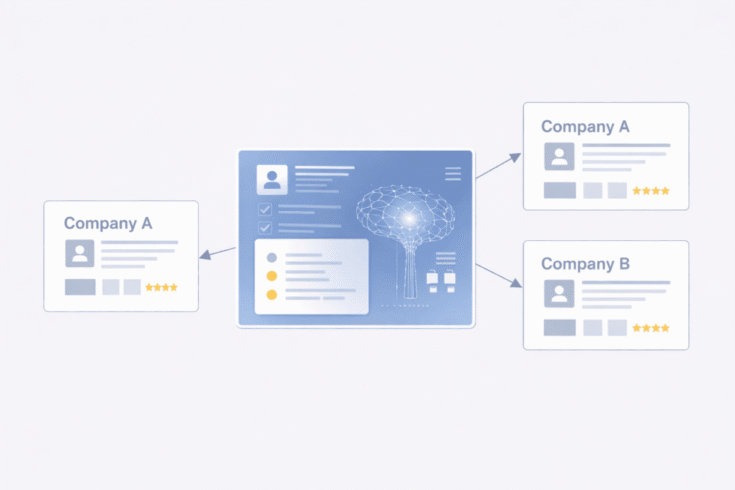
A significant and often overlooked obstacle to AI visibility is the design and architecture of B2B websites themselves. Many organizations, in their pursuit of human-centric design and conversion optimization, inadvertently create barriers that prevent AI systems from accessing or understanding their content. Common issues include:
- JavaScript-heavy rendering: Complex JavaScript can hinder AI crawlers from accessing and indexing content effectively.
- Dynamic content loading: Content that loads only after user interaction can be missed by AI systems.
- Robots.txt directives: Overly restrictive robots.txt files can block AI agents from crawling important pages.
- Poor site structure and navigation: Illogical site hierarchies and complex navigation can confuse AI agents.
- Lack of structured data (Schema markup): Insufficient use of schema markup leaves AI with less explicit information about the content’s meaning.
The AI Visibility study revealed a striking dichotomy: approximately 90% of B2B websites are optimized for human conversion, featuring prominent "Contact Sales" buttons and clear calls to action. However, these same sites often create "agent blockades," preventing AI systems from seamlessly navigating and interpreting the user journey. This introduces a novel form of funnel leakage, not at the point of conversion or engagement, but at the crucial stage of interpretation.
Context is the New Differentiator: Beyond AI Capabilities
The problem extends beyond mere content optimization; it delves into the realm of data and architectural strategy. As noted in "Martech for 2026," a key insight is that "AI is a commodity. Context is differentiation." In an era where AI capabilities are becoming widely accessible to competitors, buyers, and partners, the question shifts from "Do you have AI?" to "What does your AI truly know, and how effectively can it act on that knowledge?"
What truly separates companies is their ability to provide rich, accurate, and readily accessible context to AI systems. This requires:
- Unified data foundations: Consolidating data from various sources to create a single, coherent view.
- Composable architectures: Building flexible and modular systems that can adapt to evolving AI needs.
- High-quality, structured data: Ensuring data is clean, accurate, and formatted for machine readability.
- Domain-specific knowledge graphs: Developing interconnected webs of information that AI can leverage for deeper understanding.
The "New Martech Stack for the AI Age" report underscores the critical need for a unified data foundation and composable architecture to support AI-driven experiences. While only 23% of organizations reported having AI agents in full production, with the majority still in experimental phases, a significant 56% identified poor data quality as a major impediment to AI success. This challenge is equally pertinent to external visibility as it is to internal operations. If a company’s systems and content fail to provide clean, usable context, AI will be unable to represent the brand accurately.
Actionable Steps for B2B Teams: Navigating the AI Visibility Frontier
Adapting to this new AI-driven buyer journey is not about abandoning traditional SEO; it’s about expanding the definition of visibility. B2B teams should consider the following practical steps:
1. Audit How AI Describes You:
Actively query AI tools like ChatGPT, Bard, or Claude with questions about your company, its products, and its market position. For example, ask:
- "Explain [Your Company Name]’s core offering."
- "What are the main benefits of [Your Product/Service]?"
- "How does [Your Company Name] differentiate itself from competitors?"
Analyze the responses for accuracy, completeness, and nuance. Look for:
- Factual errors: Misstated product features, incorrect market positioning.
- Omissions: Key differentiators or benefits that are missing.
- Vague language: Descriptions that lack specificity and clarity.
- Misinterpretation: AI drawing incorrect conclusions about your value proposition.
2. Make Your Content More Extractable:
Shift your content creation mindset from purely storytelling to a more structured, system-design approach. Prioritize:
- Clear, concise language: Avoid jargon and overly complex sentence structures.
- Structured formats: Utilize headings, bullet points, and numbered lists to organize information logically.
- Explicit definitions: Clearly define key terms, product features, and service offerings.
- Quantitative data: Incorporate metrics, statistics, and performance indicators where appropriate.
- Internal linking: Ensure a logical flow of information through well-placed internal links.
3. Reduce Friction for Machine Access:
Evaluate your website to ensure AI agents can navigate and understand it freely. Consider:
- Website performance: Optimize page load speeds and ensure smooth rendering.
- Robots.txt optimization: Carefully review and adjust robots.txt directives to allow access to relevant content.
- Sitemap submission: Ensure an up-to-date XML sitemap is submitted to search engines and AI indexing services.
- Structured data implementation: Implement Schema markup extensively to provide explicit context for your content.
- Mobile-friendliness: Ensure your site is responsive and functions well across all devices, as AI models often process information from mobile-first indexing.
4. Align Messaging Across Channels:
AI systems synthesize information from multiple sources. If your messaging is inconsistent across different platforms, your positioning will suffer. Ensure:
- Brand messaging consistency: Your website, social media, press releases, and sales collateral all convey a unified message.
- Data accuracy: Product specifications, pricing, and feature lists are identical across all touchpoints.
- Value proposition clarity: The core benefits you offer are consistently articulated.
- Keyword alignment: Key terms and phrases are used consistently to describe your offerings.
5. Treat AI Visibility as a Strategic Function:
AI visibility is not solely an SEO or content marketing concern. It is a strategic imperative that sits at the intersection of:
- Marketing strategy: Defining how your brand is perceived and communicated.
- Data governance: Ensuring the accuracy, quality, and accessibility of your information.
- Technology architecture: Building systems that can support AI integration.
- Go-to-market (GTM) execution: Aligning all customer-facing activities.
This requires orchestration, not just isolated optimization efforts. It demands a coordinated approach across departments to ensure your brand’s narrative is both compelling to humans and comprehensible to machines.
The Future of B2B Marketing: Influencing Systems, Not Just People
The fundamental shift for B2B marketers is recognizing that they are no longer solely marketing to human buyers. They are increasingly influencing the very systems that buyers rely on to make decisions. These AI systems operate on logic and data; they do not prioritize narrative compellingness if they cannot understand the underlying information.
Therefore, the critical question for every B2B organization becomes: "If an AI had to explain your company in one sentence, would it get it right?" Increasingly, this AI-generated summary will be the first impression potential buyers have of your brand. The ability of AI to accurately articulate your value proposition is becoming the new frontier of B2B marketing success, demanding a strategic alignment of content, data, and technology to ensure your brand not only exists but is clearly understood in the evolving digital ecosystem.
For organizations realizing that this challenge transcends content and involves a deeper coordination of data, GTM strategy, and overall orchestration, Heinz Marketing offers a complimentary GTM orchestration assessment. By partnering with Heinz Marketing, B2B teams can align their messaging, data, and go-to-market execution, ensuring their strategies are clearly communicated to both human buyers and the intelligent systems guiding their decisions.