rifanmuazin
Published on April 17, 2026, the Sinch Mailgun 2026 Email Impact Report provides a comprehensive, data-driven analysis affirming email’s enduring importance while highlighting a widening chasm between sophisticated, data-led email programs and those operating on outdated assumptions. Drawing insights from a global survey of over 1,200 email senders and an unparalleled analysis of more than 400 billion real emails processed through Sinch Mailgun infrastructure in 2025, the report serves as a critical compass for organizations navigating the complexities of digital communication in the latter half of 2026 and beyond. Its five chapters delve into crucial areas: Return on Investment (ROI), industry benchmarks, deliverability trends, artificial intelligence (AI) adoption, and future investment strategies, painting a vivid picture of the challenges and opportunities ahead.
The Enduring Power of Email and the ROI Measurement Gap
Email, often considered a foundational pillar of digital marketing, continues to hold paramount importance for organizations worldwide. A striking 78% of senders surveyed emphatically state that email is either "very" or "extremely" important to their organization. This level of organizational buy-in is a testament to email’s pervasive reach, cost-effectiveness, and direct communication capabilities, qualities that few other marketing channels can consistently match. However, this strong belief in email’s value does not always translate into rigorous, evidence-based program management.
A significant finding from the report reveals a critical disconnect: fewer than half of email senders actively measure the Return on Investment (ROI) of their email programs. Specifically, only 46% track the ROI for promotional emails, and a slightly lower 43% do so for transactional emails. This indicates that a substantial majority of teams are operating on conviction and perceived value rather than concrete financial evidence. In an era where data-driven decision-making is increasingly imperative, this measurement gap represents a substantial vulnerability for many organizations.
For those who do measure, the financial returns are compelling. Among senders who track promotional email ROI, 60% report a return greater than $10 for every $1 spent. A remarkable 13% of these senders claim an even higher return, exceeding $40 for every dollar invested. Similarly, 62% of senders measuring transactional email ROI achieve the $10:1 threshold, with 13% also reporting returns above $40:1. The report, however, offers a nuanced interpretation for these exceptionally high returns, suggesting they might occasionally signal underinvestment in email programs rather than peak efficiency. In such cases, organizations could potentially achieve even greater overall revenue by investing more strategically to capture untapped opportunities, rather than merely maximizing the ROI on a minimal spend.
The primary obstacle cited for increasing email investment is budget constraints, with 43% of senders identifying this as their biggest barrier. This presents a classic Catch-22: budget is hard to secure without data, yet most teams are not collecting the data necessary to build a compelling business case for increased funding. The report strongly recommends a pragmatic approach: starting with an intermediate step like tracking "revenue per campaign." While the attribution model might not be perfectly refined initially, this provides tangible data points that can begin to justify further investment and pave the way for more sophisticated ROI tracking down the line. The implication is clear: without demonstrating tangible financial impact, email programs risk being undervalued and underfunded, despite their inherent effectiveness.
Unpacking Real-World Email Benchmarks from 400 Billion Messages
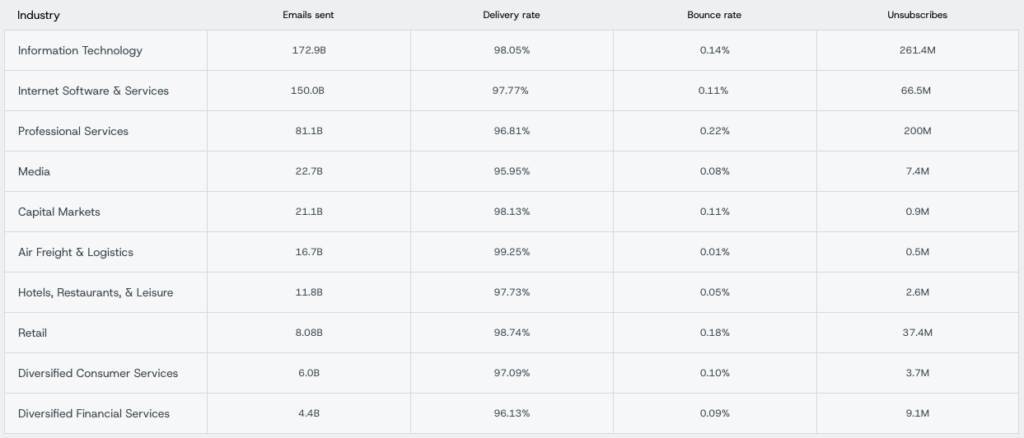
Traditional email industry benchmarks have historically relied heavily on surveys and self-reported estimates, which can often be skewed by optimism bias or incomplete data. The Sinch Mailgun report takes a radically different and more authoritative approach in its second chapter, presenting benchmarks derived from the analysis of 400 billion real emails sent through its infrastructure across the top 10 industries by volume in 2025. This vast dataset offers an unprecedented, granular view of actual email performance.
The industry-specific data reveals significant variations in delivery and bounce rates. Air Freight & Logistics leads the pack with an exceptional 99.25% delivery rate and a minuscule 0.01% bounce rate. This superior performance is largely attributed to the nature of their communications: predominantly transactional sends such as shipping confirmations and tracking updates. These messages are highly anticipated and desired by recipients, leading to fewer rejections and higher engagement. In stark contrast, the Media industry records the lowest delivery rate among the top 10 at 95.95%. This disparity is understandable given the Media sector’s tendency for high-volume promotional sends to broad audiences, which naturally encounters more challenges with recipient engagement, list hygiene, and spam filters, exerting downward pressure on delivery metrics.

However, the report cautions against relying solely on delivery rate as a definitive measure of success. An email technically "delivered" to a recipient’s spam or junk folder still counts as delivered, yet fails to achieve its intended purpose. The report unequivocally states that senders must pair delivery rate tracking with rigorous inbox placement testing. This dual approach provides a far more accurate understanding of where emails are actually landing – whether in the primary inbox, promotions tab, or spam folder – rather than merely confirming server acceptance. Without this critical distinction, marketers risk overestimating the effectiveness of their campaigns and missing opportunities for optimization.
Another crucial insight from the benchmark analysis concerns unsubscribe rates, which can often be misinterpreted without proper context. The Information Technology sector, for example, registered the highest raw number of unsubscribes at 261 million. However, when contextualized against its colossal send volume of 172.9 billion emails, this translates to an unsubscribe rate of approximately 0.15%. Conversely, the Retail industry generated 37.4 million unsubscribes from a much smaller volume of 8.08 billion sends, resulting in a significantly higher unsubscribe rate per email. This comparison powerfully illustrates that raw unsubscribe figures, in isolation, are meaningless. Marketers must always consider unsubscribe volume relative to the total number of emails sent to gain an accurate and actionable understanding of audience engagement and list health. These real-world benchmarks provide a much-needed reality check for businesses, allowing them to compare their performance against industry averages derived from actual data, not just self-reported figures.
Advancements in Deliverability Outpace User Literacy
Email deliverability – the ability for an email to successfully reach a recipient’s inbox – is universally recognized as a critical factor for email program success. The report confirms this sentiment, with 89% of senders stating that deliverability is important to their organization. Encouragingly, 43% of senders reported an improvement in their inbox placement over the past 12 months. This positive trend is largely attributed to significant advancements in email infrastructure and security protocols.
A key driver of this improvement has been the increased adoption of DMARC (Domain-based Message Authentication, Reporting, and Conformance). The report shows a clear upward trajectory in DMARC adoption among email senders: 43% in 2023, rising to 54% in 2024, and reaching 61% in 2025. This growth has been significantly propelled by stringent requirements from major mailbox providers such as Gmail, Yahoo, and Microsoft, which have mandated DMARC implementation for bulk senders to combat spam and phishing. For the first time in Sinch Mailgun’s research, enforcement policies (quarantine or reject) are outpacing passive monitoring, with over half of DMARC adopters now actively using these stricter policies. This indicates a maturing landscape where email authentication is becoming a non-negotiable standard, not just an optional best practice.
Despite these tangible infrastructure improvements, a glaring gap in understanding persists among email senders. A substantial 36% of senders claim to monitor their "email deliverability rate," a metric that, as the report correctly points out, does not exist in a meaningful, actionable way. This confusion highlights a fundamental misunderstanding: the "delivery rate" merely indicates that an email was accepted by the recipient server, irrespective of whether it landed in the inbox or the spam folder. The true measure of success, "inbox placement," directly assesses whether an email reached the intended inbox. Alarmingly, only 25% of senders actively conduct inbox placement tests to ascertain where their emails are truly landing. Furthermore, a significant 27% of DMARC users are unaware of the specific policy (none, quarantine, or reject) they have implemented, underscoring a lack of fundamental knowledge regarding their own email security configurations.
This dichotomy—improving tools and infrastructure juxtaposed with lagging user literacy—represents a critical vulnerability for many organizations. While the technical mechanisms for improved deliverability are in place and evolving, the human understanding and strategic application of these tools are not keeping pace. This knowledge gap can lead to suboptimal email performance, wasted marketing spend, and missed opportunities, even for those who have invested in the latest security protocols. The report implicitly calls for greater education and training within organizations to ensure that email teams fully comprehend and leverage the sophisticated tools at their disposal.
AI’s Transformative, Yet Uneven, Impact on Email Programs
The integration of Artificial Intelligence (AI) into marketing workflows has been a dominant theme across industries, and email is no exception. The Sinch Mailgun report confirms widespread interest, with a striking 79% of senders either currently using or planning to use AI in their email programs. This strong interest underscores the perceived potential of AI to revolutionize various aspects of email marketing, from content creation to audience segmentation and optimization.
However, the report also reveals that actual, regular AI usage is considerably lower, standing at just 27%. A significant portion of adopters are still in the experimental phase, dabbling with AI tools rather than systematically embedding them into their core workflows. This suggests a journey from curiosity to consistent, impactful integration is still underway for many organizations.
The most common application of AI in email marketing is copy generation, cited by 41% of senders. Following closely are content personalization (36%), dynamic content creation (29%), send time optimization (27%), and data analysis (27%). This pattern of adoption reveals a critical insight: AI delivers the most significant value when it is deeply integrated into decision-making processes, rather than being confined to mere content production. Teams that are leveraging AI for personalization, optimizing send times, and conducting sophisticated testing are reporting compounding returns. Conversely, teams that are using AI primarily for superficial tasks, such as drafting basic subject lines, are experiencing limited impact and struggling to demonstrate tangible value.
The report provides compelling statistical evidence of AI’s transformative potential. Among senders who have implemented AI, 54% reported that their email programs improved moderately or significantly year over year. In stark contrast, only 37% of senders who are not using AI saw similar improvements in the same time period. This 17-point gap is arguably the clearest signal yet that AI is beginning to stratify email programs by performance tier, creating a discernible advantage for early and effective adopters. While the report carefully notes that this does not definitively prove causation, the consistent direction of the data strongly suggests a correlation between AI integration and enhanced email performance.
Intriguingly, 23% of AI users reported that it had not helped them at all. This finding reinforces the notion that the tool itself is not the sole determinant of success; rather, it is the depth and strategic integration of AI that unlocks its true potential. Organizations that treat AI as a superficial add-on will likely see minimal gains, whereas those that embed it into core strategic functions—such as audience understanding, content relevance, and campaign optimization—will reap substantial benefits. This implies a need for not just technological adoption, but also a strategic rethinking of workflows and skill sets within email marketing teams.
Future Investment Trends and Strategic Imperatives for 2026
Looking ahead to 2026, the Sinch Mailgun report identifies "taking advantage of AI" and "increasing email engagement" as the top priorities for email senders, both cited by 40% of respondents. This dual focus underscores a clear understanding within the industry: AI is seen as a crucial enabler for achieving higher engagement, which remains the ultimate goal of effective email communication.
Regarding investment plans, the outlook is cautiously optimistic. 31% of organizations plan to increase their email investment in the coming year, reflecting a growing recognition of email’s value and potential. A significant 48% intend to maintain their current spending levels, indicating stability in budget allocations for this channel. Only a small fraction, 7%, anticipate decreasing their email investment. This overall trend suggests that email is firmly entrenched as a vital marketing channel, with many organizations looking to either sustain or grow their commitment.
The report’s conclusion is both straightforward and profound: email works. The extensive data collected across ROI metrics, real-world benchmarks, and deliverability trends unequivocally supports email’s effectiveness as a communication and marketing tool. However, the report also issues a clear directive: the email programs that will truly distinguish themselves and pull ahead in the competitive digital landscape are those that commit to simultaneous investment in three interconnected areas:
- Measurement: Proving ROI with real, attributable data is no longer optional. Organizations must move beyond conviction and establish robust tracking mechanisms to demonstrate the tangible financial impact of their email efforts. This includes sophisticated attribution models and a clear understanding of key performance indicators beyond simple open and click rates.
- Deliverability: Consistently reaching the inbox requires proactive and continuous effort. This encompasses adherence to best practices in email authentication (like DMARC), meticulous list hygiene to maintain a clean and engaged audience, and ongoing monitoring of inbox placement to ensure messages bypass spam filters. Neglecting deliverability is tantamount to shouting into a void.
- Optimization: Leveraging AI and systematic A/B testing is essential for improving performance at scale. This means moving beyond basic content creation with AI to integrating it for personalization, predictive analytics, dynamic content, and intelligent send-time optimization. Continuous testing ensures that campaigns are constantly refined and improved based on actual user behavior.
Crucially, the report emphasizes that none of these strategic imperatives necessitate a massive upfront budget. Starting with incremental improvements in each area can yield significant returns, and the benefits of such investments are compounded over time. For instance, even a modest investment in basic ROI tracking can unlock the data needed to justify further budget increases. Similarly, implementing stricter DMARC policies or conducting regular inbox placement tests can drastically improve the reach of existing campaigns without requiring substantial additional spending.
The broader implication of the 2026 Email Impact Report is a call to action for email marketers and business leaders alike. While email’s foundational strength remains, its future effectiveness hinges on a commitment to data, security, and intelligent optimization. Those who embrace this evolving paradigm will not only maintain their competitive edge but will also unlock unprecedented levels of engagement and ROI from their email programs in the years to come. The report serves as a timely reminder that in the dynamic world of digital marketing, complacency is the greatest risk, and continuous, informed improvement is the only path to sustained success.