A common misconception in the world of e-commerce is that business growth is inextricably linked to an expanding workforce and escalating marketing spend. However, a deeper examination of high-performing businesses reveals a different narrative, one where strategic operational efficiency and proactive tax planning often eclipse aggressive marketing tactics as the primary engines of sustained profitability. This shift in focus challenges the prevailing wisdom that “more people” and “more ad spend” are the only pathways to scaling success, offering a more nuanced and often more effective approach to maximizing bottom-line results.
The story of one particular store owner serves as a compelling case study in this paradigm shift. Facing persistent challenges with profitability despite solid revenue, this entrepreneur, who previously managed a team of 35 employees, found himself in a constant state of stress. The sheer logistical and managerial demands of a large in-house team, on top of the core business operations, proved to be an unsustainable burden. In a decisive move to recalibrate his business model, he made a series of strategic decisions. He transitioned to a remote work infrastructure, outsourced his warehousing and fulfillment operations to a third-party logistics (3PL) provider, and significantly restructured his workforce by replacing many full-time employees with freelancers and independent contractors. The outcome was transformative: his team now comprises a single full-time employee and eight contractors, a lean operational structure that has led to unprecedented profit margins and a dramatic reduction in personal stress. This anecdote, while individual, is not an isolated incident and points to broader trends observed across the e-commerce landscape.
Examining Data: The Leanness Advantage

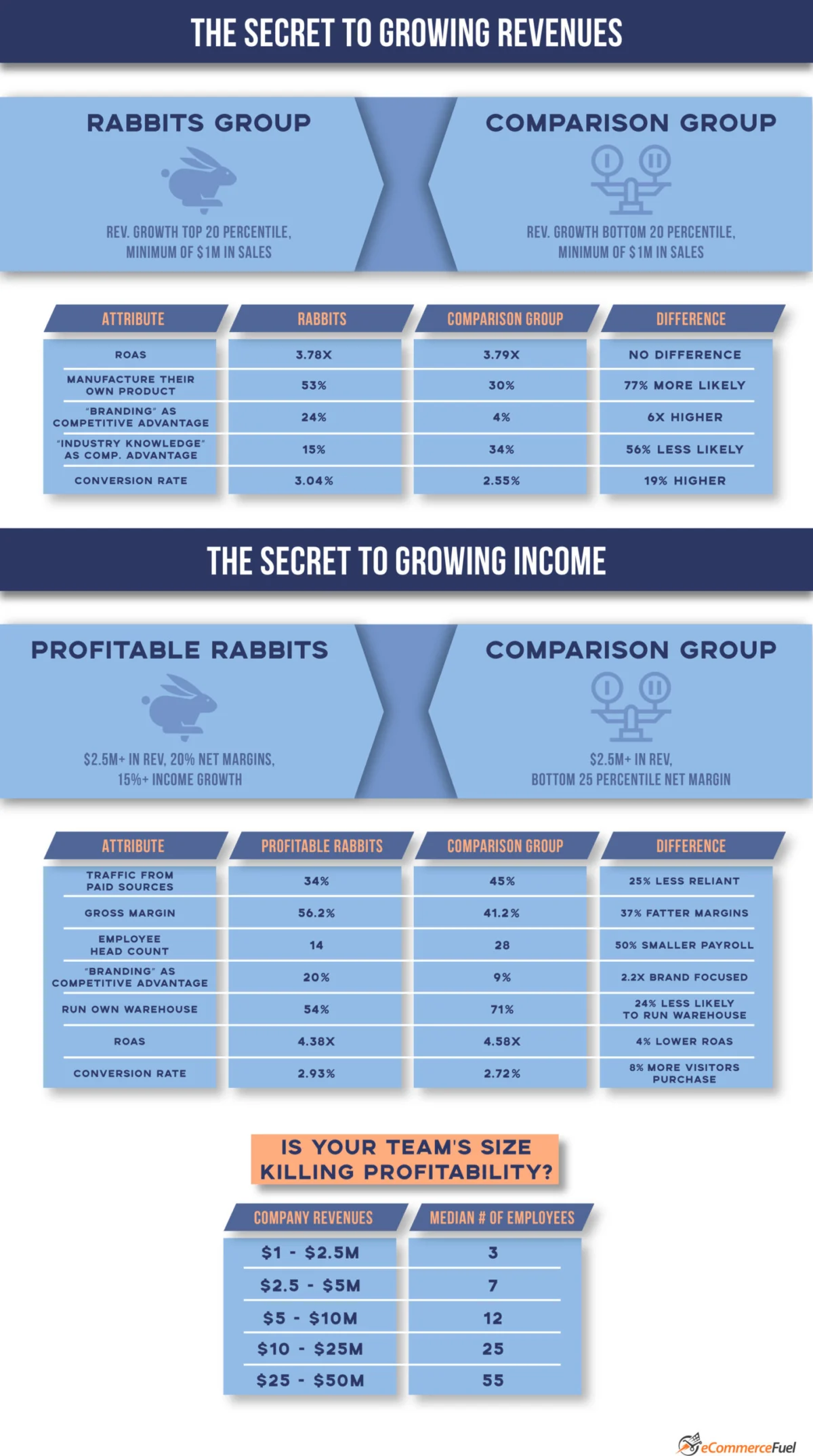
Research conducted across hundreds of e-commerce businesses to identify the characteristics of highly profitable ventures yielded surprising insights. While the initial hypothesis leaned towards superior marketing strategies as the key differentiator, the data indicated otherwise. A comprehensive analysis revealed that the Return on Ad Spend (ROAS) between top-performing and struggling businesses was negligible, suggesting that exceptional marketing prowess was not the sole determinant of profitability. Instead, the most significant distinguishing factor was operational leanness.
Specifically, top-performing businesses were found to have, on average, half the payroll expenses of their less profitable counterparts. Furthermore, these leading companies were 25% more likely to outsource their warehouse operations, a move that often leverages economies of scale and specialized expertise offered by 3PLs. Concurrently, they exhibited a 25% reduced reliance on paid traffic, indicating a greater emphasis on organic growth, customer retention, and efficient conversion strategies rather than aggressive, high-cost customer acquisition. This empirical evidence strongly suggests that operational efficiency and cost management, often overlooked in the pursuit of revenue growth, are in fact more potent drivers of profitability than marketing ingenuity alone. The upcoming eComFuel Trends Report is poised to further validate and expand upon these findings, inviting business owners to participate in ongoing data collection to refine these patterns.
Defining “Lean”: Beyond Headcount Reduction
The concept of “staying lean” is frequently misinterpreted as a euphemism for layoffs or a simplistic reduction in employee numbers. However, true operational leanness extends far beyond headcount. It encompasses a holistic evaluation of all business overheads, from physical infrastructure to recurring software subscriptions. This includes assessing the necessity of large, underutilized office spaces that may have been acquired during periods of perceived growth but are now a drain on resources, especially in an era where remote work has become increasingly viable. Similarly, the decision to manage warehousing in-house versus outsourcing to a 3PL often hinges on a detailed cost-benefit analysis, considering the 3PL’s ability to handle fluctuating volumes more efficiently and cost-effectively.

Moreover, the proliferation of Software as a Service (SaaS) tools, while offering immense utility, can also contribute to insidious overhead creep. Subscriptions that auto-renew without regular review, even for seemingly small amounts like $50 or $200 per month, can accumulate into significant annual expenses. A crucial filter for identifying and eliminating unnecessary overhead is to critically examine what constitutes the core competency and unique selling proposition of a brand. If a company’s competitive advantage lies in its product design or customer service, then maintaining an in-house design team or customer support staff might be justifiable. However, if tasks like order packing and shipping do not directly contribute to the brand’s unique value proposition, then outsourcing these functions to specialized providers can unlock significant cost savings and operational efficiencies. Profitable businesses are not merely cutting costs arbitrarily; they are making deliberate, strategic decisions about where to allocate resources based on their core strengths and competitive advantages.
The Imperative of Proactive “Hard Conversations”
A recurring theme in the journey of successful entrepreneurs is their willingness to engage in difficult conversations. This often involves confronting uncomfortable truths about operational inefficiencies, staffing needs, and resource allocation. The tendency for many business owners is to postpone these critical discussions until external pressures, such as economic downturns, cash flow crises, or declining profitability, force their hand. However, the most resilient and profitable businesses are those that address these challenges proactively, before they escalate into existential threats.
This proactive approach involves asking pointed questions: Is a particular role truly necessary, or was it a result of ad-hoc hiring driven by perceived busyness? Are certain software subscriptions maintained out of genuine necessity or simply out of habit? What would be the immediate impact of needing to reduce expenses by 25% overnight, and what measures would be implemented? By regularly posing these questions and acting upon the answers, business owners can maintain a lean and agile operational structure, not as a reaction to crisis, but as a deliberate strategy for sustained financial health. This intentionality allows for controlled adjustments and strategic pruning, ensuring that the business remains optimized for profitability and resilience.

Leveraging Tax Efficiency: An Unsung Hero of Profitability
While marketing and operational costs are frequently scrutinized, the impact of tax liabilities on net profit is often underestimated. Many business owners view taxes as a fixed cost, a percentage of revenue that must be paid regardless of strategic decisions. However, a closer examination reveals that proactive tax planning can significantly enhance after-tax outcomes, effectively increasing the amount of profit retained by the business. This is not about engaging in aggressive or illicit tax avoidance schemes, but rather about strategically utilizing available legal deductions, credits, and financial instruments.
Consider a hypothetical scenario involving two identically performing e-commerce businesses, each generating $2.5 million in revenue and $250,000 in profit, with identical personal financial situations for their owners. Owner A, who engages in minimal proactive tax planning, might pay approximately $75,000 in annual taxes. In stark contrast, Owner B, who actively implements a range of tax-efficient strategies, could reduce their tax burden to as little as $21,000, a difference of over $54,000 per year. This substantial disparity can be achieved through a combination of well-established, legitimate strategies:
- Profit Sharing Contributions: Owner B might contribute significantly to retirement accounts through profit-sharing plans, often exceeding the limits of standard 401(k)s. For instance, a $45,000 contribution could yield approximately $13,500 in tax savings, assuming a 30% marginal tax rate.
- Appreciated Stock Donations: Instead of donating cash, donating appreciated stock to charities allows the owner to avoid capital gains tax on the stock’s growth while still receiving a deduction for its full fair market value. This can result in savings of around $3,500.
- Maximized Health Savings Accounts (HSAs): Contributing the maximum family limit to an HSA ($8,500 in this example) provides a triple tax advantage: contributions are tax-deductible, earnings grow tax-free, and qualified withdrawals for medical expenses are also tax-free. This strategy can save approximately $2,550 in taxes.
- Employing Children: Paying children for legitimate work performed in the business offers a dual benefit. The payments are deductible for the business owner, reducing taxable income, while the children can invest these earnings in Roth IRAs, allowing for tax-free growth over decades. Paying three children $7,000 each could result in around $6,300 in tax savings.
- Inventory Donations: Donating slow-moving or obsolete inventory to charities at its fair market value can provide a substantial deduction, often far exceeding the net realizable value if liquidated at a loss. A $60,000 inventory donation could save approximately $18,000 in taxes.
These examples illustrate how strategic financial planning, particularly in the realm of taxation, can unlock significant financial advantages that directly impact net profitability.

The Invisible Nature of Tax Optimization
The reason these tax optimization strategies often remain “invisible” to many business owners is the fragmented nature of financial reporting. Personal tax returns, business filings, brokerage statements, and payroll reports are often handled separately, lacking a consolidated view of the overall tax liability. This fragmentation prevents owners from gaining a comprehensive understanding of their total tax expenditure and from identifying potential areas for optimization. While a “decent” accountant can ensure accurate filing and compliance, they may not proactively suggest strategies for reducing tax burdens. Such proactive ideation is typically the domain of forward-thinking tax professionals who view tax planning as an ongoing, strategic process rather than a mere compliance exercise.
A Simple Test for CPA Effectiveness
A straightforward yet revealing test for the effectiveness of a Certified Public Accountant (CPA) is to ask: “When was the last time you proactively approached me with a new idea to improve my financial situation?” If the answer is that the CPA only responds to direct questions or handles routine filings, it suggests they are providing adequate but not exceptional service. While this level of service ensures compliance, it can lead to substantial missed opportunities, as demonstrated by the $54,000 annual difference between the two hypothetical owners. The pursuit of greater after-tax profitability requires engaging with CPAs who are not only knowledgeable about tax regulations but are also strategic advisors capable of identifying and implementing innovative solutions tailored to the business’s unique circumstances.

Conclusion: Strategic Leanness and Tax Efficiency as Pillars of Profit
In the competitive landscape of e-commerce, marketing efforts, while important, are not the sole determinants of sustained profitability. The data consistently points towards operational leanness and strategic tax planning as equally, if not more, critical factors. Businesses that prioritize optimizing their operational structure, whether through outsourcing, remote work, or efficient resource allocation, and those that actively engage in proactive tax planning to minimize their liabilities, are demonstrably more profitable. As the e-commerce industry continues to mature, a focus on these often-overlooked levers—reducing unnecessary overhead and maximizing after-tax income—offers a powerful and sustainable path to enhanced financial success. The insights gained from observing high-performing businesses underscore a fundamental truth: keeping more of what you already earn is often a more impactful strategy for long-term profitability than solely focusing on earning more.

 Raul Delapena Setiawan
 Ammar Sabilarrohman