Lina Irawan
The internet is no longer solely the domain of human users. Recent data indicates a significant shift, with automated bots now accounting for a substantial portion of website traffic. According to NBC News, these bots represent 57% of all website requests, a figure that underscores a growing challenge for businesses and website owners: understanding the distinction between human visitors and machine-driven activity. Traditional analytics tools, while adept at profiling human users, often fall short in differentiating and analyzing the increasing volume of bot interactions. This is precisely where platforms like Microsoft Clarity are emerging as crucial instruments for gaining a more comprehensive understanding of digital footprints.
Microsoft Clarity, a free analytics platform, has been actively developing features aimed at providing visibility into AI-driven traffic. While offering established capabilities in user experience and website analytics, its recent focus on AI visibility seeks to equip marketers and webmasters with the tools to discern how AI crawlers, search engines, and digital assistants interact with their websites. To assess these new functionalities, a multi-week testing period was undertaken on the Brainlabs Digital website, revealing key insights into the evolving nature of web traffic and user engagement.

Setting Up and Integrating AI Visibility Features
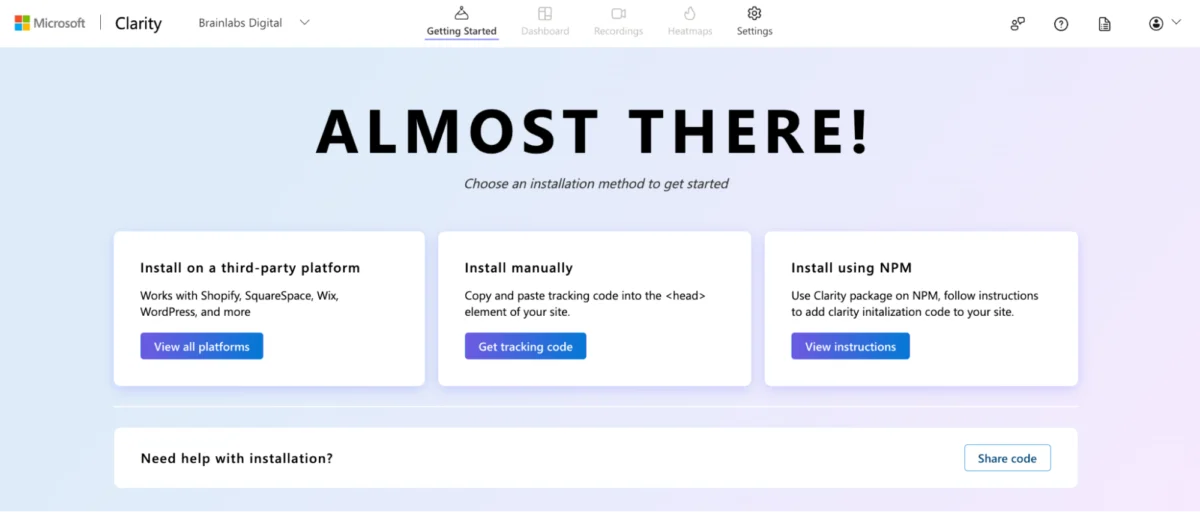
The initial setup of Microsoft Clarity is designed for user accessibility. As a free service, it requires the implementation of a simple tracking script on a website, a process that typically takes only a few minutes. This script can be integrated directly into a website’s code or through available plugins and integrations for popular platforms such as Shopify and WordPress.
However, to unlock the full potential of Clarity’s AI visibility features, additional integrations and configuration steps are often necessary. For instance, to gain deeper insights into bot activity, connecting to Google Analytics and integrating server-log data through a platform-specific plugin, such as a WordPress plugin, proved essential. This server-log data is particularly valuable as it provides information that would otherwise require extensive manual sifting through log files, offering a more streamlined approach to data analysis. Microsoft provides comprehensive setup documentation, guiding users through the various installation options and integration possibilities.
Understanding the Influx of Bots: Who is Crawling Your Site and Why
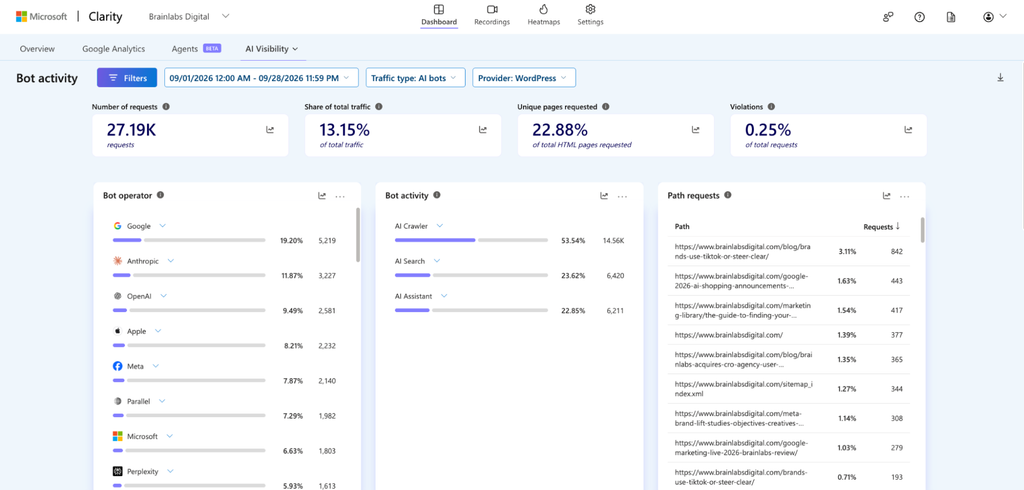
At the core of Clarity’s AI visibility features is the Bot Activity Dashboard. This dashboard provides a detailed breakdown of the bots visiting a website, including their frequency of visits, the specific pages they access, and crucially, categorizes them into three distinct types of AI-driven activity:
- AI Crawlers: These bots are primarily responsible for indexing web content for search engines and large language models. They systematically browse websites to gather information that will be used to train AI models or to populate search engine result pages.
- AI Search: This category encompasses bots that interact with a website as part of an AI-powered search query. This could involve bots from AI assistants that are actively seeking answers to user questions by referencing web content.
- AI Assistants: These are the bots representing the end-users of AI-powered tools. They are the agents through which users interact with AI models, and their activity on a website can indicate how AI models are interpreting and presenting information.
Understanding these distinctions is paramount. A bot accessing a website does not automatically equate to a human actively searching for a brand or that the content is being utilized in an AI-generated response. The purpose behind the bot’s activity provides a critical starting point for accurate data interpretation.
During a specific testing period, from September 1 to September 28, 2026, Microsoft Clarity recorded approximately 27,190 AI bot requests on the Brainlabs Digital website. This volume represented 13.15% of the total traffic measured within that specific dashboard. Within this AI-driven traffic, AI crawlers constituted the largest segment at 53.54%. AI Search and AI Assistant activities followed, accounting for 23.62% and 22.85% of the requests, respectively. Leading operators observed during this period included Google, Anthropic, and OpenAI, though their respective request volumes showed considerable variation.
Analyzing Bot Behavior: Scrape-to-Referral Ratios and Their Implications
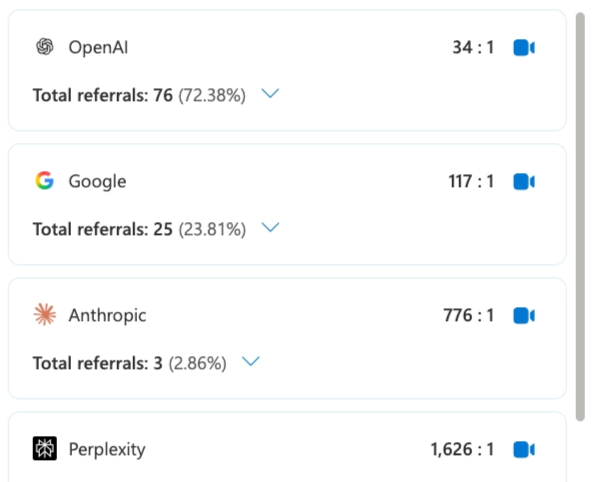
Beyond simply identifying bot traffic, Clarity offers metrics to analyze the downstream impact of these interactions. The scrape-to-referral ratio is a key indicator, comparing AI scraping activity with actual referral visits originating from AI platforms. Over the observed period, the Brainlabs Digital website reported an average scrape-to-referral ratio of 90:1, with a total of 105 referrals.
However, these ratios varied significantly across different AI platforms. OpenAI recorded a ratio of 34:1 with 76 referrals, Google at 117:1 with 25 referrals, and Anthropic at a much higher 776:1 with only three referrals. These figures prompt careful consideration regarding the traffic value generated by each platform. It is important to note that referral traffic does not necessarily reflect the entire influence a platform may have had on a customer’s decision-making journey. Therefore, this ratio is treated as one data point among others, including traffic, conversion rates, and overall visibility metrics, rather than a definitive measure of qualified click-throughs.
Uncovering AI Citations and Topic Insights
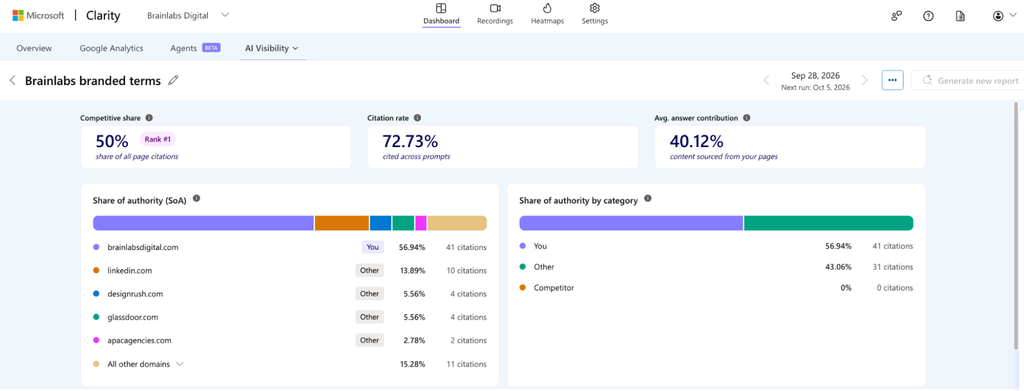
A particularly innovative feature within Clarity, currently in beta, is "Topic Insights." This functionality allows users to define specific topics and then track how frequently their website is cited when AI platforms address prompts related to those topics. For Brainlabs’ branded terms, Clarity indicated a citation rate of 72.73% across the tracked prompts, with a competitive share of 50%. The website garnered 41 citations, with 56.94% of these appearing in the "share of authority" breakdown.
While strong branded term results are often expected and common for many websites, the more revealing insights emerged from analyzing non-branded prompts. When examining broader queries that did not explicitly mention Brainlabs, the platform identified gaps in AI search measurement and agentic enablement – two core service areas that the company aims to be recognized for.
As Topic Insights is still in its developmental stages, certain limitations exist. The feature does not automatically generate prompts for users, and the current limit of tracking up to 15 prompts per topic means the accuracy of the results is directly tied to the quality and relevance of the chosen prompts. While the "grounding queries" within the Citations tab can offer a starting point, they tend to reflect where content already appears, making them less effective at identifying areas of absence. Comprehensive prompt research, competitive analysis, and ongoing validation remain critical alongside Clarity’s reports. Brainlabs itself has published its "State of AI Visibility Report 2026," detailing their strategic approach to prioritizing and scoring the most impactful prompts.
Bridging Technical Issues with Real User Experiences
Clarity’s established analytics features also proved instrumental during the testing period. The platform effectively consolidates data on Core Web Vitals, JavaScript errors, and user behavior signals such as dead clicks, rage clicks, and excessive scrolling. Critically, each of these metrics is linked directly to corresponding session recordings, allowing for a granular analysis of user interactions.
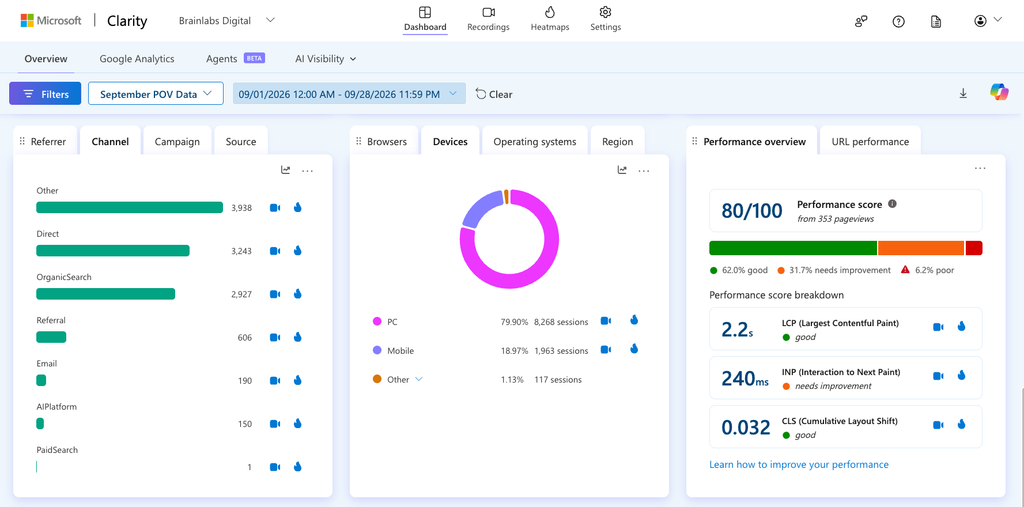
In a specific performance overview, the Brainlabs website scored 80 out of 100 across 353 pageviews. While this represented a relatively small sample size, it offered a valuable snapshot. Largest Contentful Paint (LCP) was recorded at a good 2.2 seconds, but Interaction to Next Paint (INP) at 240 milliseconds was flagged for improvement. During the same period, 6.75% of sessions exhibited dead clicks, and 2.92% involved quick backs, indicating potential areas of user frustration or confusion.
The session recordings provide a deeper layer of context to these broader performance metrics. An error report might indicate that something has gone wrong, but a session recording reveals precisely what a visitor was doing at the moment the issue occurred. This was particularly evident when examining the client feedback page. The company’s internal culture emphasizes "Feedback is a Gift," making a malfunctioning feedback form a critical issue to address promptly. Clarity identified a session where a client encountered repeated JavaScript errors and made multiple attempts to submit feedback. Although this single session did not definitively indicate a widespread trend, it pinpointed the exact location and nature of the problem, enabling a targeted investigation.
Expanding the Measurement Stack for Comprehensive Insights
After several weeks of rigorous testing, Microsoft Clarity has emerged as a valuable addition to the Brainlabs Digital measurement stack, offering a distinct perspective on website access and usage. While Google Analytics remains central to their reporting, and existing AI visibility tools like Ahrefs, Peec.ai, and seoClarity continue to provide crucial organic performance context, Clarity’s strength lies in its detailed bot activity analysis and its ability to connect site errors directly to real user behavior.
It is important to acknowledge that many AI visibility features are still in their nascent stages, meaning the quality of the data is contingent on proper configuration, the clarity of the questions being asked, and the careful interpretation of the results. Furthermore, some of the most impactful insights are often found beyond the main dashboards, requiring a degree of active exploration to fully understand the platform’s capabilities.
For marketers considering Microsoft Clarity, its free accessibility makes it a compelling option to explore. The recommended approach is to begin by clearly defining the questions they aim to answer, identifying any gaps in their current measurement tools, connecting relevant data sources, and dedicating time to thoroughly understand the metrics presented across each dashboard. This proactive and analytical approach is key to harnessing the full power of emerging analytics platforms in an increasingly complex digital environment. The evolution of web traffic, with bots playing an ever-larger role, necessitates a corresponding evolution in how we measure and understand online interactions, ensuring that both human and machine activities are accounted for in the pursuit of effective digital strategies.


 Siti Muinah