The digital marketing landscape has undergone a seismic transformation, moving beyond traditional search engine optimization (SEO) into the realm of AI visibility. As buyers increasingly turn to sophisticated AI answer engines like ChatGPT, Perplexity, and Gemini for their initial research, the imperative for brands to optimize their presence within these conversational interfaces has never been greater. This shift has given rise to a new category of tools: AI visibility platforms, which extend beyond mere monitoring to empower marketing teams with the ability to close critical citation gaps, integrate AI search data with CRM attribution, and scale programs across diverse regions and complex content workflows. In this rapidly evolving environment, while platforms like Peec AI have established a foothold in tracking AI visibility, the market is burgeoning with robust alternatives, each offering unique strengths to address the multifaceted challenges marketers face in 2026 and beyond.
The Paradigm Shift: From Traditional SEO to AI-Native Optimization
For years, the bedrock of digital discovery was Google’s traditional search results page. Marketers meticulously tracked keyword rankings, organic traffic, and click-through rates, optimizing content to climb the SERPs. However, the advent and rapid adoption of large language models (LLMs) and AI-powered search interfaces have fundamentally altered this paradigm. Instead of typing queries into a search bar, users are now prompting AI systems with complex questions, seeking synthesized answers, comparisons, and recommendations directly. This behavioral shift means that a brand’s appearance, context, and sentiment within an AI-generated response often precede any direct visit to a company website. Studies indicate a significant and growing percentage of users now rely on AI for initial product research, industry insights, and vendor evaluations, making AI visibility a critical precursor to traditional web traffic and ultimately, revenue.
This evolution has rendered the 2021 SEO framework increasingly inadequate. Marketers can no longer solely rely on metrics designed for a world where Google was the undisputed gateway to information. The new battleground is "presence" – how often, how prominently, and how favorably a brand is cited by AI systems. This is where AI visibility monitoring, often referred to as AI brand monitoring or Answer Engine Optimization (AEO), steps in. It’s the practice of systematically tracking a brand’s appearance within AI-generated responses, identifying sources, analyzing sentiment, and understanding competitive positioning.
Peec AI: A Pioneer in AI Visibility and its Limitations
Peec AI emerged as one of the early innovators in this space, specifically designed to track brand mentions, citation frequency, and sentiment across up to ten major AI models. Its core strength lies in measuring "presence" rather than just clicks or rankings. It identifies where a brand appears within an AI’s answer, and whether that framing is positive, neutral, or negative. Crucially, Peec AI’s Source Identification feature allows teams to reverse-engineer why an AI might recommend a competitor, by surfacing the specific third-party reviews, comparison pages, or documentation cited. This granular citation analysis is a significant departure from traditional link analysis, offering invaluable insights for content and SEO teams seeking to build authority in the AI era. Peec AI also provides a useful distinction between Google AI Overviews and Google AI Mode, ensuring more accurate reporting.
However, despite its foundational capabilities, Peec AI presents certain limitations that have spurred the development of more comprehensive alternatives. Its primary shortcomings include:
- Remediation Gaps: While Peec AI excels at identifying visibility gaps and opportunities, it does not provide integrated tools for content generation or workflow automation to fix these gaps. Teams are left to create briefs, draft copy, and manage publishing independently.
- Attribution Deficit: A significant drawback for revenue-focused teams is the absence of native CRM integration. Visibility data remains siloed within Peec AI’s dashboard, requiring manual export, separate attribution modeling, and ongoing maintenance to connect it to pipeline, revenue, or campaign performance.
- Historical Data Void: Tracking commences only upon subscription, meaning no historical data backfill is available. This prevents benchmarking against past performance or understanding long-term AI visibility trends before tool adoption.
- Platform Coverage Nuances: While covering popular engines, Peec AI may miss some emerging AI surfaces. Furthermore, its prompt methodology relies on AI-generated queries rather than real user prompts, which can impact the accuracy and relevance of reported visibility.
These limitations highlight a critical market need for platforms that not only monitor but also enable action, attribution, and enterprise-grade scalability.
Leading Alternatives for 2026: A Deep Dive into Enhanced Capabilities
-1.png)
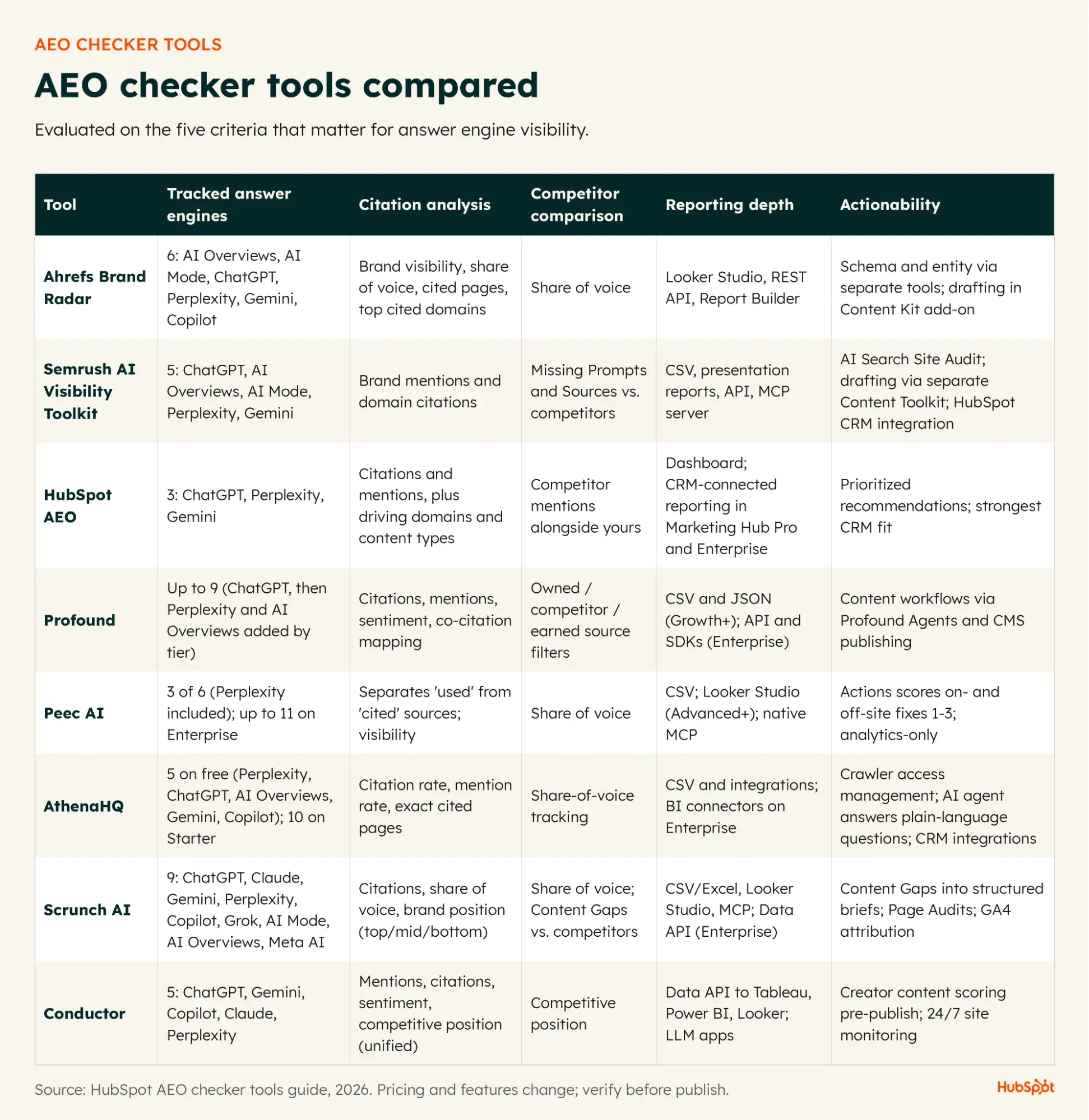
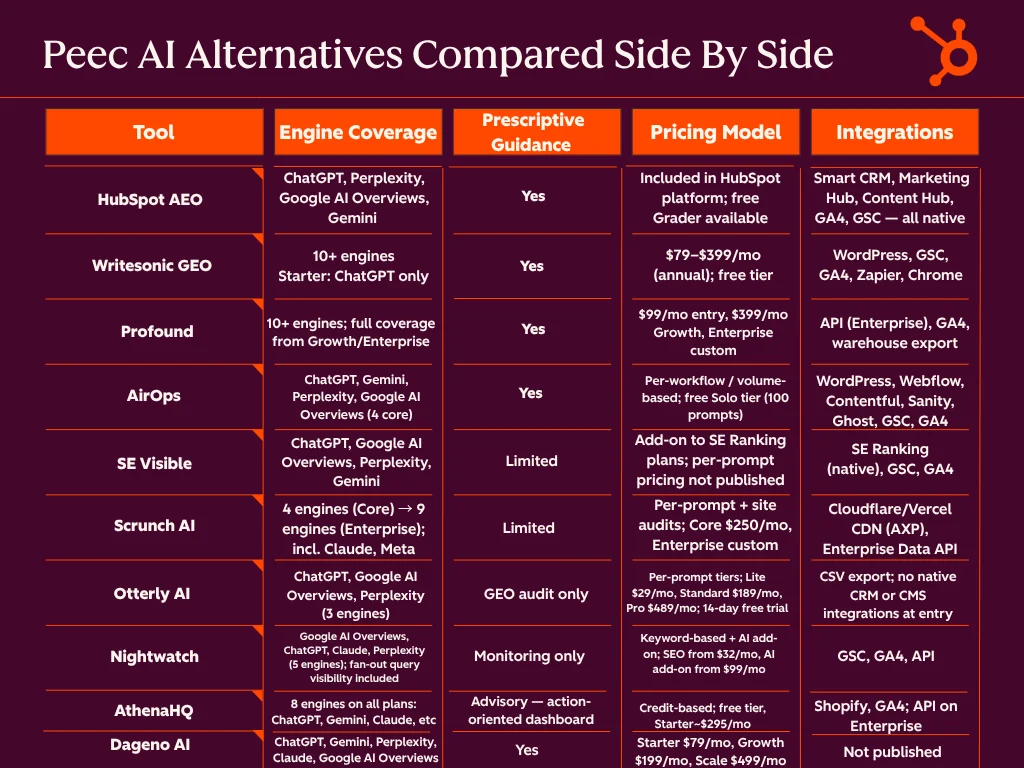
The market for AI visibility platforms is diversifying, with solutions tailored to various organizational needs, from comprehensive CRM integration to advanced content generation and enterprise-level analytics. The strongest alternatives for 2026 are designed to move beyond mere dashboards, offering actionable insights and integrated workflows.
1. HubSpot AEO: Bridging Visibility to Revenue
- Best For: B2B marketing and RevOps teams demanding native CRM attribution.
- Key Differentiator: HubSpot AEO stands alone as the only platform in this category built natively within a CRM. It seamlessly integrates AI brand mentions, citation rates, prompt share of voice, and competitive benchmarks directly into HubSpot’s Smart CRM. This means AI visibility data lives alongside contact records, deal stages, and campaign performance, eliminating the need for custom integrations or manual data reconciliation.
- Implications: This native integration provides immediate context for sales teams, allowing them to see if a prospect was influenced by a ChatGPT citation before any direct interaction. For RevOps, it directly closes the loop on whether AEO programs are generating measurable revenue, a challenge that typically consumes significant time and resources with other platforms.
- Limitations: Teams prioritizing deep prompt dataset analytics or AI crawler diagnostics might find specialist tools more capable in those specific niches.
- Pricing: Starts at $50/month (standalone) or included in Marketing Hub Professional and Enterprise. A free AI Search Grader is available for baseline benchmarking.
2. Writesonic GEO: The Power of Prescriptive Content
- Best For: Teams whose primary bottleneck is executing on identified visibility gaps.
- Key Differentiator: Writesonic GEO offers an end-to-end solution, not just showing AI visibility but also explaining why citations are missing, and then enabling immediate content creation to address those gaps. Its integration between visibility data and content generation is highly advanced, allowing teams to act on insights without switching tools.
- Implications: This integration creates a compounding advantage for content-heavy operations, streamlining the workflow from insight to content production.
- Limitations: The monitoring layer is relatively newer and less established than those of dedicated trackers. Engine coverage on entry plans can be slightly narrower.
- Pricing: Starts at $79/month, making it a budget-friendly option that combines both writing and monitoring.
3. Profound: Enterprise-Grade Analytics and Security
- Best For: Enterprise marketing teams, large agencies, and organizations with strict security and compliance requirements.
- Key Differentiator: Profound offers a comprehensive suite for tracking brand mentions, citations, sentiment, and prompt volume across over 10 AI platforms. Its "Agents" feature can generate AEO-optimized content at scale, with human oversight. Profound boasts an industry-leading prompt dataset, with over 1.5 billion real user prompts and 400 million anonymized conversations, lending significant credibility to its measurement.
- Implications: The combination of real user prompt data and integrated content creation capacity makes Profound a powerful single platform for organizations that demand both robust measurement and scalable execution. Its enterprise-grade security features (SSO, role-based access, data residency) align with stringent corporate governance.
- Limitations: Price is a significant factor, with the Growth plan starting at $399/month. It can be overkill for smaller teams or nascent AEO programs.
4. AirOps: Scaling AI Optimization for Agencies
- Best For: Content operations teams and agencies managing multiple brands or extensive content libraries.
- Key Differentiator: AirOps is a content operations platform that integrates AEO research and visibility analysis. Its "Insights" feature tracks citation rate, mention rate, and sentiment, while "Page360" connects this data to Google Search Console and GA4. Crucially, "Quill" (AirOps’ Playbooks) can research, draft, and publish content directly to various CMS platforms like Webflow, WordPress, and Contentful.
- Implications: For agencies, the templated Playbooks and direct CMS publishing offer significant operational leverage, transforming insights into published content within a unified workflow across multiple clients.
- Limitations: Its tracking depth is newer than dedicated monitors. Teams focused purely on measurement might find themselves paying for underutilized production capabilities.
- Pricing: Free entry tier available; paid plans scale with volume and complexity.
5. SE Visible (by SE Ranking): Integrated SEO and AEO
- Best For: Teams already utilizing SE Ranking for traditional SEO who seek a unified SEO + AEO solution.
- Key Differentiator: SE Visible integrates AI overview tracking intelligence directly into the established SE Ranking ecosystem. This provides marketers with over 13 years of historical SEO context alongside new AI-tracking capabilities. The inclusion of unlimited seats across all plans enhances accessibility for entire marketing teams.
- Implications: This unified approach eliminates the need for a separate AEO subscription, offering efficiency for teams balancing traditional SEO and emerging AEO strategies. The historical SEO data provides valuable comparative benchmarking.
- Limitations: The AI visibility data is relatively newer. Teams solely focused on AEO might find the extensive SEO features to be unnecessary overhead.
6. Scrunch AI: Unveiling AI Crawler Insights
- Best For: Enterprise brands and agencies requiring AI crawler analytics in addition to standard visibility tracking.
- Key Differentiator: Scrunch AI operates at the enterprise level, augmenting standard brand visibility tracking with AI crawler analytics. This unique feature reveals how AI bots and agents interact with a website before synthesizing their answers. Its Agent Experience Platform (AXP) automatically serves AI-optimized content to AI agents without affecting the human-facing site.
- Implications: For technical SEO teams, understanding the AI crawling process offers a fundamentally different diagnostic capability, moving beyond outputs to analyze inputs. This allows for deeper optimization strategies.
- Limitations: The entry-level Core plan at $250/month is a significant investment. While audit and optimization features are strong, its content generation layer is less developed than Writesonic or AirOps.
Cost-Effective Solutions: Otterly AI and AthenaHQ
For startups, SMBs, solo founders, or teams piloting AEO programs on a limited budget, several credible low-cost or free options exist:
7. Otterly AI: Best for Low-Cost Entry

- Best For: Startups, SMBs, and teams testing AEO before committing to enterprise pricing.
- Key Differentiator: Starting at $29/month, Otterly AI offers robust brand mention and citation tracking across multiple answer engines, holding a 4.9/5 G2 rating. Its GEO audit feature evaluates 25+ on-page factors and provides fix-it checklists, offering a thin optimization layer uncommon in entry-tier tools.
- Implications: Provides a genuine monitoring capability at an accessible price point, allowing small teams to establish a baseline for measurement without substantial financial commitment.
- Limitations: Narrower engine coverage (3 engines vs. 10+ for top-tier tools) and lack of CRM integrations at entry price points. The jump to higher tiers can be steep.
8. AthenaHQ: Best for Starting Without a Budget Commitment
- Best For: Early-stage programs, teams evaluating AEO for the first time, and organizations needing a proof of concept.
- Key Differentiator: AthenaHQ offers a free entry tier, a significant advantage for teams needing to demonstrate value before securing budget. It functions as a brand intelligence tool with AI visibility capabilities, tracking mentions, citations, and competitive share of voice.
- Implications: Allows organizations to build a data-driven business case for AEO investment using real data from the free tier.
- Limitations: Lacks auditing and optimization capabilities, and enterprise-grade security features are limited. It’s a starting point, not a long-term solution for serious AEO programs.
9. Nightwatch: Diagnosing the "Why" Behind AI Absence
- Best For: Teams seeking to understand the AI reasoning process and those for whom traditional rank tracking remains a primary job.
- Key Differentiator: Nightwatch is notable for its "fan-out query visibility," which reveals the real-time web searches AI systems conduct before composing their answers. Starting at $32/month for base SEO monitoring and $99/month for the AI tracking add-on, it covers Google AI Overviews, ChatGPT, Claude, and Perplexity.
- Implications: This diagnostic capability shows not just that a citation is missing, but why, by revealing the AI’s information-gathering process. This is invaluable for content and SEO teams looking to understand citation pathways.
- Limitations: Engine coverage is narrower than enterprise alternatives, and the layered subscription model for SEO and AI tracking can feel fragmented.
10. Dageno AI: Ambitious Full-Workflow Execution
- Best For: Teams seeking to transition from monitoring to execution within a single platform, without immediate enterprise pricing.
- Key Differentiator: Dageno AI is a newer entrant with an ambitious scope, aiming to provide a full workflow from data monitoring to strategy, content generation, and result attribution. It positions itself as a direct upgrade path for teams ready to close visibility gaps identified by tools like Peec AI.
- Implications: Its focus on an integrated attribution layer is a key advantage, attempting to connect content actions directly to visibility outcomes and, ultimately, ROI.
- Limitations: As an early-stage tool, the breadth of its claims requires careful validation during a trial period, as the depth of each capability is still developing.
Strategic Considerations for Tool Selection: Beyond the Dashboard
Choosing the right AI visibility platform is a strategic decision that extends beyond simply comparing feature lists. The most effective selection process involves evaluating a tool’s capacity to integrate with existing workflows, demonstrate measurable ROI, and scale with evolving business needs.
Connecting AI Visibility to Measurable ROI: The Attribution Imperative
The most common pitfall in AEO programs is the failure to connect visibility data to tangible business outcomes. An AI visibility tool becomes a revenue-generating investment only when it’s integrated into an organization’s attribution model.
- Tag AI-Sourced Traffic: Implement dedicated UTM parameters for AI-sourced campaigns and configure channel groupings in GA4 to capture known AI referrer patterns (e.g., perplexity.ai, chatgpt.com). Ensure your CRM (like HubSpot’s Smart CRM) captures this source data at contact creation.
- Standardize Tracking: Every piece of content published as part of an AEO workflow should include campaign parameters that link back to the specific AI visibility gap it was designed to close. This creates a clear lineage from "tool X identified a gap for [query Y]" to "content Z was published, generating N pipeline-influenced contacts."
- CRM Dashboarding: Build custom CRM dashboards that surface AI-sourced contacts by lifecycle stage, deal stage, and revenue. Presenting leadership with a pipeline view filtered by "originated from AI search" fundamentally shifts budget conversations.
The AEO Playbook: From Monitoring to Action
Effective AEO programs follow a repeatable six-step cycle:
- Prompt Research: Identify high-value buyer intent queries across target personas.
- Prompt Engineering: Craft and test prompts to elicit specific AI responses.
- Content Strategy: Map prompt gaps to content opportunities (new content, refreshes).
- Content Creation: Develop AI-optimized content with an "answer-first" approach.
- Distribution & Authority Building: Publish and promote content to establish citation authority.
- Measurement & Iteration: Track AI visibility, citation rates, and revenue impact, then refine the strategy.
Tools like HubSpot Content Hub can provide the workflow infrastructure for briefs, approvals, and asset management, while HubSpot’s AI tools can accelerate prompt generation and content drafting, creating a closed loop from gap detection to measurement.
.png?width=650&height=488&name=White%20Simple%20Comparison%20Graph%20(2).png)
The Future of Search: AI Visibility as a Core Competency
The trajectory of digital search indicates an increasing reliance on AI-synthesized information. As AI models become more sophisticated, personalized, and integrated into daily workflows, a brand’s AI visibility will become an indispensable component of its overall digital strategy. The tools discussed here represent the current cutting edge, empowering marketers to not only observe this shift but actively participate in shaping their brand’s narrative within the AI landscape.
Frequently Asked Questions About AI Visibility Alternatives
Is there a low-cost AI visibility alternative worth testing first?
Absolutely. Otterly AI, starting at $29/month with a 14-day free trial, provides credible monitoring across ChatGPT, Google AI Overviews, and Perplexity. AthenaHQ offers a free entry tier, ideal for proof-of-concept. Nightwatch, with base SEO monitoring from $32/month and an AI tracking add-on at $99/month, also offers an affordable entry. These options allow teams to establish a baseline before committing to larger investments. For scalable growth and native CRM integration, teams often migrate to solutions like HubSpot AEO.
Which AI visibility alternatives provide actual optimization recommendations?
Writesonic GEO and AirOps lead in providing actionable optimization workflows, as both identify gaps and offer integrated tools for content creation and remediation. Profound’s "Agents" feature also facilitates AEO-optimized content generation at scale. Otterly AI includes a GEO audit feature with fix-it checklists for on-page factors. Tools like Peec AI, Scrunch AI, and AthenaHQ primarily focus on monitoring and require teams to independently devise solutions.
How do I validate the accuracy of AI visibility data?
To ensure accuracy, cross-reference your AEO tool’s data against multiple independent sources. Check Google Analytics 4 (GA4) for AI-referred sessions, Google Search Console for any AI Overview impression data, and perform manual spot checks by running the same prompts directly in ChatGPT, Perplexity, and Gemini to compare results. Crucially, investigate whether the tool uses real user prompts or synthetic queries; real user prompts offer a more accurate reflection of actual visibility. Profound, for instance, openly publishes its prompt methodology and dataset size, setting a benchmark for transparency.
Do these tools integrate with CRM and analytics for attribution?
Native CRM integration is a rarity in this category, with HubSpot AEO being the notable exception. Built directly into HubSpot’s Smart CRM, it provides seamless integration of AI visibility data, contact records, and deal attribution. For other tools, AirOps connects to Google Search Console and GA4 via Page360. Profound and Scrunch AI offer API access on enterprise plans, enabling custom CRM connections. Most other tools rely on CSV exports or Zapier-compatible webhooks for data transfer. For robust attribution, integrating your chosen AEO tool with HubSpot Smart CRM via API or Zapier, and utilizing custom properties for AI-sourced leads, is the most reliable approach.
What’s the best AI visibility alternative for multi-language brands?
Peec AI itself is a strong contender for multi-language and multi-country tracking. Among alternatives, Profound and Scrunch AI offer multi-region tracking at their enterprise tiers. SE Visible leverages SE Ranking’s established multi-language keyword infrastructure. For global brands, the key is to assess whether multi-language support is natively built into the core platform for reliable cross-market reporting, rather than offered as a bolt-on feature.
Conclusion: Making an Informed Decision
The optimal AI visibility platform is not a one-size-fits-all solution. The choice hinges on an organization’s specific needs, budget, and the most pressing limitations in its current digital marketing strategy. For teams requiring direct CRM integration and revenue attribution, HubSpot AEO stands as the sole native solution. For overcoming content production bottlenecks, Writesonic GEO and AirOps offer integrated monitoring and creation capabilities. Enterprises prioritizing security, compliance, and deep analytics will find Profound to be a powerful ally. Those seeking to understand the why behind AI’s citations can leverage Nightwatch’s diagnostic depth. And for budget-conscious teams or those in early-stage programs, Otterly AI and AthenaHQ provide credible starting points. The underlying principle remains: tools that facilitate action and measurable outcomes will drive genuine program value, far surpassing those that merely present data in a dashboard. Begin by establishing a baseline with a free tool like the AI Search Grader, then strategically select the alternative that best addresses your unique challenges and propels your brand’s presence in the AI-driven future.