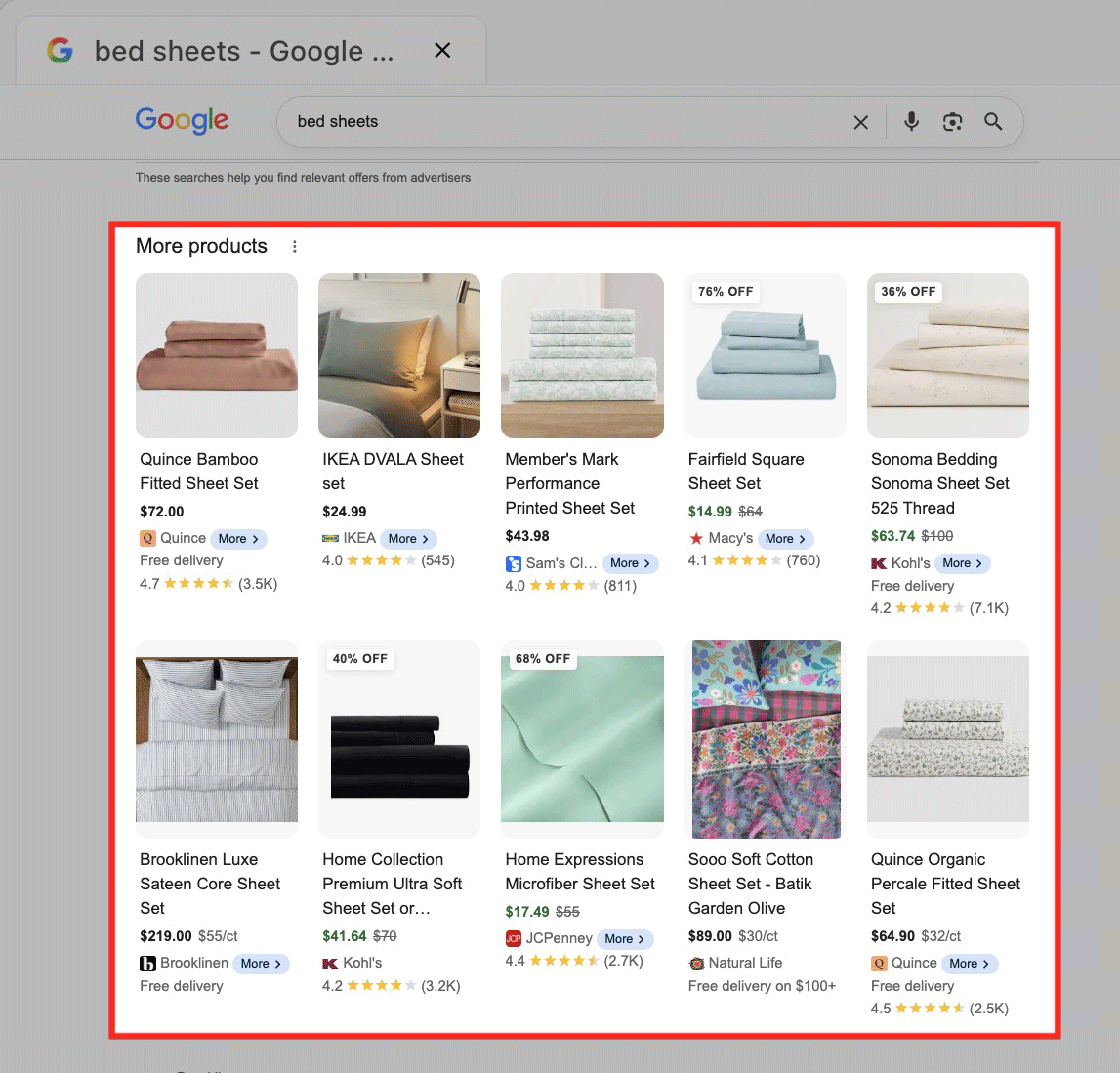
Google is currently conducting tests within its search interface, specifically for shopping results, by introducing a visually prominent blue background color for the "More" link that appears within product grids. This experimental alteration aims to enhance user experience by making the option to view additional retailers for a specific product more noticeable, a significant departure from the standard, less conspicuous text link previously employed.
The observation of this new interface element was initially reported by Bordie Clark, who shared findings across platforms including X (formerly Twitter) and SERPalerts. Clark noted that "Google is testing out a prominent ‘More >’ blue label within product grids to highlight when additional retailers are advertising a product." He further elaborated on the contrast with the existing system, stating, "Normally, free listings will display with the ‘& more’ text when multiple retailers stock an item, which is less visible than this experiment." This test, while not yet widely replicable across all user accounts, signals Google’s continuous efforts to refine its e-commerce integration within the core search experience.
The Evolving Landscape of Google Shopping
Google’s journey into e-commerce has been extensive and marked by several strategic shifts aimed at capturing a larger share of the burgeoning online retail market. From its early days as Froogle, later rebranded as Google Product Search, and then evolving into the comprehensive Google Shopping platform, the tech giant has consistently sought to connect consumers with products and merchants. A pivotal moment occurred in 2020 when Google made it free for merchants to list their products on Google Shopping, a move widely seen as a direct challenge to Amazon’s dominance and an effort to democratize product discovery.
Prior to this shift, Google Shopping primarily operated on a paid model, where Product Listing Ads (PLAs) were the main vehicle for merchants to showcase their offerings. The introduction of free listings dramatically expanded the inventory of products available through Google Search, inviting a wider array of businesses, especially small and medium-sized enterprises (SMEs), to participate without an immediate advertising cost barrier. This strategic pivot underscored Google’s ambition to become a central hub for product discovery, not just through advertising, but through comprehensive organic listings as well.
The ongoing testing of UI elements, such as the prominent blue "More" link, is a natural progression of this strategy. By making it easier for users to discover additional retailers, Google aims to increase transparency, foster competition among merchants, and ultimately provide a more robust and satisfying shopping experience for consumers. These granular changes, though seemingly minor, often have significant implications for user engagement, click-through rates, and ultimately, merchant visibility and sales.
The Significance of User Interface (UI) and User Experience (UX) in E-commerce
In the hyper-competitive realm of online retail, every element of the user interface and overall user experience plays a critical role in guiding consumer behavior. A visually distinct "More" link is not merely an aesthetic change; it represents a deliberate attempt to influence user interaction. Psychology of color, particularly the use of blue, is often leveraged in web design. Blue is widely associated with trust, reliability, and functionality, and it is a common color for hyperlinks and call-to-action buttons, implicitly signaling interactivity.
For users navigating product grids, the immediate visibility of a clearly marked "More" option can significantly reduce friction in the shopping journey. Instead of scrolling or inferring that additional options exist, the prominent blue link acts as an explicit invitation to explore further. This can be particularly beneficial for products with many variants, different pricing options from multiple vendors, or those where less prominent retailers might offer competitive deals. Enhancing discoverability directly translates to a better user experience, as shoppers are empowered with more choices and potentially better value.
From a merchant’s perspective, this UI enhancement could be a double-edged sword but largely a positive one. While it might lead to more competition being surfaced for initial listings, it also means that their products, even if not among the first few displayed, have a greater chance of being discovered if a user clicks the "More" link. This could be particularly advantageous for smaller businesses or those with niche products that might otherwise be overlooked in a crowded marketplace. Any improvement in the clarity and prominence of calls to action (CTAs) generally leads to increased click-through rates (CTRs), which is a key metric for online visibility and potential conversions.
A Chronology of Google’s E-commerce Initiatives
Google’s foray into e-commerce has seen continuous evolution and strategic adjustments:
- 2002: Launch of Froogle: Google’s initial product search engine, aiming to index product listings from various online stores.
- 2007: Rebranding to Google Product Search: An evolution of Froogle, offering more advanced features and integration.
- 2012: Transition to Google Shopping and Paid Model: Google Product Search shifts to a commercial model, requiring merchants to pay for Product Listing Ads (PLAs) to appear in shopping results. This marked a significant change from its previous free listing approach.
- 2013-2019: Expansion of PLAs and Shopping Ads: Google significantly invested in its shopping ad formats, integrating them more deeply into the main search results page (SERP) and introducing various ad types like Showcase Shopping Ads and Local Inventory Ads.
- 2020: Introduction of Free Product Listings: In response to the growing e-commerce landscape and increased competition (especially from Amazon), Google announced that merchants could list their products for free on Google Shopping. This was a monumental shift, opening the platform to millions more businesses. This move aimed to provide more comprehensive product options for users and attract a broader base of merchants.
- 2020-Present: Continuous Integration and UI/UX Refinements: Google has consistently worked to integrate shopping features more seamlessly into the core search experience, introducing rich results, product carousels, and visual enhancements. The current test of the blue "More" link falls squarely within this ongoing strategy of incremental UI/UX improvements designed to optimize the shopping journey.
Supporting Data and Market Context
The global e-commerce market continues its rapid expansion, projected to reach trillions of dollars annually. Google, as a primary gateway to online information, holds a crucial position in this ecosystem. While Amazon dominates direct product searches, Google remains a significant force for product discovery, particularly for users beginning their search journey with a general query.
- Google’s Retail Search Share: According to various industry reports, Google continues to capture a substantial share of digital ad spending, with retail search advertising being a significant component. While precise figures vary, Google’s ad revenue from retail categories underscores its importance to merchants.
- Impact of UI on CTR: Studies on user interface design consistently show that clear, prominent, and well-designed calls-to-action can significantly increase click-through rates. For instance, changing button colors or making links more visually distinct can lead to double-digit percentage increases in engagement. A blue, highlighted "More" link is designed to be just such an enhancement.
- Merchant Dependence: Millions of businesses, from global brands to local shops, rely on Google Search and Google Shopping for visibility and customer acquisition. Any change that affects how their products are displayed or discovered has direct implications for their online sales strategies. The free listings initiative alone has been credited with providing a lifeline to many small businesses during challenging economic periods.
- Competitive Landscape: Google faces intense competition not only from Amazon but also from social media platforms (like Instagram Shopping, TikTok Shop) and other niche e-commerce sites. Continuous innovation in its shopping interface is essential for Google to maintain its relevance and attractiveness to both users and merchants.
Inferred Statements and Industry Reactions
While Google has not issued an official statement regarding this specific UI test, its general philosophy on product development offers insight. A hypothetical statement from Google’s e-commerce division might read: "Our commitment is to continually enhance the user experience on Google Search, connecting shoppers with the most relevant products and retailers. We regularly test new features and interface designs to ensure we’re providing comprehensive options and an intuitive shopping journey. These tests help us understand how users interact with product information and how we can better support both consumers and the vast ecosystem of merchants."
Industry analysts are likely to interpret this test as a strategic move. An analyst might comment: "This seemingly minor UI tweak with the prominent blue ‘More’ link is indicative of Google’s ongoing efforts to refine its shopping experience. By making it easier to discover additional retailers, Google aims to increase user engagement within its shopping ecosystem, potentially boosting competition among merchants, offering more choice to consumers, and ultimately, solidifying its position as a primary product discovery engine. It could also indirectly benefit Google by driving more interactions with free and potentially paid listings further down the funnel."
From a merchant’s perspective, especially those relying heavily on Google Shopping, the reaction would likely be cautiously optimistic. A representative for a small online retailer might state: "Any change that improves the visibility of our products and makes it easier for customers to find us, even if we’re not the first listing, is a welcome development. If a more prominent ‘More’ link drives more clicks, it could provide a significant boost to our traffic and sales, helping us compete more effectively against larger players."
Broader Impact and Implications
The implementation of a prominent blue "More" link in Google Shopping results carries several significant implications across various stakeholders:
- For Users: The primary beneficiaries are consumers. A clearer, more visible pathway to additional product options means more informed purchasing decisions, potentially better prices, and access to a wider array of retailers. This reduces the effort required to compare options, enhancing the overall convenience and satisfaction of online shopping.
- For Merchants and Advertisers: This change could significantly impact visibility for retailers whose products appear beyond the initial visible carousel. If the blue "More" link proves effective in driving clicks, it could lead to increased traffic for these "secondary" listings. This might necessitate a re-evaluation of bidding strategies for paid ads, as the entry point to a broader selection of products becomes more appealing. For merchants relying on free listings, it could level the playing field slightly, giving them a better chance to be discovered. The increased competition surfaced by a more accessible "More" link might also encourage merchants to optimize their product data, pricing, and availability to stand out.
- For Google: By enhancing the user experience and facilitating deeper exploration of product options, Google strengthens its position as a go-to platform for e-commerce. Increased engagement within its shopping ecosystem can lead to more data for refining search algorithms, potentially higher ad revenue (as more users interact with product listings, some of which are paid), and a more robust offering against direct competitors like Amazon. It reinforces Google’s strategic shift towards providing a comprehensive product discovery platform, integrating organic and paid listings seamlessly.
- SEO and SEM Strategies: For Search Engine Optimization (SEO) professionals, the emphasis remains on optimizing product feeds and structured data to ensure products are eligible for rich results and free listings. For Search Engine Marketing (SEM) specialists, monitoring the impact of this UI change on click-through rates for both organic and paid shopping results will be crucial. Understanding how users navigate from the initial product grid to the "More" options will inform future ad placement and budget allocation decisions.
In conclusion, Google’s continuous A/B testing, exemplified by the blue "More" link in shopping results, is a testament to its relentless pursuit of refining the user experience and bolstering its presence in the e-commerce sector. While a seemingly minor visual adjustment, such changes reflect a deeper strategic imperative to connect consumers with a broader range of products and merchants, fostering a more dynamic and competitive online shopping environment for all involved. As these tests roll out, their impact will be closely watched by users, merchants, and industry analysts alike, shaping the future of product discovery on the world’s leading search engine.


 Pevita Pearce
 Nila Kartika Wati