

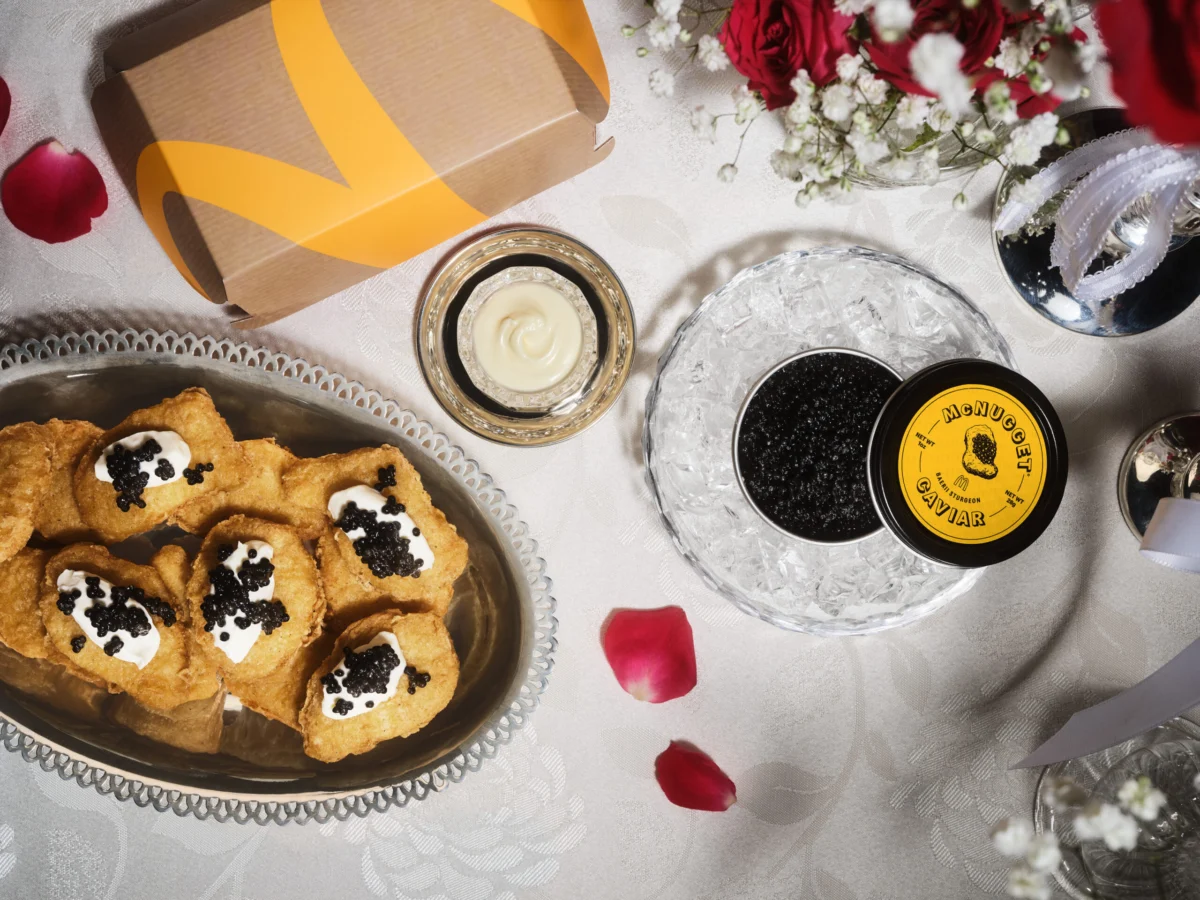
The intersection of high-culture luxury and mass-market convenience has long been a fertile ground for experimental marketing, but few campaigns have captured the cultural zeitgeist as effectively as the recent collaboration between McDonald’s and Paramount Caviar. What began as an organic social media trend, characterized by fans topping their Chicken McNuggets with dollops of expensive sturgeon roe, was transformed into a masterclass in PR agility and brand resonance. By leveraging “social listening” and lean, earned-media strategies, McDonald’s and its PR agency, Golin Ketchum, turned a seemingly absurd food pairing into a sold-out sensation that dominated digital conversations and redefined the “date night” for a budget-conscious generation.
The Genesis of a High-Low Culinary Phenomenon
For decades, caviar was synonymous with the upper echelons of society, associated with white tablecloths, mother-of-pearl spoons, and prohibitive price tags. Conversely, the Chicken McNugget has stood since 1983 as the ultimate symbol of accessible, standardized fast food. The collision of these two worlds was not a boardroom invention but a grassroots movement born on social media platforms like TikTok and Instagram.
The trend first gained significant momentum during the U.S. Open, an event where luxury hospitality often meets casual snacking. Shortly thereafter, the pairing received the ultimate “celebrity stamp of approval” when global icon Rihanna was documented sampling the combination. This wasn’t just a flash-in-the-pan moment; search behavior began to reflect a growing curiosity. Data from Google Trends indicated that searches for “chicken caviar” were not only rising but were projected to peak in early February.
For McDonald’s, the challenge was not to create a trend, but to validate one. Liz Fernandez, director of brand communications at McDonald’s, noted that the brand’s approach to modern campaigns is rooted in authenticity rather than mere ideation. The goal was to identify a “fan truth”—a behavior already existing within the community—and provide the tools to elevate it.
A Chronology of Strategic Execution
The path from social listening to a physical product drop required a precise timeline and a deep understanding of cultural hooks. The campaign was structured around several key phases:
- Identification (Late 2023): McDonald’s social monitoring teams flagged a recurring behavior where users were purchasing “high-low” snacks. The specific pairing of McNuggets and caviar emerged as the most visually arresting and conversation-starting iteration.
- Strategic Alignment (January 2024): Working with Golin Ketchum, the brand decided to target Valentine’s Day. The choice was tactical; Gen Z consumers were increasingly vocal about the “dating crisis,” citing the high costs of traditional romantic outings. Positioning a McDonald’s-based caviar kit as a “wallet-friendly date night” provided a solution to a real-world consumer pain point.
- Partnership Forging: To maintain the “high” half of the high-low equation, McDonald’s partnered with Paramount Caviar, a respected purveyor of luxury seafood. This ensured the campaign had culinary credibility and wasn’t seen as a mere gimmick.
- The Tease and Seed (Early February 2024): Instead of a traditional ad buy, the brand relied on earned media. Kits were sent to influential voices and traditional news outlets ahead of the official drop. This created a sense of exclusivity and “FOMO” (fear of missing out) before the general public could even access the site.
- The Drop (February 10, 2024): At 11:00 AM ET, the McNugget Caviar kits were made available for free on a dedicated microsite.
Supporting Data and Digital Impact
The scale of the campaign’s success is best illustrated through its digital metrics. When the “McNugget Caviar” kits finally went live, the response was overwhelming. Despite only 750 kits being available—a number chosen to maintain extreme scarcity—the traffic to the promotional website was staggering.
According to internal data, more than 6 million people visited McNugget收Caviar.com during the launch window. The entire inventory sold out in less than two minutes. On X (formerly Twitter), “McNugget Caviar” ascended to the number one trending topic globally, outpacing traditional news cycles.
The reach of the campaign extended far beyond the 750 lucky recipients. During its launch week, the initiative secured 4,400 media placements across lifestyle, news, and business publications. The total social reach was estimated at a colossal 13.8 billion impressions. Perhaps most importantly for the brand’s bottom line, Fernandez reported a significant lift in purchase intent among consumers who were aware of the campaign, proving that even a limited-edition “free” giveaway can drive traffic back to the core menu.
The secondary market further validated the kit’s “icon” status. Within hours of the sell-out, kits began appearing on eBay with asking prices exceeding $300, a testament to the brand equity McDonald’s had successfully built around a box of nuggets and a tin of fish eggs.
Official Responses and Strategic Philosophy
The success of the campaign has provided McDonald’s with a blueprint for future activations. Meg Farquhar, executive vice president and executive creative director at Golin Ketchum, emphasized that the campaign worked because it leaned into the “ILY” (I Love You) sentiment of Valentine’s Day without the corporate stuffiness. “Nothing says ‘ILY’ quite like a limited drop… and the best part? It’s on us,” the company stated in its official press announcement.
However, the rapid sell-out also provided a learning opportunity regarding demand management. Liz Fernandez admitted that the only regret was the limited quantity. “The fan response truly surpassed our expectations,” she stated. She noted that for future “drops,” the communication regarding sell-outs is just as critical as the launch itself. Disappointed fans require clear language and immediate updates to maintain brand affinity even when they miss out on a promotion.
This “fan-first” philosophy marks a shift in how legacy brands interact with younger demographics. Rather than telling consumers how to enjoy their food, McDonald’s is now observing how they already enjoy it and then joining that conversation as a facilitator.
Analysis of Implications: The Future of “Earned-First” Marketing
The McNugget Caviar campaign serves as a significant case study for the broader marketing industry, particularly in its total reliance on earned media. In an era where consumers are increasingly adept at tuning out paid advertisements and sponsored content, the “earned-first” approach focuses on creating “news” rather than “ads.”
By identifying a “fan truth”—the existing habit of pairing nuggets with caviar—McDonald’s avoided the “cringe” factor often associated with brands trying too hard to be “hip.” The campaign felt additive to the culture rather than forced upon it.
Furthermore, the campaign highlights the power of “High-Low” branding. In a bifurcated economy, where luxury goods and discount retail are both seeing growth while the middle market struggles, bridging the gap between these two extremes allows a brand to appeal to multiple psychological triggers: the desire for prestige and the thrill of a bargain.
For other brands looking to replicate this success, the lesson is clear: social listening must be more than just a metric in a monthly report. It must be a source of creative inspiration. As Fernandez noted, the first step is to watch how customers use a product when the brand isn’t looking. Whether it is a specific way of dipping a fry or an unlikely flavor combination, these organic behaviors are the seeds of the next viral campaign.
Conclusion: Lessons for the Industry
The “McNugget Caviar” kit was more than just a quirky Valentine’s Day promotion; it was a demonstration of how a 70-year-old brand can remain at the center of cultural relevance. By combining data-driven insights (Google Trends) with celebrity influence (Rihanna) and a timely seasonal hook (Valentine’s Day), McDonald’s and Golin Ketchum created a moment that felt both exclusive and inclusive.
The campaign’s legacy will likely be its proof of concept for “scarcity marketing” in the digital age. When 6 million people vie for 750 items, the brand wins not through sales of the item itself, but through the massive “halo effect” that elevates the entire product line. As fast-food competition intensifies, the ability to turn a simple chicken nugget into a luxury status symbol is perhaps the most valuable tool in a marketer’s arsenal. Moving forward, the industry can expect to see more legacy brands mining social media for “fan truths,” proving that sometimes the best ideas aren’t dreamed up in a conference room, but discovered in a TikTok comment section.









