The digital marketing landscape is undergoing a profound transformation, driven by the ascendancy of artificial intelligence in search. At the forefront of this evolution is AI search optimization, often referred to as Answer Engine Optimization (AEO), a strategic discipline focused on enhancing a brand’s likelihood of being cited and mentioned by generative AI tools such as ChatGPT, Gemini, and Google’s AI Overviews. This nascent field is rapidly proving its value, not through sheer volume of traffic, but through the exceptional quality and intent of the visitors it delivers. A groundbreaking study by Microsoft Clarity, encompassing over 1,200 publisher and news sites, revealed that visitors referred by AI tools convert at an astonishing rate, signing up for services at roughly 11 times the rate of those arriving via traditional search. This compelling data underscores the immediate and significant impact AEO can have on a brand’s conversion funnel, repositioning it as an indispensable component of modern digital strategy.
The Shifting Paradigm: From Keywords to Conversational AI
For decades, search engine optimization (SEO) has revolved around keywords, backlinks, and technical prowess to rank highly in traditional search results. However, the introduction and rapid adoption of large language models (LLMs) have fundamentally altered how users interact with information. Instead of scanning lists of links, users are increasingly turning to AI answer engines to receive direct, synthesized responses to complex queries. This shift from transactional keyword searches to conversational information retrieval has necessitated a new approach to digital visibility: AEO. While various terms like generative engine optimization (GEO), AI SEO, and LLM optimization (LLMO) circulate within the industry, HubSpot champions the term Answer Engine Optimization (AEO) to accurately reflect its core objective: optimizing content to be the definitive answer for AI.
AEO does not replace traditional SEO; rather, it builds upon and complements it. Strong foundational SEO practices – ensuring content is crawlable, well-structured, and authoritative – provide the bedrock upon which AEO strategies are built. The distinction lies in the primary goal: SEO aims to drive clicks to a website, while AEO strives for a brand’s content to be directly incorporated and cited within an AI-generated answer. The benefits for brands are multifaceted: increased brand visibility within AI responses, enhanced credibility through direct citation, and, critically, higher conversion rates from the high-intent audience that AI referrals attract.
While AI search traffic currently constitutes a smaller percentage compared to traditional search, its growth trajectory and conversion power are undeniable. Data from Semrush indicates that AI traffic experienced a remarkable 66.02% growth in 2025, outpacing almost every other digital channel except paid search. Despite accounting for only 0.14% of total visits, this growth rate signals a significant trend. Ahrefs’ May 2026 data further clarifies that AI search still represents less than 1% of the total search share. However, these figures alone do not convey the full story. The true impact of AI lies in its ability to influence purchasing decisions and shape brand perception without requiring a user to click through to a website. When AI answers directly inform buyer choices, brands must ensure they are controlling the narrative presented by these powerful new gatekeepers of information.
Deconstructing AI Search: How Content is Discovered and Cited
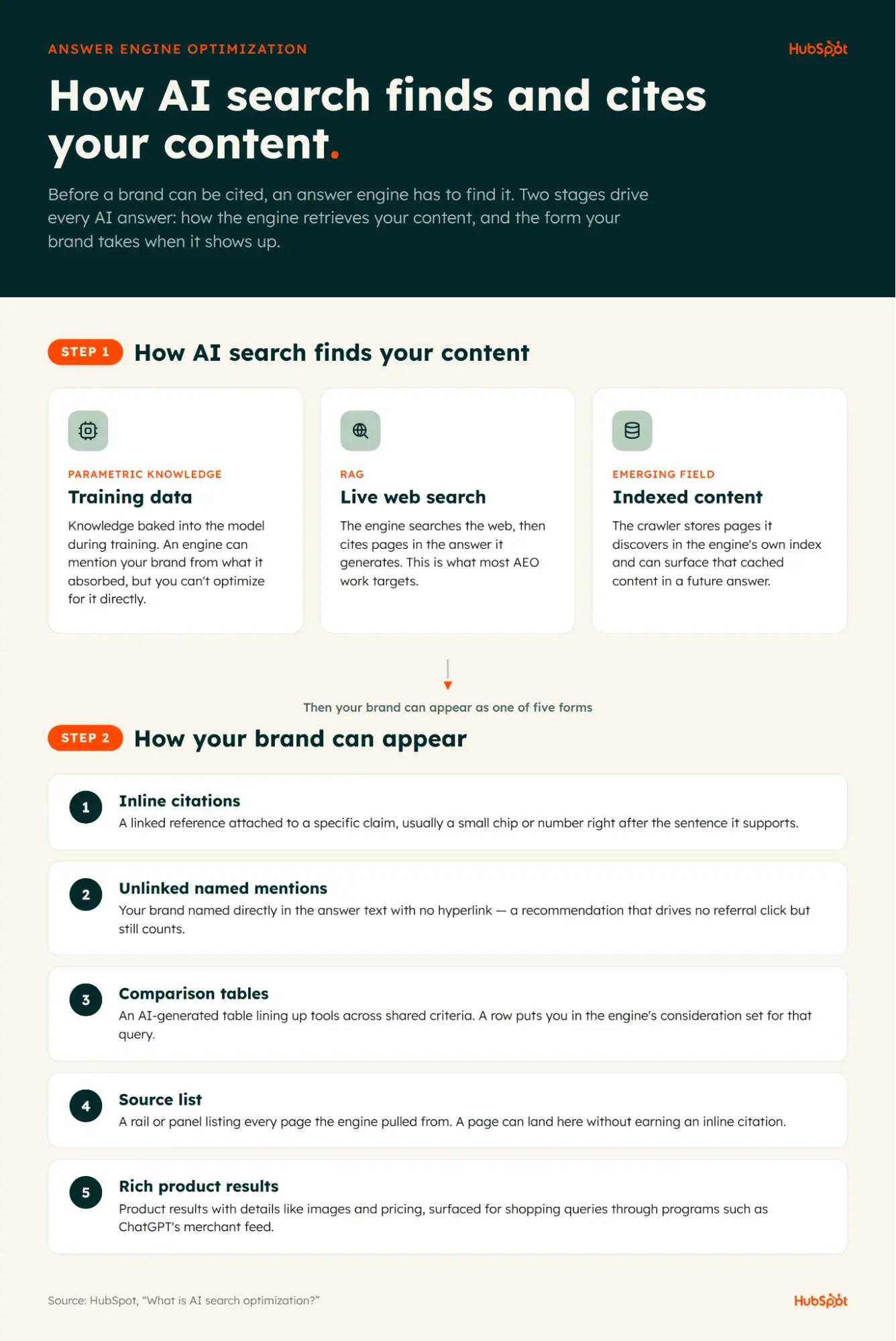
AI answer engines, powered by sophisticated LLMs, employ various mechanisms to discover and cite content. These models are trained on vast datasets, enabling them to understand and generate human-like text. When it comes to surfacing brand content, AI can draw from a wide array of sources, both owned and third-party.
Content Types That AI Search May Cite:
AI engines are not limited to traditional web pages. They can pull information from:
- Owned Web Properties: This includes websites, blog posts, landing pages, product pages, and resource hubs.
- Social Media Profiles: Public profiles and content on platforms like LinkedIn, X (formerly Twitter), Facebook, and Instagram.
- Review Sites: Customer reviews and brand mentions on platforms such as G2, Capterra, Yelp, and Trustpilot.
- News Articles and Press Releases: Coverage in journalistic publications and official company announcements.
- Forums and Community Boards: Discussions on platforms like Reddit, Quora, and industry-specific forums.
- Video Transcripts: Content derived from spoken words in YouTube videos and other video platforms.
- E-commerce Product Listings: Detailed product information, images, and pricing data from online stores.
Where Brands Can Appear in AI Search:
Brands can achieve visibility within AI answers in several distinct forms, each with unique implications:
-
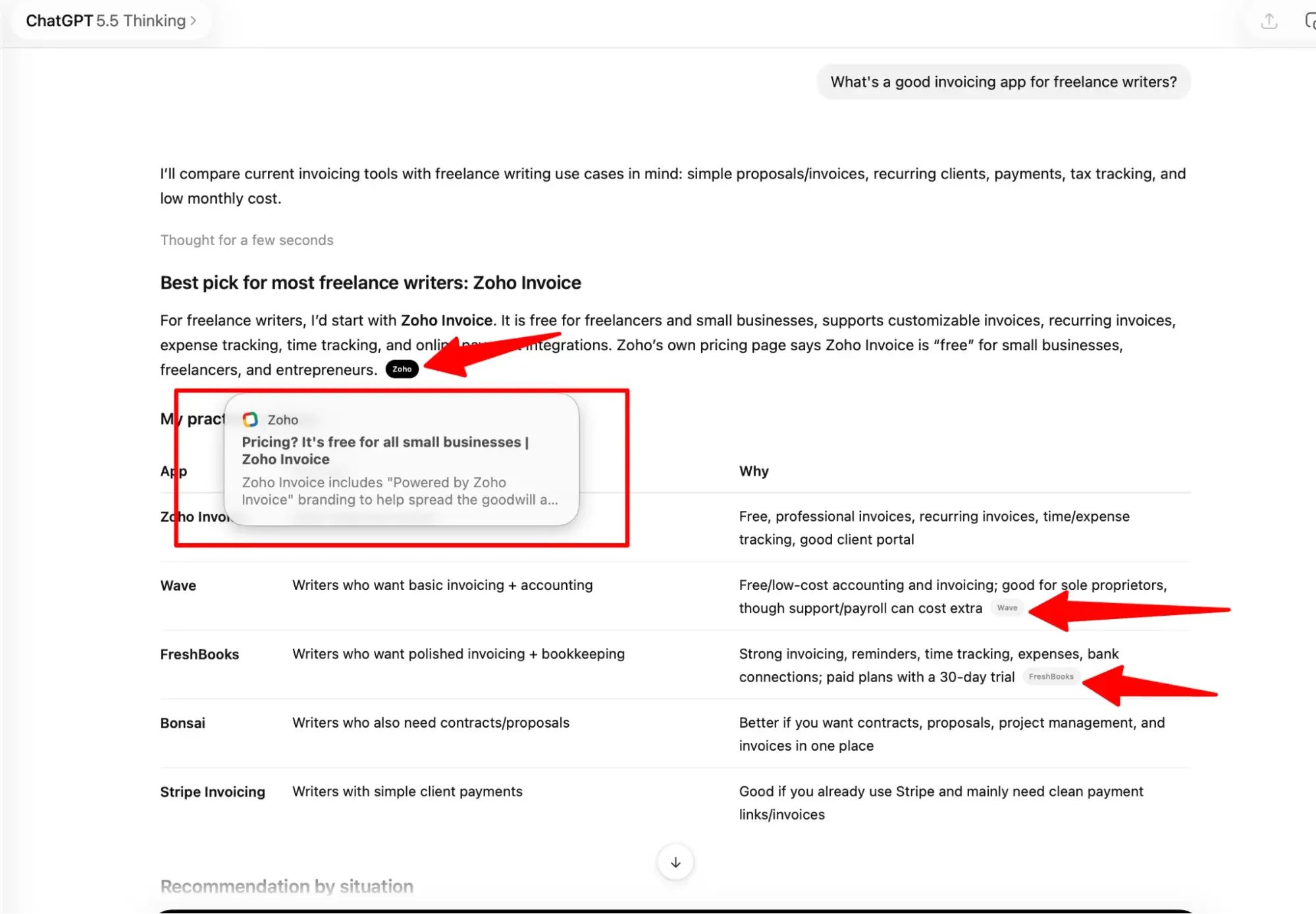
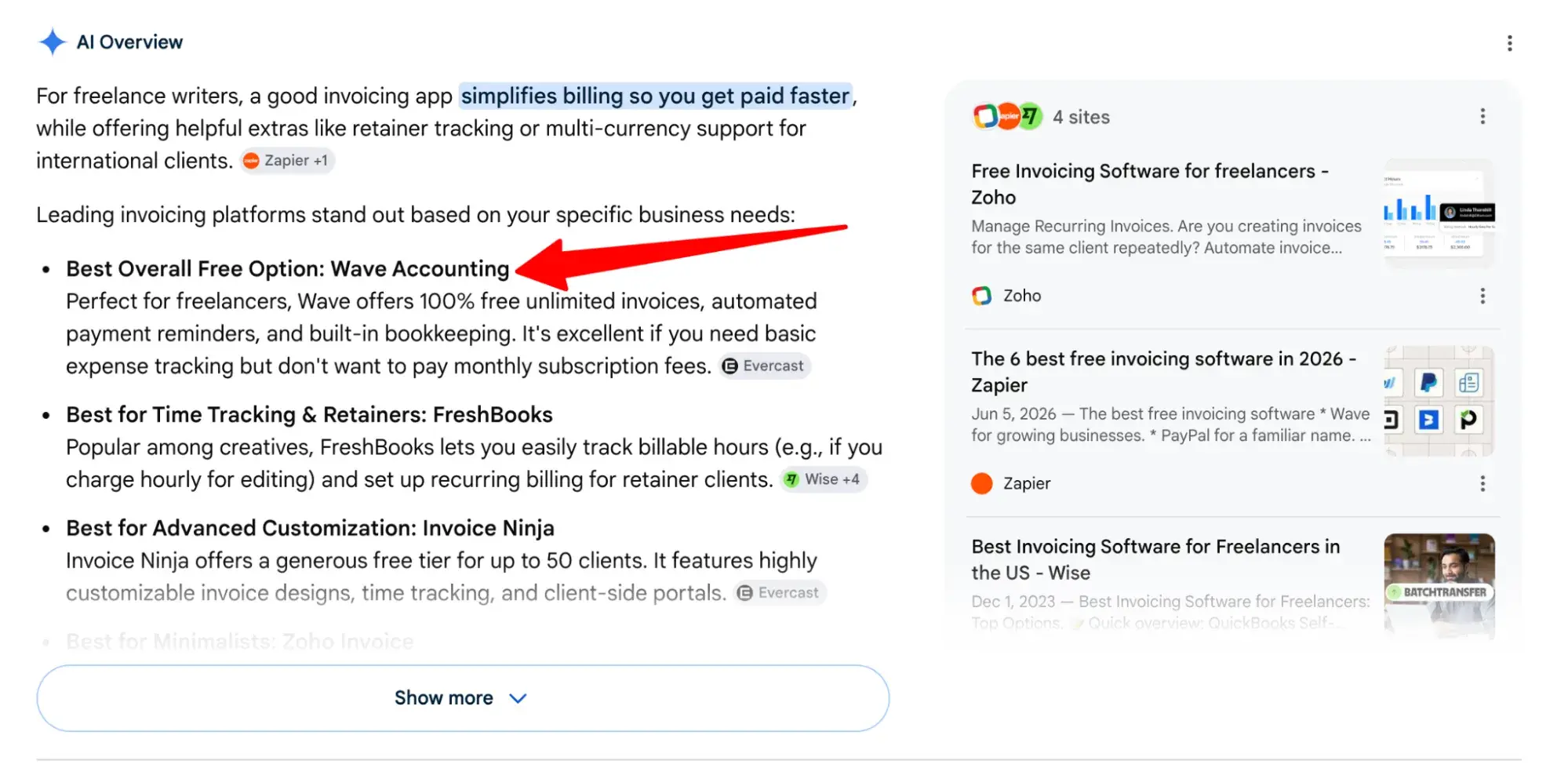
Inline Citations: This is the most direct form of attribution, appearing as a linked reference (often a small chip or number) immediately following a specific claim within the AI’s answer. Clicking this link typically directs the user straight to the source page. Inline citations are highly valuable as they offer direct referral traffic and explicit recognition for specific pieces of information. For instance, an AI might state, "Zoho Invoice offers robust features for small businesses [1]," with [1] linking directly to a Zoho Invoice product page or review.
-
Unlinked Named Mentions: In this scenario, a brand is named directly within the AI’s response without an accompanying hyperlink. While these mentions do not generate direct referral traffic, they are crucial for brand awareness and influence. An AI might recommend "invoicing apps like Zoho Invoice" without providing a link, subtly steering user perception and consideration. Tracking these mentions is vital for understanding a brand’s mindshare within AI-generated narratives.
-
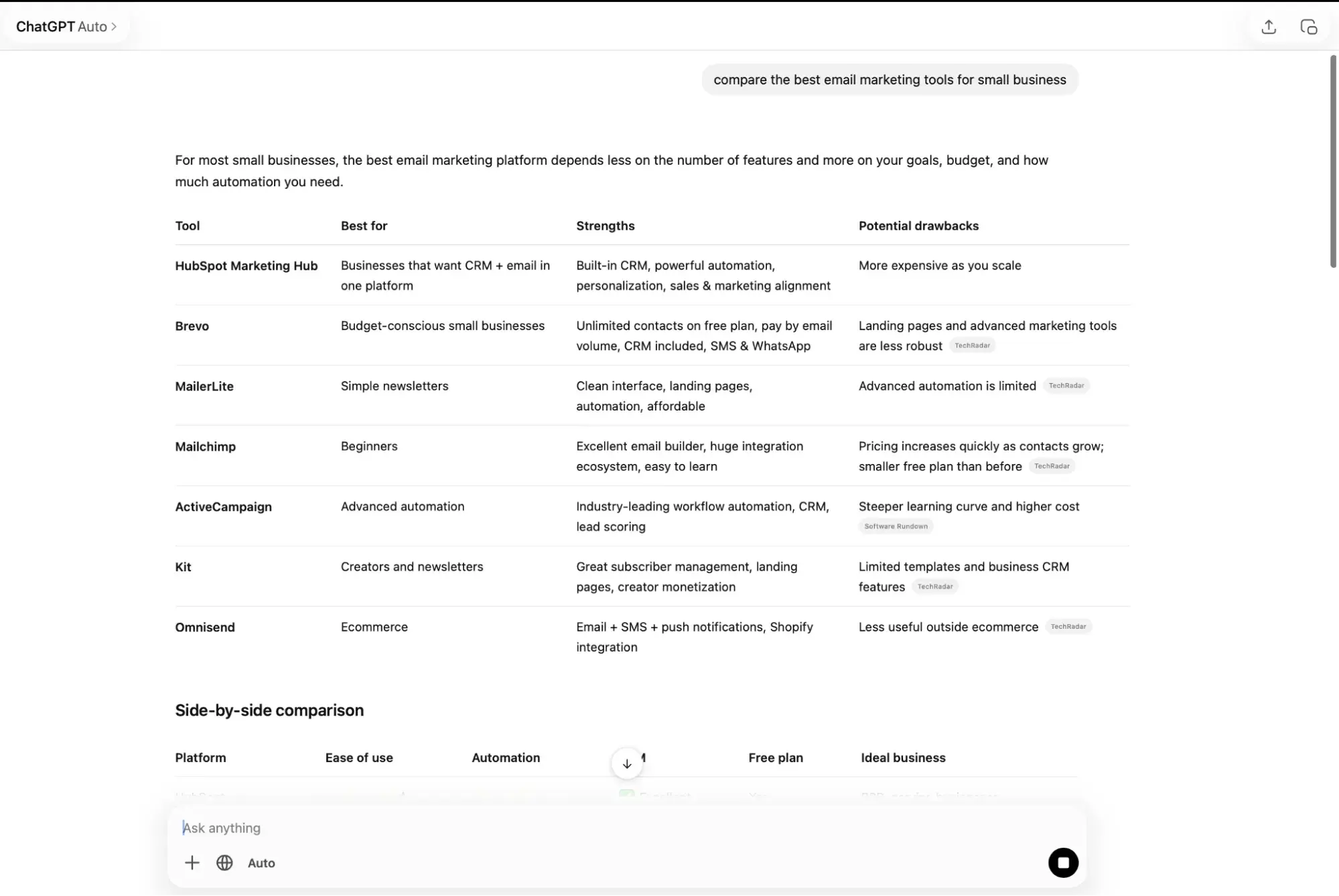
Comparison Tables: AI engines frequently generate tables that compare several tools or brands based on shared criteria such as features, best use cases, strengths, and drawbacks. Being included in such a table positions a brand within the engine’s consideration set for a given query. The information presented in these tables becomes the AI’s summary of the brand’s competitive standing, making accuracy and favorable framing paramount. For example, a ChatGPT table comparing email marketing tools might list HubSpot, Mailchimp, and Constant Contact, detailing their respective strengths and weaknesses.
-
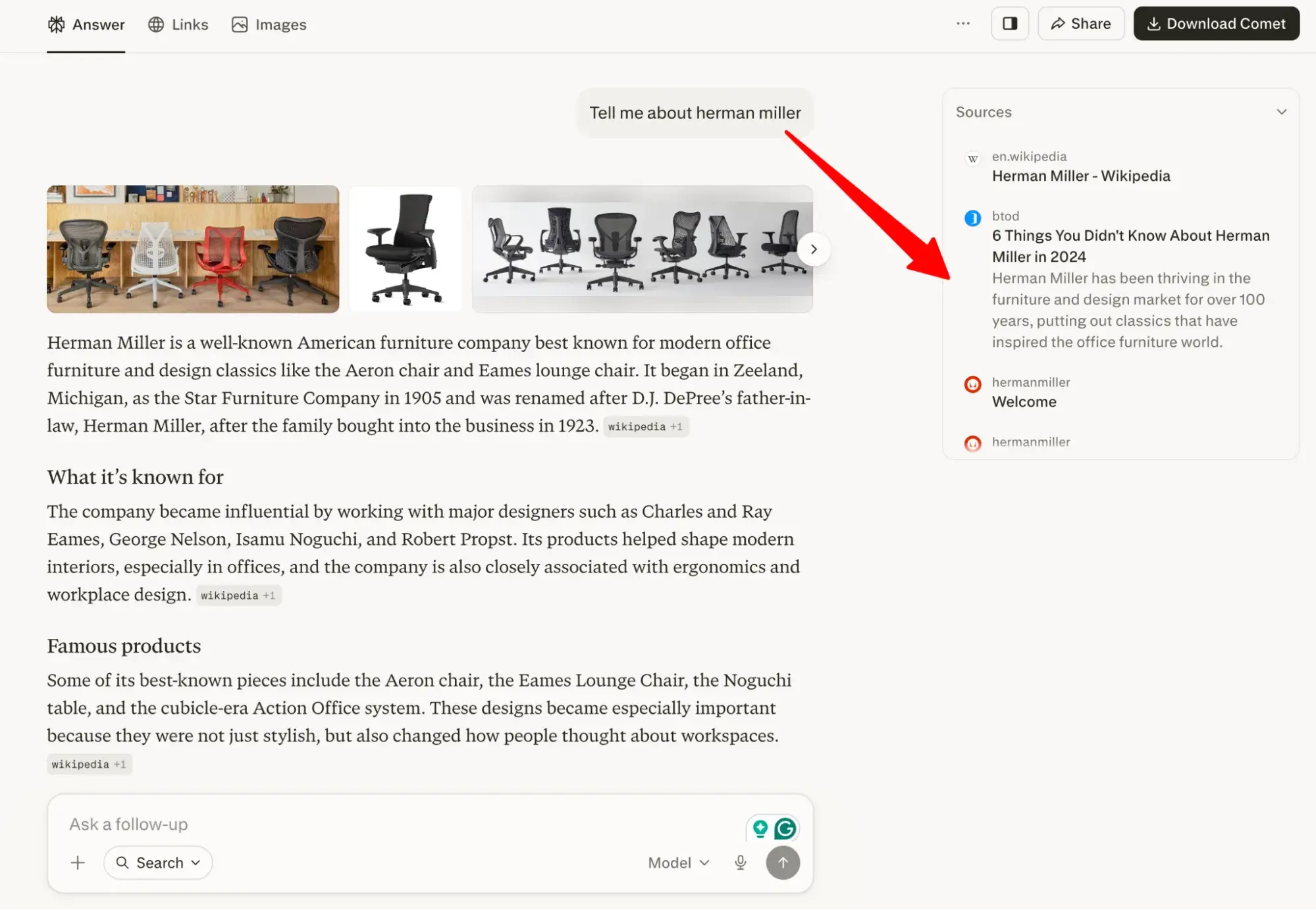
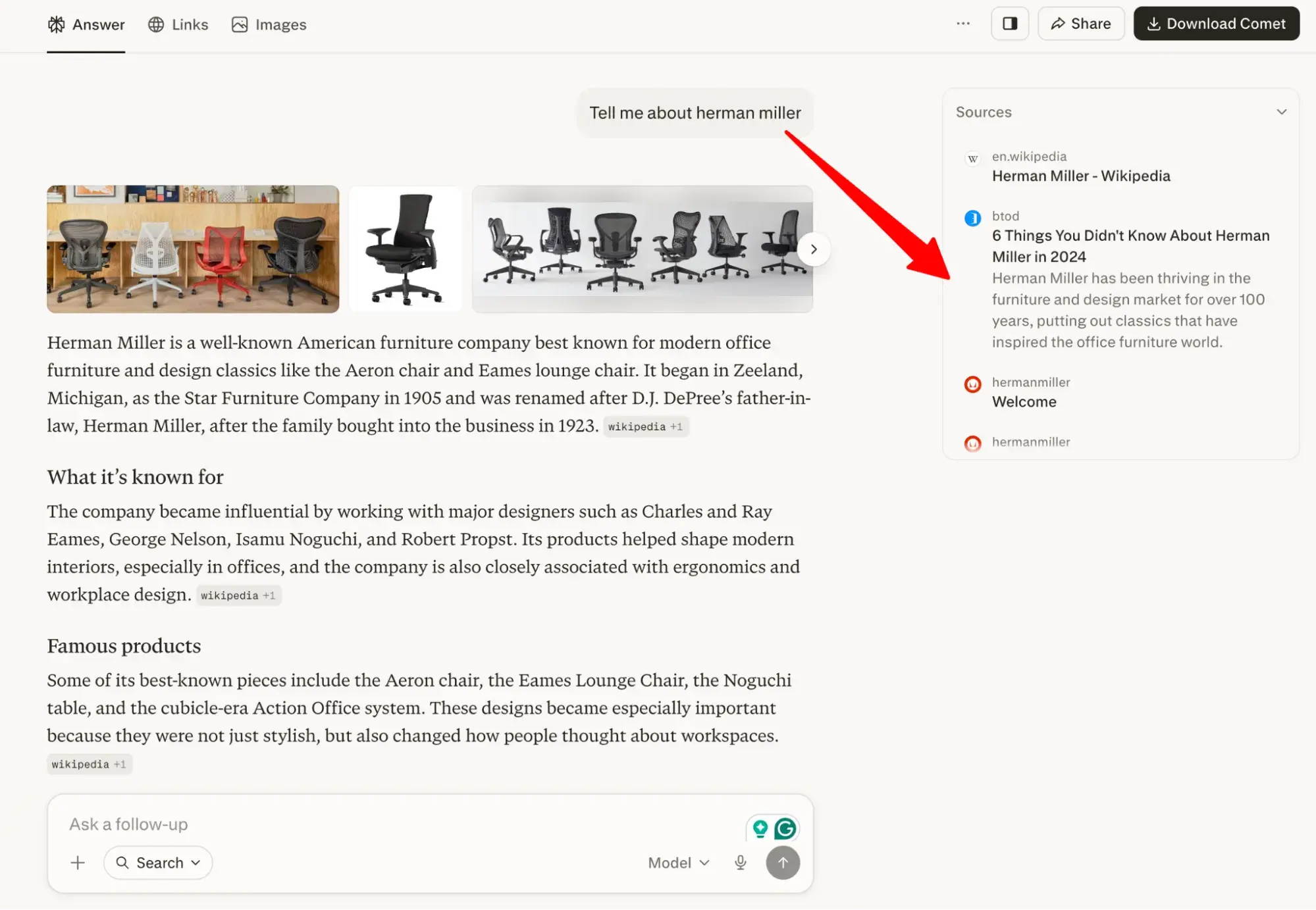
Source List: This typically appears as a panel or rail alongside or below the AI’s main response, listing all the pages and sources the engine consulted to construct its answer. A page can be included in this list even if it isn’t directly tied to an inline citation. Appearing in the source list offers indirect visibility and contributes to overall brand authority, signaling to users that the brand’s content is relevant and trustworthy.

-
Rich Product Results: Specifically for shopping-related queries, AI can surface product results complete with images, pricing, ratings, and detailed descriptions. Platforms like ChatGPT have developed merchant programs to integrate product listings directly into their responses. For example, a query about "best ergonomic office chairs" might yield a rich product result for a Herman Miller Aeron chair, including its price, user rating, and key features.
AEO vs. SEO: Complementary, Not Competitive
The emergence of AEO has sparked considerable debate within the digital marketing community regarding its distinctiveness from traditional SEO. While they share the overarching goal of increasing online visibility, AEO and SEO are fundamentally distinct yet highly complementary practices. Understanding these differences is crucial for crafting an effective multi-channel digital strategy.
Key Differentiators:
- Primary Goal: SEO primarily aims to drive clicks to a website by achieving high rankings in search engine results pages (SERPs). AEO, conversely, focuses on ensuring a brand’s content is directly cited or mentioned within the AI-generated answers, influencing user decisions even without a click.
- Target Audience: SEO algorithms are designed to interpret keywords, backlinks, and technical signals to determine relevance and authority. AEO targets the sophisticated natural language processing capabilities of LLMs, which strive to understand and respond in a human-like manner, focusing on semantic meaning and direct answers.
- Optimization Focus: SEO emphasizes technical aspects like site speed, mobile-friendliness, schema markup (for rich results), keyword density, and link building. AEO prioritizes the clarity, conciseness, and directness of answers, alongside strong credibility signals, semantic triples, and the ability for LLMs to cleanly extract information.
- Measurement Metrics: SEO performance is typically measured by organic traffic, keyword rankings, bounce rates, and conversion rates from direct website visits. AEO necessitates tracking brand mentions within AI responses, sentiment analysis of those mentions, the accuracy of cited information, and the downstream impact on conversions, even from "zero-click" interactions.
- Content Strategy: Traditional SEO often encourages comprehensive, long-form content that covers a topic exhaustively to capture various long-tail keywords. AEO favors an "answer-first" approach, where the most direct and factual answer to a likely user query is presented upfront, followed by supporting details.
In essence, a robust SEO strategy creates the accessible, authoritative, and relevant content base that AEO then optimizes for AI extraction. Without strong SEO fundamentals, content may not even be discoverable by AI crawlers. Conversely, without AEO, even well-ranked content might be overlooked by AI engines seeking direct answers, leading to missed opportunities for direct citation and influence. The ongoing evolution of search, as detailed in various industry analyses, consistently shows that successful brands will integrate both disciplines.
Strategic Pillars of AI Search Optimization
Optimizing content for AI search citations requires a multi-faceted approach, addressing both the intrinsic quality and structure of the content itself, as well as external signals of authority.
A. Content Optimization: Crafting for AI Extraction
The way content is structured and presented directly impacts an AI engine’s ability to extract and cite information cleanly.
-
Answer First, Details After: This is perhaps the most critical formatting adjustment for AEO. Content should begin by directly answering the implied question, ideally in a clear subject-predicate-object format (a "semantic triple"). Only after providing the direct answer should supporting details, context, and examples follow. This reverses a common journalistic tendency to build up to a point. For example, instead of: "According to Omnisend, a series of three shopping cart abandonment emails results in 69% more orders. So you can see why reminding buyers of what they left behind in their carts is powerful, right?", an AEO-optimized version would be: "Buyers who receive cart abandonment emails are more likely to complete their purchase. A series of three shopping cart abandonment emails leads to 69% more orders, according to Omnisend." This clear, concise answer is immediately digestible by an LLM.
-
Conduct Prompt Research: Analogous to keyword research in SEO, prompt research guides AEO strategy by identifying the natural language queries and follow-up questions users are likely to ask an AI answer engine. This allows brands to proactively structure their content to directly address these prompts. Approaches include simulating user queries in various AI tools and analyzing existing AI answers to understand the types of questions they respond to and the language they use. This insight helps content creators preemptively provide the exact information AI models are seeking.
-
Credibility Signals (E-E-A-T): AI models, particularly those powering Google AI Overviews, Gemini, and Perplexity, heavily rely on signals of Experience, Expertise, Authoritativeness, and Trustworthiness (E-E-A-T) to determine the reliability of information.
- On-Page Author Bios: An on-page author bio, detailing an author’s years of experience, specific areas of expertise, and any relevant credentials or publications, carries significantly more citation weight than a mere byline. Consistency in author identity across the brand’s website, LinkedIn, and other trusted professional profiles (e.g., Crunchbase, G2) helps AI engines form a clearer, more authoritative understanding of the source.
- Original Data & External Research: Content that backs up its assertions with original, first-party data (e.g., proprietary research, survey results, benchmarks) is highly favored by AI engines, especially ChatGPT and AI Overviews. This provides unique facts that an AI cannot find elsewhere, positioning the page as the authoritative source. When claims are not original, attributing them to credible sources and providing outbound links to the original research significantly enhances verifiability and trustworthiness, a pattern particularly strong in AI Overviews and Gemini.
B. Technical Structure: Enabling AI Readability and Trust
Beyond content quality, the technical underpinnings of a webpage dictate how effectively AI engines can read, interpret, and trust its information.
-
Schema Markup and Semantic HTML: These elements provide crucial structural cues to AI engines. Schema markup, a specialized vocabulary for labeling content types, can help AI understand the context and relationships between entities on a page. While Google advises against over-focusing on structured data for AI features, it does state that schema remains a good idea for overall SEO and eligibility for rich results. HubSpot’s State of AEO 2026 found that FAQ sections paired with schema markup correlate with higher citations in Gemini, Google AI Mode, and Perplexity. Semantic HTML (e.g., using
<article>,<section>,<header>,<footer>,<nav>,<aside>,<main>tags correctly) also aids in machine parsing and accessibility, allowing screen readers and AI crawlers to better navigate and interpret page structure. It is always advisable to validate schema markup using tools like Schema.org validator and Google’s Rich Results Test. -
Server-Side Rendering (SSR) or Static Site Generation (SSG): This is paramount for ensuring content visibility across a wide range of AI crawlers. Many AI models and their associated crawlers lack the ability to execute JavaScript, meaning content loaded dynamically client-side after the initial page response remains invisible to them. SSR and SSG circumvent this by delivering fully populated HTML in the initial response, before any client-side scripts run. This ensures that all critical content is immediately available for AI ingestion, particularly important for engines beyond Google which may have less advanced rendering capabilities.
C. Off-Page Signals: Building External Authority
AI engines extensively verify credibility through third-party sites, making off-page signals a critical component of AEO.
-
The Power of Third-Party Validation: Research by the AEO agency Fan Out indicates that Google AI Overviews derive 51% of its citations from off-site sources, such as review platforms. This highlights the importance of a strong, positive external brand presence.
-
Reddit and YouTube’s Influence: Fan Out’s research further revealed that Reddit and YouTube collectively contribute more AI citations than all other off-site platforms combined. This is likely due to the authentic, user-generated content, community validation, and diverse perspectives found on these platforms, which AI models value as indicators of real-world experience and sentiment. Brands should strategically engage with these platforms, fostering positive discussions and providing valuable content.
-
Digital PR and Bylines: ChatGPT, in particular, leans heavily on publisher-controlled sources, with 78% of its citations coming from vendor- or publisher-controlled content. News and media sites alone account for 9.5% of all ChatGPT citations, according to Semrush. This makes digital PR a highly effective route to AI citations. Securing expert quotes and bylines on high-authority publications not only builds brand recognition but also reinforces authoritativeness, linking an expert’s identity to a trusted domain. Mentions in respected publications, even without direct links, bolster overall brand authority.
-
Local and E-commerce Optimization: While AI Overviews show up for a relatively small percentage of shopping (3.2%) and local (7.9%) searches (Ahrefs), the opportunity for these verticals shifts to conversational AI engines. HubSpot’s State of AEO 2026 found that product listings and landing pages were cited in 86% of ChatGPT queries and 84% of Perplexity queries tested.
- E-commerce Strategies: To optimize for AI in e-commerce, brands should maintain high-quality, detailed product pages, utilize comprehensive XML product feeds, and implement Product schema markup. Similarweb’s 3rd Annual Global Ecommerce Report revealed that ChatGPT-referred e-commerce visits convert at an impressive 11.4%, significantly higher than the 5.3% for organic search. Brands generating product data with AI must also adhere to Google Merchant Center policies.
- Local Strategies: Local AI visibility is more challenging to secure than a traditional Google local 3-pack spot. SOCi’s 2026 Local Visibility Index reported that multi-location brands appeared in ChatGPT recommendations only 1.2% of the time, compared to 35.9% in Google’s local 3-pack. To bridge this gap, brands must ensure their Google Business Profile is complete and accurate, and that their Name, Address, and Phone number (NAP) details are consistent across all directories AI engines might consult. Implementing LocalBusiness schema on each location page is also vital for helping engines parse crucial information like hours, service areas, and categories.
Avoiding Pitfalls: What NOT to Do in AI Search Optimization
As with any emerging field, AEO is susceptible to misconceptions and "hacks" that can be ineffective or even detrimental. Understanding what to avoid is as important as knowing what to implement.
-
Do Not Create Special Files Just for AI: The notion of creating
llms.txtfiles, separate Markdown versions of pages, or other machine-readable formats specifically for AI crawlers is a misconception. Google explicitly states that its AI search features do not use such files, and maintaining them will neither help nor hurt visibility. Furthermore, serving a bot-only version of a page that differs significantly from what users see can be interpreted as cloaking, a practice that violates Google’s spam policies and can lead to penalties. -
Do Not Over-Chunk Content as a Gimmick: While logical structure and clear headings are beneficial for both users and AI, artificially fragmenting content into excessively short, one-sentence paragraphs or FAQ-style snippets purely to "trick" AI models is counterproductive. Google’s Danny Sullivan has advised creators against this practice. A well-structured page naturally creates retrieval boundaries through clear headings, focused paragraphs, and logical sections. Prioritizing perceived ranking signals over readability ultimately harms the user experience, which is increasingly factored into AI’s assessment of content quality.
-
Do Not Publish Commodity or Mass-Produced Content: The proliferation of generative AI tools has made it easier to produce large volumes of content quickly. However, recycling existing information or using AI to spin up unoriginal pages designed solely to game rankings is classified as "scaled content abuse" and directly violates Google’s spam policies. AI engines are designed to identify and prioritize unique, valuable, and authoritative content. The work that genuinely earns citations is content that offers a first-hand perspective, original data, expert insight, or a unique angle that cannot be found elsewhere. If a tactic suggests creating content solely for bots, it should be treated as a red flag; lasting AEO success hinges on serving human readers first.
Measuring Success and Charting the Future
The advent of AI answer engines necessitates a reevaluation of how digital marketing success is measured. Clicks, while still relevant, no longer provide the complete picture, as AI can influence decisions without direct website visits. Measuring AEO involves tracking brand mentions, assessing their accuracy and sentiment, and connecting this visibility to broader business outcomes.
-
Assessing AI Visibility with Graders: To establish a baseline, tools like HubSpot’s AEO Grader offer a free, one-time diagnostic. This grader evaluates how ChatGPT, Perplexity, and Gemini describe a brand, providing a composite score across sentiment, presence quality, brand recognition, share of voice, and market competition. Such tools also allow for competitive analysis, revealing where competitors appear in AI answers and a brand does not. While graders offer a snapshot, ongoing monitoring is crucial for tracking trends over time.
-
Connecting Visibility to Pipeline: The ultimate measure of AEO success is its impact on the business pipeline. The Microsoft Clarity study, encompassing all channels, found that AI-referred visitors converted at approximately three times the rate of visitors from other traffic sources. This elevated conversion rate is attributed to the fact that users engaging with AI answer engines are often further along in their decision-making process, having used AI for research and comparison before clicking through. HubSpot’s internal data corroborates this, showing that after implementing AEO strategies, qualified leads from AI grew by an astounding 1,850%, with these leads converting at three times the rate of those from other sources. To effectively connect AI visibility to pipeline metrics, AI data must be integrated with demand generation and CRM systems, allowing marketers to correlate increases in citations with lifts in form fills, demo requests, and ultimately, revenue. Solutions like AEO in Marketing Hub aim to bridge this gap by tracking brand visibility alongside campaign metrics.
Preparing for AI Agents and What Comes Next
The evolution of AI is moving beyond simply answering questions to actively completing tasks. The next frontier in AI search optimization involves preparing for AI agents – sophisticated programs capable of navigating websites, filling out forms, and acting on a user’s behalf within a logged-in session. Browser agents, such as OpenAI’s ChatGPT agent and Perplexity’s Comet, are already demonstrating these capabilities. Furthermore, commerce agents are emerging, with initiatives like OpenAI’s Agentic Commerce Protocol, which enables ChatGPT to surface products and seamlessly hand off purchase processes to a merchant’s own systems.
The readiness work for AI agents largely extends the principles of AEO. Agents rely on well-structured, machine-readable signals and can only effectively interact with pages that are clean, accessible, and semantically optimized. The core foundational work of improving rendering, structured data implementation, web accessibility, and consistent product feeds will be paramount. Agents can only reliably buy, book, or submit information when relevant controls (buttons, forms, interactive elements) are clearly exposed and machine-interpretable. This does not necessitate a complete overhaul of existing technology stacks or CMS platforms for most organizations. Instead, a focus on these incremental but impactful technical and content improvements will ensure brands are well-positioned for the agent-driven future.
Frequently Asked Questions About AI Search Optimization
-
How long does it take to see results from AI search optimization? The timeline for AEO results varies depending on the specific optimization lever pulled. Technical fixes, such as implementing server-side rendering or correcting schema markup, can yield results within days or weeks as AI engines recrawl the site. Authority signals, such as earned media placements, consistent entity details across platforms, and the gradual inclusion of content in AI training data, typically compound over several months. It is crucial to set realistic expectations and implement ongoing monitoring to track incremental progress rather than anticipating immediate, dramatic shifts.
-
Who should own AI search optimization across marketing and SEO? AEO functions most effectively as a shared responsibility across multiple teams rather than residing with a single owner. The SEO or content team often serves as the natural lead, given the significant overlap with their existing on-page and structural optimization expertise. However, because AI citations are also heavily influenced by earned media, consistent brand profiles, and accurate product data, AEO necessitates active participation from PR, brand, and web development teams. Designating a central coordinator to orchestrate efforts and ensure accountability across these supporting functions is key to successful implementation.
-
Do I need to rebuild my site or change CMS to optimize for AI search? No, a complete overhaul of your technology stack, a switch in CMS platforms, or the creation of AI-only files is generally not required to compete effectively in AI search. Google has explicitly stated that its AI features do not necessitate special structured data, content chunking, or
llms.txtfiles, and that maintaining these will not enhance visibility. The most impactful fixes revolve