rifanmuazin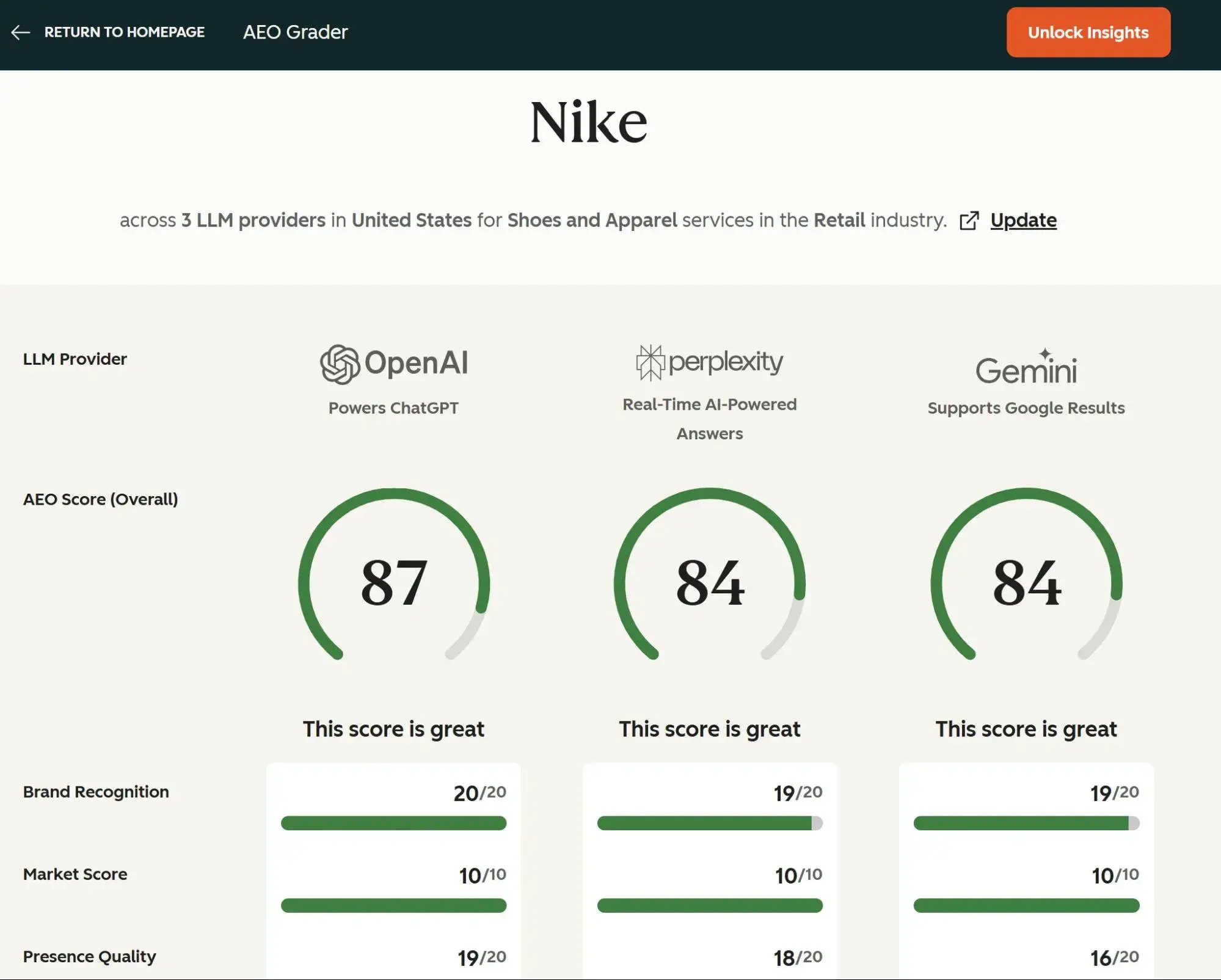
The digital marketing arena is undergoing a profound transformation, driven by the ascendancy of generative artificial intelligence in search and content discovery. Traditional search engine optimization (SEO) strategies, once focused solely on keyword rankings and organic traffic, are proving increasingly insufficient as AI-powered answer engines reshape user behavior and content consumption. Every company’s competitors are now showing up in AI-generated answers, but a critical question remains for marketers: do they know which ones, for which queries, and, most importantly, why? This strategic void is precisely what Answer Engine Optimization (AEO) competitor analysis is designed to address, offering teams a vital new lens through which to understand and dominate the evolving digital landscape.
The Paradigm Shift: From Ranking to Citation
The fundamental shift lies in how information is presented and consumed. Answer engines like ChatGPT, Perplexity AI, Google’s AI Overviews, and Gemini do not simply rank pages; they synthesize information and cite sources. This distinction fundamentally alters the competitive dynamic. A brand might proudly hold a top-three organic ranking for a critical query, yet find itself entirely absent from the concise, authoritative AI answer that a prospect encounters first. This phenomenon, often leading to "zero-click searches," renders traditional visibility metrics incomplete.
According to a recent study by Search Engine Land, a staggering 58.5% of U.S. Google searches and 59.7% of EU searches now result in zero clicks, meaning users find their answers directly within the SERP, frequently from AI Overviews. Concurrently, the independent adoption of large language models (LLMs) is skyrocketing, with ChatGPT alone surpassing 900 million weekly active users as of early 2024. These figures underscore not a future trend, but a present reality that demands immediate strategic adaptation. Brands failing to track who is earning these crucial AI citations, and the underlying reasons, are making content and SEO decisions with only half the picture, risking substantial loss of market influence and customer engagement.

Understanding AEO Competitor Analysis
AEO competitor analysis is the systematic process of identifying which brands, pages, and specific content elements answer engines cite in their AI-generated responses. Crucially, it involves benchmarking a brand’s own visibility against its rivals across the same critical queries. AEO, or Answer Engine Optimization, itself is the practice of structuring content in such a way that AI platforms are most likely to surface it as a trusted, authoritative answer.
This discipline extends beyond merely optimizing one’s own content. It involves systematically tracking who else these sophisticated engines are citing, why their content is preferred, and what strategic gaps a brand can exploit. While traditional SEO competitive research focuses on keyword rankings, backlinks, and organic traffic, AEO competitor analysis measures entirely different units:
- Citation Frequency: How often a brand or its content is referenced.
- Answer Share: The percentage of queries in a given topic where a brand is cited.
- Entity Coverage: How well a brand, its products, and key concepts are understood and articulated by AI.
- QA Content Depth: The comprehensiveness and directness of answers to specific questions.
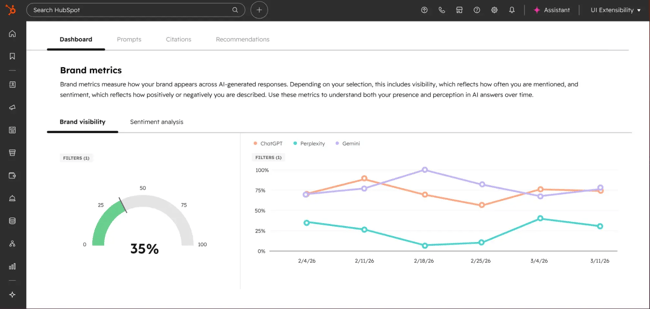
The shift in measurement reflects a deeper change in the underlying competition: marketers are no longer solely vying for a position on a search results page, but rather for the trust and authoritative endorsement of an LLM. HubSpot’s AEO tools, for instance, are designed to streamline this process, showing marketers which prompts cite competitors and where their own brand is conspicuously absent, offering a clear benchmark of AI visibility.
The Urgency of AEO Competitor Analysis

The importance of AEO competitor analysis is immediate and growing, driven by several interconnected factors:
-
Emerging Channels Favor Front-Running Adopters: Answer engine search is not a distant possibility but a rapidly adopted current channel. Teams that build AEO measurement and content infrastructure now are establishing citation authority before most competitors have even recognized the shift. Industry experts observe that citation patterns in LLMs tend to be "sticky" – once a model associates a brand with authority on a topic, that association often persists across various queries and even model updates. This confers a significant, compounding advantage to early movers. Waiting to "wait and see" is a strategic misstep that can lead to being perpetually behind.
-
AI Answers Compress Traditional SERPs: The visual impact of AI Overviews cannot be overstated. They frequently push organic blue links far down the page, often below the fold, rendering them effectively invisible to users seeking immediate answers. For high-intent queries – such as "what is the best CRM for startups," "how do I calculate customer lifetime value," or "how to choose marketing automation software" – the AI answer is the primary SERP result for the majority of users. If a competitor consistently appears in these dominant AI answers and a brand does not, that brand is effectively invisible for those critical buying-stage and informational queries, irrespective of its organic rankings. This represents a direct threat to brand awareness and lead generation.
-
Visibility Shifts to Citations, Entities, and QA Patterns: Traditional search primarily rewards pages and their associated keywords. Answer engines, however, prioritize entities (brands, concepts, products, people) and answers. They evaluate content based on several key signals:
- Clarity and Directness: How precisely and concisely a question is answered.
- Factual Accuracy: The verifiability and truthfulness of the information.
- Topical Authority: The breadth and depth of content on related subjects, demonstrating comprehensive expertise.
- Structure and Readability: How easily the information can be parsed and understood by an AI model.
- Trustworthiness and E-E-A-T (Experience, Expertise, Authoritativeness, Trustworthiness): Signals that indicate the reliability of the source.
Competitor analysis in this new environment therefore requires understanding not just what rivals are publishing, but how their content is structured, which entities they effectively cover, and why LLMs prefer it. HubSpot AEO, for example, provides detailed breakdowns of which domains, content types, and sources are most frequently cited, offering actionable insights for content strategy.
-
Profound Impact on Pipeline Influence, Support Deflection, and Brand Authority: AEO visibility transcends mere traffic metrics; it has a direct, measurable downstream business impact. Brands that consistently appear in AI answers for buying-stage queries ("best [category] software," "how to choose a [tool]," "[brand A] vs [brand B]") are influencing purchase decisions before a prospect even visits a website. This early-stage influence can significantly shorten sales cycles and improve conversion rates. Furthermore, by owning AI-generated answers to common customer issues and product FAQs, companies can proactively deflect inbound support questions, reducing operational costs and improving customer satisfaction. Consistently being cited as an authoritative source also significantly boosts brand authority and perception in the minds of consumers and other businesses.
A Step-by-Step Guide to AEO Competitor Analysis
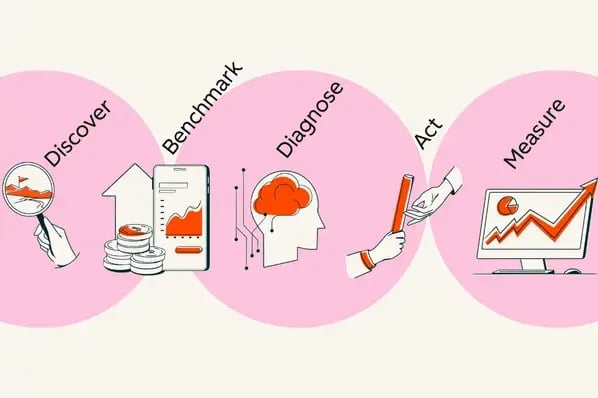
Executing a comprehensive AEO competitor analysis requires a structured approach, moving from data collection to actionable insights.
Step 1: Collect Priority Questions that Answer Engines Must Resolve.
The foundation of any AEO strategy is a meticulously curated query set – a representative list of questions your target audience asks that answer engines are highly likely to resolve with a generated answer. These queries should span the entire customer journey, including:
- Informational Queries: "What is [concept]?" "How does [process] work?"
- Navigational Queries: "Where can I find [brand/product feature]?"
- Commercial Investigation Queries: "Best [category] software," "[Product A] vs [Product B]."
- Transactional Queries: "How to buy [product]," "Pricing for [service]."
Sources for these queries are diverse: existing keyword research, customer support tickets, sales call transcripts, "People Also Ask" boxes in Google, industry forums, and social media discussions. Aim for 30 to 100 queries across your core topic clusters to ensure a statistically meaningful view of answer share. For HubSpot users, built-in AEO features can suggest prompts based on existing CRM data, providing highly relevant starting points.
Step 2: Test Queries Across Chatbots and AI Overviews.
Once the query set is established, run each query across multiple prominent answer engines: ChatGPT, Perplexity, Google AI Overviews, and Gemini. For each test, meticulously record:
- The AI-generated answer.
- All cited sources/URLs.
- Any explicitly mentioned entities (brands, products, people).
- The overall tone and factual accuracy of the answer.
While manual testing for a small set of top queries (10-15) can build intuition about why certain content gets cited, AEO tools are essential for scalability. Manual testing across 50+ queries on four platforms quickly becomes unsustainable. Dedicated AEO tools automate this process, tracking responses and citations over time.
Step 3: Extract Cited Sources and Entities.
For every query in your set, thoroughly document each cited source and named entity. This process constructs a detailed map of:
- Competitor Domains: Which rival websites are consistently cited.
- Specific URLs/Content Types: Whether AI prefers blog posts, product pages, whitepapers, or FAQs.
- Key Entities: Which brands, products, or concepts are most frequently associated with authoritative answers.
Analyzing these patterns can reveal valuable insights. For instance, if a competitor’s blog consistently garners citations while their product pages do not, it suggests LLMs favor informational content for certain query types. The consistent appearance of a direct competitor for your core queries signals an immediate and significant competitive threat.
Step 4: Map Competitors by Topic Cluster and Answer Share.
Organize the collected citation data by topic cluster, rather than just by individual competitor. Calculate a rough answer share for each brand: the percentage of queries within a specific topic cluster where that brand is cited. This mapping provides two critical insights:
- Strengths and Weaknesses: Identify which topic clusters a brand dominates in AI answers, and where competitors have a stronger presence.
- Emerging Threats and Opportunities: Pinpoint new competitors gaining traction in AI answers, or underserved niches where a brand can establish authority.
Visual representations, such as a chart mapping answer share by topic, can make these insights immediately apparent.
Step 5: Diagnose Why Competitors Win.
This is arguably the most crucial and often overlooked step. It’s not enough to know that a competitor wins citations; marketers must understand why. For each competitor page that consistently earns citations, conduct a deep analysis of:
- Content Structure: Is it formatted with clear headings (H2/H3), bullet points, and concise summaries? Does it use direct-answer patterns?
- Data Sources: What evidence or data does the content cite? Is it proprietary research, reputable third-party studies, or expert opinions?
- Topical Authority: How comprehensively does the page (and the broader domain) cover the topic cluster? Does it demonstrate E-E-A-T?
- Keyword Optimization: Are target keywords naturally integrated, particularly in headings and introductory paragraphs?
- Backlink Profile and Domain Authority: While not a direct AEO metric, strong traditional SEO signals still contribute to overall trustworthiness and visibility for LLMs.
A highly actionable diagnostic question to ask is: "If I were a language model trying to answer this question, would this page give me a clear, trustworthy, and complete answer?" This reframing helps cut through complexity and pinpoint critical content gaps. HubSpot Marketing Hub’s AEO features, for example, generate prioritized, plain-language recommendations to help translate these diagnostic insights into concrete actions.
Essential AEO Competitor Analysis Tools and Workflows
A mix of specialized AEO tools and enhanced traditional SEO platforms is required for a robust competitive analysis.
-
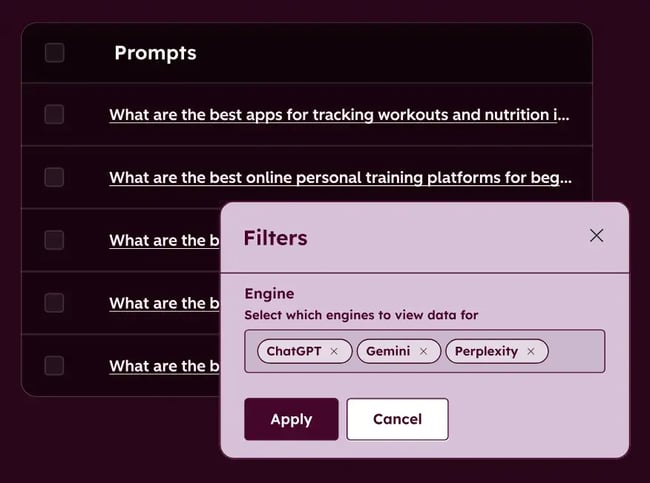
HubSpot AEO: Provides a holistic view of a brand’s presence across major answer engines (ChatGPT, Perplexity, Gemini). It tracks share of voice at the prompt level, identifying where a brand is cited, where competitors dominate, and where gaps exist. Crucially, it translates complex visibility data into actionable insights, helping marketers prioritize content creation and optimization efforts. Its ability to connect visibility data to a clear strategy, showing which sources and content types are favored, makes it a powerful operational tool.
- Best for: Marketers seeking an accessible, comprehensive platform to understand and act on AI visibility data.
-
HubSpot AEO Features in Marketing Hub: For existing HubSpot users, AEO features within Marketing Hub Pro and Enterprise integrate AI visibility insights directly into existing marketing workflows. By leveraging CRM data, the system automatically suggests the most relevant prompts based on a company’s industries, competitors, and customer segments. This integration allows marketers to track answer share trends, identify visibility gaps, and, most importantly, connect AEO performance to contact and pipeline reporting within the CRM, providing a clear view of business outcomes.
- Best for: Marketing teams aiming to integrate AI visibility insights directly into their CRM and existing marketing execution processes.
-
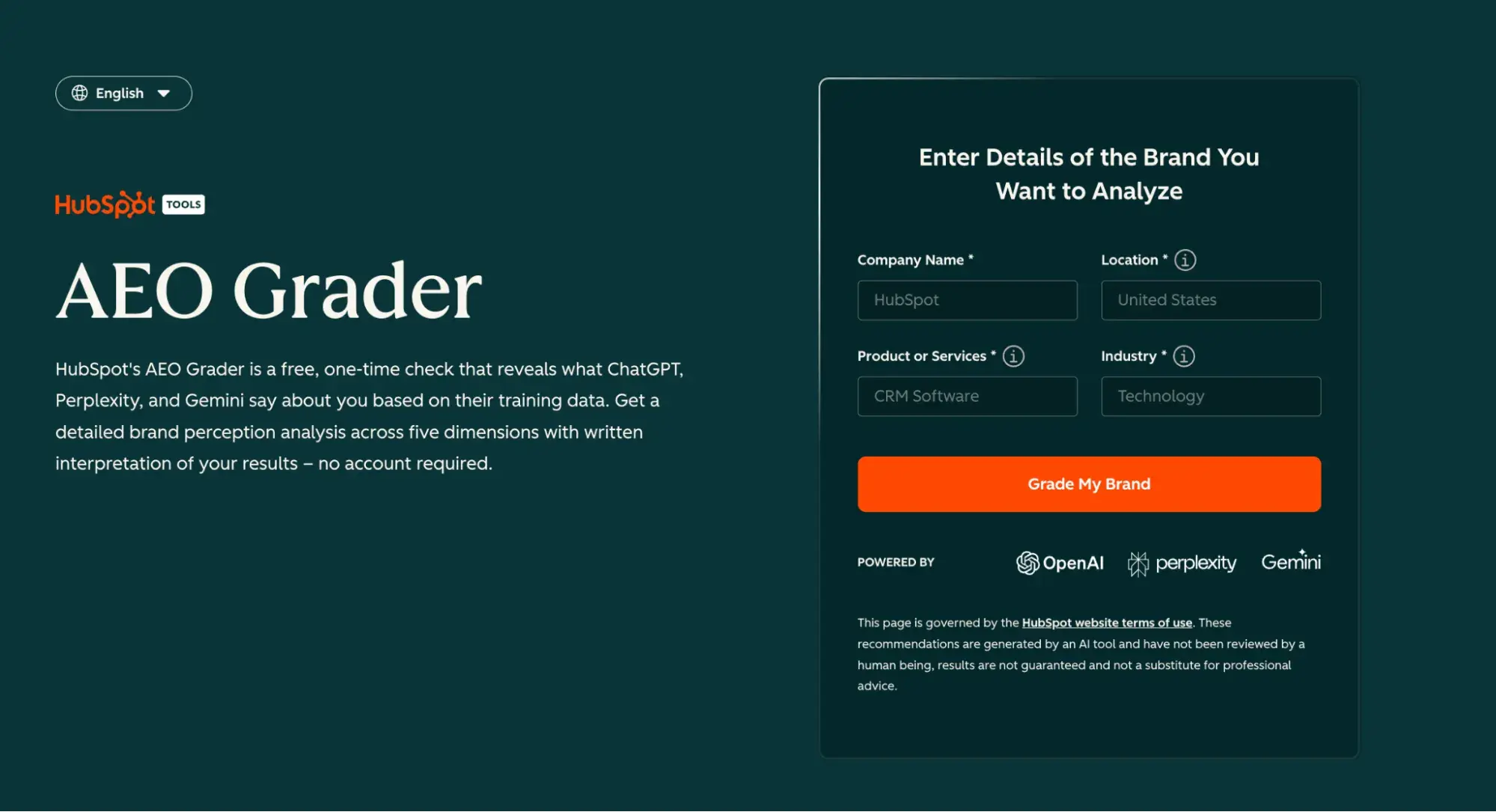
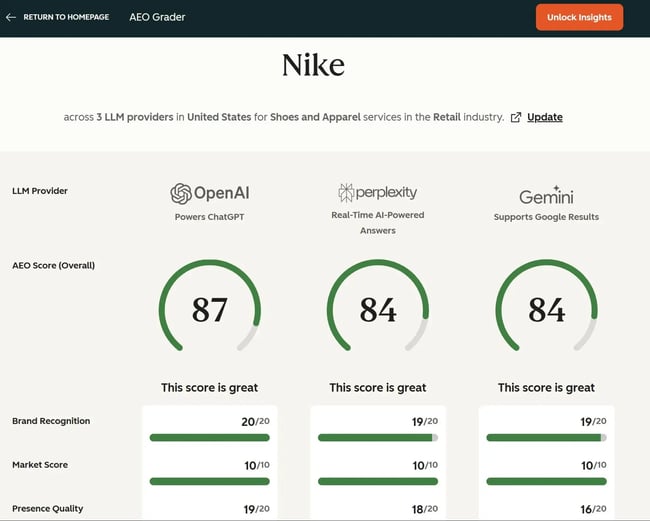
HubSpot AEO Grader: A free, low-friction entry point into AEO. It benchmarks answer engine visibility by measuring how often a brand appears in AI-generated answers relative to competitors. It offers a quick snapshot of share of voice and how the brand is represented, making it ideal for initial assessments and identifying whether visibility gaps exist without requiring extensive setup.
- Best for: Marketers looking for a quick, initial assessment of their AI visibility.
-
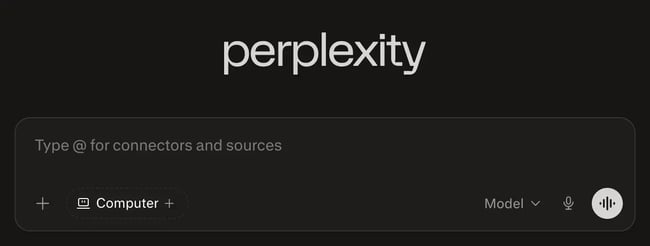
Perplexity AI: An invaluable tool for qualitative spot-checks. Running priority queries directly in Perplexity offers a fast, free view into cited sources and answer structures. Its inline citation display makes it easy to identify competitor URLs earning placement. Perplexity’s "Focus" modes (Web, Academic, Writing) can also be used to test how answer sources vary by query context, providing deeper insights into AI reasoning.
- Best for: Quick, qualitative analysis and understanding citation patterns.
-
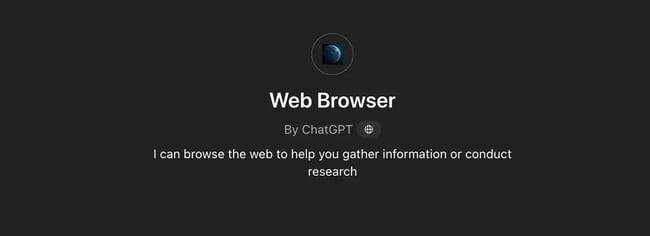
ChatGPT with Browse: ChatGPT’s browsing mode surfaces citations for current queries, making it particularly useful for testing consideration-stage and comparison queries (e.g., "best X for Y" formats). Brand mentions in these AI answers often have a high purchase influence, making this a critical platform for monitoring competitive presence in mid-funnel queries.
- Best for: Testing conversational and mid-funnel queries for brand mentions.
-
Ahrefs (and similar traditional SEO tools like Semrush, Moz): While AEO focuses on citations, traditional SEO tools remain vital for diagnosing why certain pages earn AI citations. Factors like backlink authority, on-page optimization, and broader topical authority signals still contribute significantly to LLM citation patterns. Ahrefs can be used to audit competitor pages that consistently earn AI citations, helping identify the underlying SEO strengths that reinforce their AI visibility.
- Best for: Pairing traditional SEO data with AEO insights to understand underlying authority.
-
BrightEdge or Conductor: Enterprise SEO platforms are increasingly incorporating AI Overview and answer engine tracking features. These sophisticated tools are best suited for large organizations managing hundreds of topic clusters, requiring automated citation monitoring, robust reporting, and seamless integration with broader enterprise marketing strategies.
- Best for: Enterprise teams requiring large-scale AEO tracking and reporting.
Key AEO Competitor Analysis Metrics and Dashboards
Effective AEO demands a new set of metrics and a dashboard that visualizes performance.
1. Measure Answer Share and Citation Frequency:
- Answer Share: The foundational AEO metric. It represents the percentage of queries in a defined set where a brand is cited in the AI-generated answer. This is the AEO equivalent of organic market share and should be tracked at three levels:
- Overall Brand Answer Share: Across all tracked queries.
- Topic Cluster Answer Share: Performance within specific content categories.
- Competitor-Specific Answer Share: How a brand performs against individual rivals.
- Citation Frequency: The raw count of how many times a domain or specific URL is cited across the query set. A high citation frequency on a small number of pages might indicate an over-reliance on a few content assets, while broad citation frequency across many pages signals strong topical authority and a robust content ecosystem. Tracking changes over time helps identify trends and the impact of content updates.
2. Track Entity Coverage and QA Depth:
- Entity Coverage: Measures whether a brand, its products, and key topics are explicitly recognized and correctly associated by answer engines. This can be tested by directly asking LLMs questions like: "What is [Your Brand]?", "What does [Your Brand] do?", or "Who uses [Your Product]?". Vague, incomplete, or incorrect answers signal an entity clarity problem that will suppress citations across a wider query set. Competitor entity coverage should also be analyzed to identify best practices.
- QA Depth: Measures how completely and directly a brand’s content answers the specific questions in its query set. This can be scored using a simple rubric:
- Direct Answer: The content provides an immediate, concise answer to the question.
- Comprehensive: The answer is thorough, covering all necessary facets of the question.
- Trustworthy: The answer is factually accurate and supported by credible sources.
Comparing a brand’s QA depth against competitors reveals areas for content improvement and optimization.
3. Connect AI Answer Visibility to Conversions:
The ultimate challenge is linking AI visibility to tangible business outcomes, as AI-generated answers don’t always result in trackable clicks. A multi-touch attribution approach is essential:
- UTM-tagged URLs: Implement specific UTM parameters on cited content URLs to track direct referral traffic from AI answers where links are provided.
- Self-Reported Attribution: Add "AI Answer Engine" or "ChatGPT/Perplexity/Google AI" as an option on lead forms and in sales conversations to capture direct user feedback on how they discovered the brand.
- Branded Search and Direct Traffic Proxies: Monitor increases in branded search queries and direct traffic following AEO content investments. While not a direct attribution, sustained increases can serve as a proxy for AI-influenced awareness and trust.
- CRM Integration: In platforms like HubSpot, create custom contact properties for "AI-attributed first touch" or "AI-influenced lead." Over time, this builds a dataset correlating AEO content investments with actual contact and deal creation, enabling marketers to tie answer engine performance to revenue.
Translating AEO Competitor Insights Into Action
Completing the analysis is only the first step; the real value comes from translating findings into a prioritized, actionable list. Common, high-impact actions derived from AEO competitor analysis include:
- Develop Direct-Answer Content: Create or optimize content specifically designed to provide concise, authoritative answers to high-priority queries. This often involves restructuring existing content to feature a direct answer prominently at the beginning of a section (e.g., under an H2/H3 heading that matches the query).
- Enhance Entity Coverage and Clarity: Ensure your brand, products, services, and key concepts are clearly defined and consistently represented across all digital assets. Implement structured data (Schema Markup, particularly FAQ and HowTo schema) to reinforce these entities for AI models.
- Fortify Topical Authority: Identify topic clusters where competitors dominate and develop comprehensive, in-depth content that establishes your brand as an expert. This may involve creating pillar pages, topic clusters, and detailed guides that cover all facets of a subject.
- Optimize for E-E-A-T: Emphasize signals of Experience, Expertise, Authoritativeness, and Trustworthiness. This includes author bios, expert endorsements, clear citation of sources, and secure website protocols.
- Refine Content Structure and Readability: Break down complex information into easily digestible chunks using headings, subheadings, bullet points, numbered lists, and short paragraphs. LLMs favor content that is easy to parse.
- Address Content Gaps: Pinpoint specific questions or subtopics where competitors are cited, and your brand is not. Create new content or expand existing pieces to fill these critical gaps.
- Monitor and Iterate: AEO is an ongoing process. Continuously monitor competitor citations, track answer share, and refine content strategies based on new data and evolving AI model behaviors.
- Educate Stakeholders: Communicate the shift to AEO to internal teams, including sales, product, and executive leadership, explaining its impact on pipeline, brand authority, and customer support.
Frequently Asked Questions About AEO Competitor Analysis
How often should you run AEO competitor analysis?
A full AEO competitor analysis, including running the complete query set, documenting citations, and updating benchmarks, is recommended on a monthly cadence for most teams. For highly competitive markets or during active content campaigns, biweekly monitoring of top-priority query clusters can be a worthwhile investment. Unlike traditional SEO rankings, which update continuously but often incrementally, AI citation patterns can shift meaningfully after a competitor publishes new content or following a major model update, necessitating regular snapshots to detect changes.
How do you attribute pipeline impact from AI answers?
Pipeline attribution for AI answers is complex due to the nature of "zero-click" interactions. It requires a multi-pronged approach:
- UTM-tagged URLs: Use specific UTM parameters on any URLs provided within AI answers to track direct referral traffic.
- Self-Reported Attribution: Incorporate "AI Answer Engine" or specific LLM platforms as a "how did you hear about us?" option on lead forms and in sales conversations.
- Branded Search & Direct Traffic: Monitor increases in branded organic search queries and direct website traffic as a proxy for AI-influenced awareness.
- CRM Integration: Implement custom contact properties in your CRM (like HubSpot) to flag leads or contacts whose first touch or significant interaction may have been influenced by an AI answer. This allows for long-term analysis of AI’s contribution to the pipeline.
What is the best way to structure QA content for LLM citations?
The content format most consistently cited by LLMs is the direct-answer structure. This involves:
- Verbatim Question as Heading: The target question appears verbatim (or near-verbatim) as an H2 or H3 heading.
- Immediate Direct Answer: The first 1-3 sentences immediately following the heading provide a complete, direct, and concise answer to that question.
- Supporting Details: Supporting details, examples, and nuance follow in clearly organized subsections.
- Schema Markup: Use FAQ schema markup for question-and-answer content and HowTo schema for process-oriented content to explicitly signal structure to search engines and AI models. Avoid lengthy preambles; LLMs favor content that gets straight to the point, demonstrating clarity and authority.
When should you prioritize AEO over traditional SEO?
AEO and traditional SEO are not mutually exclusive; rather, they are complementary. Many of the same content quality signals that drive high organic rankings (authority, depth, structured formatting, freshness, E-E-A-T) also drive AI citations. However, AEO should be prioritized when:
- Declining Organic Click-Through Rates (CTRs): If analytics show declining organic CTRs despite stable or improving keyword rankings, it’s a strong signal that AI answers are intercepting clicks for your target queries. In this scenario, investing in AEO content structure and citation optimization will likely yield a higher marginal return than chasing incremental ranking improvements.
- Dominant AI Overviews: For any query type where AI Overviews or LLM answers are already dominant and highly visible on the SERP, AEO should become the primary optimization lens.
- High-Intent Queries: For mid-to-lower funnel queries with high commercial intent, where AI answers can directly influence purchase decisions, AEO becomes a critical competitive battleground.
From Analysis to Action: Turning AEO Insights Into Competitive Advantage
AEO competitor analysis offers marketers an unprecedented view into how brands are recommended at the crucial moment of decision-making within AI environments. It moves beyond the limitations of traditional SEO rankings, allowing teams to measure citation frequency, answer share, and entity presence, and critically, to understand why competitors are being surfaced in AI-generated answers.
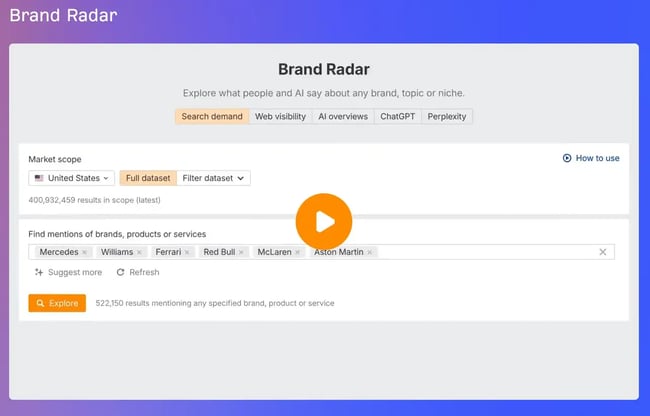
The true competitive advantage, however, stems from the ability to rapidly translate these insights into concrete, strategic actions. Identifying gaps is only valuable if teams can act on them quickly and consistently. Tools like HubSpot’s AEO Grader provide an accessible starting point, benchmarking current visibility. From there, HubSpot AEO and its features within Marketing Hub enable ongoing tracking, detailed competitor analysis, and prioritized recommendations that are directly connected to content execution, CRM data, and pipeline reporting.
For businesses investing in AEO, the path forward is clear: build and continually refine a reliable query set, diligently track answer share over time, and consistently optimize content based on what AI engines actually cite. The companies that operationalize this process early and effectively will not merely keep pace with competitors; they will actively define how their category, products, and services are represented in the burgeoning era of AI-powered answer engines, securing a dominant position in the future of digital discovery.