rifanmuazin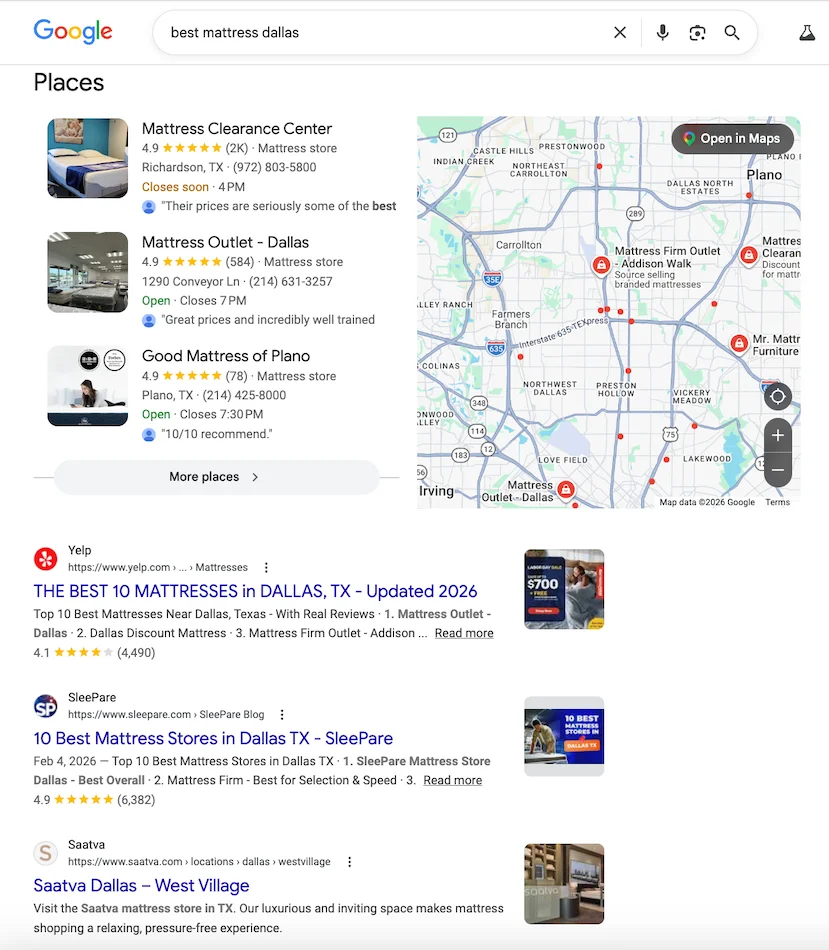
For years, the established playbook for content marketing was straightforward: create valuable content, optimize it for search engines, and wait for users to discover it through clicks. This model thrived in an era where search engines primarily delivered lists of links, encouraging users to navigate through multiple pages, compare information, and gradually build their understanding of a product or service within a business’s sales funnel. However, the advent of advanced Artificial Intelligence, particularly in search, has fundamentally altered this dynamic, necessitating a significant reevaluation of content strategies. AI is now capable of synthesizing information, summarizing complex topics, merging related queries into single answers, and often presenting a prospect’s initial understanding of a business before they even visit its website. This transformation does not signal the end of content marketing; rather, it demands an update to the underlying assumptions that have long governed its effectiveness. This article will delve into three critical ways AI-powered search is impacting content strategies and explore the strategic adjustments businesses must consider to maintain their influence on decision-making processes.
The Diminishing Dominance of Thought Leadership in AI Search
Historically, thought leadership has been a cornerstone of content marketing, with businesses leveraging strong viewpoints, challenging conventional wisdom, and offering unique perspectives to capture attention. This approach was highly effective in a click-driven search environment, where such distinct voices could differentiate a brand and foster trust once a user landed on their site. Yet, AI search operates on a different principle: explanation over persuasion. AI systems are designed to synthesize information from various sources to provide clear, concise answers, not to win arguments or champion a singular opinion.
The Mechanics of AI Synthesis
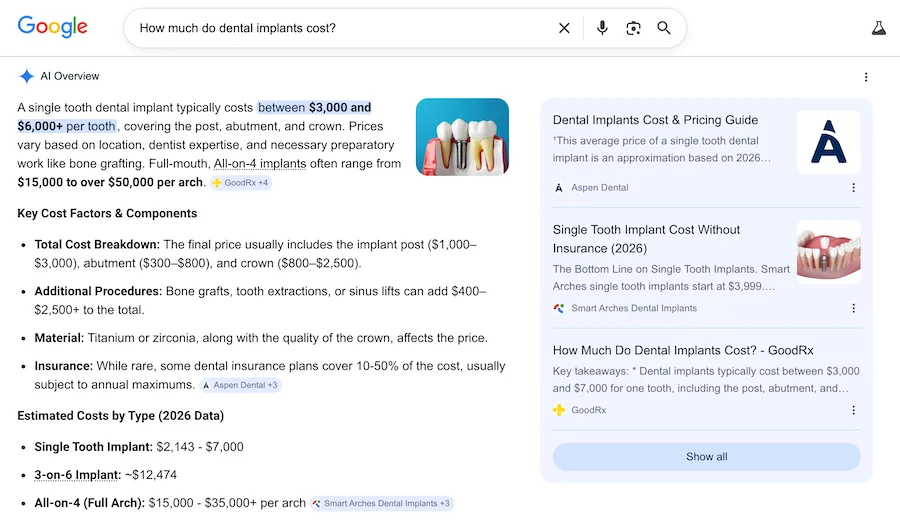
When a user poses a query, such as "How much do dental implants cost?" AI systems do not simply surface the most provocative or opinionated answer. Instead, they aggregate information from multiple reputable sources, blending facts, figures, and contextual data into a single, coherent response. The primary objective of this synthesized answer is to satisfy the user’s query with maximum precision and minimal ambiguity. This means AI prioritizes content that offers clear definitions, specific data points, and objective explanations over subjective interpretations or persuasive arguments.

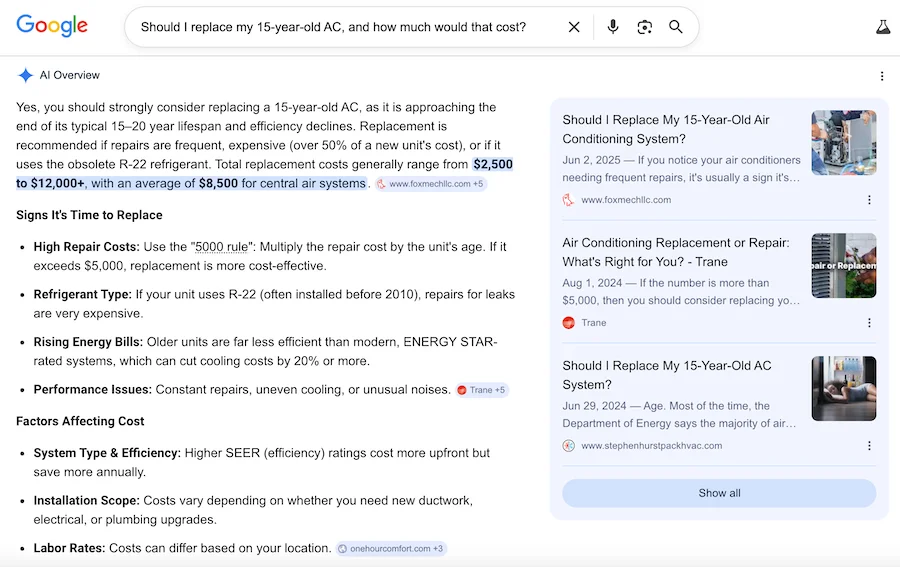
Consider the difference between two statements regarding HVAC replacement. The first, an opinion-led statement, might declare, "You should replace your 15-year-old AC unit because it’s likely inefficient and will soon fail." This statement requires interpretation and introduces a degree of judgment. The second, an explanation-first statement, might read, "A 15-year-old AC unit may be nearing the end of its typical lifespan of 15-20 years. Replacement is often considered when repair costs exceed 50% of a new unit’s price, or when energy efficiency drops significantly, leading to higher utility bills." This version provides concrete metrics and conditions, making it far easier for AI to integrate into a broader, consensus-driven answer.
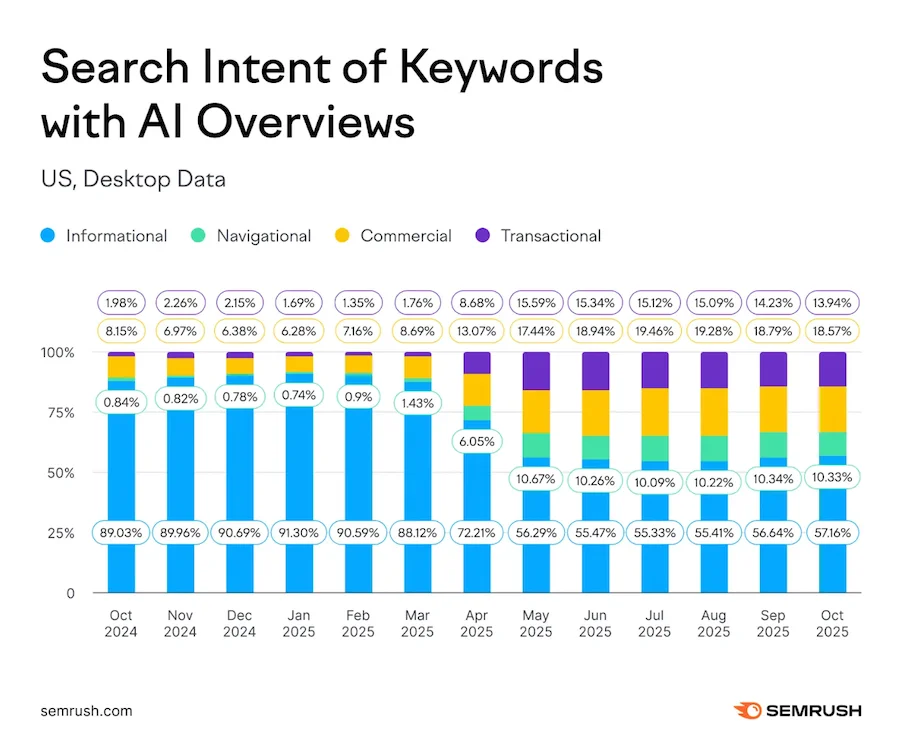
The more interpretation a piece of content demands, the more challenging it becomes for AI to merge it seamlessly with other sources. AI systems tend to avoid statements that introduce conflict or subjective judgment when synthesizing information across different websites. Consequently, definition-first content, which offers objective explanations, is more frequently reused by AI, even if opinion-led content ranks highly in traditional search results. Data from SEMrush’s study on AI Overviews supports this trend, revealing a consistent preference for low-ambiguity explanations over strong, subjective perspectives.
Expert Insights on the Shift
Maeva Cifuentes, Founder & CEO of Flying Cat Marketing, has observed this paradigm shift firsthand across her client base. "For a long time, the SEO formula was simple: more traffic meant more leads, and you could calculate it almost linearly," Cifuentes notes. "AI broke that correlation. It took over the informational layer of search, the research, the synthesis, the ‘what should I think about this?’ questions, and started answering them directly." This informational layer was once the fertile ground for thought leadership content, responsible for capturing researchers, nurturing awareness, and generating top-of-funnel traffic.
While AI now dominates this layer, Cifuentes emphasizes that content is not obsolete; its role has evolved. "What changed technically is that content is still being used; it’s just not generating the value exchange it used to," she explains. "We see client pages getting cited in AI responses, which means the content was useful enough to reference, but the user got the answer inside the AI and never clicked through. The citation replaced the click." This reframes the challenge: the issue is not the usefulness of content but the locus of value exchange. Businesses may still shape understanding, but this influence may occur without direct traffic generation.
Claudia Bird, Senior Content Writer at Grizzle.io, offers a nuanced perspective, observing that thought leadership can still perform well in AI environments, but only under specific conditions. "One of our enterprise clients got a ton of citations and traffic from content that was only meant to be a thought leadership and sales enablement play. But it spoke directly to a crucial pain point for their audience," Bird states. This suggests that perceived authority and clarity are paramount, overriding the format itself. "It’s not as simple as a standalone format that ‘does or doesn’t work.’ There’s a lot more happening in the background—based on perceived authority—that impacts performance," she adds.
The underlying structural issue is clear: thought leadership is not defunct, nor is opinion or perspective unwelcome. However, if an explanation is weak, fragmented, or buried beneath commentary, AI will likely bypass it in favor of clearer, more direct sources. When AI skips a brand’s explanation, the foundational understanding of a business is built using content from elsewhere, potentially leading to misaligned initial perceptions.
Strategic Adjustments for Businesses
Businesses whose content strategies heavily rely on opinion-led thought leadership without a strong foundation of clear explanation risk losing control over how their brand is initially perceived. While their content may still rank, AI might construct its summary from more straightforward explanations provided by competitors. This can lead to generic expectations among potential buyers by the time they do reach a company’s website, as their understanding of the service, cost, target audience, and competitive landscape has already been synthesized elsewhere.
To adapt, businesses should not abandon their unique perspectives but must reorder their content presentation. The strategy should shift to beginning with plain-language explanations, clearly defining the scope of a service, identifying its target audience, and detailing its mechanics before introducing critiques or unique viewpoints. This foundational clarity allows AI systems to safely reuse the explanatory content, while still offering human readers the brand’s differentiated perspective.
For instance, instead of leading with a headline like "Why Most Agencies Waste Your Marketing Budget," the content should first explain what marketing agencies typically do, how retainers are structured, what influences pricing, and when agency support is genuinely beneficial. After establishing this clear groundwork, the critique can be introduced. This sequence ensures that AI can safely incorporate the explanatory elements, while human readers still engage with the brand’s distinctive insights. Maintaining a clear separation between explanation and commentary, anchoring viewpoints in specific scenarios, and employing specificity to reduce ambiguity are key to thriving in this new landscape. In AI search, clear explanation earns visibility first, followed by differentiation. Reversing this order risks shaping understanding only after a user has already arrived, potentially with a preconceived notion formed elsewhere.
The Demise of the Single-Page-Per-Intent Model
For an extended period, effective SEO was synonymous with discipline: identify keyword intent, map a single web page to each distinct intent, and create highly focused content that directly answered specific query types. This approach made sense in a traditional search engine results page (SERP) environment, where users navigated a fragmented journey, frequently returning to search results to refine queries and compare information across multiple sites. However, AI search does not adhere to this strict segmentation.
The AI’s Integrated Approach to Queries
When a user asks a complex question, such as, "Should I replace my 15-year-old AC, and how much would that cost?" AI systems typically do not provide three separate answers. Instead, they synthesize a consolidated explanation that integrates lifespan expectations, repair thresholds, cost drivers, timelines, and associated tradeoffs into a single, comprehensive response. This blending of definition, fit, pricing, and comparison directly challenges the long-standing SEO model of mapping one page to one intent.
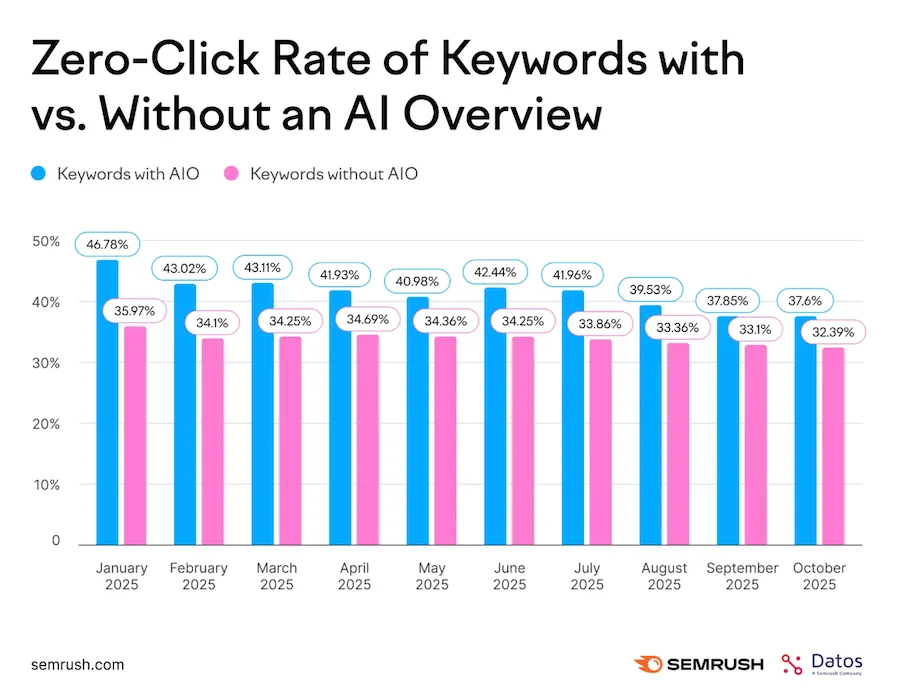
Recent data underscores the dramatic reduction in clicks from search. SparkToro’s clickstream research indicated that nearly 60% of Google searches resulted in zero clicks even two years ago, a figure likely to have increased. When Google’s AI Overviews are present, this zero-click rate escalates further. Semrush’s analysis of keywords triggering AI Summaries found a higher incidence of zero-click searches compared to queries without an AI Overview. This means that a significant portion of users are forming their understanding of a topic before ever visiting a website.
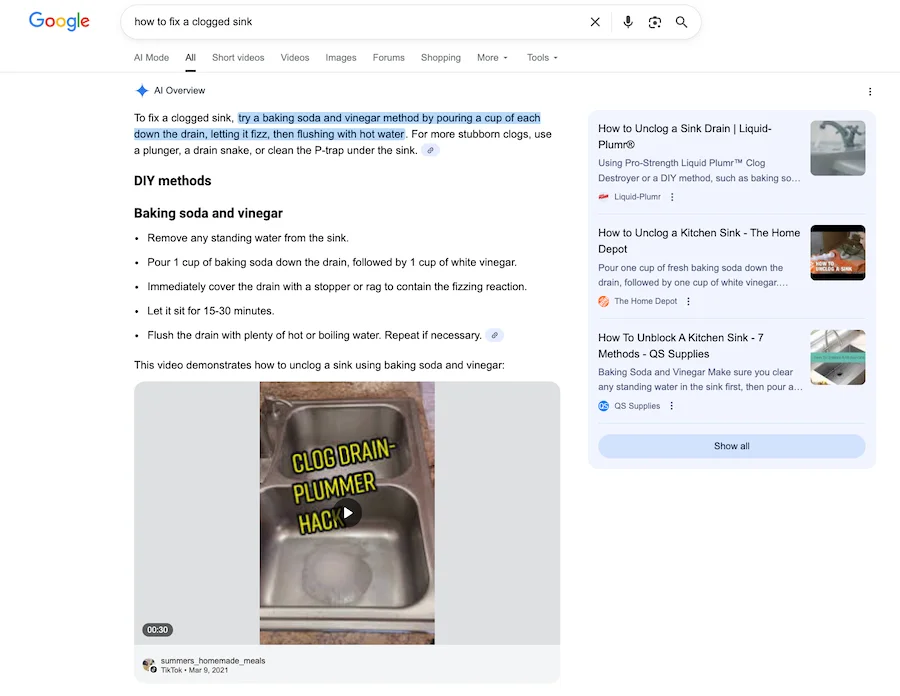
If a company’s core information is dispersed across multiple URLs—one for definitions, another for pricing, a third for eligibility, and a fourth for comparisons—AI will merge these fragmented pieces. This synthesis process can lead to the loss of nuances, as the AI system pulls definitions from one source, pricing averages from another, eligibility conditions from a third, and general best practices from a fourth, reconciling them into a generalized, consensus-driven explanation. This consensus-driven approach often flattens differentiation, a subtle but potentially costly effect, particularly for smaller businesses.
Competitive Implications of Intent Collapse
The collapse of distinct search intents has profound implications for competition. In a traditional search environment, competition occurred on a page-by-page basis. A business ranking for "dental implant cost" could shape how pricing was perceived, while one ranking for "HVAC repair vs. replacement" could influence how that tradeoff was framed. Each query represented a moment of direct influence.
AI fundamentally alters this competitive landscape. When multiple intents converge into a single synthesized answer, businesses are no longer competing for individual keywords. Instead, they are competing for their positioning to survive within a compressed summary that blends input from various sources. This compression inherently struggles to preserve nuanced details. As AI combines definition, pricing, eligibility, and comparison into one explanation, it gravitates toward what is broadly consistent across multiple sites. Edge cases, narrow specialization, and detailed boundaries are often overlooked unless they are explicitly integrated into the core narrative.
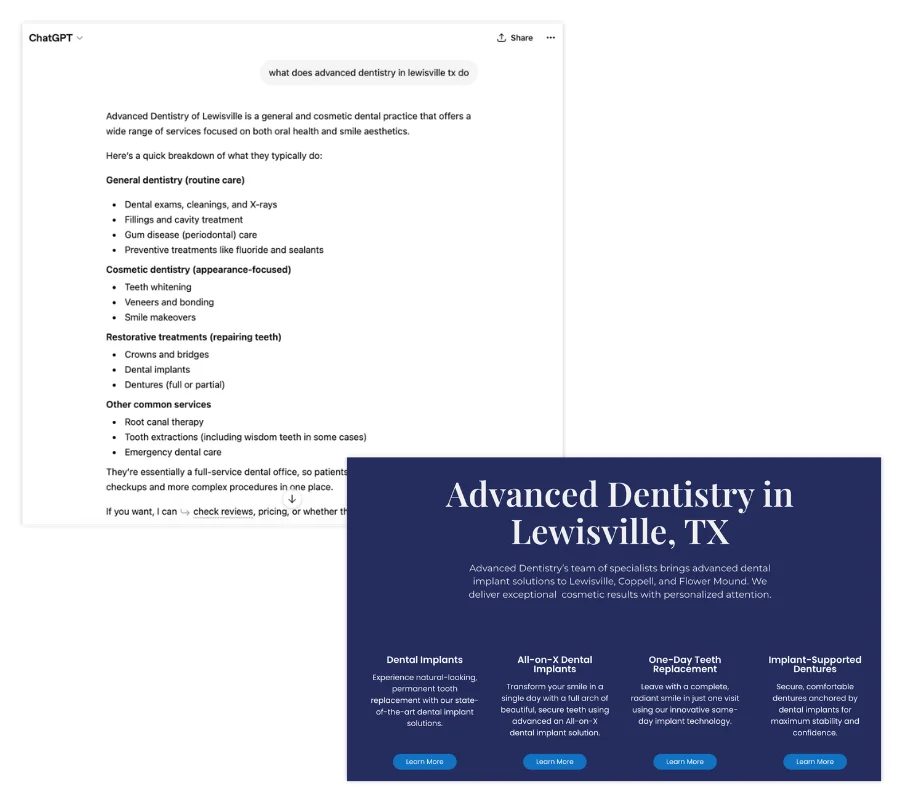
This is where the competitive consequences become apparent. Expertise residing in secondary pages, scattered blog posts, or disconnected FAQs may not survive the synthesis process. AI models tend to favor the center of the market, overlooking the margins where differentiation typically thrives. A dental practice specializing in advanced surgical implant cases might be summarized as a general dental implant provider. An HVAC company focused on high-efficiency systems for older homes could be framed as a standard replacement provider. Over time, this subtle flattening of specialization shifts how potential buyers perceive a business before any direct engagement. Instead of competing on specialization, businesses risk competing on category averages, and instead of standing out through unique positioning, they may blend into consensus language.
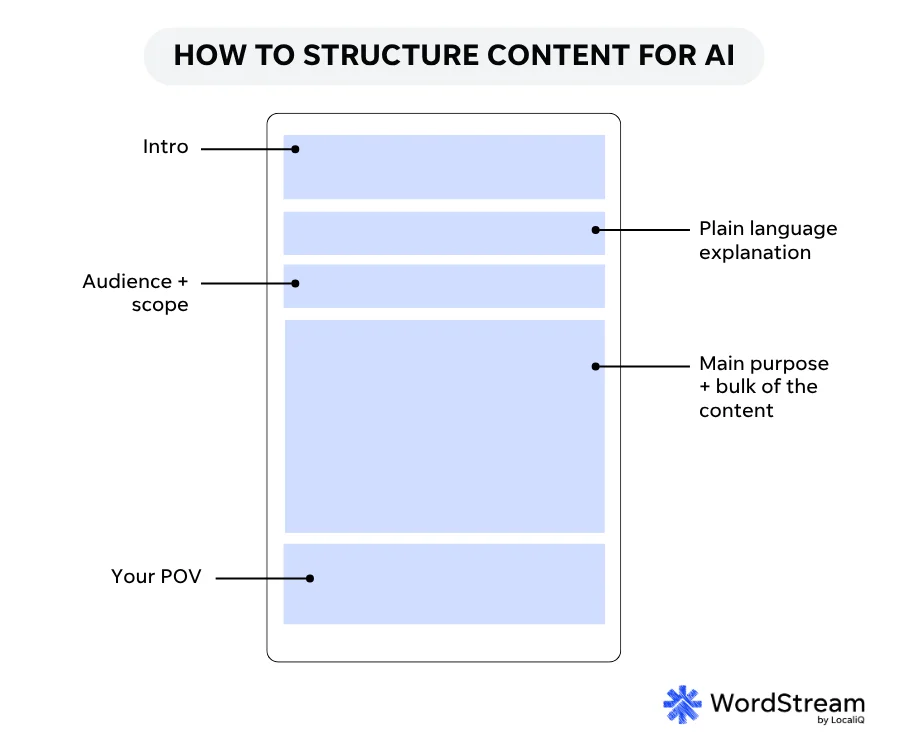
The deeper cost of this intent collapse is not primarily related to rankings or traffic volume but to the erosion of differentiation within the pre-click explanation layer. Once this differentiation erodes, the impact is felt in slower sales cycles, increased price sensitivity, and initial conversations that begin with generic assumptions rather than informed interest. This competitive consequence is often underestimated by businesses.
Strategic Adjustments for Businesses
Rethinking page structure in the age of AI search is not about creating more content, but about redefining the responsibilities of individual pages. In the past, separating definitions, pricing, eligibility, comparisons, and objections into distinct URLs was logical, with each page targeting a specific query and the buyer piecing the information together over time. However, this sequential assembly of knowledge is changing.
When AI collapses multiple intents into a single answer, it expects content to function as a cohesive explanation. If a company’s core service logic is fragmented across several thin or loosely connected pages, AI will likely reconstruct that logic, potentially relying on external sources to fill gaps. Therefore, the most critical service pages must evolve from isolated keyword targets into comprehensive decision hubs.
A high-value service page should clearly articulate what the service entails, who it serves, what factors influence pricing, the typical timeline, existing tradeoffs, and alternative solutions. It should also proactively address common objections, rather than relegating them to separate FAQs or blog posts. This integrated approach does not necessitate lengthy, bloated pages but acknowledges that buyers and AI systems now encounter offerings as complete narratives, not as sequences of disconnected answers. If pricing variability causes confusion in sales calls, that explanation should be embedded within the main service page. Similarly, if repair versus replacement is a consistent decision point, that logic should be part of the core service page. If qualification rules are essential for determining fit, they should be explicit and readily visible.
When the full context resides together, the synthesized explanation is more likely to accurately reflect a company’s true positioning. Conversely, fragmented context forces AI to reconstruct the narrative using external averages and generalized advice, diminishing a business’s control over its initial brand representation.
The Shifting Starting Point: Your Website as Validation, Not Introduction
In numerous scenarios, prospective buyers no longer initiate their understanding of a product or service on a company’s website. Instead, they begin by posing broad questions to AI, receiving a consolidated answer that blends definitions, pricing context, comparisons, and tradeoffs. This AI-generated summary becomes their baseline understanding. By the time they navigate to a company’s website, their intent is often to validate the information they’ve already acquired, not to learn from scratch.
Stephanie Yoder, Director of Content at Rebrandly, observes this trend keenly: "Technical searches, factual queries, and how-to content are migrating rapidly to AI platforms, while commercial searches still largely happen on traditional search engines." This compression of research means users who once spent considerable time reading multiple articles can now obtain a synthesized answer from AI in a fraction of the time. This shift fundamentally alters the order of influence; a company’s website now functions as a point of validation rather than an introduction.
When this occurs, a company’s messaging is evaluated against an existing framework. If it aligns, conversations progress smoothly. If it conflicts, valuable time is spent correcting assumptions that the business did not originate. The starting point of the buyer’s journey has moved, and content strategies must adapt accordingly.
The Upward Shift of the Funnel
Maeva Cifuentes’ team has noted this pattern: "What we noticed first was that traffic dropped but leads didn’t. That was the signal. AI was filtering out the researchers and delivering the buyers. That told us the formula had changed—not broken—changed." This distinction is crucial. AI is absorbing much of the early-stage exploration and compressing comparison stages, potentially filtering out some casual researchers who previously navigated through multiple informational pages.
Consequently, fewer visitors may reach a website, but those who do are often further along in their decision-making process. While a decline in session counts might initially appear as a negative trend, an examination of lead quality, objection patterns, and sales conversations reveals a different picture. The sales funnel has not disappeared; it has simply shifted upward. With the initial layer of understanding occurring before a click, content strategies can no longer assume they control the opening frame of the buyer’s narrative. The buyer’s understanding is now shaped upstream by a synthesized answer that may not fully represent a business’s specialization, boundaries, or unique positioning.
When a website contradicts this pre-assembled explanation, it can create a wobble in trust. Conversely, clear confirmation accelerates trust. This shift is subtle, as it may not always manifest as immediate traffic loss but rather as narrative misalignment, which impacts revenue long before it affects search engine rankings.
Strategic Adjustments for Businesses
At this juncture, the strategic objective transforms from persuasion first to confirmation first. If a buyer arrives with a summary already in mind, the website’s content must quickly answer the question: "Is what I read accurate here?" This requires a strategic focus on the initial 150-200 words of core service pages. These introductory paragraphs carry disproportionate weight and must efficiently convey:
- Clarity: Directly address the user’s likely AI-formed understanding.
- Alignment: Confirm or gently correct the key points the user may have gleaned.
- Differentiation: Briefly hint at what makes the business unique, without being overly promotional.
If these introductory paragraphs are vague, aspirational, or excessively promotional, both AI systems and human buyers will default to external framing. Clarity in this initial section reduces friction, which in turn improves alignment and ultimately enhances close rates.
The Compounding Effect of Interconnected Challenges
Each of these three shifts—the diminished role of thought leadership, the collapse of single-intent pages, and the altered starting point of buyer journeys—presents manageable challenges individually. Businesses can adjust thought leadership structures, rethink page segmentation, and refine their core service pages. However, when all three shifts occur concurrently, their combined effect is significantly amplified.
When opinion-heavy content is bypassed in AI summaries, when search intent is fragmented across multiple URLs, and when AI forms the initial explanation before a user clicks through to a website, a subtle but critical outcome emerges: businesses lose control over how their brand is initially described. Accuracy is paramount in this new environment. Consider the implications: if a business’s unique value proposition is lost in synthesis, or if its specialized services are generalized, potential clients may arrive with mismatched expectations. This leads to longer sales cycles, increased price sensitivity, and conversations that require extensive effort to realign with the business’s actual offerings.
Addressing Content Challenges for Enhanced AI Performance
The overarching solution lies in fundamentally rethinking the responsibilities of core web pages. Businesses need revenue-driving pages that are structurally designed for synthesis. This means creating content that explains clearly before offering perspective, combining related intents rather than isolating them, explicitly defining boundaries alongside benefits, and ensuring pages can withstand summarization without losing their essential nuance.

A crucial first step is auditing key service pages with pointed questions. Does the page clearly explain what the service is and who it is for? Does it explicitly define pricing factors and timelines? Does it address common objections and tradeoffs? Most importantly, if an AI system were to extract and summarize only the initial portion of this page, would that summary accurately reflect the desired brand positioning? If the answer is not a resounding "yes," the page’s structure requires revision.
Artificial intelligence has not rendered content obsolete; it has fundamentally reassigned its purpose. In this evolving landscape, clarity triumphs over cleverness, explanation must precede differentiation, and accuracy holds greater weight than originality in the initial layer of understanding. Content for businesses, particularly small businesses, no longer exists solely to attract clicks. Its primary function is now to shape the explanation that forms before the click ever occurs. When web pages effectively control this explanation layer, traffic becomes more resilient, and sales conversations become more aligned. Conversely, when they do not, businesses will find themselves spending more time correcting upstream assumptions than moving deals forward. In an environment increasingly characterized by zero-click searches, the entity that shapes the explanation ultimately shapes the pipeline.