rifanmuazin
The digital marketing landscape is currently undergoing a significant shift as businesses move away from haphazard A/B testing toward a more disciplined, data-centric methodology known as Conversion Rate Optimization (CRO). Industry data suggests that while the average e-commerce conversion rate hovers between 2% and 3%, top-tier performers achieving 5% or higher often rely on structured frameworks rather than intuition. At the center of this movement is the SHIP model—Scrutinize, Hypothesize, Implement, and Propagate—a continuous loop designed to maximize the compound effect of website optimizations on revenue.
For many organizations, the primary obstacle to growth is not a lack of ideas, but a lack of focus. Most teams waste significant resources testing low-impact changes that fail to move the needle. To address this, the SHIP model provides a roadmap that prioritizes high-impact changes based on rigorous data analysis and behavioral psychology. By moving from a "project-based" mindset to a "process-based" one, companies are finding that they can systematically uncover the root causes of visitor friction and convert more of their existing traffic into loyal customers.
The Scrutinize Phase: Identifying the Root Causes of Friction
The first and arguably most critical phase of a successful CRO program is Scrutinize. In this stage, practitioners move beyond simply identifying where visitors drop off and begin investigating why they are leaving. This requires a dual-pronged approach combining quantitative data—the "what"—with qualitative insights—the "why."
Quantitative data is typically sourced from analytics platforms like Google Analytics 4. Marketers look for high-bounce pages, high-exit pages, and specific steps in the checkout funnel where users abandon their carts. However, the industry is increasingly recognizing that data alone is insufficient. As Chris Goward, founder of Widerfunnel, has noted, simply knowing that a page performs poorly does not explain the psychological barriers a user faces.
To bridge this gap, the Scrutinize phase incorporates qualitative methods such as heatmaps, session recordings, and on-site surveys. This empathy-driven approach treats the website as a sales conversation. If a customer stops responding, the CRO specialist must determine if the breakdown occurred because of a technical bug, a usability hurdle, or a fundamental lack of trust.
Distinguishing Between Bugs, Usability, and Conversion Issues
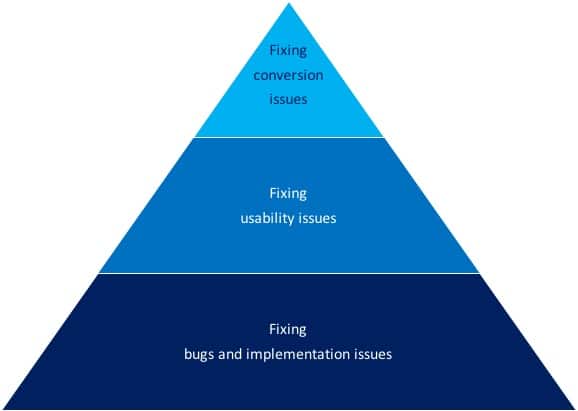
A common pitfall in the digital optimization space is the conflation of usability and conversion optimization. While every usability issue is technically a conversion issue, the reverse is not true. A website can be perfectly user-friendly and functional yet still fail to convert visitors if it lacks a compelling value proposition or social proof.
Industry experts categorize website issues into three distinct buckets:

- Bugs: Technical malfunctions, such as broken buttons or slow-loading scripts, that prevent the site from functioning as intended.
- Usability Issues: Elements that make it difficult for a user to navigate, such as confusing menus or unclear form labels.
- Conversion Issues: Psychological barriers, such as a lack of trust, "Fear, Uncertainty, and Doubt" (FUDs), or a weak call-to-action.
Research indicates that focusing solely on bugs and usability creates a "frictionless" site but does not necessarily drive sales. True conversion optimization focuses on persuasion—addressing the user’s motivations and anxieties to guide them toward a desired action.
The Science of the Hypothesis: From Initial Ideas to Concrete Plans
Once potential issues are identified, they are compiled into a "research opportunities list." However, a list of problems is not a testing plan. Each item must be paired with a hypothesis—a predictive statement that outlines the expected impact of a specific change.
The process involves moving from an "initial hypothesis" to a "concrete hypothesis." An initial hypothesis might state: "Adding social proof will increase trust and conversions." While a good starting point, it lacks the specificity required for scientific testing. A concrete hypothesis, by contrast, is grounded in evidence: "Based on qualitative data from online polling, we observed that users do not trust the brand. Adding three customer testimonials to the homepage will increase trust and improve conversion rates by 10%."
A concrete hypothesis must be testable, measurable, and based on observed data. This rigorous approach ensures that every A/B test conducted has a clear rationale, reducing the likelihood of "false positives" and ensuring that even failed tests provide valuable learnings for the organization.

A Comparative Analysis of Prioritization Frameworks
With dozens or even hundreds of potential tests identified, prioritization becomes the "make or break" factor of a CRO program. Several frameworks have emerged as industry standards, each offering a different method for scoring and ranking ideas.
The PIE Framework, developed by Widerfunnel, evaluates tests based on three factors: Potential (how much improvement can be made), Importance (how valuable the traffic is on that page), and Ease (how much effort is required to implement the test). While PIE is praised for its simplicity, critics argue that it is often too subjective, as different team members may have wildly different views on what constitutes "potential."
In response to these limitations, the PXL Framework from CXL introduced a more objective, binary scoring system. Instead of subjective ratings, PXL asks a series of "yes/no" questions: Is the change above the fold? Is it addressing an issue found in user testing? Is it a change to motivation rather than just aesthetics? This model attempts to remove human bias from the equation, providing a more consistent ranking of ideas.
Another notable model is the Hotwire Framework, introduced by Pauline Marol. This framework emphasizes the strategic alignment of a test with overall business objectives. Marol has argued that prioritization is not just about finding the "easiest" test, but about thinking deeply about long-term business impact. This model is particularly favored by product managers who need to justify testing resources to executive leadership.

The Invesp Model: A Weighted Approach to Data Discovery
Building upon previous frameworks, the Invesp Prioritization Framework introduces a weighted average system that rewards ideas discovered through multiple research methods. If a problem is identified through both heatmaps and analytics, it receives a higher score than an issue found through only one channel.
The Invesp model scores items based on eleven criteria, including the type of change (adding, removing, or relocating elements), the device specificity (mobile vs. desktop), and the strength of the evidence. For example, a change that addresses a conversion blocker identified through four or more research methods receives a top score of 12, whereas a single-source observation might only score a 3.
This model also accounts for the "type of change." Adding or removing an element is generally seen as having a higher impact than simply changing the location or emphasis of an existing element. By using these granular metrics, teams can ensure they are focusing on the most transformative changes rather than minor cosmetic tweaks.
Broader Implications for the Digital Economy
The move toward these sophisticated CRO frameworks reflects a broader trend in the digital economy: the rising cost of customer acquisition (CAC). As digital advertising becomes more expensive and competitive, businesses can no longer afford to ignore the traffic they already have.

Industry analysts suggest that for every $92 spent on acquiring customers, only $1 is spent on converting them. This imbalance is increasingly unsustainable. Organizations that adopt models like SHIP and implement rigorous prioritization are finding that they can achieve "compound growth." In this scenario, a series of small, 5% improvements in conversion rate do not just add up; they multiply, leading to massive increases in long-term profitability.
Furthermore, the data gathered during the Scrutinize and Hypothesize phases often provides insights that go beyond the website. Behavioral data can inform product development, customer service protocols, and even offline marketing strategies. In this sense, CRO is evolving from a niche technical discipline into a core business strategy.
Conclusion: The Future of Iterative Growth
There is no "perfect" prioritization framework that applies to every business. As Chris Goward has noted, every website lives in a unique market environment influenced by competition, seasonality, and internal culture. However, the transition from "testing for the sake of testing" to a structured, hypothesis-driven process is now a requirement for any business seeking to remain competitive in a digital-first world.
By following the SHIP model and utilizing objective prioritization frameworks, companies can stop wasting time on low-impact ideas and start focusing on the changes that truly drive revenue. As the digital landscape continues to evolve, the ability to turn raw data into actionable psychological insights will remain the hallmark of successful conversion rate optimization.