rifanmuazin
The discipline of Conversion Rate Optimization (CRO) has undergone a radical transformation over the last decade, shifting from a niche tactical function to a core strategic pillar for digital-first enterprises. As the complexity of user journeys increases and the volume of available data grows exponentially, practitioners are forced to reconcile traditional research methodologies with the burgeoning capabilities of artificial intelligence. Simbar Dube, a Conversion Research Specialist at Enavi and a veteran of the industry, provides a critical perspective on this evolution. With a professional lineage rooted in journalism and a career trajectory that includes leadership roles at prominent firms like Invesp, Dube’s approach to optimization emphasizes the necessity of human curiosity in an era of automated analysis.
From Journalism to Data Science: The Evolution of a Conversion Specialist
Simbar Dube’s entry into the world of CRO in 2019 was not a planned career shift but rather a natural progression of his fundamental interests. Transitioning from journalism to a role as a Content Editor at Invesp, he eventually ascended to the position of Head of Marketing before specializing in conversion research. Dube notes that the core tenets of journalism—investigating leads, asking incisive questions, and understanding human motivation—are directly transferable to the digital optimization space. In his view, the environment has changed, but the objective remains the same: uncovering the "why" behind human behavior.

At Enavi, Dube’s work is centered on identifying the specific points of friction within a user journey where intent collapses. His methodology moves beyond the superficial application of "best practices," which often fail to account for the unique context of a specific brand or audience. Instead, he advocates for a research-heavy approach that prioritizes evidence over intuition. When asked to define the discipline of optimization in a concise manner, Dube characterizes it as "Curiosity. Tested. Proven. Repeat." This cyclical process underscores the scientific nature of the field, where hypotheses must be validated through rigorous testing before they are accepted as fact.
The Integration of Artificial Intelligence in Research Workflows
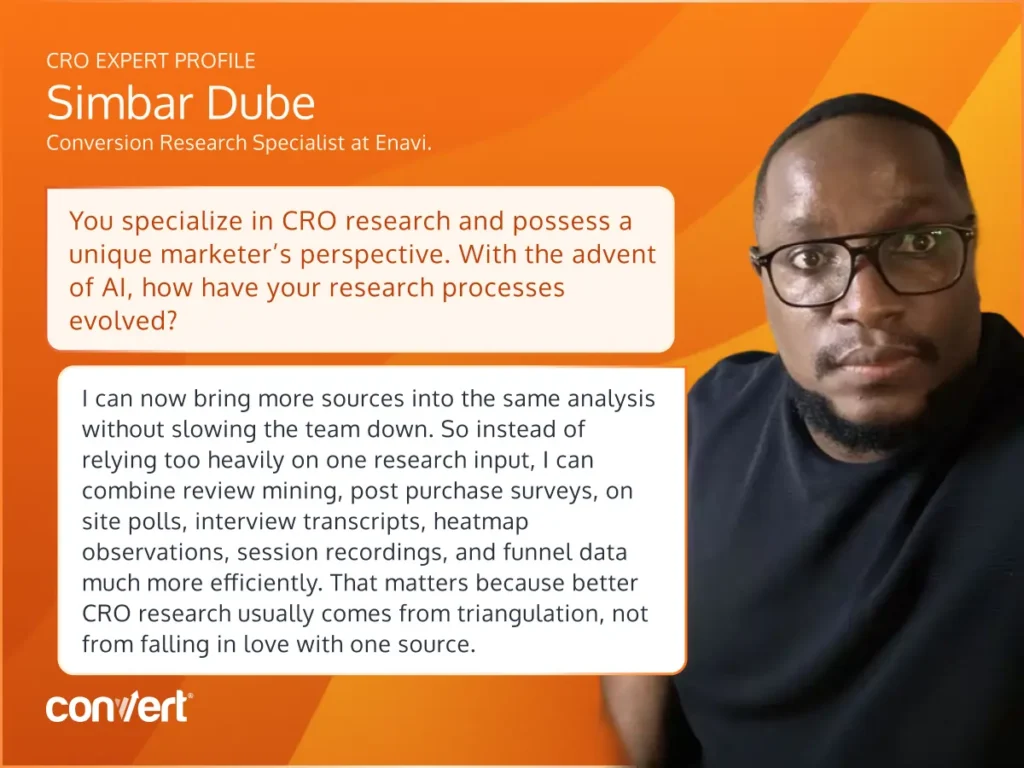
The advent of generative AI and advanced machine learning has introduced a new variable into the CRO equation. For many in the industry, AI represents a threat to the traditional role of the researcher. However, Dube views it as a powerful catalyst for efficiency. According to recent industry reports, the global market for AI in marketing is expected to grow at a compound annual growth rate (CAGR) of nearly 30% through 2030, reflecting a broad-based shift toward automated data processing.
Dube explains that while the fundamentals of his research process remain intact, AI has fundamentally altered the speed and scale at which he operates. Historically, high-quality CRO research was a labor-intensive endeavor. A researcher might spend weeks manually reviewing hundreds of customer surveys, analyzing session recordings, and synthesizing interview transcripts to find patterns. Dube notes that AI now allows for "triangulation"—the process of combining multiple data sources like heatmaps, post-purchase surveys, and funnel data—to occur in a fraction of the time.

"Before AI, you could go deep, but it was harder to go wide at the same time," Dube observes. By using AI to cluster recurring objections and compare language patterns across thousands of data points, researchers can achieve a level of synthesis in hours that previously took days. This acceleration does not merely save time; it improves the quality of the output by allowing the researcher to pressure-test their own biases and explore alternative explanations for user behavior that they might otherwise have overlooked.
The Limits of Automation: Judgment vs. Acceleration
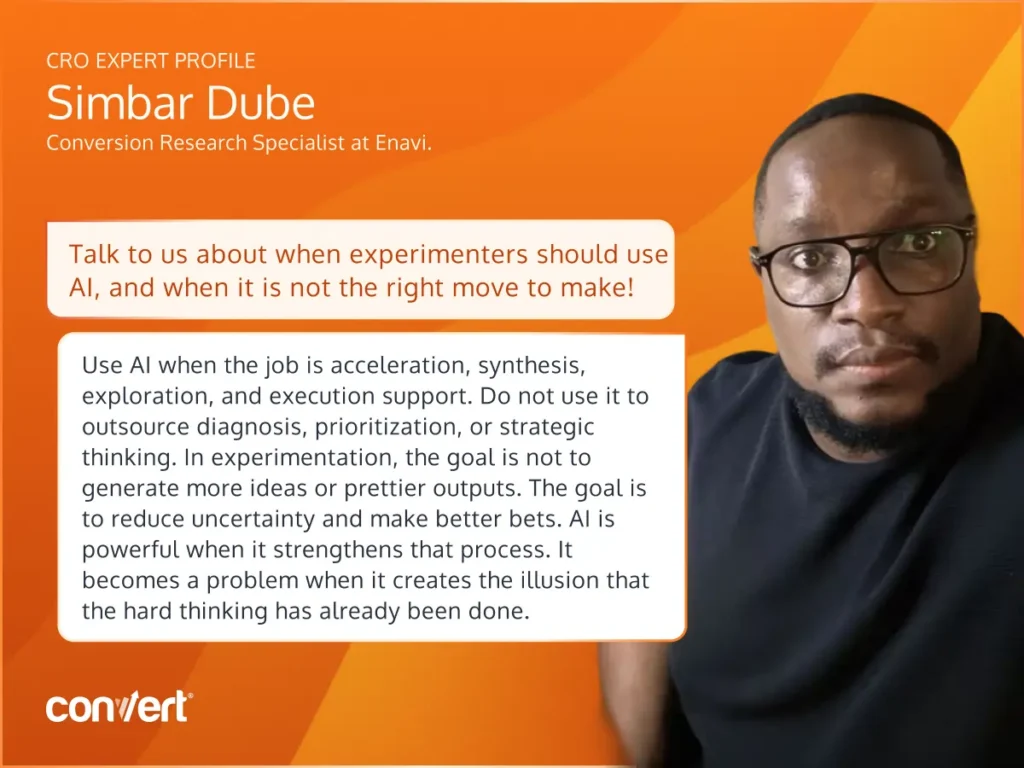
Despite the clear advantages of AI in data synthesis, Dube maintains a strict boundary regarding its application. He argues that the most significant risk in the current landscape is the temptation to outsource "judgment" to an algorithm. While AI is adept at surfacing signals—identifying that 40% of users are complaining about a specific checkout step, for instance—it lacks the commercial context to determine if that friction is the primary bottleneck affecting revenue.
The distinction between "acceleration" and "diagnosis" is central to Dube’s philosophy. In a professional newsroom or a corporate boardroom, the data provides the evidence, but the human provides the strategy. Dube asserts that prioritization—deciding which experiment to run first based on business goals, technical feasibility, and potential impact—must remain a human-led activity. He cautions against treating AI as a "final authority" on the roadmap, noting that a model cannot replace the discipline of understanding a specific business’s commercial reality or its unique customer segments.
Case Study: Bridging the Gap Between Online Anxiety and Physical Retail
To illustrate the practical application of his optimization philosophy, Dube points to a high-impact experiment conducted for a retail client. The challenge involved a product category where customers felt significant "purchase anxiety"—a psychological barrier common in fashion and high-end goods where the fit and feel of an item are paramount. Data indicated that customers living near physical store locations had a higher lifetime value (LTV) and average order value (AOV) when they shopped in-person rather than online.
The objective was not simply to increase website conversions, but to use the digital platform to drive high-value physical traffic. Dube and his team designed an experiment centered on the "Buy Online, Pick Up In Store" (BOPIS) model. By making the pickup option more prominent for local users and positioning it as the "fastest and most reassuring" way to purchase, they addressed the customer’s fear of an incorrect fit while simultaneously moving demand into a more profitable channel.
This "offline-style" experiment highlights a broader trend in CRO: the move toward omnichannel optimization. According to a 2023 retail report by Shopify, nearly 50% of consumers say the ability to buy online and pick up in-store influences where they choose to shop. Dube’s test was successful because it was rooted in a deep understanding of customer psychology rather than a simple desire to change the color of a button. The results were measured not just in clicks, but in increased foot traffic and stronger order values for the local cohort.
Diagnostic Outreach in B2B Sales Motions
Dube’s experimentation framework extends beyond e-commerce into the realm of B2B sales and pipeline management. He treats "stalled deals"—prospects who have stopped communicating with sales teams—as an experimentation problem. In one instance, he tested different re-entry strategies for a client’s sales team. Rather than using generic "nurture" emails or broad case studies, they implemented a "pointed diagnosis" approach.
This method involved reaching out to prospects with a specific analysis of what was likely constraining their growth, based on data observed in their funnel. The goal was to provide value immediately and give the buyer a reason to think, rather than just a reason to click a link. Dube found that highly specific, diagnostic outreach consistently outperformed polished marketing collateral. This reinforces his belief that in any field—whether sales or CRO—the most effective interventions are those that demonstrate a profound understanding of the recipient’s specific challenges.
Broader Impact and the Future of the Industry
The insights shared by Simbar Dube suggest a future for CRO that is increasingly technical yet fundamentally human. As AI tools like Shopify’s "Sidekick" or various automated testing platforms become standard, the barrier to entry for running "tests" will lower. However, the barrier to running meaningful tests will likely rise. The industry is moving toward a bifurcated state where basic execution is automated, but strategic insight becomes a premium service.
For businesses looking to scale their experimentation programs, the implications are clear: investment in AI tools must be matched by an investment in skilled researchers who can interpret the output. The "human in the loop" is not just a safety measure; it is the source of the creative leaps that lead to breakthrough growth.
Dube’s journey from journalism to the forefront of conversion research serves as a reminder that the most valuable skill in the digital economy is the ability to synthesize complex information into actionable truth. As he continues his work at Enavi, his focus remains on the "Curiosity. Tested. Proven." cycle—a methodology that ensures that even as the tools change, the pursuit of understanding remains the primary driver of success.
The ongoing "Think Like a CRO Pro" series continues to highlight these perspectives, offering a roadmap for organizations trying to navigate the volatile intersection of technology and consumer behavior. In an environment where data is noisy and AI is ubiquitous, the specialists who can find the "signals in the noise" will be the ones who define the next era of digital commerce.