rifanmuazin
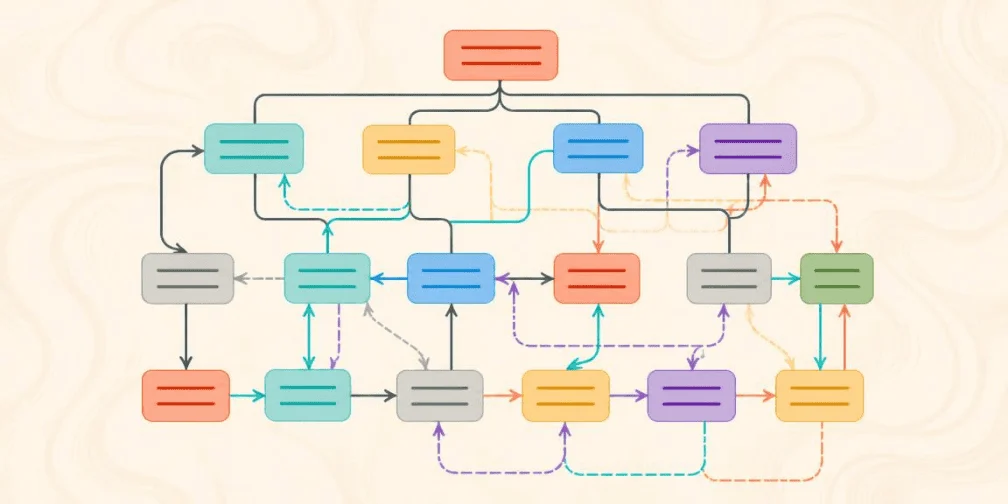
The traditional model of Business-to-Business (B2B) marketing, once characterized by a relatively contained buyer discovery process, has undergone a profound transformation. Gone are the days when potential customers would engage with a limited selection of options, compare them against a clear set of criteria, and move forward with a well-defined path to decision. Today, B2B buyer discovery is a far more intricate, fragmented, and elongated journey, unfolding across a diverse array of digital and physical environments, making it increasingly challenging for marketers to trace and influence.
McKinsey & Company’s extensive research underscores this paradigm shift, revealing that B2B buyers now interact with an average of ten distinct channels throughout their decision-making process. This diffusion of engagement signifies a fundamental alteration in how understanding is acquired. Rather than a singular, definitive moment of insight, buyer comprehension is now an accumulation of experiences, shaped by repeated exposure, cross-referencing of information, and continuous validation, often without a definitive indicator of when confidence is ultimately established.
This evolving reality has prompted a deeper examination within the B2B marketing community. Leading voices, such as those at TopRank Marketing’s B2B Marketing Blog, have been actively dissecting the implications of this multi-channel discovery. Their analyses have delved into how a "Best Answer Marketing" framework can be architected to accommodate this complexity, emphasizing the critical role of data-driven insights in clarifying buyer objectives, the necessity of integrated strategies to maintain message coherence, the foundational importance of trust in fostering belief, and the power of experiential content in deepening engagement.
The core challenge for modern B2B marketers lies in ensuring that their brand narrative remains robust and consistent across this fractured discovery landscape. It is no longer sufficient to rely on initial impressions. The true test of a brand’s efficacy now hinges on its ability to withstand scrutiny as buyers repeatedly encounter its messaging, often through disparate sources, diverse voices, and under varying forms of evaluation. This necessitates a strategic approach that prioritizes continuity and resonance, rather than simply broad reach.

The Demise of the Linear Buyer Funnel
The long-held concept of a neatly defined buyer funnel, progressing linearly from awareness to consideration and finally to decision, has become an artifact of a bygone era. Contemporary B2B buyer journeys are characterized by their non-linear and multi-environmental nature, frequently lacking a discernible starting point. Each touchpoint within this complex ecosystem serves a unique purpose, and no single channel can unilaterally bear the weight of the entire decision-making process.
The initial stages of buyer orientation are increasingly influenced by AI-driven tools, which empower individuals to rapidly frame their challenges and identify potential areas of inquiry. Subsequently, search engines play a pivotal role in the validation phase, enabling buyers to cross-reference claims, compare competing perspectives, and scrutinize information. Peer-driven forums and communities offer invaluable lived experiences and authentic testimonials, while expert opinions and proprietary brand content contribute to the evaluation of an idea’s practical applicability. Crucially, these various interactions are not mutually exclusive; they are cumulative, building a more comprehensive understanding over time.
The fundamental intent of B2B buyers has not shifted; they remain committed to making sound, well-informed purchasing decisions. What has evolved is their methodology for mitigating uncertainty. Instead of placing their trust in a singular source of information, buyers are increasingly inclined to triangulate signals across multiple platforms, seeking a high degree of consistency before committing to a course of action.
In this dynamic environment, mere visibility is no longer an adequate strategy. If a brand’s messaging or core propositions exhibit inconsistencies, contradictions, or a lack of clarity as buyers navigate different channels, it inevitably erodes confidence. Consequently, multi-channel discovery transcends a mere pursuit of reach; it becomes a strategic imperative focused on continuity—ensuring that the fundamental brand narrative remains intact and coherent, irrespective of where buyers seek reassurance.
Research Illuminates the Complexities of Multi-Channel Discovery
Emerging research, such as that detailed in "The State of B2B Thought Leadership in 2026," starkly illustrates this profound shift in buyer behavior. The findings reveal that discovery is no longer confined to a single locus, and a significant portion of marketing teams are experiencing considerable strain in their efforts to support buyer evaluation across a multitude of disparate environments simultaneously.
A survey of 797 senior B2B marketers participating in this research consistently identified fragmentation as a primary challenge. Approximately one-third of respondents reported limited visibility into the performance of their marketing efforts across the entire buyer journey, while another third indicated an over-reliance on a select few channels. These metrics suggest a disconnect: while marketers acknowledge the expanding reach of buyer engagement, many still lack the structured frameworks necessary to foster connected and impactful interactions across these diverse touchpoints.
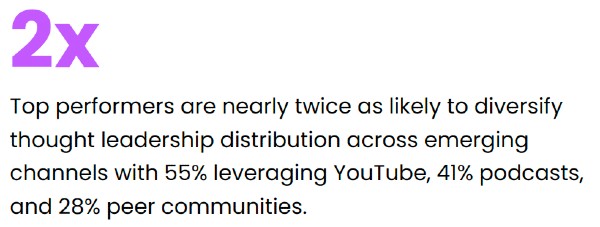
Furthermore, the research highlights a noticeable decentralization of influence. Top-performing B2B organizations are demonstrably more likely to diversify their thought leadership distribution strategies, extending their presence beyond a narrow spectrum of established platforms. This includes a more pronounced adoption of emerging channels such as video, podcasts, and peer communities. These environments are particularly conducive to buyers revisiting complex ideas, discerning subtle nuances, and validating perspectives over extended periods.
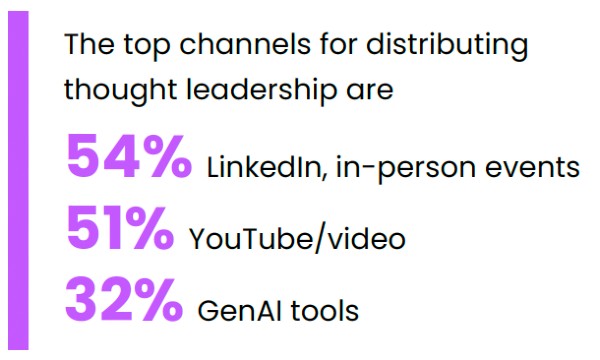
The report also points to a growing divergence between how B2B marketers are distributing thought leadership content and the actual methods buyers are employing to discover it. While platforms like LinkedIn and traditional in-person events continue to hold significant sway, video content has emerged as an increasingly vital component of the discovery process. Notably, nearly one-third of buyers now report utilizing Generative AI (GenAI) tools for thought leadership discovery—a channel that a substantial number of marketers still perceive as secondary.
Taken in aggregate, these findings underscore a critical challenge for the B2B marketing sector. The issue is not solely about selecting the "right" channel. Instead, it is about meticulously ensuring that the underlying brand proposition and core messaging are presented with unwavering consistency across all environments where buyers actively seek to validate information, compare options, and ultimately build the confidence required for their decisions.
Buyer Channel Utilization for Uncertainty Reduction
As the scope of buyer discovery expands across a broader spectrum of environments, B2B buyers are increasingly leveraging each channel for specific types of reassurance. The inherent value of each interaction becomes more apparent when examined through the lens of risk reduction rather than merely as an opportunity for message delivery.
- AI Tools & Early Orientation: These platforms often serve as initial navigators, helping buyers to quickly define and articulate their problems, thereby reducing the initial uncertainty of where to begin their search.
- Search Engines & Validation: Search engines provide a crucial layer of verification, allowing buyers to confirm claims made by vendors, compare features and benefits, and access diverse viewpoints to contextualize information.
- Peer Communities & Lived Experience: Discussions within professional networks and industry forums offer candid insights into the practical realities of using specific solutions, providing a vital counterpoint to vendor-provided information and mitigating the risk of investing in an unsuitable product.
- Expert Voices & Credibility: Authoritative figures and reputable industry analysts lend credibility to ideas and solutions, helping buyers to assess the intellectual rigor and long-term viability of a particular approach.
- Brand Content & Deep Dive Evaluation: Owned content, such as white papers, case studies, and detailed product documentation, allows buyers to conduct in-depth evaluations, explore technical specifications, and gain a comprehensive understanding of a brand’s offerings.
What proves most consequential is not necessarily the precise sequence of these interactions, which can vary significantly among individuals, but rather the functional role each touchpoint fulfills. Buyers are meticulously constructing confidence incrementally. Each channel addresses a distinct query or concern, and collectively, these interactions determine whether an idea or solution is perceived as sufficiently reliable to warrant further action.
High-Performing B2B Brands Architect for Multi-Channel Discovery
Leading B2B marketers have adopted a fundamental understanding: they cannot dictate where buyer discovery occurs. Buyers will encounter ideas in diverse locations, at varying times, and frequently outside the structured confines of any deliberate marketing campaign. Consequently, the strategic focus shifts from achieving dominance across all channels to cultivating consensus around the brand’s core narrative. This involves becoming the "Best Answer" in a manner that resonates deeply with buyers in the spaces they inhabit, where they place their trust, and where they are most susceptible to influence.
Instead of planning channel strategies in isolation, top-tier B2B marketers begin with a clearly articulated point of view. They then meticulously ensure that this perspective is consistently supported by verifiable proof and demonstrable credibility across all platforms where buyers are likely to seek confirmation. This continuity of language, evidence, and framing is maintained whether the brand’s message appears in an AI-generated summary, a search engine result, a peer-to-peer discussion, or a more in-depth piece of owned content. This unwavering coherence of narrative, fortified by compelling proof, is central to the "Best Answer Marketing" system and aligns seamlessly with emerging concepts like LinkedIn’s "Buyability."
These high-achieving B2B marketers also recognize that repetition is not a sign of inefficiency; it is a strategic necessity. Buyers anticipate encountering the same core ideas multiple times throughout their journey. When thoughtfully designed, each subsequent exposure serves to add context, reinforce understanding, and reduce the cognitive load associated with building trust in the information presented.
Most importantly, successful marketers are structuring their discovery strategies around authentic buyer behaviors. They anticipate that buyers will engage in comparative analysis, actively seek external validation, and revisit information as their decision-making process evolves. By organizing information and discovery pathways with these inherent behaviors in mind, brands not only enhance their appeal to human buyers but also optimize their visibility and relevance for AI-powered discovery tools. The ultimate objective is not to enforce a rigid, linear path but to simplify each evaluation point by maintaining absolute consistency in the underlying strategic thinking.
Multi-Channel Discovery Rewards Narrative Coherence and Trust
The complexities of multi-channel discovery do not necessitate that B2B brands be ubiquitously present across every conceivable platform. Instead, it demands that they consistently demonstrate reliability and coherence wherever buyers choose to engage.
As buyer discovery increasingly extends across AI tools, search engines, online communities, and owned media channels, the competitive advantage shifts away from mere channel mastery and toward the cultivation of narrative coherence. Buyers do not forge decision confidence from isolated touchpoints. Instead, confidence is built when ideas remain steadfast under scrutiny, when supporting evidence does not fluctuate across different channels, and when the guidance provided feels cumulative and progressively reassuring.
In this context, the often-overlooked function of multi-channel discovery transcends simple reach. Its primary objective is the construction of buyer confidence. B2B companies that grasp this fundamental principle move beyond the superficial goal of merely being seen; they aspire to be believed, positioning themselves as trusted "Best Answer Brands."
For a deeper understanding of how to leverage proof to build consensus and establish a dominant presence as a Best Answer Brand, the comprehensive report "Answer Engine: The State of B2B Thought Leadership in 2026" offers invaluable insights. This research details how leading B2B marketers are strategically designing for multi-channel discovery and fostering consensus in the environments where buyers actively seek information and make critical decisions.
About the Author:
Theresa Meis brings a unique and diverse background to her role in content strategy. Her career began in marketing writing, coinciding with the nascent stages of TopRank Marketing. Over two decades, she amassed varied experience, including managing operations and marketing for an award-winning home inspection company and establishing a successful farmer’s market that fostered community connections and supported local producers. This rich tapestry of experiences informs her commitment to developing content that resonates both intellectually and emotionally with target audiences. Beyond her professional endeavors, Theresa is a recognized fire dancer and co-founder of the troupe Fandazzi Fire, a testament to her creative spirit and collaborative approach.