rifanmuazin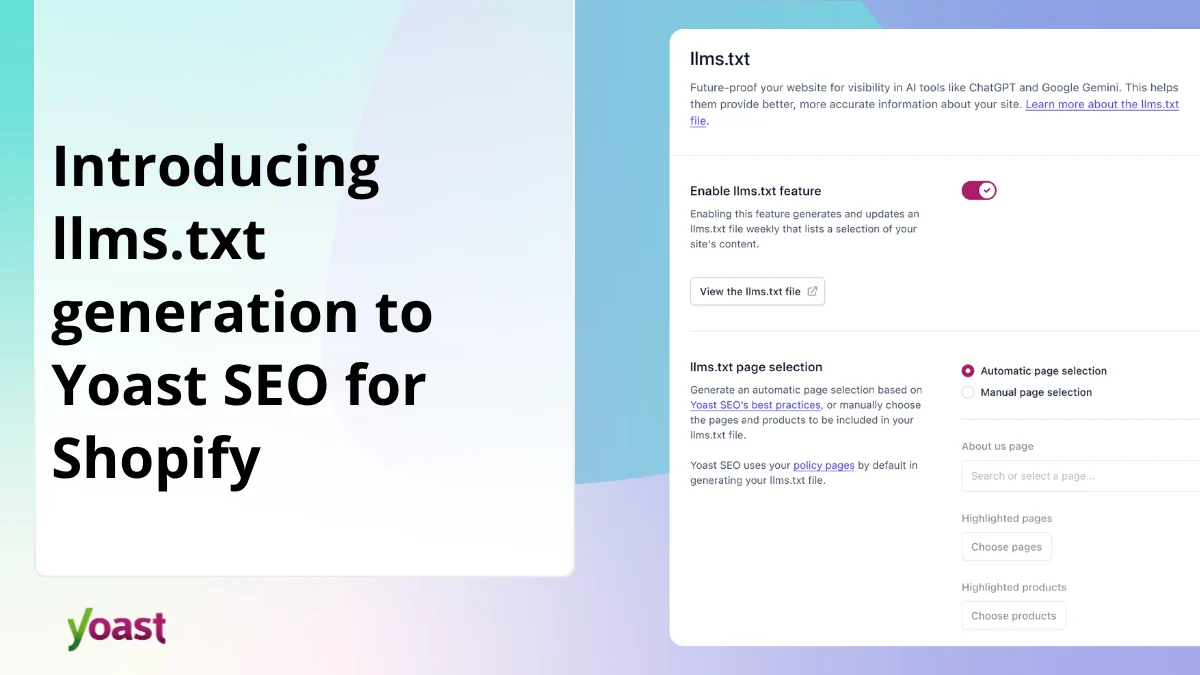
The digital commerce landscape is undergoing a profound transformation, increasingly influenced by artificial intelligence (AI) and large language models (LLMs) that are reshaping how consumers discover products and interact with brands. In response to this evolving environment, Yoast SEO for Shopify has launched its innovative llms.txt feature, a critical tool designed to empower e-commerce merchants by ensuring AI platforms accurately represent their product catalogs, policies, and brand narratives. This development addresses a growing concern among online businesses: the potential for AI tools like ChatGPT and Google Gemini to misinterpret, incompletely describe, or even misdirect potential customers due to their inherent limitations in comprehensively indexing vast online stores.
The Rise of AI in E-commerce and the Challenge for Merchants
The integration of AI into daily digital interactions has accelerated dramatically over the past few years. From personalized recommendations to AI-powered chatbots and generative AI tools that summarize information or answer queries, AI is becoming an omnipresent layer between consumers and the web. For e-commerce, this means that a significant portion of product discovery is no longer solely reliant on traditional search engine results pages (SERPs). Instead, customers might first encounter product descriptions or brand information synthesized by an AI assistant, an LLM chatbot, or an AI-driven search interface.
This shift presents both immense opportunities and significant challenges for online retailers. While AI can streamline the customer journey and provide instant answers, its effectiveness hinges on the quality and accuracy of the data it processes. Unlike conventional search engine crawlers, which are meticulously designed to index entire websites, AI tools often operate differently. They frequently "grab what they can find, quickly, and fill in the gaps," as noted by Yoast. This approach can lead to several critical issues for e-commerce businesses, particularly those with extensive product catalogs: incomplete product descriptions, outdated pricing or availability information, and, in worst-case scenarios, the misattribution of products or even the accidental redirection of shoppers to competitors based on faulty AI inferences. A recent study by Statista indicated that e-commerce sales are projected to reach over $8 trillion globally by 2027, underscoring the immense financial stakes involved in accurate product representation. Furthermore, consumer trust in online information is paramount; research suggests that 88% of consumers are less likely to return to a website after a poor experience, including encountering incorrect product details.
Understanding the Problem: AI’s Incomplete Grasp of E-commerce Catalogs
The core issue lies in the operational differences between how traditional search engines and modern LLMs interact with web content. Search engine spiders are programmed to systematically crawl and index every accessible page, building a comprehensive database that informs search results. They follow links, process sitemaps, and adhere to robots.txt directives to understand site structure and content. In contrast, many LLMs, especially those integrated into conversational AI interfaces, often rely on a combination of pre-trained data, real-time web snippets, and inference models. They may not perform a deep, comprehensive crawl of an entire e-commerce store, especially one with thousands of SKUs, intricate category structures, and frequently updated stock levels.
This partial understanding leads to a phenomenon akin to an AI tool attempting to describe a large library by only glancing at the first few shelves. It might capture some popular titles but miss entire genres, new arrivals, or the specific organization chosen by the librarian. For an e-commerce store, this translates into AI providing generic descriptions, missing key product attributes, or failing to highlight unique selling propositions. For instance, an AI might describe a product as "a blue shirt" when it is, in fact, an "eco-friendly, hand-dyed indigo linen shirt with custom embroidery," losing critical details that drive conversions and differentiate the brand. Moreover, if an AI pulls outdated information about a sale price that has expired or a product that is out of stock, it directly harms the customer experience and can lead to frustration and lost sales. The rapid evolution of product lines and seasonal changes inherent in e-commerce further exacerbates this challenge, making static or partially indexed AI knowledge quickly obsolete.
Introducing llms.txt: A New Paradigm for AI-Driven Product Discovery
Recognizing this critical gap, Yoast SEO for Shopify has engineered llms.txt, a feature designed to act as a definitive guide for AI tools. Functionally similar in principle to robots.txt, which instructs search engine crawlers on what to index or ignore, llms.txt provides explicit directives to AI models about the most important content on a Shopify store. It creates a dedicated file that precisely communicates which parts of a merchant’s digital storefront hold the highest value and should be prioritized for AI interpretation.
"We saw a clear need to bridge the communication gap between rapidly evolving AI technologies and the meticulously curated product catalogs of e-commerce businesses," stated a representative from Yoast, emphasizing the company’s long-standing commitment to empowering webmasters. "The llms.txt feature is our answer to ensuring that AI tools describe products with the accuracy, completeness, and brand integrity that merchants have worked so hard to build." This innovative approach effectively transforms the AI’s "wandering around" a store into a guided tour, highlighting top products, essential collections, critical policies (like shipping and returns), and key informational pages.
How llms.txt Works: Bridging the Information Gap
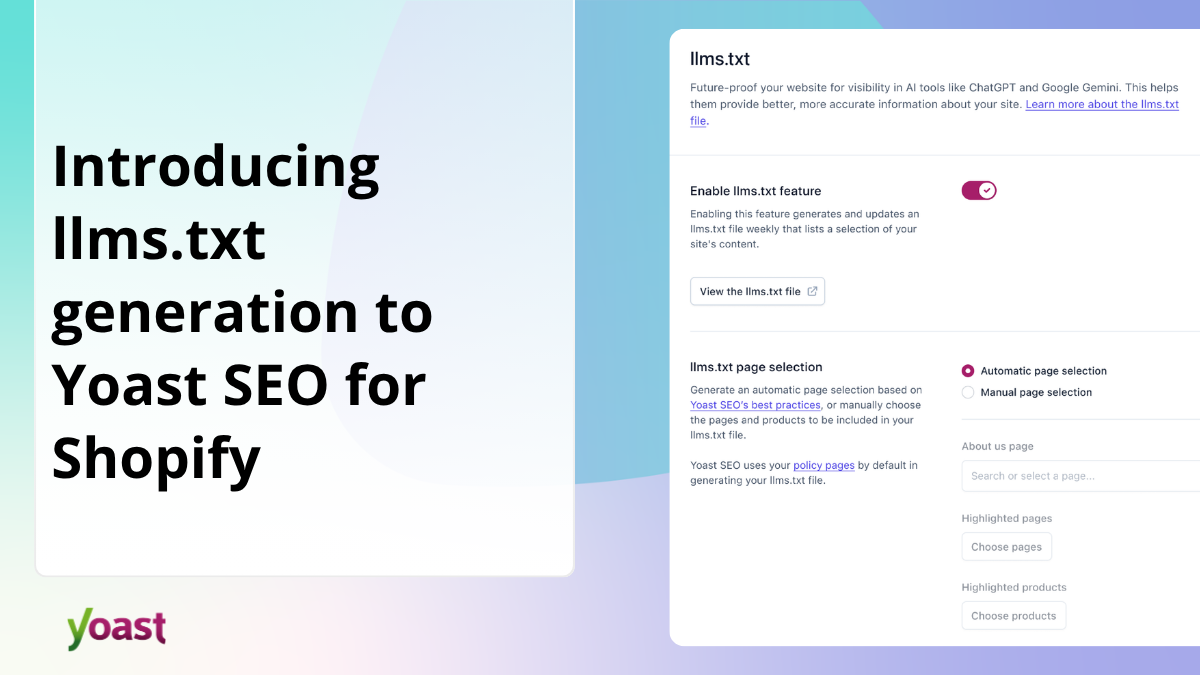
The implementation of llms.txt is designed for simplicity and efficiency, requiring no technical expertise from the merchant. Once activated within the Yoast SEO for Shopify interface, the feature automatically generates and maintains a .txt file specifically tailored for AI consumption. This file acts as a curated sitemap for LLMs, directing their attention to the most relevant and up-to-date information.
Merchants have two primary methods for utilizing llms.txt, offering flexibility based on their operational needs and desired level of control:
-
Automatic Management: This is the default and most streamlined option. Upon activation, Yoast SEO automatically constructs and updates the
llms.txtfile on a weekly basis, leveraging the store’s Shopify data. This automated process intelligently highlights:- Top-selling products: Ensuring that popular and high-demand items receive accurate AI representation.
- New arrivals: Quickly informing AI about the latest additions to the catalog, preventing outdated information.
- Key product collections: Providing AI with structured information about product categories.
- Store policies: Ensuring AI accurately conveys crucial details regarding shipping, returns, privacy, and terms of service, which are vital for customer trust and legal compliance.
- Essential pages: Including contact information, FAQs, and other critical informational content.
This automatic curation significantly reduces manual effort for merchants, allowing them to focus on core business operations while trusting Yoast to maintain AI-friendly data.
-
Manual Selection and Granular Control: For merchants who require precise control over what information is shared with AI, the
llms.txtfeature offers a manual selection mode. In this mode, users can hand-pick specific products, collections, or individual pages they wish to feature prominently in thellms.txtfile. This is particularly useful for highlighting seasonal promotions, exclusive product lines, or pages critical for specific marketing campaigns. Additionally, there is a dedicated input field to explicitly include the "About Us" page, allowing AI tools to accurately understand and convey the brand’s story, mission, and values—elements often lost in automated content scraping.
Regardless of the chosen method, thellms.txtfile undergoes weekly updates. This ensures that information remains current, reflecting any changes in product availability, pricing, or content. Crucially, the system automatically removes deleted products from the file, preventing AI from referencing non-existent items and further enhancing data integrity.
The Strategic Advantages for Shopify Merchants
The implementation of llms.txt offers a multifaceted strategic advantage for Shopify merchants operating in an AI-driven digital economy:
- Enhanced Accuracy and Consistency: By providing explicit directives,
llms.txtdramatically reduces the likelihood of AI generating inaccurate, incomplete, or outdated product descriptions. This consistency across AI platforms reinforces brand messaging and prevents customer confusion. - Improved Customer Experience and Conversion: When AI tools provide precise and relevant product information, customers can make more informed purchasing decisions. This leads to a smoother, more satisfying shopping experience, reducing bounce rates and increasing conversion opportunities. Accurate AI responses also minimize post-purchase issues related to misinformation.
- Strengthened Brand Reputation and Trust: Controlling the narrative around products and policies, even when delivered through AI, is paramount for brand integrity.
llms.txtempowers merchants to ensure their brand story, values, and offerings are communicated correctly, fostering trust and loyalty. - Optimized AI SEO (GenAI Optimization): Just as traditional SEO aims to rank well in search engines,
llms.txtintroduces a new dimension of "AI SEO" or "Generative AI Optimization." It allows merchants to optimize their content for AI understanding, ensuring they are favorably represented in AI-driven discovery channels, which are increasingly becoming a primary gateway for consumers. - Competitive Edge: Early adopters of
llms.txtgain a distinct advantage. While competitors might struggle with AI misrepresentations, merchants utilizing this feature can ensure their offerings are accurately and compellingly presented, capturing more attention and business from AI-assisted shoppers. - Time and Resource Savings: The automated nature of
llms.txtin its default setting saves valuable time and resources that would otherwise be spent manually correcting AI-generated inaccuracies or constantly monitoring various AI platforms for brand mentions.
Background and Development: Yoast SEO’s Commitment to Webmasters
Yoast has long been a foundational player in the SEO ecosystem, known for its widely adopted plugins for WordPress and, more recently, for Shopify. Founded by Joost de Valk, the company has consistently focused on democratizing SEO, making complex technical optimizations accessible to a broader audience. Their history includes pioneering features that help websites communicate effectively with search engine crawlers, from XML sitemaps to schema markup integration.
The development of llms.txt is a natural evolution of Yoast’s mission. As AI emerged as a transformative force, the Yoast team identified a new challenge for webmasters—how to manage the interaction between their content and these intelligent systems. Drawing parallels with the established robots.txt protocol, they conceived llms.txt as a necessary standard for the AI age. This reflects a proactive stance in adapting SEO principles to new technological paradigms, ensuring that online businesses remain discoverable and accurately represented in an increasingly AI-centric web. The feature underlines Yoast’s commitment not just to search engine optimization but to broader web optimization, encompassing all forms of digital discovery.
Ease of Implementation: No Technical Expertise Required
A significant barrier for many e-commerce merchants is the perceived complexity of technical SEO. Yoast has meticulously designed llms.txt to be exceptionally user-friendly, adhering to their philosophy of making powerful tools accessible. Typically, creating and managing a custom .txt file for web crawlers or AI would involve direct code editing or server-level configurations, tasks beyond the comfort zone of many business owners.
With Yoast SEO for Shopify, the entire process is integrated directly into the familiar Yoast interface. Merchants simply need to locate the llms.txt toggle within their settings and switch it on. The system handles all the underlying technical complexities of file generation, hosting, and regular updates. Yoast has also built in safeguards; if a merchant already has a redirect set up for /llms.txt, the system will respect it and provide a notification, preventing any conflicts or accidental breakage of existing configurations. This "set it and forget it" approach ensures that even businesses without dedicated IT staff or SEO specialists can leverage this advanced feature.
Opt-In Philosophy: Empowering Merchant Control
In an era where data privacy and control are paramount, Yoast has adopted an opt-in philosophy for llms.txt. This means the feature is not automatically enabled; merchants must actively choose to turn it on. This design decision stems from Yoast’s belief that every merchant should retain full agency over how their digital content is consumed and utilized by emerging AI technologies.
"We firmly believe that merchants should have the ultimate say in how their valuable product information is interpreted and used by AI," stated a Yoast spokesperson. "The opt-in nature of llms.txt empowers them to make an informed decision about participating in this new frontier of AI-driven discovery, ensuring alignment with their brand strategy and data governance policies." This approach respects merchant autonomy, acknowledging that while AI offers immense benefits, businesses must have the ability to control their digital footprint in these new interaction models. It underscores a broader industry trend towards greater transparency and control for content creators in the age of generative AI.
Reactions and Industry Perspectives
The introduction of llms.txt is likely to be met with positive reactions from the e-commerce community and SEO professionals. Merchants, particularly those with extensive and frequently updated catalogs, have long grappled with the challenge of ensuring consistent and accurate representation across various platforms. The rise of AI has amplified this concern, making a solution like llms.txt highly anticipated.
"This is precisely the kind of proactive tool that e-commerce businesses need right now," commented Sarah Chen, an independent e-commerce consultant. "As AI assistants become primary interfaces for product search, having a direct channel to feed them accurate information is invaluable. It’s about protecting brand integrity and optimizing for the next generation of discovery." Industry analysts may view llms.txt as a precedent-setting move, potentially influencing other SEO platforms and content management systems to develop similar mechanisms for AI interaction. From the perspective of AI developers, tools like llms.txt can contribute to the overall quality and reliability of AI-generated content, by providing structured, authoritative data sources, thereby mitigating the risk of misinformation.
The Broader Implications for Search and E-commerce
The launch of llms.txt by Yoast SEO for Shopify is more than just a new feature; it represents a significant step in the ongoing evolution of SEO and the interaction between websites and intelligent systems. It formalizes a new protocol for content creators to communicate directly with AI models, much like robots.txt did for search engine crawlers decades ago.
This development signals a future where "AI SEO" or "Generative AI Optimization" becomes an increasingly critical discipline. Merchants will not only need to optimize for traditional search algorithms but also for the nuances of how LLMs consume, synthesize, and present information. The llms.txt file acts as a direct line of communication, allowing businesses to dictate the "truth" about their offerings to AI, bypassing potential misinterpretations from broad, unstructured web scraping.
The implications extend beyond just product descriptions. As AI becomes more integrated into every aspect of digital commerce—from customer service to personalized marketing—having a reliable, standardized method to inform these systems becomes indispensable. llms.txt could pave the way for more sophisticated interactions, where businesses can feed AI not just product details but also brand ethos, sustainability efforts, community involvement, and other critical elements that define a brand. This enhanced control will be crucial for maintaining brand authenticity and building deeper customer relationships in an increasingly AI-mediated world. The feature underscores a growing recognition that AI, while powerful, needs explicit guidance to serve human users and businesses effectively, marking a pivotal moment in the ongoing dance between content creation and digital consumption.
In conclusion, the llms.txt feature from Yoast SEO for Shopify is a timely and essential innovation. It addresses a pressing need for e-commerce merchants to maintain control over their brand narrative and product information in the face of rapidly advancing AI technologies. By providing a clear, structured guide for AI tools, it ensures accuracy, enhances customer experience, and fortifies brand reputation, solidifying its place as a critical tool for navigating the future of AI-driven product discovery and online commerce. Merchants are encouraged to turn on the llms.txt toggle in Yoast SEO for Shopify next time they log in to their store, taking a proactive step towards optimizing their digital presence for the age of artificial intelligence.