rifanmuazin
The landscape of B2B marketing has undergone a significant transformation, particularly in how the impact of thought leadership is perceived and measured. Historically, the effects of B2B thought leadership were often viewed through a somewhat mystical lens. The launch of a compelling research report, the publication of insightful executive perspectives, and a subsequent increase in brand visibility were frequently followed by a tangible uplift in pipeline generation. However, the precise mechanisms driving this correlation remained largely opaque, shrouded in a degree of mystery that made consistent, predictable outcomes challenging to engineer.
This era of perceived "magic" has gradually given way to a more analytical approach, largely facilitated by advancements in modern marketing analytics. Today, B2B marketing leaders possess the tools to dissect how thought leadership influences engagement and pipeline progression. While these analytics can illuminate specific facets of this relationship, a persistent challenge remains: the fragmentation of data. Brand engagement metrics might reside in one reporting suite, campaign performance data in another, and crucial revenue figures locked within CRM systems. The critical missing piece has been a clear, cohesive view that stitches these disparate signals together, revealing the intricate connections between initial engagement and eventual revenue outcomes. This is where the promise of unified analytics comes into play, offering the visibility needed to bridge these gaps.
Thought Leadership: Integrated Within the Modern Marketing Ecosystem
Within frameworks like "Best Answer Marketing," the genesis of effective thought leadership lies in foundational insights. These can manifest as original research, proprietary data, or a distinctly articulated point of view, rigorously grounded in expertise and verifiable proof. This core insight is not intended to be a static asset, confined to a single piece of content. Instead, it serves as the bedrock that informs a multitude of marketing activities. It shapes executive commentary, fuels influencer collaborations, underpins demand generation programs, empowers sales enablement efforts, and guides ongoing brand publishing initiatives. The overarching narrative, derived from this foundational insight, then reverberates across various channels, appearing in search engine results, social media conversations, webinars, industry events, and direct outreach. When influence is strategically disseminated across such a broad spectrum of touchpoints, its impact transcends the capabilities of any single dashboard to capture comprehensively.

The Measurement Gap: A Hindrance to Thought Leadership’s Full Potential
For multichannel thought leadership programs, this inherent fragmentation of data presents a significant impediment to achieving full visibility. As Jane Bartel, Director of Search & Content Marketing at TopRank Marketing, explains, "Measuring the influence of thought leadership on marketing outcomes means understanding how it advances buyers through the journey and impacts the KPIs that track their progression. Each format and channel produces data points framed around metrics that each tell part of the larger story. To prove the value of thought leadership and to surface insights for optimizations, two things are crucial: unified analytics and a measurement model that translates multiple signals into a cohesive view."
When engagement metrics, opportunity data, and ultimate revenue outcomes are siloed, the true influence of thought leadership becomes exceedingly difficult to quantify. Consequently, investment decisions often gravitate towards areas that are easiest to measure, leading to an overemphasis on isolated channel outputs rather than a holistic appreciation of cross-channel influence. By integrating brand, demand, and sales data within a singular analytical framework, the often-overlooked influence of thought leadership can be brought into sharp focus.
High Performers’ Understanding of Visibility and its Implications
Empirical data strongly supports this notion. A comprehensive study, "The State of B2B Thought Leadership in 2026," revealed that approximately one-third of marketers identify limited visibility into funnel performance as a primary challenge. Furthermore, a similar proportion of marketers report an over-reliance on a narrow set of channels, potentially missing opportunities for broader impact. Perhaps most telling, 41% of respondents cited difficulty in measuring performance as the leading reason for their content underperforming.

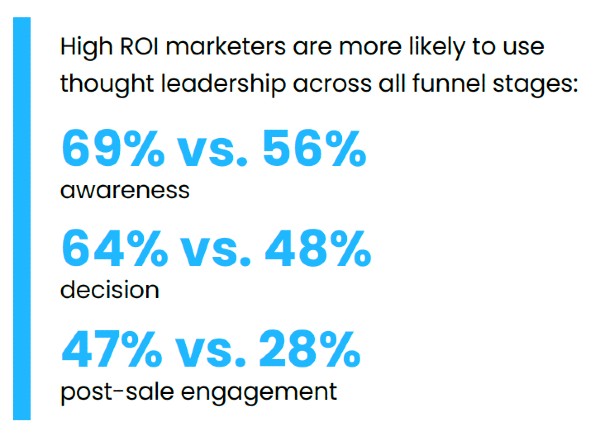
Conversely, top-performing B2B organizations demonstrate a more sophisticated approach. These teams are more likely to distribute their thought leadership content across multiple stages of the buyer’s journey. Crucially, they are also more adept at connecting brand-building activities directly to tangible revenue outcomes. The implication is clear: underperformance in B2B marketing is less often a consequence of a lack of effort and more frequently a result of a deficiency in integrated, cross-channel visibility.
Redefining Success: From Impressions to Demonstrable Influence
The multichannel dissemination of thought leadership naturally generates a diverse array of engagement signals. These can range from website visits and content downloads to webinar registrations, social media interactions, and direct inquiries. While each of these interactions represents individual activity, their collective effect signifies forward momentum in the buyer’s journey.
Consider a typical scenario: a company releases original industry research. This initial publication leads to report downloads. Subsequently, some individuals attend a follow-up webinar, while others engage with executive commentary that contextualizes the research findings. Sales teams then leverage this research as a valuable resource in their discussions with prospective clients. Over time, accounts and individual stakeholders who have been exposed to these multiple touchpoints are observed to enter the sales pipeline at higher rates and progress through its various stages with greater efficiency.
This observable buyer behavior can be directly mapped to key metrics such as opportunity creation, pipeline velocity, and ultimate revenue contribution. In this redefined paradigm, success is not solely measured by isolated impressions but by the demonstrable progression of buyers through the funnel, a progression demonstrably influenced by strategic thought leadership.

Unifying Data Across the Entire Buyer Journey: The Infrastructure for Insight
The implementation of unified analytics that encompasses the complete customer journey functions as the essential infrastructure for understanding and optimizing thought leadership. This infrastructure connects data points from awareness and engagement stages through to conversion and post-sale activities, consolidating them within a single analytical environment. This unified environment is capable of revealing both milestone achievements and the cumulative impact of marketing efforts.
Connecting Cross-Channel Activity: The Foundation of Measurable Influence
Effective measurement necessitates the integration of signals from across a broad spectrum of marketing activities. This includes data from website analytics, social media platforms, email marketing campaigns, content management systems, webinar platforms, advertising channels, and CRM systems. When these diverse datasets are seamlessly integrated, patterns of influence and causality begin to emerge, making them quantifiable and actionable.
Attribution and Modeling at Scale: Unlocking Sophisticated Insights
Understanding the complex influence of multichannel thought leadership often requires advanced analytical techniques. This can involve a combination of Marketing Mix Modeling (MMM) and Multi-Touch Attribution (MTA) to accurately discern how content impacts pipeline progression across various channels. As Daniel Kravtsov, CEO of Improvado, highlights, "Measuring the impact of multi-channel thought leadership programs requires sophisticated analytics. At times, it takes a combination of Marketing Mix Modeling and Multi-Touch Attribution to understand how content influences the pipeline across channels. The problem is that marketing orgs spend 20-40% of their time manually aggregating data from Google Analytics, social platforms, CRMs, and media monitoring tools, rather than running these analyses. Without a unified analytics infrastructure, you can’t build reliable attribution models or MMM frameworks. Complex programs demand complex measurement." The manual aggregation of data from disparate sources is a significant drain on resources, diverting valuable time and expertise away from strategic analysis and optimization.
Building Executive Confidence Through Evidence: The Power of Unified Analytics
Unified analytics fundamentally alters how marketing leadership engages in revenue-focused conversations. It provides Chief Marketing Officers (CMOs) and other senior leaders with a shared, consolidated view of engagement, opportunity, and revenue data, harmonized across previously siloed systems. By evaluating research interaction, repeat exposure, and account activity in conjunction with pipeline performance and closed revenue, thought leadership is brought into the same analytical frame as other critical growth investments.
This enhanced visibility empowers leaders to identify which narratives are resonating most effectively and merit reinforcement. It also highlights areas where programs may require adjustment or redirection. The ability to demonstrate the tangible contribution of thought leadership to revenue outcomes builds crucial executive confidence and solidifies marketing’s strategic role within the organization.
Transforming Thought Leadership into a Sustainable Growth Engine

When measured comprehensively across the entire customer journey, thought leadership transcends its role as a mere brand-building exercise and evolves into a sustained driver of revenue growth. Unified analytics provides the essential structure to manage these relationships deliberately and optimize their impact.
By measuring engagement, opportunity progression, and revenue contribution in concert, thought leadership becomes a manageable and predictable growth lever. This integrated approach allows for the reinforcement of high-impact narratives, the agile adjustment of underperforming efforts, and the grounding of investment decisions in clear, actionable evidence. Ultimately, with end-to-end visibility across the buyer journey, thought leadership functions not as an ephemeral concept but as a consistent, measurable force propelling business growth.
The journey from perceiving thought leadership’s impact as magical to understanding it as a data-driven engine of growth represents a significant maturation of B2B marketing practices. The ongoing evolution of analytical capabilities and the strategic adoption of unified data platforms are critical for any organization seeking to harness the full potential of its thought leadership initiatives in today’s competitive landscape.
To further explore the strategies and insights of leading B2B marketers in connecting brand, demand, and revenue, and in building robust measurement systems that foster growth, one can examine resources such as "The State of B2B Thought Leadership in 2026." Such research often delves into the practical application of these principles, offering a roadmap for organizations looking to elevate their thought leadership efforts from isolated activities to integrated drivers of sustainable business success.