rifanmuazin
On January 24, 2026, a significant disruption impacted teams utilizing Salesforce Marketing Cloud (SFMC) for email campaigns, leading to widespread deliverability issues and severe damage to sender reputations. This crisis stemmed from a critical security update implemented by Salesforce, which inadvertently rendered millions of previously generated email links inoperable, compounded by a concurrent, albeit separate, outage affecting Microsoft email services. The incident highlighted the intricate vulnerabilities within the global email ecosystem and underscored the paramount importance of robust security protocols, continuous monitoring, and proactive crisis management for businesses heavily reliant on email communication.
Background to the Disruption: A Necessary Security Enhancement
Salesforce Marketing Cloud is a cornerstone platform for thousands of enterprises globally, enabling them to manage vast email marketing campaigns, transactional notifications, and customer communications. Its reliability is central to maintaining customer relationships and driving business operations. The precipitating event for the January 24 disruption was Salesforce’s urgent response to a potential security vulnerability within its email link encryption methodology. Such vulnerabilities, if exploited, could expose sensitive user data, compromise data integrity, or enable unauthorized access, posing immense risks to both Salesforce and its clients.
To mitigate this identified flaw, Salesforce swiftly implemented a new, more secure method of authenticated encryption. This move, while technically necessary for safeguarding user data and platform integrity, unfortunately introduced a critical compatibility issue: the new encryption method was not backward-compatible with the old one. Consequently, all email links generated within SFMC prior to January 21, 2026, became invalid, effectively expiring and ceasing to function. This included crucial elements like click-through links for marketing promotions, password reset links, and, critically, unsubscribe links—a compliance nightmare for senders.
The Unforeseen Complication: Link Length and DKIM Signatures
Adding another layer of complexity to the unfolding crisis was an unanticipated technical conflict with Microsoft’s email infrastructure. The new, more secure links generated by SFMC were significantly longer than their predecessors, often more than double the original character count. This increased length triggered a legacy rule within Microsoft’s email systems, which was designed to automatically insert line breaks into messages exceeding certain character limits.
This seemingly innocuous formatting adjustment had catastrophic consequences for email authentication. DomainKeys Identified Mail (DKIM) is a vital email authentication method that allows an organization to take responsibility for transmitting a message, ensuring that the email has not been altered in transit. DKIM works by attaching a digital signature to the email header. When a recipient server receives an email, it verifies this signature against a public key published in the sender’s DNS records. The integrity of this signature is highly sensitive to any changes in the email’s content or structure, including the insertion of line breaks. When Microsoft’s legacy rules added line breaks to the longer SFMC links, the DKIM signatures of those emails were broken, rendering them invalid. This authentication failure signaled to recipient servers that the emails might be spoofed or tampered with, leading to a drastic increase in bounce rates and immediate rejections.

A Compounding Crisis: The Microsoft Outage
The situation was further exacerbated by a major outage that had affected Microsoft email services (Hotmail, Outlook, and Microsoft 365) just days prior, between January 22 and 23. This separate incident had already generated a significant uplift in soft bounce activity for emails destined for Microsoft inboxes, leaving many businesses already grappling with disrupted communication channels. The SFMC encryption issue, occurring immediately on the heels of this outage, created a perfect storm, pushing email deliverability for many senders into unprecedented low territories. The cumulative effect meant that even if an SFMC email managed to bypass the link-breaking issue, it might still have been impacted by the lingering effects of the Microsoft outage.
The Immediate and Far-Reaching Impact on Senders and Subscribers
The dual-pronged crisis had immediate and severe ramifications across the digital marketing landscape:
- Broken Click-Through Traffic: For emails sent before January 21, all embedded links became non-functional. Subscribers attempting to click on promotions, information pages, or any other call-to-action were directed to generic error pages. This resulted in lost sales opportunities, frustrated customers, and a significant degradation of user experience.
- Compliance Catastrophe: The failure of unsubscribe links posed a serious compliance risk. Email marketing regulations, such as CAN-SPAM in the United States and GDPR in Europe, mandate that recipients must have an easily accessible and functional way to opt-out of receiving emails. With unsubscribe links broken, businesses faced potential legal penalties, fines, and a massive erosion of subscriber trust. Recipients unable to unsubscribe through legitimate channels are far more likely to mark emails as spam, further damaging sender reputation.
- Massive Increase in Bounce Rates: The broken DKIM signatures, primarily affecting emails sent to Microsoft domains, led to a surge in authentication failures. Recipient servers, unable to verify the sender’s legitimacy, rejected these emails outright, causing a dramatic increase in hard bounces. This meant that a significant portion of legitimate email campaigns simply never reached their intended recipients.
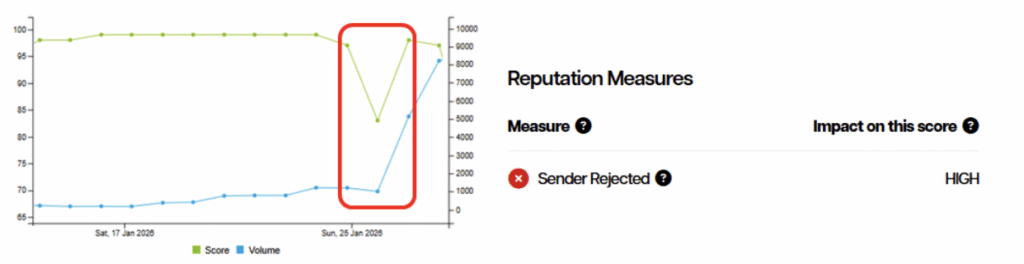
- Severe Damage to Sender Reputation: Validity’s data vividly illustrated the incident’s impact on sender reputations. The sudden spike in authentication failures, bounces, and, crucially, spam complaints, signaled to Internet Service Providers (ISPs) that these senders were potentially engaging in malicious activity or were compromised. Recipients, encountering broken links and unverified emails, often perceived these issues as signs of phishing or fraud, leading them to proactively report the emails as spam. This negative feedback loop severely damaged the Sender Scores of affected organizations.
- Plummeting Deliverability: The overall effect was a drastic drop in email deliverability rates. Validity reported that average inbox placement rates at Microsoft inboxes plummeted, with overall deliverability dropping by approximately 25%. For many SFMC senders, particularly those heavily impacted by the DKIM issue, inbox placement rates reportedly approached zero percent in the immediate aftermath of the incident. This meant that marketing messages, critical transactional emails (like order confirmations, shipping updates, or password resets), and customer service communications were simply not reaching their intended audiences.
Visual data, such as the Sender Score graph provided by Validity, showed a sharp, almost vertical, decline in reputation scores for large email programs during this period, indicating a sudden and severe impact. Similarly, a graph depicting Microsoft Global Inbox Placement Rates for January 2026 illustrated a significant dip corresponding with the incident, highlighting the widespread nature of the problem beyond individual SFMC users.
Official Responses and Industry Analysis
Salesforce acknowledged the security vulnerability and the subsequent disruption, directing users to a detailed security notification. Their rapid implementation of a new encryption method underscored the severity of the initial vulnerability. However, the lack of immediate backward compatibility and the unforeseen interaction with Microsoft’s legacy systems created a cascading failure. While Salesforce’s primary concern was data security, the execution of the fix had significant operational repercussions for its users.
Microsoft, having experienced its own outage days prior, would likely have been aware of the increased bounce rates and DKIM failures. While specific public statements regarding the SFMC link issue were not broadly circulated, their systems were the passive enabler of the DKIM problem due to the legacy line-breaking rule. This incident may prompt a review of such legacy rules within major mailbox providers to prevent similar widespread issues in the future.
Industry experts, like Validity, quickly analyzed the situation, providing critical insights and data to help senders understand the scope of the damage. Their immediate recommendations focused on monitoring key metrics and proactive recovery steps, underscoring the role of third-party analytics in navigating such crises.
Safeguarding Your Email Program: Lessons Learned and Recovery Steps
The SFMC disruption served as a stark reminder of the fragile nature of email deliverability and the critical importance of proactive monitoring and robust contingency planning. For businesses to safeguard their email programs against similar future events, several key strategies are essential:
- Continuous Monitoring of Sender Reputation Metrics: Tools like Sender Score are indispensable for real-time tracking of an organization’s email reputation. A sudden drop in this score can be an early warning sign of deliverability issues, allowing for faster intervention. Monitoring metrics such as bounce rates, spam complaint rates, and authentication pass/fail rates (DKIM, SPF, DMARC) is paramount.
- Deep Dive into Bounce Profiles: When performance dips are observed, senders must be able to review changes in their bounce profiles using tools like Bounce Lookups. Understanding the specific reasons for bounces (e.g., authentication failure, content issues, mailbox full) helps diagnose the root cause of deliverability problems. Close monitoring of DKIM pass/fail rates specifically would have been a crucial indicator during this incident.
- Proactive Communication with Subscribers: In the event of widespread link failures or deliverability issues, transparent communication with subscribers is vital. Informing them about the technical issues, apologizing for any inconvenience, and providing alternative ways to access information or unsubscribe can help mitigate frustration and reduce spam complaints.
- Strategic Resending of Critical Emails: For SFMC senders impacted by the incident, a critical recovery step involves re-sending crucial emails with newly generated, functional links. This is especially important for transactional emails (e.g., password resets, order confirmations) and, critically, unsubscribe confirmation emails to ensure compliance and rebuild trust. This might require segmenting audiences to target only those who received the original, broken links.
- Reviewing Email Templates and Link Structures: Post-incident, organizations should review their email templates and the platforms used for link generation. Understanding how external platform changes can impact link functionality and authentication mechanisms is key to future resilience.
- Engaging with Platform Support: Immediately engaging with Salesforce support and other relevant platform providers (like Microsoft, if issues are specific to their domains) is crucial for obtaining official updates, workarounds, and understanding recovery timelines.
Keeping Consumer Trust at the Forefront: The Future of Email Marketing
As the digital landscape evolves, consumer trust has solidified as the bedrock of any successful sender-subscriber relationship. The incident underscored that in an era of increasingly sophisticated email fraud and cyber threats, earning and maintaining that trust demands constant vigilance and adaptability. Consumers are more discerning than ever, and any disruption, whether due to a security patch or a technical glitch, can be perceived as a sign of insecurity or malicious intent.
Understanding emerging trends and anticipating future challenges is just as important as responding to present-day crises. The email marketing industry is at a crossroads, with evolving mailbox provider requirements, the transformative potential of Artificial intelligence (AI) in reshaping inbox access, and new regulations continually redefining success. Events like the Litmus Live session, "Where is email marketing headed in 2026?", featuring industry leaders like Danielle Gallant and Al Iverson, become invaluable forums for discussing these shifts. Insights shared at such events help senders to not only navigate current complexities but also to proactively protect consumer trust, cultivate stronger subscriber relationships, and maximize long-term revenue in an increasingly intricate email ecosystem. The SFMC incident serves as a potent reminder that in the world of email, security, deliverability, and trust are inextricably linked, and a failure in one can cascade into a crisis for all.