Iffa Jayyana
YouTube, a cornerstone of Alphabet’s diverse portfolio, navigated a complex financial quarter in Q3 2026, reporting a notable deceleration in its advertising revenue growth even as its subscription services demonstrated robust expansion. The video giant’s ad revenue reached $11.2 billion for the period, marking a 9% year-over-year increase. While substantial, this figure represented a slowdown compared to the 13% growth observed in the preceding second quarter of 2026. This shift underscores a broader strategic pivot within YouTube, as the platform intensifies its focus on diversifying monetization avenues beyond traditional advertising, particularly through burgeoning subscription offerings, enhanced creator revenue opportunities, and advanced artificial intelligence integration. Parent company Alphabet, in its official earnings release, highlighted these contrasting trends, indicating a deliberate effort to build resilience against potential market fluctuations in the digital advertising sector.
Divergent Trends in Monetization: Ad Revenue Deceleration
The reported 9% year-over-year growth in YouTube’s Q3 2026 ad revenue, totaling $11.2 billion, signals a maturation phase for the platform’s primary monetization engine. For a company of YouTube’s scale, generating over $11 billion from advertising in a single quarter is still a formidable achievement, yet the dip from Q2’s 13% growth prompts a closer examination of underlying market dynamics. This slowdown is not isolated to YouTube; the broader digital advertising market has faced headwinds throughout 2026, influenced by persistent macroeconomic uncertainties, inflationary pressures impacting consumer spending, and increased scrutiny from advertisers on return on investment. Furthermore, the competitive landscape for digital ad dollars has become more fragmented and intense. Platforms such as TikTok, Meta’s Facebook and Instagram, and emerging short-form video players are all vying for a share of brand budgets, exerting downward pressure on growth rates for established giants.
Analysts have been closely monitoring these trends, noting that while Alphabet’s core Google Search advertising business often demonstrates greater resilience during economic downturns due to its direct intent-based targeting, YouTube’s brand advertising revenue can be more susceptible to cuts in discretionary marketing spend. The single-digit growth rate, while still positive, suggests that YouTube may be reaching a point where exponential ad revenue expansion becomes increasingly challenging. This necessitates a strategic recalibration, pushing the platform to explore and solidify alternative revenue streams to maintain its impressive overall growth trajectory and contribute meaningfully to Alphabet’s bottom line. The emphasis on ad targeting improvements, potentially leveraging AI, as mentioned by Alphabet, indicates an attempt to optimize existing ad revenue rather than solely relying on volume growth.
The Rise of Subscription Services: A New Pillar of Growth
In stark contrast to the moderated ad growth, YouTube’s subscription services, encompassing YouTube Music and YouTube Premium, showcased remarkable momentum in Q3 2026. These offerings collectively surpassed the 150 million subscriber mark, contributing significantly to an 11% increase in Google’s overall subscription revenue. This milestone represents a substantial acceleration in subscriber acquisition, building upon a strong foundation established earlier. Just under two years prior, in early 2024, YouTube’s premium subscription offerings had first crossed the 100 million subscriber threshold. The addition of 50 million subscribers in less than two years underscores the growing consumer appetite for an ad-free viewing experience, offline downloads, and access to an extensive music library, particularly as YouTube positions itself as a comprehensive entertainment hub.
This impressive subscriber growth provides YouTube with a crucial buffer against the inherent volatility of the advertising market. Recurring subscription revenue offers greater predictability and stability, acting as a powerful diversification strategy. For consumers, the value proposition of YouTube Premium extends beyond ad removal, offering background playback and exclusive content access in some regions. YouTube Music, a direct competitor to services like Spotify and Apple Music, benefits from YouTube’s vast video catalog, allowing seamless transitions between audio and video content. The sustained growth in subscriptions also reflects a broader industry trend where users are increasingly willing to pay for premium digital experiences that enhance convenience and content access. This strategic emphasis on subscriptions not only bolsters YouTube’s financial stability but also deepens user engagement, creating a more loyal and valuable audience base for the platform.
Connected TV: YouTube’s Dominance and Revenue Catalyst
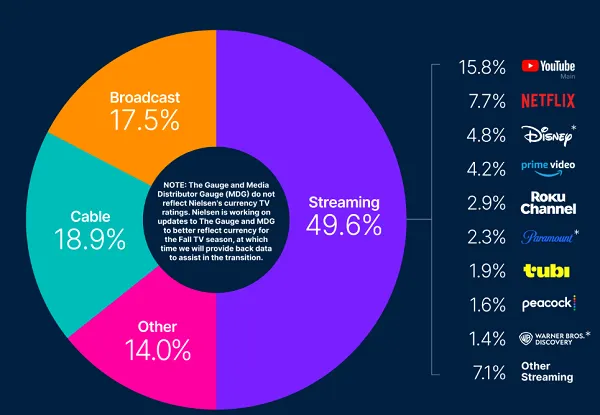
A pivotal factor fueling YouTube’s overall growth and particularly its subscription momentum is its escalating dominance in the Connected TV (CTV) space. According to Nielsen’s "The Gauge" report from August 2026, which meticulously tracks U.S. TV viewing behaviors, YouTube has solidified its position as the top streaming platform in the United States. This achievement signifies a profound shift in how audiences consume video content, increasingly opting for digital platforms over traditional linear television. YouTube’s strategic investment in its "Living Room" experience – its optimized interface for smart TVs and streaming devices – is now yielding substantial returns.
During the Q3 earnings call, Google Chief Business Officer Philipp Schindler highlighted the immense importance of the Living Room experience, noting that it now accounts for more than one-third of total YouTube ads revenue. This statistic is particularly telling, indicating that CTV is not merely a channel for subscription sign-ups but a significant and growing advertising real estate. The shift of viewership from traditional broadcast and cable television to streaming services like YouTube on larger screens has profound implications for advertisers. Budgets historically allocated to linear TV are now migrating to CTV, where YouTube offers unparalleled reach, sophisticated targeting capabilities, and robust measurement tools. The platform’s ability to deliver both long-form content and short-form video (through Shorts on CTV) caters to diverse viewing habits, further cementing its appeal to a wide array of advertisers seeking to engage audiences in the comfort of their living rooms. This trend is expected to continue, with YouTube poised to capture an even larger share of the global CTV advertising market in the coming years, solidifying its role as a central player in the future of television.
Empowering the Creator Economy: Diversified Revenue Streams

Beyond advertising and subscriptions, YouTube is aggressively expanding its commitment to the creator economy, fostering new and diverse revenue streams that benefit both the platform and its vast community of content creators. A significant indicator of this commitment is the robust growth of its creator ecosystem: more than three million creators are now actively participating in YouTube’s Partner Program, enabling them to monetize their content through various mechanisms, including ad revenue sharing, channel memberships, and Super Chats. This expansive network underscores YouTube’s position as a premier destination for digital content creation.
Furthermore, YouTube’s foray into e-commerce continues to gain traction, with over 1.3 million channels now enrolled in its shopping program. This initiative allows creators to seamlessly integrate product promotions and sales directly into their videos, transforming content into shoppable experiences. A recent and strategically significant development in this arena is YouTube’s new affiliate partnership with Amazon. This collaboration permits U.S.-based creators to tag Amazon products directly within their videos, Shorts, and livestreams. This integration dramatically simplifies the affiliate marketing process for creators, providing them with a streamlined path to earn commissions on sales generated through their content. For YouTube, it enhances the platform’s utility as a discovery and purchasing destination, further embedding itself into the consumer journey. Philipp Schindler also noted the strong adoption of YouTube’s Demand Gen products by small and medium-sized businesses (SMBs), indicating a healthy ecosystem where businesses can connect with their target audiences through effective advertising solutions, thus reinforcing the platform’s overall economic vitality. These diversified revenue opportunities not only provide creators with more sustainable income streams but also strengthen YouTube’s overall ecosystem, making it more resilient and attractive for both talent and advertisers.
Artificial Intelligence: Enhancing Creation and Engagement
The strategic integration of Artificial Intelligence (AI) stands out as another critical pillar in YouTube’s forward-looking strategy, aimed at enhancing both ad targeting capabilities and the creative output of its users. As Philipp Schindler articulated during the Q3 earnings call, AI is increasingly central to YouTube’s operations, particularly given the sheer volume of content uploaded daily – "more than 20 million videos are being uploaded" every 24 hours. To manage this scale and empower creators, YouTube is leveraging generative AI tools within YouTube Studio, providing creators with advanced functionalities to streamline their workflow. This includes a conversational editing assistant specifically designed for Shorts and YouTube Create, making complex video editing more accessible and intuitive.
YouTube has been at the forefront of deploying AI-powered creative features. In March 2026, the platform launched an AI-powered "reimagine" option for Shorts, allowing viewers to generate alternative video versions based on an existing creator’s clip. This feature encourages creative exploration and viewer engagement. Prior to this, YouTube had also experimented with an "Extend with AI" option, which enabled creators to generate alternative video endings, offering novel storytelling possibilities. The platform’s commitment to AI is clearly resonating with its user base. A report published by YouTube just last week revealed compelling data: 61% of individuals who had posted videos on the app over the past 12 months expressed interest in using AI to insert themselves into video content. This indicates a strong appetite among creators for AI tools that can augment their presence and creative capabilities.
While the adoption data is promising, YouTube acknowledges the challenges associated with AI-generated content, particularly the potential for "AI slop" – low-quality, repetitive, or unoriginal content generated indiscriminately by AI. The platform will undoubtedly need to refine its moderation policies and develop advanced AI detection mechanisms to ensure content quality and maintain trust. However, the current trajectory suggests that YouTube’s strategic investment in AI is not merely about efficiency but about fundamentally reshaping the content creation paradigm, offering creators powerful new tools to innovate and engage their audiences more effectively.
Strategic Outlook and Future Implications
YouTube’s Q3 2026 performance signals a strategic evolution, moving beyond its traditional reliance on advertising to embrace a more diversified and resilient business model. The moderation in ad growth, while a point of scrutiny, is effectively counterbalanced by the impressive surge in subscription revenue, the increasing monetization of Connected TV viewership, and the robust expansion of its creator economy initiatives. This multi-pronged approach positions YouTube to weather potential economic downturns and intense competition in the digital media landscape.
The rapid ascent of YouTube Premium and Music to 150 million subscribers underscores the success of its value proposition and the growing consumer demand for enhanced, ad-free experiences. This recurring revenue stream provides a stable financial foundation, allowing YouTube to invest further in content, technology, and creator support. Similarly, the dominance in CTV, as evidenced by Nielsen’s "The Gauge" report and the significant contribution of "Living Room" experiences to ad revenue, indicates YouTube’s strategic capture of the ongoing shift from linear television to streaming. This positions the platform as a crucial partner for advertisers seeking to reach audiences on the largest screen in the house.
Furthermore, the continuous innovation in creator monetization, exemplified by the Amazon affiliate partnership and the expansion of its shopping program, reinforces YouTube’s commitment to fostering a sustainable ecosystem for its vast community of creators. These initiatives not only generate new revenue for YouTube but also deepen creators’ loyalty to the platform, making it a more attractive destination for talent. Finally, the aggressive integration of AI, from ad targeting to generative content creation tools, highlights YouTube’s ambition to remain at the technological forefront. While challenges like "AI slop" will require vigilant management, the proven user interest in AI-powered tools suggests a future where content creation is more accessible, efficient, and innovative.
In conclusion, YouTube is strategically transforming from primarily an ad-supported video platform into a comprehensive digital media powerhouse – a "super app" encompassing video, music, shopping, and advanced content creation tools. This diversification, coupled with its technological leadership in AI, suggests a resilient and adaptable future for YouTube, capable of navigating evolving market dynamics and sustaining its crucial role within Alphabet’s growth narrative. The Q3 2026 results, therefore, represent not just a financial report but a blueprint for YouTube’s sustained relevance and expansion in the rapidly changing digital landscape.


 Nana Wu

 Muslim