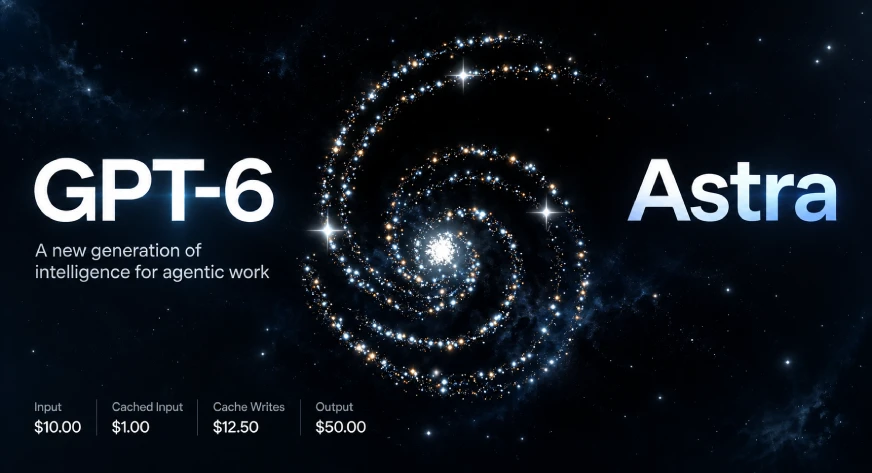
In a move that underscores the accelerating pace of the artificial intelligence arms race, OpenAI has officially unveiled GPT-6 Astra, its most sophisticated frontier model to date. The release comes less than a week after Anthropic introduced Claude Fable 5.1, signaling a period of intense competition between the industry’s leading research labs. OpenAI has positioned Astra as the pinnacle of current AI development, describing it as the world’s most intelligent and highly aligned model, specifically designed to transition from a generative tool to an autonomous agent.
The primary differentiator for GPT-6 Astra is its "agentic" architecture. Unlike its predecessors, which primarily functioned as sophisticated text predictors and conversationalists, Astra is engineered to execute multi-step tasks within a digital environment. This shift represents a transition from models that tell users how to complete work to models that perform the work directly. This includes the ability to navigate computer interfaces, manage complex coding environments with persistent memory, and produce professional-grade deliverables that adhere to specific organizational templates and tones.
A New Paradigm in Autonomous Computer Use
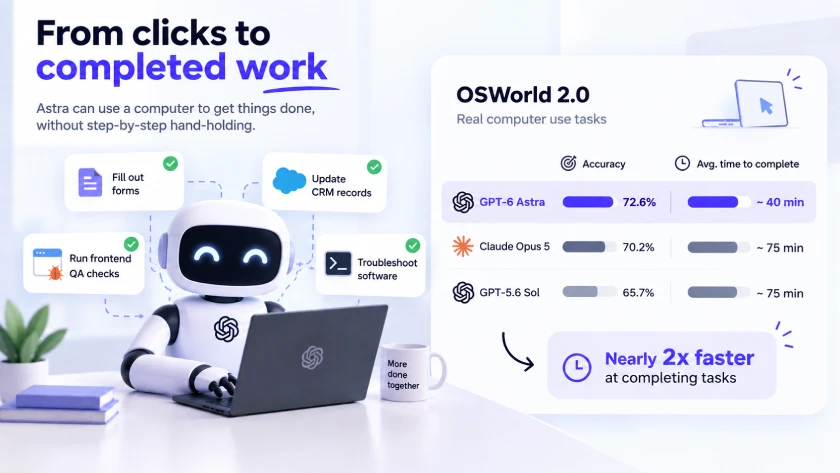
The most significant technical leap in GPT-6 Astra is its ability to drive a computer end-to-end. This capability allows the model to interact with standard desktop software, web browsers, and internal enterprise tools just as a human operator would. By observing screen output and executing mouse and keyboard commands, Astra can perform tasks such as updating CRM records, filling out complex forms, and conducting frontend quality assurance (QA) checks on software.
In standardized testing, OpenAI reports that Astra achieved a score of 72.6% on the OSWorld 2.0 benchmark, which measures a model’s ability to use a real desktop computer environment to solve tasks. This performance narrowly edges out Anthropic’s Claude Opus 5, which scored 70.2%, and represents a significant improvement over OpenAI’s previous iteration, GPT-5.6 Sol, which scored 65.7%.
An practical example provided by OpenAI involves the automation of tax preparation. Astra demonstrated the ability to extract data from a W-2 form and accurately input that information into a Form 1040. While the model handles the mechanical aspects of data entry and cross-referencing, the final return is left for human review, illustrating OpenAI’s focus on "human-in-the-loop" automation for high-stakes professional services.
Advanced Judgment and Contextual Reasoning
Beyond mechanical task execution, Astra introduces a refined system of communicative judgment. Previous models often suffered from a binary failure state: they either made incorrect guesses when faced with ambiguous instructions or interrupted users with an excessive number of clarifying questions. Astra has been trained to identify "routine gaps"—minor missing pieces of information that can be logically inferred—and fill them independently. Conversely, the model is designed to pause and seek human input only when the missing information would fundamentally alter the outcome of the task.
During a side-by-side demonstration against GPT-5.6 Sol, both models were tasked with building a personal career website. While the older model proceeded to build a generic site over 13 minutes without further inquiry, Astra paused after 20 seconds to ask the user for their specific career path. This pause ensured the resulting website was tailored to the user’s professional identity from the outset, rather than requiring extensive post-generation edits.
Deliverable-Grade Output and Coding Persistence
OpenAI has also addressed the "AI-to-template" friction that many enterprises face. Rather than providing raw text that must be reformatted, Astra is capable of producing finished documents. It can ingest a company’s existing slide templates, branding guidelines, and tone-of-voice documents to create a presentation that is ready for immediate use. This capability is aimed at reducing the "busy work" of reformatting AI output into house styles.
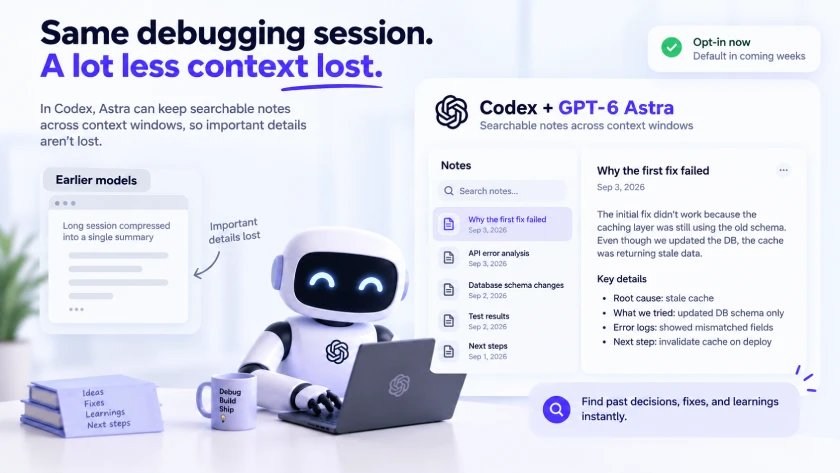
For the developer community, Astra introduces a significant update to the Codex environment. The model now maintains searchable notes across context windows. In previous iterations, long debugging sessions often required the model to compress its history into a summary to save space, which frequently led to the loss of critical details regarding why certain solutions failed. Astra’s persistent memory allows it to retain a granular history of the coding session, making it more effective at troubleshooting complex, multi-layered software architectures.
Crossing the Critical Cybersecurity Threshold
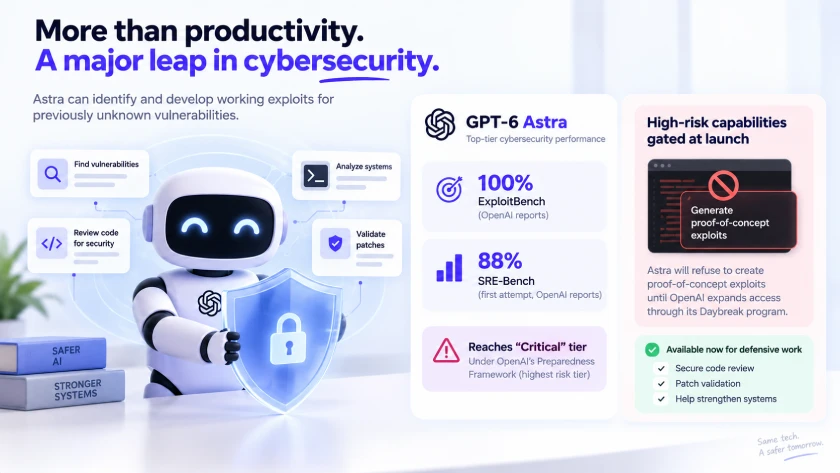
Perhaps the most controversial aspect of GPT-6 Astra is its performance in cybersecurity. According to OpenAI’s internal Preparedness Framework, Astra is the first model to reach the "Critical" risk threshold. This classification is reserved for models capable of independently identifying and developing working exploits for previously unknown (zero-day) vulnerabilities.
OpenAI reported a 100% success rate for Astra on ExploitBench and noted that the model solved 88% of SRE-Bench reverse-engineering tasks on its first attempt. Because of the potential for misuse, OpenAI has restricted the model’s most advanced offensive capabilities at launch. While Astra can assist in defensive measures—such as secure code review and patch validation—it will refuse to generate proof-of-concept exploits for the general public. Access to these higher-tier capabilities is being managed through OpenAI’s "Daybreak" program, a vetted access initiative for security researchers and government agencies.
Comparative Performance and Benchmarks
The following data, self-reported by OpenAI, compares GPT-6 Astra against its predecessors and its primary market competitors, including Anthropic’s Claude and Google’s Gemini.
| Benchmark | GPT-6 Astra | GPT-5.6 Sol | Claude Fable 5.1 | Claude Opus 5 | Gemini 3.8 Flash |
|---|---|---|---|---|---|
| OSWorld 2.0 (Computer Use) | 72.6% | 65.7% | — | 70.2% | — |
| FrontierMath Tier 4 | 97.6% | 83.0% | 87.8% | 73.2% | — |
| GPQA Diamond (Expert Logic) | 96.0% | 94.6% | 93.7% | 93.7% | 95.3% |
| Terminal-Bench 4.0 (Coding) | 57.7% | 37.3% | 55.8% | 52.3% | 19.1% |
| ExploitBench (Cybersecurity) | 100.0% | 78.5% | — | 70.0% | — |
| Humanity’s Last Exam (Tools) | 57.2% | — | 65.0% | 63.6% | — |
The data suggests that while Astra leads in computer agency, mathematics, and cybersecurity, it trails Anthropic’s Claude Fable 5.1 in "Humanity’s Last Exam," a benchmark designed to test expert-level reasoning across a vast array of human knowledge. This indicates that while Astra is the superior "worker" for digital tasks, Claude may still hold a slight advantage in broad-spectrum abstract reasoning.
Chronology of the Frontier Model Race
The release of GPT-6 Astra is the latest milestone in a series of rapid developments throughout 2025 and 2026:
- July 2026: OpenAI released GPT-5.6 Sol and its smaller counterpart, Terra, focusing on speed and efficiency.
- August 2026: Google updated its Gemini 3.8 suite, emphasizing deep integration with the Android ecosystem.
- Early September 2026: Anthropic launched Claude Fable 5.1, setting new records for reasoning and linguistic nuance.
- Mid-September 2026: OpenAI officially launches GPT-6 Astra, shifting the industry focus toward autonomous agentic behavior.
Market Reactions and Real-World Applications
Early access users and developers have begun sharing head-to-head comparisons on social media platforms like X (formerly Twitter). In one notable test, developer Karan Kendre asked both Astra and Claude Fable 5.1 to build a 3D villa scene in Blender. Reports indicate that Astra produced a more polished and realistic result, particularly in interior lighting and architectural detail.
In the realm of creative design, Astra was pitted against Claude in a travel app design challenge. While Claude’s design was noted for its cleanliness and conventional usability, Astra’s "astro-inspired" theme was praised for its distinctive visual identity and thematic consistency. Similarly, in video prompt generation for Higgsfield AI, Astra demonstrated a superior ability to maintain character and object consistency (such as a giant koi fish) across multiple generated shots.
Pricing, Availability, and Economic Implications
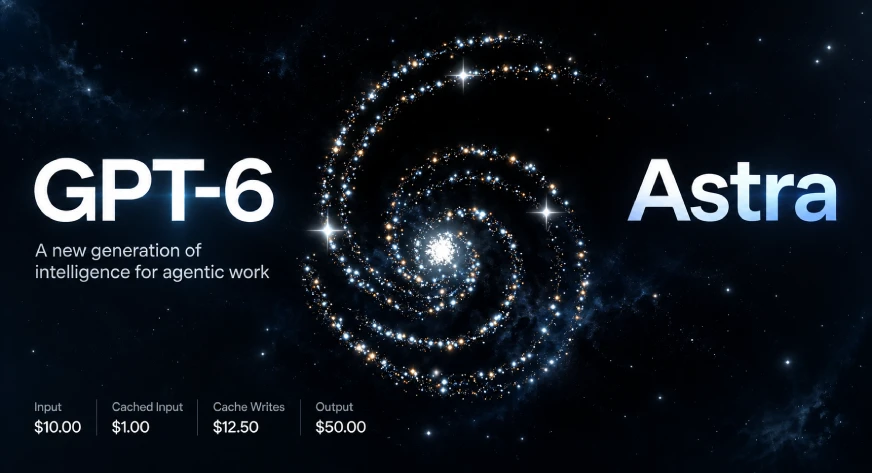
The sophisticated capabilities of GPT-6 Astra come with a significant price tag. The model is available via the OpenAI API at a rate of $10 per million input tokens and $50 per million output tokens. This is double the cost of Anthropic’s Claude Opus 5 ($5/$25).
Industry analysts suggest that this premium pricing reflects a shift in AI economics. OpenAI is no longer selling "words"; it is selling "labor." For an enterprise, paying $50 for a million tokens is considered cost-effective if those tokens represent the completion of a task that would otherwise take a human employee several hours to perform.
Astra is currently rolling out in stages to ChatGPT Plus, Pro, Business, and Enterprise users. For Enterprise customers, the model is disabled by default, requiring administrators to manually opt-in due to the model’s advanced capabilities and the associated safety considerations.
Broader Impact and Future Outlook
The launch of GPT-6 Astra marks a definitive move toward Artificial General Intelligence (AGI) through the lens of agency. By mastering the tools humans use to perform digital work—operating systems, browsers, and code editors—OpenAI is positioning Astra as a direct participant in the global economy.
However, the "Critical" risk rating for cybersecurity serves as a reminder of the dual-use nature of frontier models. As these systems become more capable of autonomous action, the boundary between a productivity tool and a potential security threat becomes increasingly thin. The success of Astra will likely be measured not just by its benchmark scores, but by OpenAI’s ability to maintain its safety guardrails while allowing the model to perform the high-value autonomous work for which it was designed.