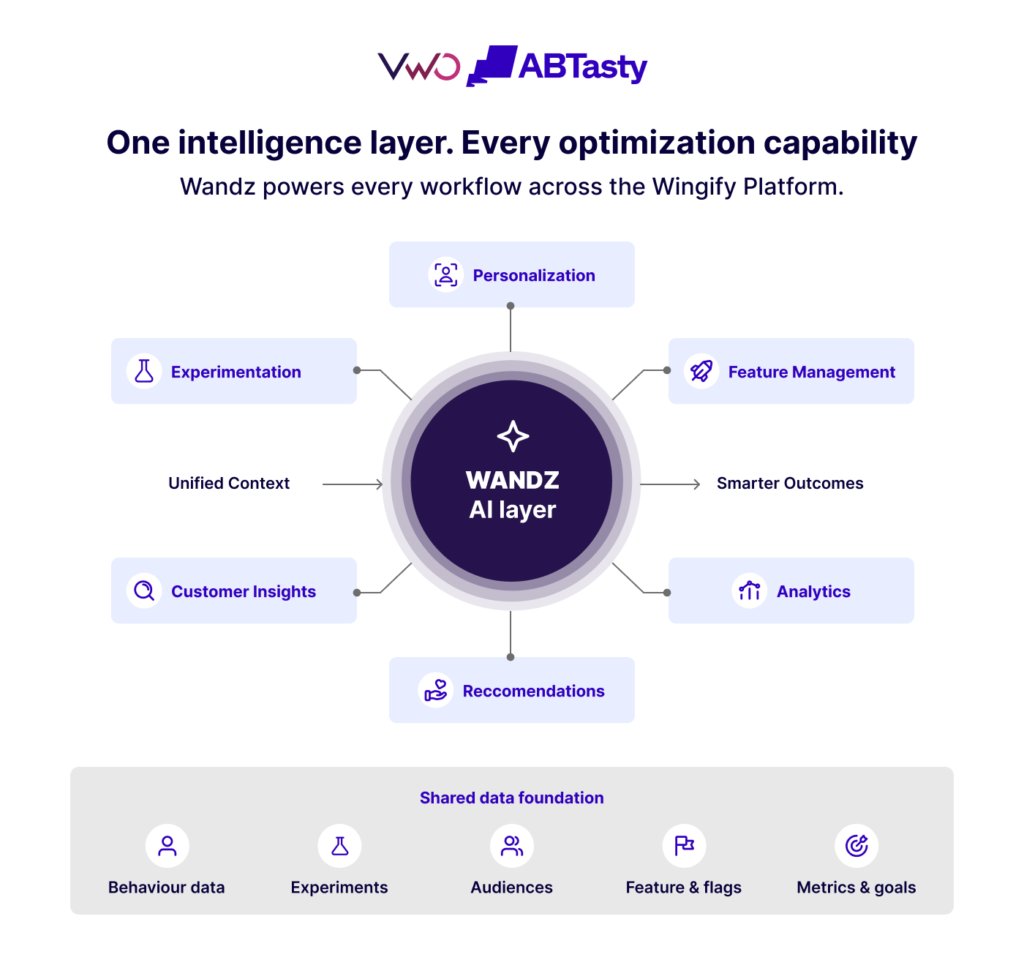
Wingify, a global leader in experience optimization and the parent company of VWO and AB Tasty, has officially introduced Wingz, an embedded artificial intelligence layer designed to serve as the foundational intelligence across its entire product suite. Unlike the prevailing industry trend of integrating standalone, third-party chatbots, Wingz is architected as a native component of the experimentation, personalization, feature management, and customer insight workflows. By leveraging direct access to live experiments, audience segments, and behavioral metrics, the system aims to eliminate the friction typically associated with data exportation and manual prompt engineering.
The introduction of Wingz marks a significant milestone in the convergence of VWO and AB Tasty under the Wingify umbrella. It represents the unification of the companies’ previous AI initiatives—specifically the Evi assistant and the Copilot tool—into a singular, cohesive intelligence layer. This strategic move is intended to provide a seamless user experience where insights derived from one tool, such as a heatmap, can immediately inform actions in another, such as an A/B test or a personalized rollout.
The Evolution of Intelligence in Digital Experience Platforms
The development of Wingz comes at a time when digital experience teams are increasingly overwhelmed by the sheer volume of data generated by modern testing platforms. While general-purpose AI tools like OpenAI’s ChatGPT, Anthropic’s Claude, and Google’s Gemini have become staples for drafting copy or generating code, they often fall short in the specialized field of Conversion Rate Optimization (CRO).
The primary limitation of general-purpose AI in this context is the "context gap." To get a useful answer regarding why a specific page’s conversion rate has dropped, a practitioner would traditionally need to export data from their testing suite, sanitize it, and then provide a lengthy prompt explaining the experimental setup, the audience parameters, and historical performance. Wingz addresses this by living inside the screens where the work is performed. Because it already "knows" the context of the experiments and the specific nuances of the audience segments, it can provide recommendations and execute tasks without the need for manual data transfers.
Industry analysts note that this shift toward "embedded" AI is a logical progression for SaaS platforms. By integrating the AI directly into the database and UI of the experimentation suite, Wingify is positioning Wingz not as an assistant to be consulted, but as a core utility that reduces the "round-trip" time between data observation and actionable execution.
A Chronology of Integration: From Evi to Wingz
The roadmap toward Wingz began several years ago as Wingify and AB Tasty independently explored how machine learning could assist marketers. Wingify initially launched Evi, an AI assistant focused on generating hypotheses and analyzing test results. Concurrently, AB Tasty developed Copilot, which aimed to assist developers and product managers with feature flagging and rollout configurations.
Following the deeper integration of VWO and AB Tasty under the Wingify corporate structure, the decision was made to unify these technologies. The timeline of this evolution reflects a broader industry shift:
- 2021–2022: Initial rollout of basic AI features (Evi and Copilot) focusing on text generation and basic data summaries.
- 2023: Pilot programs for agentic behavior, where AI began suggesting audience segments based on historical behavioral data.
- 2024: The formal announcement of Wingz as a unified layer spanning the entire converged suite, moving beyond a chatbot interface to an "intelligence DNA" model.
This unified approach ensures that as VWO and AB Tasty continue to merge their capabilities, the underlying AI remains consistent, providing a single source of truth for intelligence regardless of which specific product interface a team is using.
Core Capabilities and Workflow Enhancements
Wingz is designed to operate agentically across five primary domains: experimentation, personalization, feature management, customer insights, and analytics. The distinction of being "agentic" is critical; rather than merely providing a list of suggestions, Wingz can perform multi-step tasks end-to-end, provided a human remains in the loop for final approval.
1. Experimentation and Hypothesis Generation
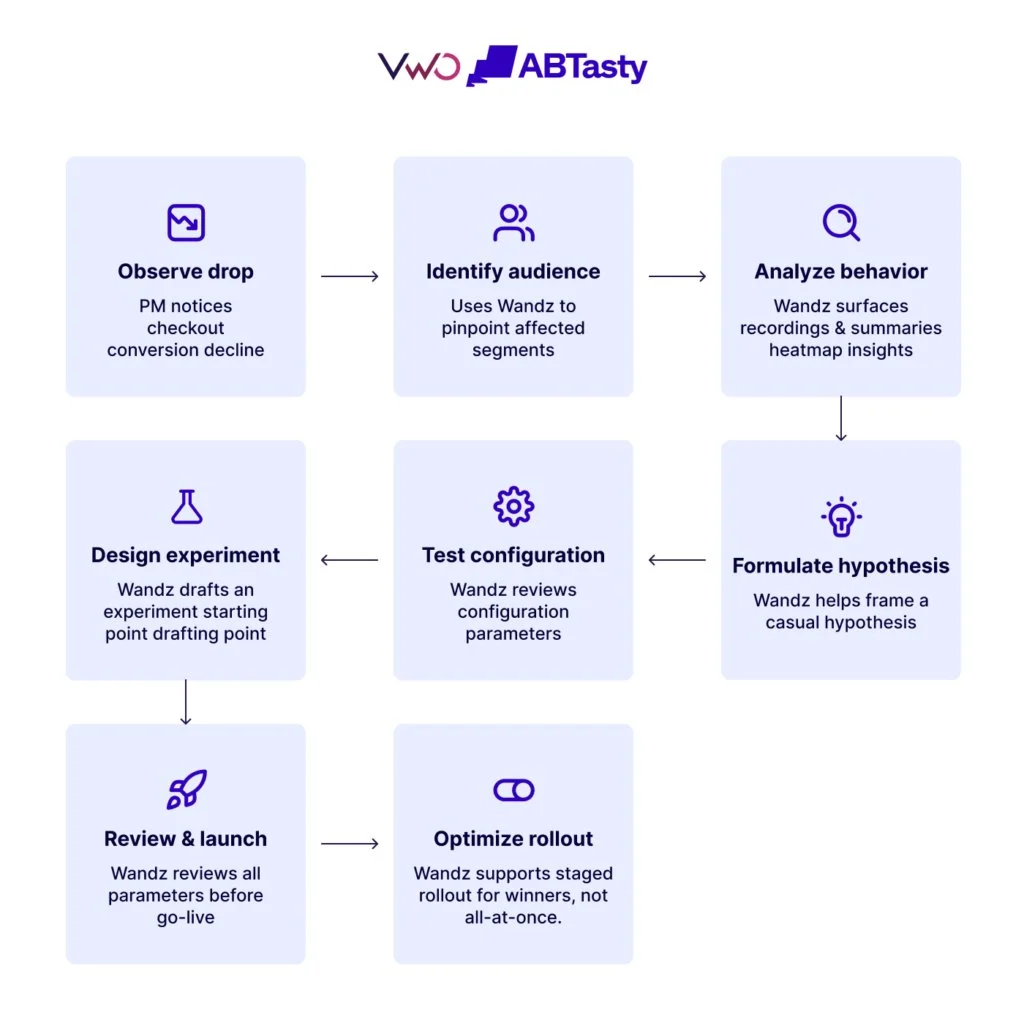
In the traditional experimentation workflow, teams often struggle to move from raw data to a viable hypothesis. Wingz automates this by analyzing current performance data to identify underperforming pages or segments. It can then draft an experiment, including the definition of variations, selection of primary and secondary metrics, and targeting of specific audiences. Once a test is concluded, Wingz interprets the results in plain language, explaining not just which variation won, but why, and what the logical next step should be.
2. Advanced Personalization and Segmentation
Personalization often fails due to the complexity of identifying which micro-segments are most likely to respond to a specific change. Wingz analyzes visitor behavior patterns to automatically suggest actionable segments. For example, it might identify a group of users who frequently visit a pricing page but drop off at the shipping stage. It can then suggest a specific experience variation for that segment, compressing an analytical cycle that would typically take days into a matter of minutes.
3. Feature Management and Rollout Risk Mitigation
For product and engineering teams, Wingz acts as a safety net during feature rollouts. It reviews configurations before launch to flag potential errors in targeting rules or traffic allocation. During a rollout, it monitors signals to suggest whether a team should accelerate the release, pause it due to an anomaly, or trigger a "kill switch" if performance metrics degrade beyond a set threshold.
4. Qualitative Customer Insights
One of the most time-consuming tasks for UX researchers is reviewing hours of session recordings or thousands of survey responses. Wingz performs the "first pass" of this data, identifying friction patterns and surfacing the most relevant sessions for human review. By connecting insights from heatmaps and recordings directly to the experimentation engine, it ensures that qualitative findings are immediately translated into quantitative tests.
5. Plain-Language Analytics
Wingz simplifies reporting by allowing users to query their data using natural language. Instead of building complex custom reports, a user can ask, "Why did mobile checkout conversion drop last Tuesday?" Wingz then analyzes the segments, traffic sources, and concurrent experiments to provide a comprehensive answer, complete with a summary suitable for executive reporting.
Comparative Analysis: Wingz vs. General-Purpose AI
The following table outlines the key architectural and functional differences between using a general-purpose AI (like ChatGPT) and the embedded Wingz layer for optimization tasks:
| Feature | General-Purpose AI | Wingz (Embedded AI) |
|---|---|---|
| Data Source | Generic training data / Manual uploads | Live suite data and historical experiments |
| Workflow | Separate application (context switching) | Built into the existing UI |
| Context | None (must be provided via prompting) | Full access to campaigns, segments, and metrics |
| Execution | Suggestions only | Can build, configure, and draft within the tool |
| Data Security | Potential risk in public LLM usage | Governed by enterprise-grade suite security |
| Continuity | Fragmented across different chats | Persistent across all Wingify products |
Security, Governance, and Human-in-the-Loop Design
As AI takes a more active role in production environments—specifically in feature management and live website testing—security and governance become paramount. Wingify has addressed these concerns by implementing strict "human-in-the-loop" guardrails.
Wingz is designed so that no recommendation is executed automatically without explicit human review and approval. Every action taken or assisted by the AI is recorded in audit logs, ensuring that enterprise teams can track who approved a specific configuration or segment. Furthermore, the system adheres to the same role-based access controls (RBAC) and data privacy standards (such as GDPR and SOC2) that govern the rest of the Wingify platform. This ensures that the AI does not bypass established security protocols, a common concern for IT and compliance departments when employees use external AI tools.
Broader Impact and Industry Implications
The launch of Wingz signals a shift in the digital experience market from "tools of record" to "tools of action." For years, platforms like VWO and AB Tasty served as the infrastructure for running tests. With the addition of an embedded intelligence layer, these platforms are becoming active partners in the strategy and execution phases.
Industry experts suggest that this will lower the barrier to entry for sophisticated experimentation. Smaller teams that lack dedicated data analysts can use Wingz to handle the "heavy lifting" of data triage and hypothesis drafting. For larger enterprise teams, the value lies in efficiency; by automating the mechanical tasks of experiment setup and reporting, senior strategists can focus on higher-level business goals.
Furthermore, the convergence of VWO and AB Tasty’s AI capabilities into Wingz reflects the ongoing consolidation in the MarTech industry. As companies seek to simplify their "tech stacks," the ability to have a single AI layer that understands both the marketing-led experimentation (VWO) and the product-led feature management (AB Tasty) provides a compelling competitive advantage.
Future Outlook
The future of Wingz, according to Wingify, involves deeper integration into the predictive aspects of customer behavior. While the current iteration focuses on analyzing what has happened and what is happening, future updates are expected to lean into "predictive experimentation," where the AI can simulate the potential impact of a change before a single visitor sees it.
As digital landscapes become more complex and consumer expectations for personalization continue to rise, the role of embedded AI like Wingz will likely move from an optional feature to an essential requirement for any brand serious about digital optimization. By shortening the distance between data-driven insight and action, Wingify is betting that the most successful digital teams will be those that have intelligence built directly into their DNA.