The landscape of commercial inquiry has undergone a profound transformation, evolving from direct engagement with salespeople to reliance on search engines, and now, to the burgeoning influence of artificial intelligence. This seismic shift presents a critical challenge for businesses: how to accurately measure the return on investment (ROI) from their AI search optimization efforts. As generative AI platforms like ChatGPT, Gemini, and Google Overviews increasingly shape consumer and business research, understanding and attributing their impact on the bottom line has become an imperative, yet complex, endeavor.
The Evolving Paradigm of Search and Information Retrieval
For decades, traditional search engines reigned supreme as the primary gateway to information, driving traffic and sales through meticulous search engine optimization (SEO). However, the advent of sophisticated large language models (LLMs) has introduced a new dynamic. Users are increasingly turning to AI chat interfaces for direct answers, summaries, and recommendations, fundamentally altering the buyer’s journey. This shift is not merely an incremental change; it represents a foundational re-architecture of how information is consumed and how purchasing decisions are initiated.
Recent industry reports underscore this profound transformation. Data from January 2026 revealed a concerning trend for traditional marketers: U.S. organic search traffic experienced a 2.5% year-over-year decline. In stark contrast, AI referral traffic to retail sites surged by an astonishing 693% over the same period. While the notion that "organic traffic isn’t dead" holds true in absolute terms, these figures undeniably point to a significant reallocation of where buyers commence their research. This divergence highlights a growing chasm between established marketing metrics and the emerging realities of AI-driven discovery, leaving many businesses grappling with the "blur" of AI’s true financial impact.
The Attribution Conundrum in AI Search
One of the primary hurdles in quantifying AI search visibility ROI is the inherent difficulty in attribution. Unlike traditional search results, where a direct click-through can often be tracked, AI-generated answers frequently lack explicit citations or direct referral links. Even when citations are present, user behavior often deviates from a direct click. A common AI-influenced purchasing journey vividly illustrates this challenge:
- A prospective buyer queries an AI for product recommendations.
- Your brand is prominently mentioned in the AI’s response.
- Three days later, the buyer independently searches for your brand name on Google.
- The buyer subsequently converts via a paid brand advertisement.
- Under a conventional last-click attribution model, credit is erroneously assigned solely to paid search, completely overlooking the initial, crucial AI touchpoint. The credit given to AI: zero.
This "dark funnel" aspect means that AI’s influence, while potent in shaping awareness and intent, often goes unrecorded by standard analytics. AI search engines rarely share detailed referral data, resulting in a significant portion of their impact being lost within the intricate tapestry of the buyer’s journey. For marketers, the solution isn’t to abandon attribution altogether, but rather to adapt by leaning into awareness-focused metrics and integrating a multi-layered measurement framework capable of capturing these elusive AI touchpoints.
A Three-Layer Measurement Framework for AI Search ROI
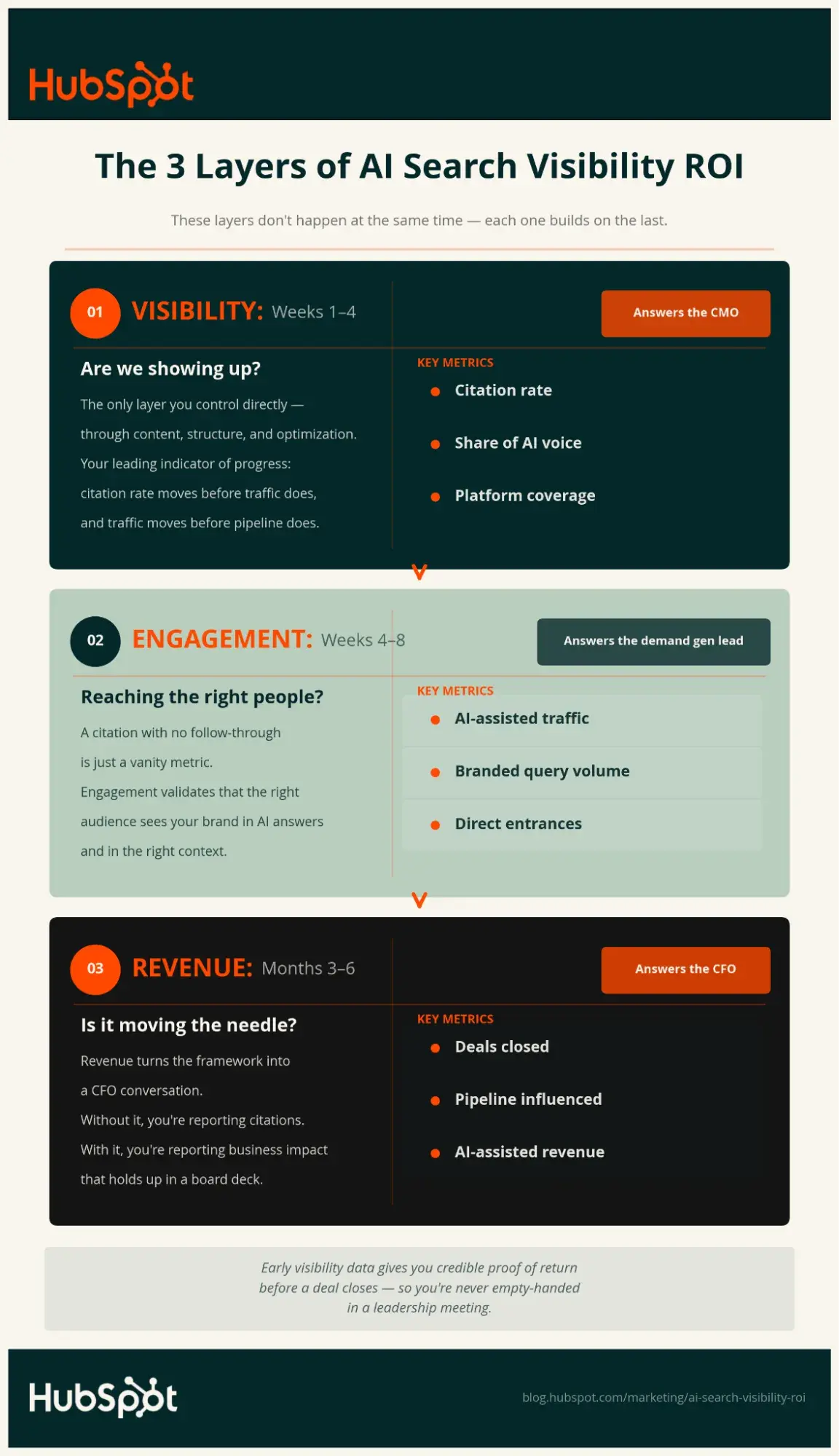
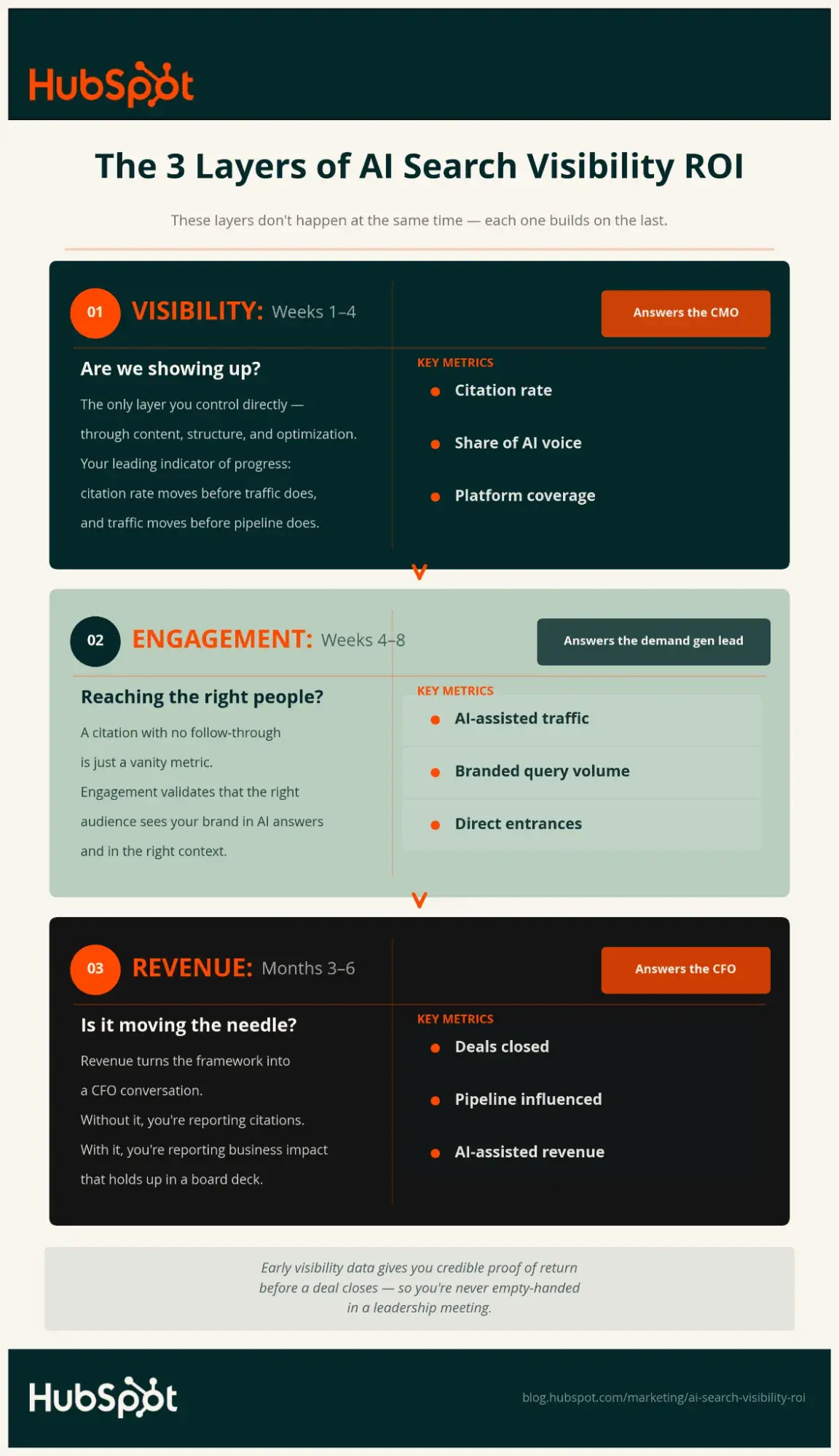
To bring clarity to the opaque world of AI search attribution, a comprehensive three-layer measurement framework is essential. This framework dissects AI search ROI into distinct yet interconnected components: Visibility, Engagement, and Revenue. Each layer plays a crucial role in painting a holistic picture of impact and addresses different stakeholder concerns within an organization.
- Visibility Metrics: This foundational layer quantifies your brand’s presence within AI-generated answers. It provides the initial proof point that your content is being recognized and cited by AI systems.
- Engagement Metrics: Building on visibility, this layer measures how AI exposure influences subsequent user actions, even if not a direct click. It bridges the gap between AI mention and active user interest.
- Revenue Metrics: The ultimate measure of business impact, this layer connects AI touchpoints to actual pipeline generation and closed deals, albeit through an assisted attribution model.
It is critical to understand that these layers represent a "delayed funnel"; their impact does not manifest simultaneously. Visibility metrics are typically the first to emerge, followed by engagement, and finally, revenue attribution. This progression provides a robust narrative, allowing marketers to report credible data on early returns while awaiting the maturation of full pipeline numbers. Without visibility, shifts in engagement are inexplicable. Without engagement context, leadership may dismiss data as mere vanity metrics. Conversely, early visibility metrics provide tangible evidence of activity and potential return, preventing "empty-handed" presentations to leadership while more complex revenue figures accumulate. When all three layers are meticulously tracked over time, they form a defensible measurement framework suitable for high-level board discussions.

Deep Dive into Key Metrics
Visibility: Tracking Share of AI Voice and Citations
Share of AI Voice (SAIV) represents the percentage of relevant AI prompts where your brand appears in the generated answer. Citation tracking takes this a step further by measuring whether your brand is explicitly linked or referenced as a source, a strong indicator that AI systems deem your content authoritative and reliable.
How to Calculate:
- Share of AI Voice (SAIV): Divide the number of prompts where your brand is mentioned by the total number of tracked prompts, then multiply by 100.
- Citation Rate: Divide the number of prompts where your brand is cited as a source by the total number of tracked prompts, then multiply by 100.
- Competitive SAIV: Track the SAIV for your key competitors across the same prompt set to benchmark your performance.
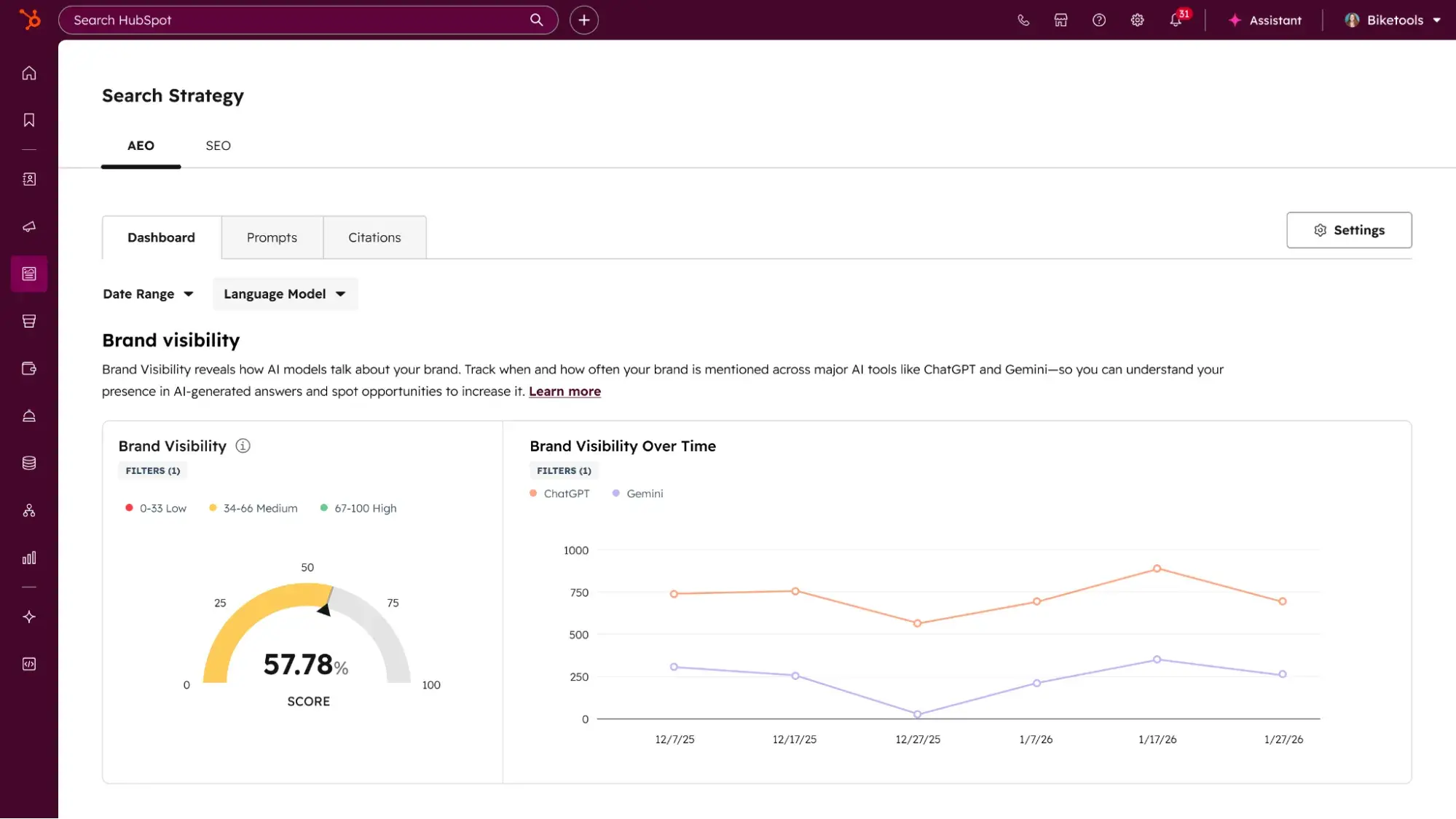
Tools like HubSpot AEO offer automated tracking of Brand Visibility Score across major platforms such as ChatGPT, Perplexity, and Gemini. These platforms monitor competitor mentions, identify content gaps, and integrate visibility data directly with CRM systems, streamlining the measurement process. This provides a clear, dashboard-driven view of your brand’s standing in the AI search ecosystem.
Engagement: Leveraging Branded Search Lift and Direct Traffic
When a brand is featured in AI answers, users often respond by directly searching for that brand later, or by navigating directly to its website. This behavior manifests as a measurable increase in branded keyword searches and direct website traffic, even without a direct click from the AI answer itself. This subtle yet significant shift signals increased brand awareness and intent driven by AI exposure.
How to Calculate:
- Branded Search Lift: Monitor your brand’s specific keyword search volume in Google Search Console. Analyze month-over-month or quarter-over-quarter growth, isolating any sustained increases that are not attributable to paid campaigns or other major marketing initiatives. A consistent rise in branded searches without corresponding paid activity strongly suggests the effectiveness of AI awareness efforts.
- Direct Traffic Analysis: Utilize Google Analytics 4 (GA4) to track direct traffic to your website. Look for trends and spikes that correlate with periods of increased AI visibility. While direct traffic can be influenced by many factors, a sustained upward trend alongside rising AI visibility provides compelling evidence of engagement.
This layer helps address the "vanity metrics" skepticism by showing tangible user interest that directly follows AI exposure, even if the direct attribution link is missing.
Revenue: Attributing Pipeline Influence in Your CRM
Achieving perfect, direct attribution for AI search remains an elusive goal due to the nature of user journeys and the lack of referral data from many AI platforms. Therefore, the objective shifts to "assisted attribution." The focus is on identifying and quantifying instances where AI played a discernable role in influencing a contact before they converted.
The strategic importance of this layer is underscored by robust data. A January 2026 survey conducted by HubSpot, involving over 3,000 CRM purchase decision-makers, revealed that AI search was the single strongest predictor of purchase intent. Buyers who utilized AI search were a remarkable 36% more likely to make a purchase compared to those who did not, surpassing the predictive power of demos, review sites, and even direct sales calls. This compelling statistic highlights the immense value of even indirectly attributing AI’s influence.
How to Calculate (Assisted Attribution Model):
- Define AI Touchpoints: Establish clear criteria for what constitutes an "AI-influenced touchpoint" within your CRM. This could include:
- Contacts who interacted with content known to be highly cited by AI.
- Contacts whose journey includes a branded search or direct visit following a period of high AI visibility for your brand.
- Leads originating from campaigns specifically designed to drive AI citations.
- Implement CRM Tracking: Utilize custom fields and robust tracking within your CRM (e.g., HubSpot’s Smart CRM) to log these AI-influenced behaviors.
- Build an Assisted Revenue Model: Develop a model that assigns a percentage of credit to AI for deals where an AI touchpoint was recorded. This credit will be a fraction, as AI is typically one of several influences.
This approach acknowledges the multi-touch nature of modern sales cycles and provides a pragmatic way to quantify AI’s contribution to the pipeline and closed revenue, even without direct click data.

Benchmarking Brand Visibility in AI Search
To transform visibility data into actionable insights, benchmarking is indispensable. It provides both a competitive reference point and a trend line, enabling businesses to assess their performance relative to rivals and track the effectiveness of their optimization strategies over time. Without these two elements, visibility data lacks context and strategic direction.
1. Identify Your Answer Competitors
A crucial distinction in AI search is that your "answer competitors" are not necessarily your direct product or service rivals. AI models prioritize content authority, clarity, and structure. This means your answer competitors could include industry media sites, analyst blogs, specialized review platforms (like G2 or Yelp), niche newsletters, or even general knowledge aggregators. These entities may not sell competing products but consistently appear in AI answers for your target prompts.
Actionable Steps:
- For each topic cluster within your defined prompt set, meticulously document every source cited in AI answers.
- Expand your competitive tracking set beyond direct product competitors to include all influential content sources.
- Analyze the type of websites frequently cited. If a media site consistently outperforms your brand for buying-stage prompts, it signals a content gap, not a product deficiency—a problem that can be addressed through strategic content creation.
2. Build a Share of Citations Chart
Regularly (e.g., monthly) run your full prompt set across target AI platforms. For each prompt, record every cited source and aggregate this data by topic cluster. This process yields a clear, visual representation of your brand’s competitive standing:
| Topic Cluster | Your Brand Citations | Top Competitor Citations |
|---|---|---|
| CRM software comparisons | 12/20 prompts | 8/20 prompts |
| Sales pipeline management | 6/20 prompts | 14/20 prompts |
| Marketing automation | 9/20 prompts | 11/20 prompts |
| Email marketing tools | 15/20 prompts | 5/20 prompts |
In this hypothetical example, "Sales pipeline management" emerges as a critical priority gap, with your brand significantly trailing. This immediately informs content strategy, indicating where new content briefs are most urgently needed. Conversely, "Email marketing tools" represents a strong position worth defending against potential competitive inroads.
3. Interpret Trends
A rising citation share in a specific cluster can stem from several factors: improvements in your content quality, a decline in a competitor’s content performance, or an update to the underlying AI model’s source preferences. It’s imperative to re-establish a fresh baseline after any major AI model release (e.g., GPT, Gemini, Perplexity updates), as these can independently reshuffle citation patterns regardless of your content quality.
The trend line, rather than any single snapshot, is paramount. A single month’s data provides a static view, but three months of consistent data reveals whether your optimization strategy is effectively moving the needle. Once benchmark data is consistently tracked, integrating it with marketing automation platforms like HubSpot Marketing Hub allows for automated multi-touch attribution and consolidated reporting, ensuring AI citation share is viewed alongside other critical marketing metrics.
Planning for AI Search Visibility Measurement Over Time
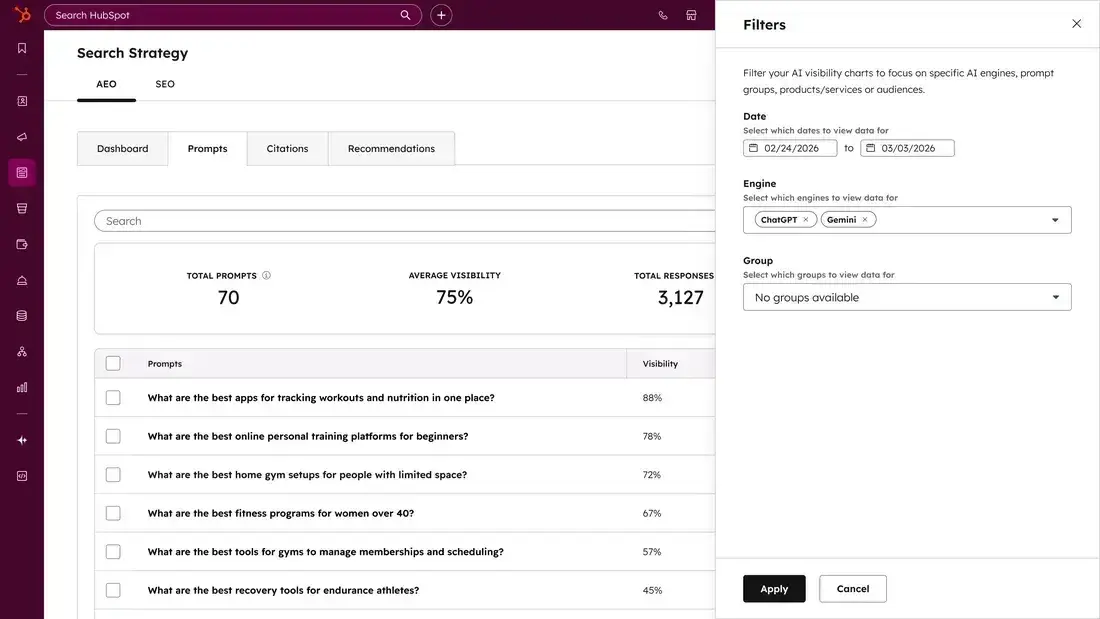
1. Define Your Prompt Set
The foundation of effective AI search measurement is a carefully curated prompt set. These prompts should accurately reflect how your target buyers research your category across all stages of the sales funnel. Aim for 20-30 prompts initially, covering:
- Awareness Stage: Broad informational questions (e.g., "What is CRM software?").
- Consideration Stage: Comparative questions (e.g., "Best CRM for small businesses?").
- Decision Stage: Specific brand-related or feature-specific questions (e.g., "HubSpot vs. Salesforce features?").
Prioritize specificity over brevity. A prompt like "What’s the best CRM for a 50-person B2B sales team with a long deal cycle?" yields far more useful and trackable data than a generic "best CRM."
2. Input Prompts into Your AI Visibility Tool
While manual testing across platforms is possible, it’s highly inefficient. Specialized tools like HubSpot AEO automatically track citations on platforms like ChatGPT, Gemini, and Perplexity daily. Multi-platform tracking is non-negotiable, as AI search visibility is no longer confined to a single ecosystem. Goodie’s 2026 Wave 2 report indicated a significant diversification, with ChatGPT’s share of B2B AI referrals dropping from 89% to 63% in eight months, while Claude reached 18.5% and Gemini 10.6%. This necessitates monitoring across all major surfaces:
- Google Overviews (Search Generative Experience)
- ChatGPT (OpenAI)
- Gemini (Google)
- Perplexity AI
- Claude (Anthropic)
Each platform possesses unique retrieval logic, citation behavior, and user intent, making a unified, multi-platform strategy essential.
3. Record Your Brand Visibility Score
For each prompt, across each platform, score your brand’s appearance on a simple scale: "not mentioned," "mentioned," "cited as a source," or "recommended." Aggregate these scores into a comprehensive Brand Visibility Score across all prompts and platforms to establish your baseline. This score should be rerun and tracked every 30 days to monitor movement and progress.
4. Audit Your Existing Content
Utilize tools like HubSpot’s free AI Search Grader to conduct a thorough audit of your current content. This tool identifies precisely where your brand is visible and where competitors are claiming the answers. The audit should involve recording:
- Date, Prompt, Platform, Model Version.
- Brand Mention? (Y/N), Brand Cited? (Y/N), Competitor Cited?
- Answer Sentiment (Positive/Neutral/Negative), and a verbatim or summary of the response.
This detailed analysis, performed for 5-10 prompts per topic cluster across 3-4 platforms, reveals critical content gaps and optimization opportunities.
5. Repeat and Refine
After implementing changes based on audit insights, consistently rerun your prompt set and analyze the data on a weekly or bi-weekly schedule. This iterative process of tracking, analyzing, optimizing, and repeating is crucial for continuous improvement and sustained AI search visibility.
Calculating AI Search Visibility ROI
Given the attribution ambiguity, calculating AI Search Visibility ROI requires a nuanced approach, integrating the visibility, engagement, and revenue metrics discussed. The fundamental formula remains:
ROI (%) = (AI-Assisted Revenue – AI Costs) ÷ AI Costs × 100
AI-Assisted Revenue
As AI search rarely yields direct click attribution, marketers must construct an assisted revenue model. This relies on:
- Robust CRM Integration: Unifying visibility and pipeline data in a Smart CRM with custom fields to flag AI-influenced contacts.
- Multi-Touch Attribution: Employing marketing automation platforms (like HubSpot Marketing Hub) to automate attribution across all channels, including identified AI touchpoints.
- AI-Influenced Behavior Tracking: Identifying specific behaviors (e.g., branded search lift, direct traffic after AI exposure) that signal AI influence before conversion.
AI Costs
AI costs are more straightforward to quantify, typically encompassing:
- AI Visibility Tools: Subscriptions to platforms like HubSpot AEO, Perplexity Pro, etc.
- Content Creation and Optimization: Resources dedicated to rewriting, structuring, and enriching content for AI systems (e.g., salaries for content strategists, writers, or agency fees).
- Training and Development: Investments in upskilling teams on AI search optimization techniques.
Example Calculation:
Imagine a team investing $2,000/month in AI visibility tools and content optimization, totaling $6,000 over a quarter. During this period, their CRM identifies $30,000 in pipeline where contacts had a confirmed AI touchpoint prior to converting. Applying a conservative 25% assisted credit (acknowledging AI as one of several influences), this amounts to $7,500 in AI-assisted revenue.
Using the formula:
ROI (%) = ($7,500 – $6,000) ÷ $6,000 × 100 = 25% ROI
This provides a tangible, defensible ROI figure that can be presented to leadership while the attribution model continues to mature.
Making the Leadership Case for AI Search
Presenting the case for investment in AI search visibility requires a strategic argument centered on three pillars: opportunity cost, competitive risk, and a clear measurement plan. Emphasize the cost of inaction, rather than solely focusing on the promise of future results.
Opportunity Cost
Highlighting the potential revenue being lost due to inaction is a powerful motivator. HubSpot data indicates that AI-referred leads convert at three times the rate of traditional search leads. Every month without measuring and optimizing for AI visibility means high-intent buyers are making decisions without your brand being part of the conversation, translating into quantifiable lost revenue.
Competitive Risk
The gap between early adopters and those waiting on the sidelines is already widening. HubSpot customers actively engaged in AI search optimization generate 170% more Marketing Qualified Leads (MQLs) and 82% more deals than comparable customers who are not. This demonstrates that competitive advantage is not a future possibility but a current reality, with tangible, measurable differences emerging quarter by quarter.
Measurement Plan
Leadership demands concrete plans, not vague promises. Present a detailed 30/60/90-day roadmap outlining:
- Defined Baseline: Your initial Brand Visibility Score and competitive benchmarks.
- Prompt Set: The specific questions being tracked across platforms.
- Metric Framework: The three-layer visibility, engagement, and revenue metrics.
- CRM Attribution Model: How AI touchpoints will be integrated and attributed within the CRM.
This demonstrates a clear understanding of how success will be measured and reported.
Expected Timeline for AI Search Visibility Improvements
A common pitfall is expecting AI search visibility results on the same rapid timeline as paid media or even traditional SEO. AI Engine Optimization (AEO) is a long-term strategy, with results building in layers. Understanding this pacing is crucial for setting realistic expectations with leadership and ensuring sustained funding.
Typical AI Search Visibility Milestone Windows:
| Timeframe | What You Should See | What to Report |
|---|---|---|
| Days 1–30 | Baseline established, prompt set running | Visibility score, competitor benchmark |
| Days 30–60 | First citation data, branded search trend | Share of AI voice, direct traffic delta |
| Days 60–90 | AI-influenced contacts appearing in CRM | AI-influenced MQL rate, pipeline touch data |
| Days 90–180 | Pipeline influence data, revenue model live | AI-assisted close rate, deal velocity |
Leading Indicators to Watch First:
While awaiting full pipeline data, several leading indicators can provide early evidence that your strategy is working:
- Rising Brand Visibility Score: Consistent improvement in your brand’s presence in AI answers.
- Increased Share of AI Voice: Gaining ground against competitors in specific topic clusters.
- Growing Branded Search Volume: More users searching directly for your brand.
- Uptick in Direct Website Traffic: More users navigating directly to your site.
If two or more of these indicators show positive movement by day 60, you have a credible narrative to present. This pattern of leading indicators points towards where future pipeline data will eventually land, building confidence and justifying continued investment.
Frequently Asked Questions About AI Search Visibility ROI
How do I improve visibility with an AI search optimization strategy?
Start with your content structure. AI systems favor content that provides direct, clear answers upfront. Rewrite key pages to answer prompts within the first 150 words, use question-based headings, and implement FAQ and Article schema for easy parsing by AI. Beyond your site, cultivate a strong brand reputation, as AI also draws from third-party sources (review platforms, industry publications). Optimizing for multiple AI engines (ChatGPT, Gemini, Perplexity, Google AI Overviews) is also critical, as each cites differently.
What timeline should I expect for improvements in AI search visibility?
Anticipate 30-60 days for content improvements to reflect in citation rate changes, and 90-180 days for these gains to translate into measurable pipeline influence. AI systems do not index and update in real-time like traditional search engines. However, branded search lift and direct traffic can shift within 4-6 weeks, and citation rates on lower-competition prompts can improve within a month. High-intent buying prompts, especially with established competitors, will take longer.
How should I pick prompts to track AI share of voice?
Gather prompts from three primary sources: sales call recordings, customer support tickets, and existing keyword research. Focus on questions your buyers genuinely ask. Prioritize specificity (e.g., "What’s the best CRM for a 50-person B2B sales team with a long deal cycle?") over brevity. Structure your prompt set across awareness, consideration, and decision funnel stages, aiming for 5-10 prompts per topic cluster. Refresh your prompt set quarterly to adapt to evolving buyer language.
What if my brand is rarely mentioned today?
A low visibility score indicates significant opportunity. First, audit which topic clusters have the lowest citation rates and identify the sources currently appearing in those answers. This reveals winning content strategies and your specific content gaps. Then, apply AEO content best practices to your highest-priority pages, focusing on clarity, direct answers, and E-E-A-T (Expertise, Experience, Authoritativeness, Trustworthiness) signals. Begin by targeting 2-3 topic clusters with the smallest competitive gaps and highest buyer intent, as visibility gains compound over time. Expect 30-60 days for meaningful movement, tracking weekly for early signals.
Conclusion: The Urgency of Action
The fundamental truth of commerce remains constant: whoever best answers buyer questions—clearly, credibly, and at the opportune moment—wins the business. AI search has fundamentally altered where those answers originate, but not the underlying principle.
The good news is that initiating an AI search visibility strategy does not require an exorbitant budget or a dedicated AI team from day one. Begin where you are. Define your first prompt set, run it through tools like HubSpot AEO to establish your Brand Visibility Score across platforms like ChatGPT, Perplexity, and Gemini. Start flagging AI-influenced contacts in your CRM and monitor your branded search trends. The picture will clarify faster than anticipated, and every data point collected now contributes to the compelling leadership case you will be making in the coming months.
The shift towards AI-driven information consumption is not a distant future; it is already underway. The only remaining question is whether your brand will be prominently featured in the answers.