The practice of manual A/B testing remains a more pervasive element of the digital landscape than contemporary industry discourse often acknowledges. While enterprise-grade experimentation platforms frequently dominate the conversation, a significant cohort of product teams, data scientists, and growth marketers continue to operate experiments through custom-built stacks. These teams utilize a combination of feature flags, bespoke scripts, existing analytics suites, and ad-platform native tools to validate hypotheses. This approach is typically driven by specific technical requirements, such as custom infrastructures, stringent budget allocations, or rigorous data compliance constraints that preclude the use of third-party software-as-a-service (SaaS) solutions.
The initial rationale for manual experimentation is frequently rooted in the pursuit of operational autonomy. By bypassing dedicated platforms, organizations retain absolute control over their codebase and data residency while avoiding the recurring licensing fees associated with premium tools. For small-scale operations or teams conducting infrequent, low-complexity tests, these manual methodologies provide a functional, if labor-intensive, pathway to optimization. However, as digital maturity increases and experimentation becomes central to corporate decision-making, the operational overhead—encompassing traffic management, tracking accuracy, statistical validation, and governance—begins to scale exponentially, often reaching a point of diminishing returns.
The Catalysts for Manual Experimentation Adoption
The decision to forego specialized experimentation software is rarely a rejection of the technology itself but rather a strategic alignment with specific organizational constraints. Analysis of industry trends reveals five primary drivers for this choice:
First, fiscal considerations remain a dominant factor. For startups or mid-market firms running only a handful of experiments per quarter, the high entry price of enterprise experimentation platforms can be difficult to justify to stakeholders. In these scenarios, leveraging existing engineering hours to build a basic traffic splitter often appears more economical on a balance sheet.
Second, the need for granular engineering control is paramount in highly customized technical environments. Teams working with headless architectures, server-side rendered applications, or native mobile apps often find that third-party SDKs introduce unwanted latency or restrict their ability to manage randomization logic. By building in-house, they ensure the experimentation layer integrates seamlessly with their specific CI/CD (Continuous Integration/Continuous Deployment) pipelines.
Third, the regulatory landscape has made data residency a non-negotiable priority for sectors such as fintech, healthcare, and government. When internal policies or international laws (such as GDPR or CCPA) restrict the transmission of user data to external servers, self-hosted experimentation systems become the only viable alternative for maintaining compliance.
Fourth, the desire to maximize existing tech stack investments often leads teams to "bolt-on" experimentation capabilities to their current tools. If an organization already utilizes a robust data warehouse like Snowflake or BigQuery, along with an analytics platform like Mixpanel, the temptation to bridge the gap with custom SQL and scripts is high.
Finally, the stage of experimentation maturity dictates the toolset. Many organizations use manual testing as a "proof of concept" to demonstrate the value of a data-driven culture before seeking the budget for a comprehensive platform.
Methodologies of Manual Implementation
Without a centralized platform to govern the lifecycle of a test, teams generally deploy one of several technical configurations to split traffic and deliver variations.
Split URL and Redirect Testing
This method involves creating two distinct versions of a webpage, often hosted on different URLs. Traffic is then routed between them at the server level or via a Content Management System (CMS). While effective for radical redesigns or checkout flow overhauls, it is prone to SEO complications and can result in "flicker" if not implemented with high-performance routing rules.
JavaScript-Based Variation Injection
This remains a common front-end approach where a script modifies page elements—such as headlines, Call-to-Action (CTA) buttons, or images—dynamically after the page loads. While flexible, this method is increasingly scrutinized for its impact on Core Web Vitals, specifically Cumulative Layout Shift (CLS).
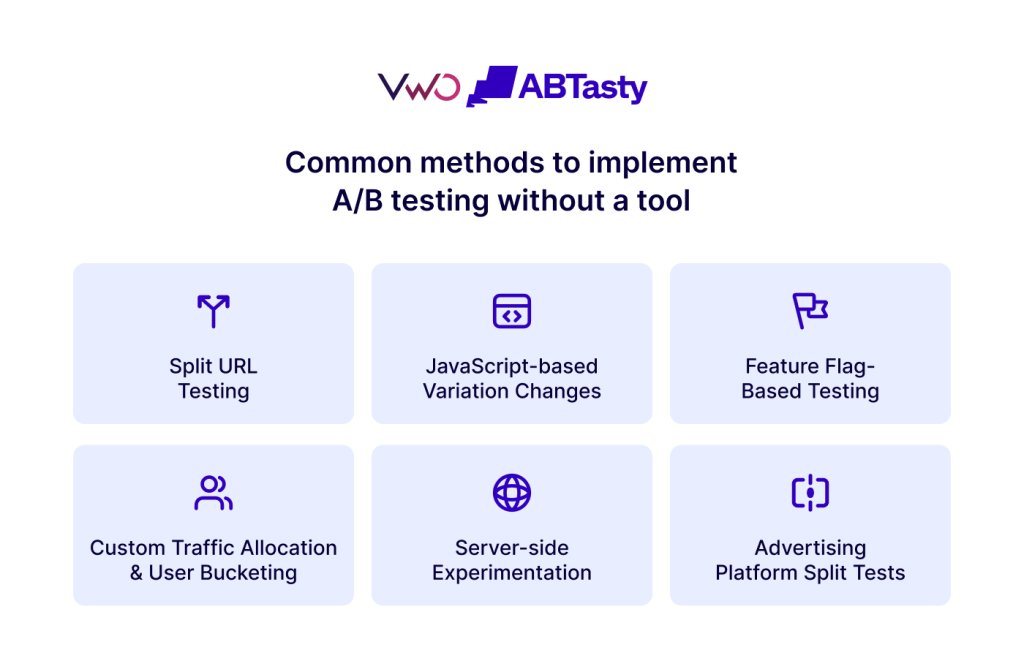
Feature Flag-Based Experimentation
Utilizing feature toggles allows developers to wrap new code in a conditional statement. This enables the team to expose a new feature to a specific percentage of users without a new deployment. While highly efficient for product releases, using flags for complex A/B testing requires a rigorous cleanup process to avoid the accumulation of "technical debt" in the form of dead code.
Server-Side Execution
In this more advanced manual setup, the assignment of a user to a variation happens on the server before the HTML is even generated. This is the preferred method for testing backend logic, such as pricing algorithms or recommendation engines, as it eliminates client-side latency and provides a more secure testing environment.
The Tracking and Analytics Infrastructure
The challenge of manual testing shifts from execution to analysis once the data begins to flow. Organizations typically rely on three primary avenues for tracking:
- Google Analytics 4 (GA4): Teams send variation assignments as custom dimensions. While accessible, this requires manual effort to build exploration reports and lacks built-in statistical significance calculators, forcing teams to export data to external spreadsheets.
- Product Analytics (Mixpanel/Amplitude): These tools are excellent for mapping user journeys. However, analyzing an A/B test manually within these platforms requires the construction of complex funnels and the manual application of filters, which can lead to human error in data interpretation.
- Data Warehouses: The most robust manual method involves routing all raw events to a warehouse like BigQuery. Data engineers then run SQL queries or Python scripts to calculate uplift. While this offers total flexibility, it demands high technical literacy and lacks the real-time visibility provided by dedicated dashboards.
The Hidden Risks: Statistical and Technical Pitfalls
The primary failure point of manual A/B testing is not the ability to change a button color, but the inability to guarantee the integrity of the results. Dedicated platforms provide "guardrails" that manual setups often lack.
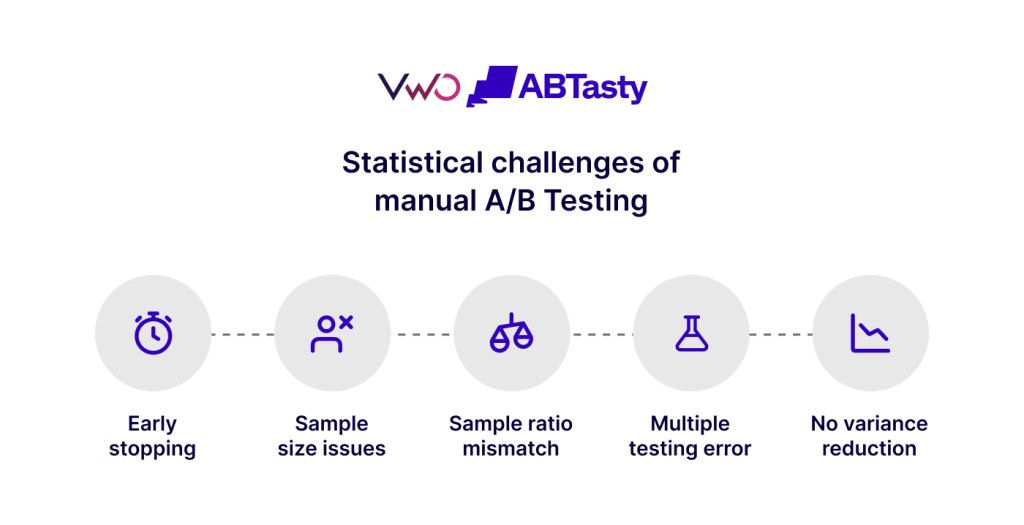
One of the most pervasive issues is the "Peeking Problem." Without automated stopping rules, teams tend to check results daily and stop a test as soon as it reaches a nominal 95% confidence level. Statistically, this practice drastically increases the rate of false positives. A result that appears significant on day four may regress to the mean by day fourteen, yet many manual testers lack the discipline to wait for a full business cycle.
Furthermore, Sample Ratio Mismatch (SRM) often goes undetected in manual environments. SRM occurs when the actual traffic split (e.g., 48/52) deviates significantly from the intended split (50/50). This is usually a symptom of a technical flaw, such as bot interference or caching issues. Dedicated platforms flag SRM automatically; manual testers may unknowingly base multi-million dollar decisions on corrupted data.
From an SEO perspective, manual testing carries the risk of "cloaking"—where search engines see different content than users—which can lead to severe ranking penalties. Additionally, without proper canonical tags on split-URL tests, search engines may index both versions, diluting the page’s authority and splitting link equity.
Moving Toward Scalable Experimentation
As organizations move beyond the "ad-hoc" testing phase, the transition to a dedicated platform like VWO or AB Tasty often becomes a matter of Return on Investment (ROI). The "Total Cost of Ownership" of a manual system includes the salary of engineers spent maintaining scripts and the salary of data scientists spent manually calculating significance. When these costs are aggregated, the price of a professional platform often proves to be the more efficient investment.

Case studies highlight the impact of this transition. For instance, the energy company Vandebron utilized behavioral insights and automated A/B testing to identify a specific friction point in a sign-up form that was invisible in raw conversion data. By addressing a technical limitation in a date-of-birth field, they achieved a 16.3% improvement in sign-up rates. Similarly, Meliá Hotels leveraged server-side experimentation to roll out booking-funnel changes progressively, moving from 5% to 100% exposure in one week, resulting in a 1.85% uplift in revenue per visitor while ensuring system stability.
Conclusion and Future Outlook
Manual A/B testing serves as a vital entry point for many organizations, providing a low-barrier way to introduce the concept of data-driven iteration. It remains a viable strategy for teams with deep engineering resources and very specific compliance needs. However, the inherent risks—ranging from statistical inaccuracies and SEO damage to the high cost of engineering maintenance—suggest that manual methods are a temporary bridge rather than a long-term solution.
As the industry moves toward AI-driven optimization and hyper-personalization, the complexity of managing these experiences manually will likely become untenable. The future of digital growth lies in the ability to run hundreds of simultaneous experiments with automated guardrails, a feat that requires the sophisticated infrastructure of a dedicated experimentation platform. For organizations looking to move from "testing" to "continuous optimization," the shift from manual scripts to scalable frameworks is not just a technical upgrade, but a strategic necessity.