The question echoing through marketing departments and client consultations today is stark: Are blogs still a viable channel for investment in the current digital climate? This query is not born of mere speculation but from a tangible shift in the online ecosystem, accelerated by the advent of artificial intelligence and the subsequent commoditization of content. As AI tools become more sophisticated in generating and synthesizing information, the traditional role of blogs as primary content factories faces scrutiny.
While some may view blogs as a relic of a bygone digital era, the data suggests a more nuanced and compelling narrative. Despite a perceived decline in direct traffic, the strategic value of blogs in the age of AI-powered search is evolving, not disappearing. This analysis delves into the latest research to reassess the enduring influence and future potential of blogs as critical components of a B2B marketing strategy.
The Shifting Sands of Search Discovery: Acknowledging the Decline in Traditional Traffic
It is undeniable that the landscape of online discovery has been fundamentally altered by the rise of AI-powered search engines and virtual agents. Gartner, a leading research and advisory company, projected in February 2024 that traditional search engine volume would experience a significant drop of 25% by 2026. This forecast, driven by the migration of users towards AI chatbots and other virtual assistants, has begun to materialize. Marketers who have historically relied on organic search traffic volume as a primary metric for return on investment (ROI) are now observing this trend reflected in their analytics dashboards.
The core of this shift lies in how search queries are now resolved. Instead of presenting a list of blue links leading to various web pages, AI-driven search is increasingly providing synthesized, direct answers to user queries. This means that even well-crafted and informative blog posts may not receive the click-throughs they once did, as users find their immediate information needs met within the AI interface itself. This presents a clear challenge for publishers who have built their strategies around driving traffic to their content.
However, the narrative does not end with declining traffic. Emerging data suggests a significant increase in the value of the traffic that does convert from AI-driven discovery channels. Research by SEMrush indicates that visitors originating from Large Language Model (LLM) interactions are, on average, 4.4 times more valuable than those arriving from traditional organic search, based on conversion rates. Further supporting this, data published by Similarweb in May revealed that referral traffic from ChatGPT boasts a conversion rate of 7.1%, a figure surpassed only by paid search advertising.
This heightened conversion rate can be attributed to the inherent trust signals associated with AI-generated answers. When an AI system synthesizes information and directs a user to a specific source, it implicitly endorses that source’s authority and relevance. This phenomenon is amplified in B2B marketing, where users are often seeking in-depth, authoritative answers to complex problems. Blogs that have consistently demonstrated topical expertise and provided valuable insights are well-positioned to benefit from this enhanced trust transfer, even as direct traffic volume may fluctuate.

The Anatomy of AI Citations: What AI Systems Actually Value
A critical recalibration in thinking about blog investment emerges when examining the raw citation volume across major AI platforms. Contrary to what one might expect, brand-owned content does not always dominate these citation lists. However, this observation should not be interpreted as a death knell for blogs. Instead, it highlights a crucial characteristic: blogs are inherently citable by nature, offering a clear pathway for brands to be included in AI-generated responses, provided the right strategic approach is adopted.
Wix’s AI Search Lab, in an analysis of 75,000 AI answers, discovered that articles are cited 2.7 times more often for informational queries. Articles and listicles, collectively, account for a substantial 67% of all informational citations. This finding underscores the structural advantage of blog content. Editorial and informational content consistently outperforms purely commercial pages, according to Otterly’s research. The format of blog posts—structured, informational, and non-transactional—aligns precisely with the types of content that LLMs seek when synthesizing answers.
While a specific blog post may not become the most cited source globally, it can serve as an owned content vehicle that produces material in a format directly favored by AI systems. This is a significant differentiator in an era where third-party platforms increasingly dictate content visibility.
The "Query Fan-Out Effect": Understanding AI’s Deconstruction of Search
A counterintuitive finding from research into AI search engines concerns their query processing methodology. Instead of matching a single user question to a single result, AI search engines often decompose complex queries into multiple parallel sub-queries. These sub-queries are then addressed by retrieving relevant content for each, which is subsequently synthesized into a comprehensive answer. This process, known as "query fan-out," has profound implications for how businesses should conceptualize their content inventories.
Crucially, research indicates that a significant portion of pages cited in AI Overviews do not rank within the top 10 organic search results. Approximately 90% of citations generated by platforms like ChatGPT originate from beyond the first or second page of traditional search results. This suggests that evergreen content, or even niche posts that meticulously answer highly specific questions, can be unexpectedly surfaced by AI systems, even if they haven’t achieved top organic rankings.
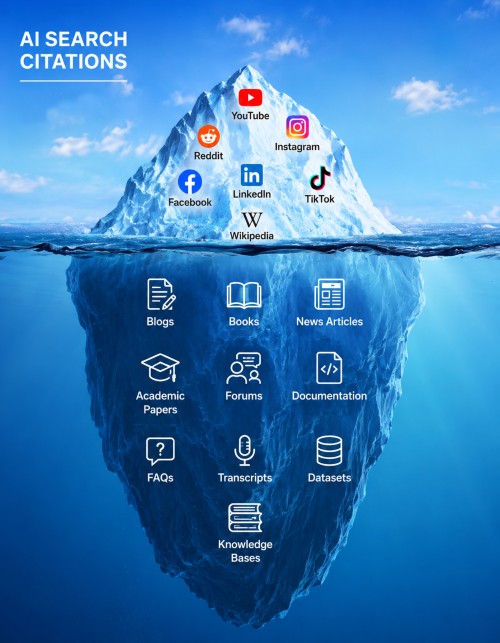
This phenomenon transforms the concept of content strategy. For enterprises with extensive legacy blog archives, this means that carefully optimized cornerstone content might not be the sole driver of AI visibility. A lesser-known, niche post from years past, addressing a very specific user need, could be precisely what aligns with one of the AI’s sub-queries. This underscores the value of maintaining a broad and deep content library, where older, less prominent pieces can still find relevance and drive citations. As Lee Odden of TopRank Marketing aptly puts it, "Blogs are now the iceberg beneath the water." Their true value lies not just in what’s immediately visible but in the vast, often unseen, repository of information they represent.

What No Longer Works: Deconstructing Outdated B2B Content Strategies
The digital marketing playbook has undergone a seismic shift, rendering outdated, scale-based content strategies increasingly ineffective. Two key findings from recent research highlight the obsolescence of these traditional approaches.
Firstly, the sheer volume of content produced is no longer a reliable indicator of success. The ease with which AI can generate content has led to an explosion of mediocre, keyword-stuffed articles that offer little genuine value. This proliferation of low-quality content has saturated the digital space, making it harder for even substantial volumes of such material to gain traction.
Secondly, the focus on capturing mid-funnel clicks through keyword optimization alone is becoming a less potent strategy. While keyword targeting remains important, AI’s ability to synthesize answers means that users may not need to traverse multiple pages to find the information they seek. This diminishes the effectiveness of a strategy solely aimed at attracting clicks to generic content.
The bottom line is that generating massive quantities of mediocre content is now easier than ever, and consequently, it is increasingly useless. The correlation for AI visibility has shifted dramatically. What AI systems value now includes original research, proprietary data, demonstrated expertise, a clear point of view, and structured content that can be extracted at the passage level without losing its contextual meaning. AI systems are not simply ranking pages; they are evaluating passages. A concise, well-structured 800-word post with a specific claim and supporting data will consistently outperform a sprawling, generic overview. This demands a move towards depth and originality over breadth and superficiality.
The Critical Importance of Content Freshness in the AI Era
One of the most significant structural advantages blogs possess over static website content is their inherent capability for recency. Research from ZipTie indicates that AI-cited content is, on average, 25.7% fresher than content that is traditionally ranked. Furthermore, a substantial 76.4% of the top-cited pages by ChatGPT were updated within the last 30 days.
This has profound implications for blog strategy. A regular content refresh cadence is now as critical as net-new publishing. Updating high-performing posts with current statistics, recent references, and emerging insights is not merely a matter of good housekeeping; it serves as a direct citation signal to AI systems. According to ZipTie’s findings, a structured content refresh strategy can elevate citation rates by as much as 292%. This also presents a cost-effective approach, as maintaining and updating existing content is often more resource-efficient than the continuous creation of entirely new URLs and content pieces.
The Brand Entity Case: Building Authority Beyond Direct Citations
There is a further dimension to the value of blogs that extends beyond direct traffic reports and citation metrics. Blogs play a crucial role in building the overarching "brand entity" that AI systems learn from over time. Ahrefs research has found a strong correlation (0.66-0.71) between branded web mentions and AI visibility across various platforms, including ChatGPT, AI Mode, and AI Overviews.
The more contexts in which a brand’s name appears across the web—whether through third-party coverage, user-generated content, or citations of its original research—the more likely that brand is to surface in AI-generated responses. Blogs serve as a primary upstream source for these mentions. By publishing original data, well-argued points of view, and in-depth analyses, brands create the raw material that other websites cite, practitioners share in forums, and ultimately, AI systems learn to associate with that brand’s expertise. As Otterly.AI succinctly advises, businesses should "treat your blog like a source, not a sales brochure." This strategic framing emphasizes the informational and authoritative role blogs should play.
Conclusion: The Evolving, Yet Vital, Role of Blogs in B2B Marketing
The question of whether blogs are still worth the investment for today’s B2B marketing efforts elicits an honest, albeit conditional, answer: it depends on what is being published and the strategic intent behind it.
If a blog’s primary function is to churn out keyword-targeted posts designed solely to capture mid-funnel clicks, the ROI case is indeed becoming more challenging to make. This model was already showing signs of strain before the acceleration brought about by AI search.
However, if a blog operates as an authoritative reference point—consistently publishing original research, delving deeply into specific use cases, maintaining a regular refresh cadence, and genuinely building topical authority—then the data overwhelmingly supports continued investment.
While blogs may not command the sheer traffic volumes they once did, they remain as influential in AI citation and discovery as any other digital channel. Often, they require a comparatively lower publishing lift than other content formats to achieve significant impact. In the evolving digital landscape, blogs are not becoming obsolete; they are transforming into foundational assets that fuel AI understanding, build brand authority, and drive high-value engagement. The strategic imperative is to adapt their purpose and execution to align with the new realities of AI-driven search and content consumption.