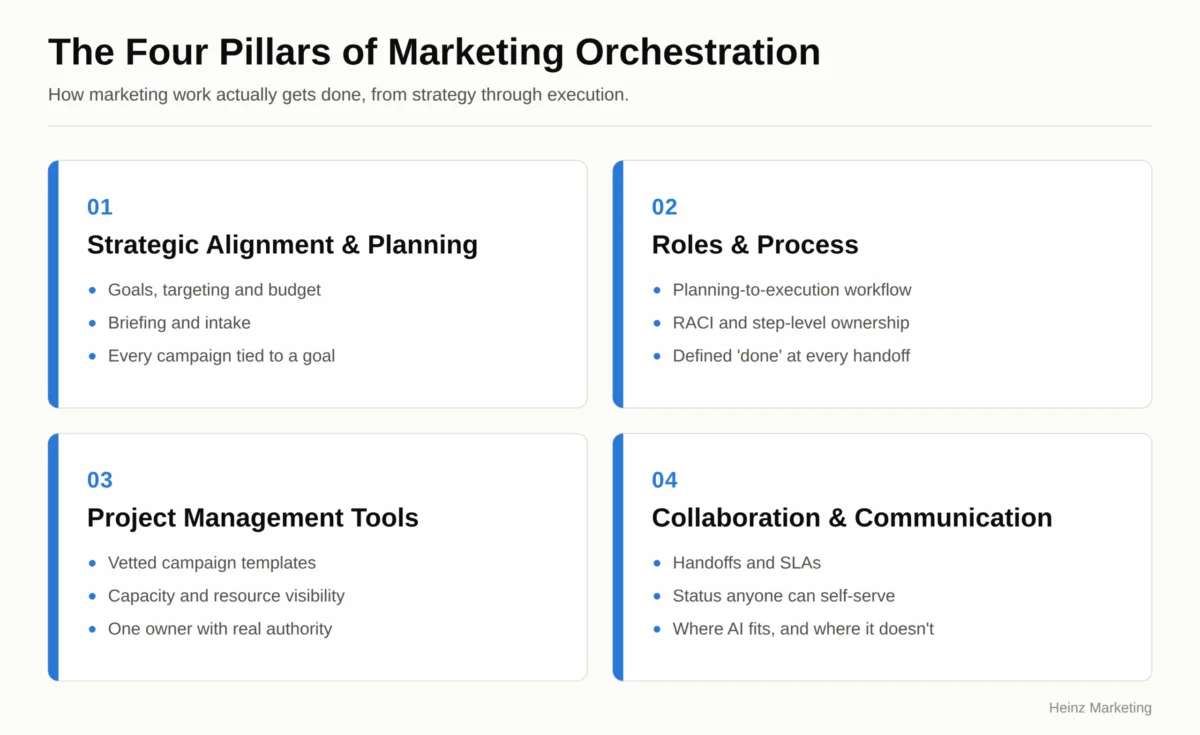
When leaders within the same marketing department independently assess their operational effectiveness, their responses often fall into two distinct clusters rather than a single, cohesive viewpoint. This phenomenon, observed through the use of marketing orchestration self-assessment tools, highlights the pervasive reality of multiple, often conflicting, operating models coexisting within a single organizational structure. The prevailing tendency to address these discrepancies through superficial fixes, such as implementing more rigorous intake forms, often exacerbates the underlying issues, suggesting that a deeper understanding of how work truly flows is paramount before any process modifications are attempted.
The consequences of this disconnect can be severe, as illustrated by a hypothetical product launch that falters due to a late-stage executive objection to a critical element. In such scenarios, the absence of a single point of knowledge or a shared understanding of the complete project plan can paralyze progress. When the individual possessing the comprehensive overview is unavailable, the entire initiative can unravel because no one else can readily access the full sequence of tasks, the complete asset list, or clearly defined ownership for each step. While the plan may have been disseminated in meetings, its actual location and the granular details of its execution remain obscure, rendering the team vulnerable to even minor disruptions. This situation, far from being an anomaly, is a common manifestation of the underlying operational fragmentation that plagues many marketing departments.
Recent observations from the rollout of a marketing orchestration self-assessment tool have provided compelling evidence for this disparity. When CMOs and their leadership teams engage with such assessments independently, significant divergences in their scores on key areas like strategic alignment and planning are frequently observed. Differences of two points or more on a five-point scale, within the same company and ostensibly the same operational framework, are not uncommon. The resulting composite scores, while appearing reasonable and suitable for benchmarking, often fail to reflect the lived experiences of the individuals within the organization, effectively averaging away the most critical insights.
The Illusion of Averages: Masking Divergent Realities
The immediate inclination upon receiving assessment results is often to present a consolidated, composite score, which offers a clean, benchmarkable figure that leadership can then target for improvement. However, this approach inadvertently obscures the most telling findings: the fundamental differences in how work is actually executed. For instance, some leaders may describe an organization with robust planning capabilities, characterized by defined intake processes, clear protocols for handling unforeseen requests, and established mechanisms for adapting to shifting priorities. In stark contrast, others within the same department might depict an environment where a senior executive’s directive can instantly override existing priorities during a meeting, prompting a scramble to comply without a clear understanding of the ripple effects.
These divergent narratives, originating from leaders within the same marketing entity, are not indicative of inaccuracy but rather of their distinct vantage points and experiences within the organization. When these responses are analyzed not by their average but by their distribution, a clear clustering emerges. This clustering typically separates into two groups: one experiencing a relatively mature and predictable operating model, and the other navigating a far more reactive and ad hoc system. The critical implication is that two distinct operating models are operating concurrently within a single organization, with leadership often operating under the assumption that a unified approach is in place.
The "Pessimist" with the Widest View: Scope and Perception
A particularly insightful observation from these assessments is the correlation between a leader’s scope of responsibility and their perceived operational effectiveness. Leaders who oversee a broader spectrum of the marketing operation tend to assign lower scores, indicating a more critical view of the overall system. Conversely, those accountable for more narrowly defined areas often report higher scores, reflecting a more positive assessment of their immediate domain. This "pessimism" is directly correlated with the breadth of the operation they can observe.
This dynamic suggests that individuals who appear to be overly negative or problem-prone might simply possess a wider perspective, allowing them to see the seams and friction points that are invisible to those with a more limited view. When conducting such assessments, it is crucial to consider the scope of each leader’s purview before dismissing their feedback. The leader who can see more of the operational landscape may be providing the most accurate, albeit perhaps less palatable, assessment of the organization’s true state.
The Double-Edged Sword of High Collaboration Scores
Ironically, dimensions such as collaboration and communication often emerge as areas of relative strength, with minimal disagreement among leadership. This is frequently attributed to the fact that individual team members are perceived as competent, diligent, and genuinely trying their best. Subject matter experts are readily available, teams engage in inter-team discussions, and no fundamental communication breakdowns between peers are typically reported.
However, it is precisely this consistently high collaboration score that can be most concerning. In numerous organizations, leaders describe the arduous process of reconstructing campaign status by piecing together information from Slack threads, numerous meetings, and personal memory, only to then confirm details with the responsible owner before reporting upwards. While the necessary information exists within the organization, it lacks a centralized, reliable repository, necessitating constant, time-consuming reconstruction, even then susceptible to discrepancies.
The fact that individuals are willing and able to undertake this manual reconstruction highlights a critical issue: the team is absorbing the cost of missing infrastructure and underdeveloped processes. This burden is paid in "attention," a finite resource that does not scale with increased headcount. Each new hire can inadvertently exacerbate this "attention tax," making the problem larger rather than smaller. Gartner research indicates that a significant 84% of marketers experience high "collaboration drag" as cross-functional work becomes increasingly complex. When nearly everyone is struggling against this drag, it can become normalized as an intrinsic part of the job.
The Flawed First Fix: Focusing on Intake Over Fundamentals
A prevalent strategy employed by companies struggling with collaboration drag centers on the implementation of a more robust intake process. The rationale is that a new request should be formally weighed against existing commitments, rather than being decided in real-time during meetings. While this is a conceptually sound solution, its frequent failure stems from a misdiagnosis of the root cause.
An effective intake process hinges on the ability to answer the critical question: "What would have to move to accommodate this new request?" This requires a clear understanding of current team capacity and the status of ongoing work. Such clarity, in turn, necessitates consistency in how work is structured and tracked, which ultimately relies on well-defined ownership beyond the team level. Many leaders report accountability residing primarily at the team level, where individuals can claim to have completed their assigned tasks, yet the work falters in the unaddressed gaps between teams. Furthermore, campaigns are often built from scratch or heavily adapted from existing templates, further complicating the assessment of capacity.
Consequently, when an intake process is prioritized as the initial solution, it lacks the foundational data to answer its core questions. Within a quarter, such initiatives often devolve into a form that is routinely ignored. This pattern is particularly evident in large marketing organizations that have attempted workflow improvements multiple times. By this stage, the challenge is not merely a process gap but the pervasive "change fatigue" that has set in.
The Path to True Improvement: Understanding Before Fixing
The most effective approach, as observed in successful organizational transformations, does not begin with a new tool or a more complex intake form. Instead, it starts with a deep, empirical understanding of how work actually flows through the organization. This involves meticulously documenting the planning-to-execution workflow, identifying and naming critical communication touchpoints, and clarifying ownership at each stage. Only after this foundational work is completed can a project management platform be configured to align with the established workflow. Centralized intake, the initial desired solution for many, often emerges as a later, more refined outcome.
Successful implementations typically involve testing the new approach with a small, contained group and a specific type of work. Regular feedback loops are established to identify points of failure, which are then addressed before the process is expanded. The impact, while potentially modest in initial scope, can be profound in practice. This leads to a tangible understanding of capacity, more consistent routing of requests, measurable service levels, and easier adoption for new team members. Ultimately, it results in improved time-to-market and a significant boost in morale – outcomes that are often overlooked in business cases but deeply felt by the entire team.
Leveraging Internal Best Practices: The Untapped Solution
Perhaps the most striking revelation from these assessments is that nearly every identified gap in lower-scoring responses already has a corresponding, functional solution present within the higher-scoring segments of the same organization. One group may have campaign status readily available without needing to contact a person, while another boasts a mature project management process with robust governance. Some have clearly defined expectations at each stage and have even integrated AI into their workflow, rather than leaving its adoption to individual habits.
The best practices for addressing nearly every identified deficiency already exist internally. The challenge lies not in a lack of capability but in the absence of a mandate or framework to scale these successful patterns across the entire organization. This presents a fundamentally different, and often more cost-effective, problem to solve than a simple capability gap.
This organizational inertia explains why these issues persist. When work crosses team boundaries, it often falls into a "belongs to no one" category, losing its impetus for resolution the moment a more urgent fire emerges. The solution to this impasse is less about elaborate strategy and more about fundamental engagement. Involving the individuals doing the work early in the process, actively listening to their experiences of where the process breaks down, and collaboratively building new approaches with them, rather than imposing them from above, is key. The people on the ground, in essence, already know where the problems lie.
A Trio of Questions for Operational Self-Reflection
To illustrate the power of scenario-based assessment, consider three representative questions that can illuminate operational maturity:
-
Campaign Status Inquiry: When you need the current status of a campaign, what is your actual process? The options range from piecing together information from fragmented sources like Slack threads and personal recollection, to directly asking the most knowledgeable individuals, to retrieving the information instantly from a shared, centralized system.
-
Mid-Quarter Urgent Request: A senior leader makes a mid-quarter request that was not part of the original plan. What is the immediate outcome? Responses span from the decision being made reactively in a live meeting, to the request being formally scoped against existing commitments, with any necessary tradeoffs clearly articulated.
-
Messaging Shift Impact: If your core messaging shifts mid-quarter, how long does it take for in-flight campaigns to incorporate the new messaging? The timeframe can vary from days, to weeks, or potentially never, while existing campaigns continue to run with the outdated framing.
Assessment for Clarity and Consensus Building
The marketing orchestration self-audit tool is freely accessible, and its efficacy is amplified when multiple leaders within a department independently score their operation. The subsequent examination of areas of disagreement, rather than focusing solely on the composite average, provides a far more accurate depiction of how the marketing organization truly functions. The divergence between the most optimistic and least optimistic leader’s assessment will invariably reveal more about the internal operational dynamics than any aggregated score ever could.