The digital communications landscape continues to evolve at a rapid pace, yet the foundational role of email remains undisputed. However, a significant chasm is emerging between organizations that strategically invest in robust measurement, stringent deliverability practices, and continuous optimization, and those that operate on mere assumptions. This pivotal insight forms the core of Sinch Mailgun’s recently published 2026 Email Impact Report, a comprehensive analysis offering a clear roadmap for email senders navigating the complexities of the modern inbox.
Released on April 17, 2026, the report synthesizes findings from a global survey of over 1,200 email senders with an unprecedented analysis of more than 400 billion real emails processed through Sinch Mailgun’s infrastructure throughout 2025. This dual-pronged approach provides a uniquely authoritative perspective on email’s current state, its challenges, and its future trajectory, spanning critical areas such as Return on Investment (ROI), industry-specific benchmarks, deliverability trends, the burgeoning adoption of Artificial Intelligence (AI), and future investment priorities. As businesses head into the latter half of 2026, the report underscores an urgent call to action for marketers to shift from intuition to data-backed strategies to unlock email’s full potential.
The Indispensable Role of Email and the ROI Measurement Deficit
Email’s strategic importance within organizational marketing ecosystems is unequivocally affirmed, with a striking 78% of senders categorizing it as "very" or "extremely" important. This level of consensus is rarely seen across marketing channels, reflecting email’s enduring power as a direct, owned communication conduit for customer engagement and retention. From nurturing leads to facilitating crucial transactional interactions, email consistently proves its value. Yet, despite this widespread organizational belief, a significant disconnect exists between conviction and concrete evidence.
Fewer than half of all surveyed senders actively measure the ROI of their email programs. Specifically, only 46% track promotional email ROI, and a mere 43% monitor transactional email ROI. This data suggests that a majority of teams are operating on faith rather than quantifiable results, potentially leaving substantial budget allocations and strategic decisions vulnerable to guesswork. In an era where data-driven decision-making is paramount, this measurement gap represents a critical vulnerability for email marketing departments seeking to justify and expand their initiatives.
For those who do measure, the returns are compelling. A substantial 60% of senders tracking promotional email ROI report a return greater than $10 for every $1 spent, underscoring email’s exceptional efficiency. Even more impressively, 13% of these senders achieve returns exceeding $40:1. Similarly, 62% of those measuring transactional email ROI report meeting the $10:1 threshold, with 13% also reaching above $40:1. However, the report astutely cautions that such exceedingly high returns (e.g., above $40:1) might, counterintuitively, signal underinvestment rather than peak efficiency. This implies that highly successful programs might be leaving significant growth opportunities on the table by not allocating more resources to an already high-performing channel.
The primary obstacle hindering increased email investment, cited by 43% of senders, is budget constraints. This highlights a classic chicken-and-egg dilemma: budgets are hard to secure without demonstrable ROI, yet many teams lack the fundamental data needed to build a compelling business case. The report offers a pragmatic solution, recommending that organizations begin by tracking revenue per campaign as an intermediate step towards full ROI attribution. Even with an imperfect attribution model initially, this approach provides tangible metrics to advocate for greater investment and fosters a culture of measurement.
Unveiling True Performance: Industry Benchmarks from 400 Billion Emails

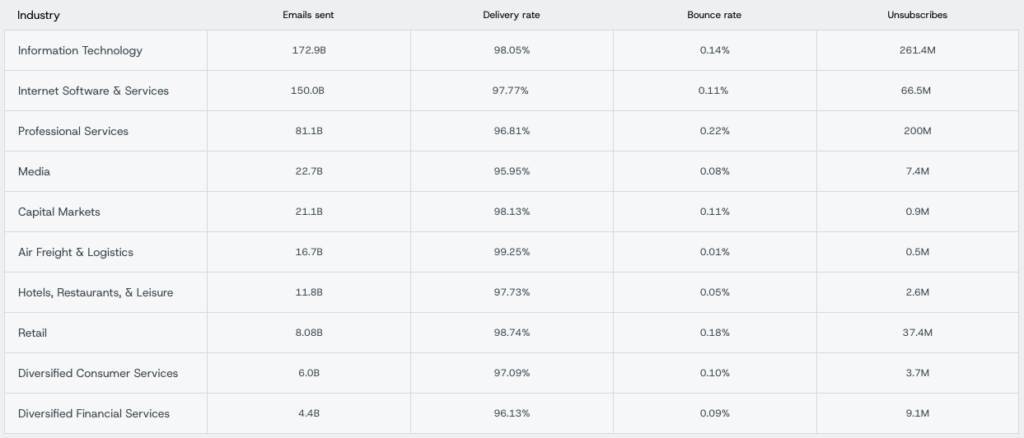
Historically, email industry benchmarks have often relied on self-reported survey data, which can be susceptible to bias or inaccuracies. The Sinch Mailgun report distinguishes itself by presenting real-world sending data from its infrastructure, encompassing the top 10 industries by volume in 2025. This unprecedented scale of 400 billion emails offers a granular, fact-based understanding of where performance truly stands.
The divergence in performance across industries is stark. Air Freight & Logistics leads with an impressive 99.25% delivery rate and a minuscule 0.01% bounce rate. This exceptional performance is largely attributed to the nature of their communications: predominantly transactional sends such as shipping confirmations and tracking updates, which are highly anticipated and desired by recipients. In contrast, the Media industry records the lowest delivery rate among the top 10 at 95.95%. This can be attributed to the high volume and broad promotional audiences characteristic of media outlets, which naturally introduce downward pressure on delivery metrics due to factors like list churn, spam complaints, and less engaged subscribers.
However, the report critically emphasizes that delivery rate alone can be a misleading metric. An email "delivered" to the spam folder still registers as delivered, failing to indicate actual inbox reach. To gain a comprehensive understanding, senders are strongly advised to pair delivery rate tracking with consistent inbox placement testing. This crucial step reveals where emails are truly landing—be it the primary inbox, promotions tab, or spam folder—providing actionable insights for optimization that a simple delivery rate cannot.
Further illustrating the importance of context, the report analyzes unsubscribe data. The Information Technology sector registered 261 million unsubscribes, the highest raw number in the table. However, when contextualized against 172.9 billion sends, this translates to a remarkably low unsubscribe rate of approximately 0.15%. Conversely, the Retail sector generated 37.4 million unsubscribes from just 8.08 billion sends, indicating a significantly higher rate per email. This comparison unequivocally demonstrates that raw unsubscribe volume, without the vital context of send volume, is statistically meaningless and can lead to erroneous conclusions about list health and content relevance.
The Deliverability Imperative: Progress in Infrastructure, Stagnation in Understanding
Deliverability, the critical ability for an email to reach its intended recipient’s inbox, is acknowledged as vital by 89% of senders. Encouragingly, 43% report an improvement in their inbox placement over the preceding 12 months, signaling genuine progress in email infrastructure and practices. A key driver behind this improvement is the significant growth in DMARC (Domain-based Message Authentication, Reporting, and Conformance) adoption.
DMARC is an email authentication protocol designed to protect domains from unauthorized use, such as spoofing and phishing attacks. Its adoption has been spurred by stringent requirements from major email service providers like Gmail, Yahoo, and Microsoft, which have increasingly mandated DMARC compliance for bulk senders to ensure a more secure and trustworthy email ecosystem. The report highlights a crucial shift: for the first time in Sinch Mailgun’s research, DMARC enforcement (using quarantine or reject policies) is outpacing passive monitoring, with over half of DMARC adopters now implementing stricter policies. This indicates a maturing understanding of DMARC’s capabilities and a proactive stance against email fraud.
Despite these infrastructure advancements, a significant gap persists in sender understanding and literacy regarding deliverability best practices. A concerning 36% of senders claim to monitor their "email deliverability rate," a metric that, as the report clarifies, does not technically exist. This confusion underscores a fundamental misunderstanding: the delivery rate simply measures if an email was accepted by the recipient server, irrespective of its final folder placement. True inbox placement, which determines whether an email reaches the primary inbox, is a distinct and more critical metric. Yet, only 25% of senders routinely conduct inbox placement tests to ascertain their actual reach. Furthermore, 27% of DMARC users are unaware of the specific policy they have implemented for their domain. This disparity between the availability of sophisticated tools and the lack of comprehensive understanding among users poses a substantial risk, potentially undermining the benefits of improved infrastructure. Without adequate knowledge, organizations may fail to leverage these tools effectively, leaving their email programs vulnerable to poor inbox placement and diminished ROI.
Artificial Intelligence: Wide Adoption, Uneven Impact
The integration of Artificial Intelligence into email marketing workflows is rapidly expanding, with 79% of senders either currently utilizing or planning to use AI in their programs. However, the report reveals that actual regular use stands at a more modest 27%, indicating that a substantial portion of adopters are still in the experimental phase rather than systematically embedding AI into their daily operations.
The most prevalent application of AI is in copy generation, cited by 41% of users, followed by content personalization (36%), dynamic content (29%), send time optimization (27%), and data analysis (27%). This pattern illuminates a critical distinction: AI delivers the most significant value when it is deeply integrated into decision-making processes, rather than being confined to mere content production. Teams that leverage AI for sophisticated tasks such as personalization, optimal send timing, and A/B testing report compounding returns, witnessing exponential improvements in engagement and conversion rates. In contrast, teams employing AI solely for superficial tasks like drafting subject lines often report limited impact.
A compelling data point from the report underscores this divergence: 54% of senders who have implemented AI reported moderate or significant year-over-year improvements in their email programs. This stands in stark contrast to just 37% of senders who are not using AI reporting similar improvements during the same period. This 17-point performance gap, while not definitively proving causation, serves as a clear signal that AI is beginning to stratify email programs into distinct performance tiers. Organizations that strategically deploy AI across their workflows are demonstrably outperforming those that do not.
The report also notes that 23% of AI users perceive no tangible benefits from its adoption. The critical takeaway here is that the tool itself is not the differentiator; rather, it is the depth and strategic nature of its integration. Simply adopting AI without a clear strategy for embedding it into core decision-making processes will likely yield minimal returns. Effective AI utilization requires a holistic approach, where AI augments human capabilities in analysis, personalization, and optimization, leading to more intelligent and impactful email campaigns.
Strategic Outlook: Where Email Investment is Heading in 2026
Looking ahead to 2026, the strategic priorities for email marketers are clearly defined. "Taking advantage of AI" and "increasing email engagement" are tied as the top priorities, each cited by 40% of senders. This dual focus highlights a forward-thinking approach, recognizing that AI is not just a tool but a catalyst for deeper, more meaningful subscriber interactions.
Regarding investment, the industry shows a cautious yet optimistic outlook: 31% of senders plan to increase their email investment, while a substantial 48% intend to maintain current spending levels. Only a small fraction, 7%, anticipates decreasing their email investment. These figures collectively indicate a sustained confidence in email marketing’s efficacy and its indispensable role in the overall marketing mix. The slight majority opting to maintain spending, rather than aggressively increase, might reflect the previously discussed challenges in demonstrating ROI, suggesting that once robust measurement practices are established, increased investment could follow.
The report’s overarching conclusion is both direct and empowering: email unequivocally works. The comprehensive data across ROI, industry benchmarks, and deliverability trends consistently supports this assertion. However, the future success of email programs will hinge on a simultaneous and integrated investment in three core areas:
- Measurement: Moving beyond assumptions to prove ROI with real, quantifiable data. This involves tracking key performance indicators, understanding attribution, and demonstrating the direct impact of email on revenue and business objectives.
- Deliverability: Consistently ensuring emails reach the inbox through rigorous authentication (like DMARC), meticulous list hygiene, and proactive monitoring of inbox placement. This foundational element dictates the very reach and effectiveness of any email campaign.
- Optimization: Leveraging advanced tools, particularly AI, and employing continuous testing methodologies to enhance performance at scale. This includes personalizing content, optimizing send times, refining subject lines, and dynamically adapting to subscriber behavior.
Crucially, the report emphasizes that none of these areas necessitate a massive budget to initiate. Even small, incremental steps in measurement, deliverability improvements, and optimization can yield significant, compounding returns over time. By fostering a culture of continuous improvement and data-driven decision-making, email programs can not only survive but thrive in the increasingly complex and competitive digital landscape. The insights from Sinch Mailgun’s 2026 Email Impact Report serve as a vital guide for marketers seeking to bridge the performance gap and solidify email’s position as a powerhouse of digital communication.