The landscape of digital advertising and conversion rate optimization (CRO) is undergoing a fundamental shift as marketing teams move away from isolated, "one-and-done" experiments toward a model of continuous, evidence-based refinement known as iterative testing. While traditional A/B testing has long been the industry standard for determining the efficacy of specific campaign elements, modern market volatility and shifting user behaviors have necessitated a more fluid approach. Iterative testing, a methodology borrowed from decades of software development and agile product management, focuses on a repetitive cycle of testing, measuring, and refining marketing assets. By building each experiment on the insights gained from previous results, organizations can adapt to real-time data, reduce the financial risks associated with large-scale campaign failures, and achieve compounding growth in conversion rates.
The Evolution of Marketing Methodology: From "Big Bang" to Iterative Cycles
Historically, marketing campaigns were designed as "big bang" events—large-scale launches supported by significant upfront investment with the hope of immediate success. However, as customer acquisition costs (CAC) continue to rise across major platforms, the margin for error has narrowed significantly. Most marketing failures in the current era are not catastrophic collapses but rather "slow leaks" where budgets are drained by underperforming assets over long periods.
Iterative testing addresses these inefficiencies by treating marketing as a living ecosystem. Instead of a single A/B test followed by a static period of activity, iterative testing creates a feedback loop. This shift represents a transition from subjective, intuition-based decision-making to a culture of experimentation. Data from the 2024 Conversion Benchmark Report highlights the necessity of this precision, noting that even minor adjustments in content delivery can yield disproportionate results. For instance, the report found that landing pages written at a 5th-to-7th-grade reading level convert at a rate of 11.1%, which is more than double the conversion rate of pages utilizing professional or academic-level writing. Such insights demonstrate that what marketers assume is "high-quality" may actually be a barrier to conversion, a discovery that only iterative testing can reliably uncover and exploit.
The Economic Case for Iterative Testing
The primary driver for the adoption of iterative testing is the acceleration of the feedback loop. In traditional marketing cycles, teams might wait an entire quarter to evaluate the performance of a campaign. Iterative models shrink these cycles to weeks or even days. By identifying what resonates with a target audience early in the process, brands can pivot their spending toward high-performing variations before the majority of the budget is exhausted.

Furthermore, iterative testing mitigates the "waste" inherent in large-scale overhauls. When a team changes five variables at once—the headline, the hero image, the call to action, the form fields, and the color scheme—they lose the ability to attribute success or failure to any single element. Iterative testing emphasizes isolated changes. This evidence-based approach is particularly critical in light of data showing that landing pages with high word complexity exhibit a -24.3% negative correlation with conversion rates. Without a step-by-step testing process, a brand might simplify its language while simultaneously making a negative change to its user interface, resulting in a net-zero gain that obscures the value of the simplified copy.
The Six-Step Iterative Framework for Marketing Teams
To successfully implement an iterative testing program, organizations must follow a structured chronology that prioritizes speed, statistical rigor, and actionable insights.
1. Hypothesis Formulation
The process begins with a laser-focused hypothesis derived from observation rather than guesswork. A valid hypothesis should follow a specific structure: "By changing [Element X] to [Variation Y], we expect [Metric Z] to increase because [Reasoning]." For example, a team might hypothesize that moving a lead-capture form from the bottom of a page to the "above-the-fold" section will increase submissions by 15% because it reduces the friction of scrolling.
2. Strategic Prioritization
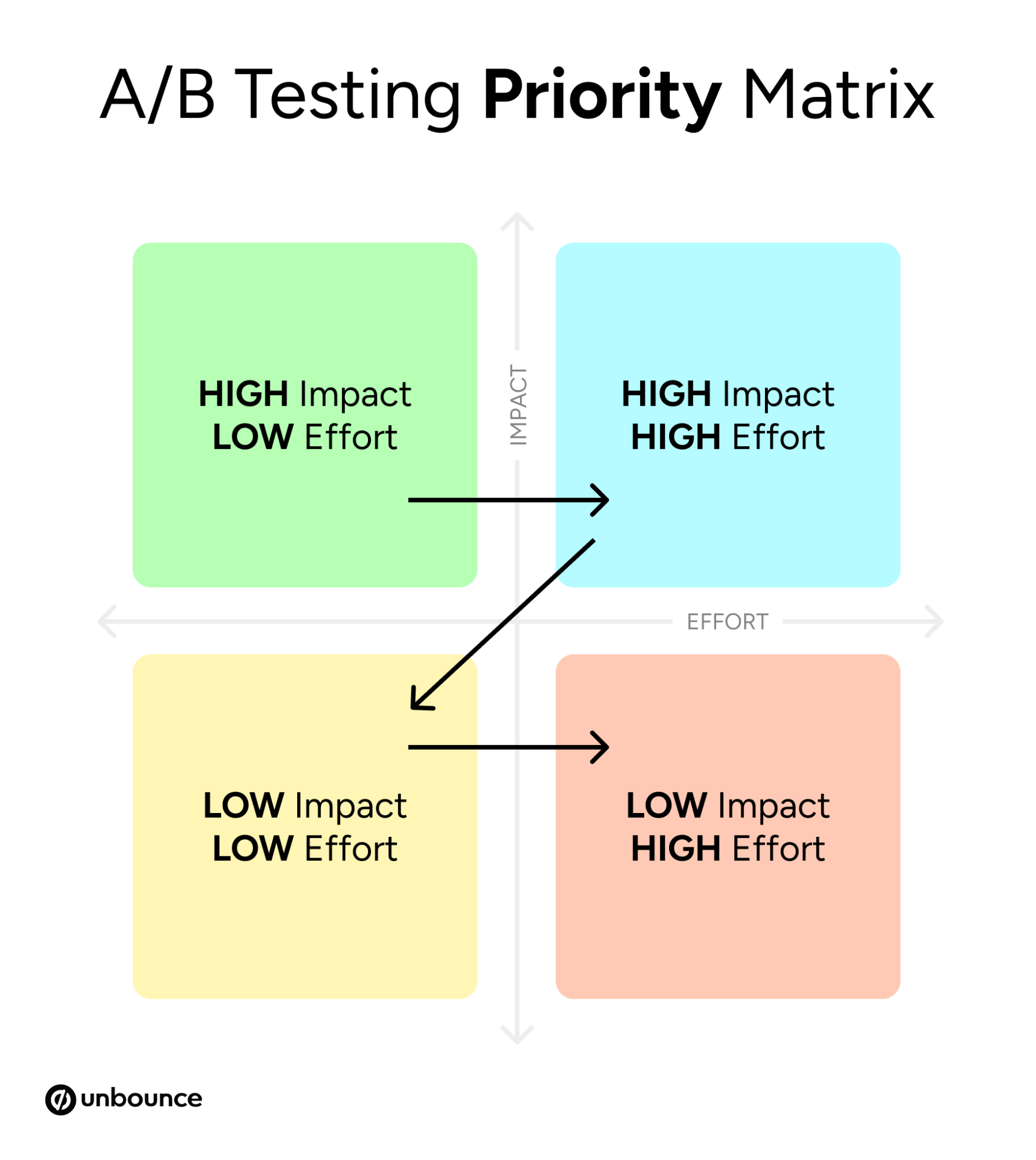
Not all tests are worth the resources required to execute them. Marketing leaders often utilize a 2×2 matrix to categorize potential tests based on "Impact" and "Effort."
- Quick Wins: High impact, low effort (e.g., changing a headline).
- Strategic Projects: High impact, high effort (e.g., redesigning a checkout flow).
- Fill-ins: Low impact, low effort (e.g., changing button color).
- Thankless Tasks: Low impact, high effort (e.g., complete backend platform migrations for minor UI tweaks).
3. Minimal Testable Variation
The goal of iterative design is to create a "Minimum Viable Test." This involves duplicating a control page and making a single, targeted change. This isolation is vital; it ensures that the resulting data is "clean" and that any lift in conversion can be directly attributed to the modification.

4. Data Collection and Statistical Significance
One of the most common pitfalls in marketing is the premature termination of a test. To gain meaningful insights, tests must reach statistical significance—the point at which results are unlikely to be the result of random chance. Industry standards suggest that a test should run for at least two full business cycles (usually two weeks) and achieve a 95% confidence level. Tools like Unbounce’s Smart Traffic are now utilizing AI to accelerate this process, sometimes providing optimization paths after as few as 50 visits, but for traditional A/B iterations, larger sample sizes remain the gold standard for reliability.
5. Analysis and Insight Extraction
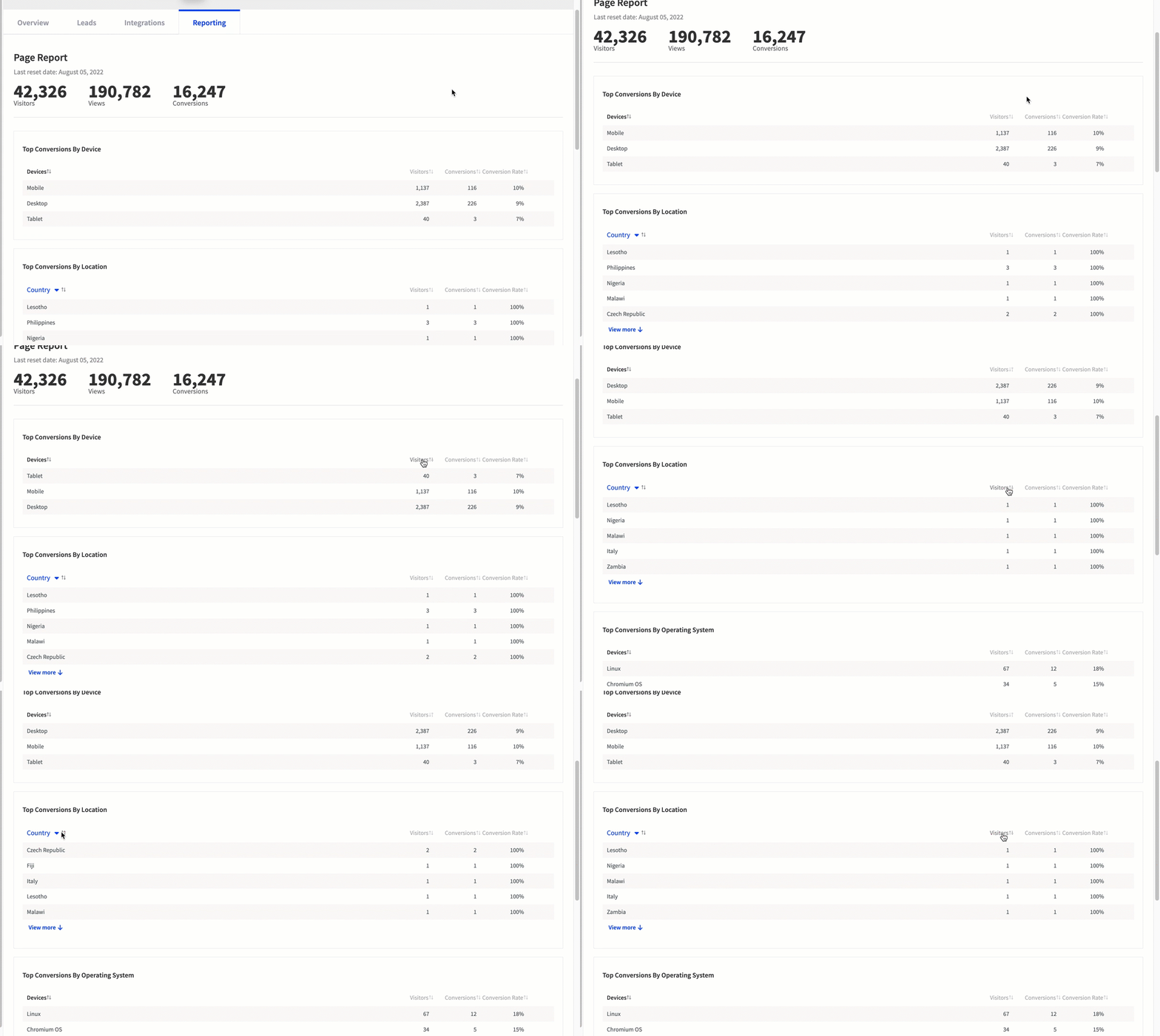
Once a test concludes, the focus shifts from "what happened" to "why it happened." If a variant wins, the team must determine if the success is scalable. If a variant fails, the "failure" is treated as a successful data point that narrows the search for the optimal solution. Analysis should also account for segment-specific data. For instance, the 2024 Conversion Benchmark Report reveals that while 83% of landing page visits occur on mobile devices, desktop visits still convert 8% better on average. An iterative test might reveal that a specific headline works for desktop users but is cut off on mobile screens, leading to a device-specific iteration.
6. Scaling and Evolution
Successful learnings are not just kept within the specific test; they are scaled across the organization. If a certain tone of voice proves successful on a landing page, that insight should be applied to email subject lines, social media copy, and paid search ads. This creates a compounding effect where the entire marketing ecosystem improves simultaneously.
Cross-Functional Integration and Official Perspectives
Industry experts emphasize that iterative testing cannot exist in a marketing silo. Josh Gallant, founder of Backstage SEO and a prominent voice in SaaS growth, suggests that the most successful testing programs are those that integrate feedback from across the organizational chart.
Sales teams can provide insights into the specific objections they hear from prospects, which can then be addressed in the next iteration of landing page copy. Customer support teams can identify common points of confusion in the user experience, providing a roadmap for UI/UX testing. When these departments collaborate, the testing backlog becomes a reflection of real-world user friction rather than internal marketing hunches.
Furthermore, the role of artificial intelligence in this cycle is becoming more pronounced. Automated traffic routing and machine learning algorithms are now capable of identifying patterns in user behavior far faster than manual analysis. However, the human element—defining the "why" behind the data—remains the critical component of the iterative process.
Broader Impact and Future Implications for the Digital Economy
As we move toward 2025 and beyond, the ability to iterate will likely become the primary differentiator between market leaders and laggards. The digital economy is characterized by "winner-take-most" dynamics where even a 1% higher conversion rate can allow a company to outbid competitors for top-tier ad placements, eventually leading to market dominance.
Iterative testing also fosters a more resilient brand. In an environment where consumer sentiment can shift overnight due to social trends or economic changes, the "test-and-learn" mindset allows brands to remain in sync with their audience. It moves marketing away from the realm of "art" and into the realm of "applied science," providing a predictable framework for growth that satisfies both creative teams and C-suite executives focused on the bottom line.
In conclusion, iterative testing is more than a tactical adjustment to A/B testing; it is a comprehensive philosophy of continuous improvement. By prioritizing small, evidence-based changes over massive, untested gambles, marketing teams can ensure that every dollar spent is an investment in institutional knowledge. As the data suggests, the path to high conversion is not found in a single stroke of genius, but in the relentless pursuit of incremental progress through the iterative cycle.