The digital realm, long dominated by the familiar "ten blue links" of traditional search engine results pages (SERPs), has undergone a profound transformation. Google’s landmark announcements at its I/O 2026 conference officially signaled the end of an era and the dawn of a new paradigm: AI-powered, interactive search experiences. This seismic shift, driven by the integration of sophisticated artificial intelligence into core search functionalities, is fundamentally reshaping how users discover information, engage with brands, and make purchasing decisions.
The Dawn of AI Overviews and Conversational Search
At the heart of this revolution are Google’s AI Overviews, now accessible to over 2.5 billion monthly users, and the burgeoning AI Mode, which has surpassed the 1 billion user mark. These features move beyond simply listing links, offering synthesized answers and engaging in conversational interactions with users. This evolution is not confined to Google; the proliferation of Large Language Models (LLMs) like ChatGPT and Microsoft Copilot has positioned them as primary discovery tools for B2B buyers.
The implications are stark. A recent Forrester report underscores the pervasive adoption of AI in the business-to-business buying process, with a staggering 94% of business buyers now integrating AI into their decision-making journeys. This pervasive integration signals a genuine disruption to traditional digital marketing strategies. The long-standing challenge of "zero-click searches" – where users find their answers directly on the SERP without clicking through to a website – is poised to intensify with the advent of generative interfaces and AI-powered information agents that can dynamically construct custom pages in response to user queries.
The Enduring Principle: Being the Best Answer
Despite the radical technological upheaval, a core principle remains immutable: brands that consistently position themselves as the most accurate, trustworthy, and valuable answers to their customers’ needs will continue to thrive. Visibility, credibility, and ultimately, selection, are now more critical than ever.
Beyond SEO vs. AEO: The Convergence of Optimization
The emergence of AI search has sparked a debate between traditional Search Engine Optimization (SEO) and a new discipline, increasingly referred to as Generative Engine Optimization (GEO). However, leading industry practitioners emphasize that these are not mutually exclusive concepts but rather two facets of the same evolving landscape. The fundamental principles that earn credibility with human audiences are precisely those that AI systems seek when generating answers. For over two decades, companies like TopRank Marketing have been at the forefront of SEO and have closely monitored the intersection of traditional search, AI-driven search, and content strategy. This experience has informed a set of ten actionable tips for remaining visible and competitive in the AI-powered search environment of 2026.
Ten Essential Strategies for AI-Powered Search Success in 2026
1. Strategic Topic Research: Moving Beyond Keywords
The era of relying solely on keyword lists and average monthly search volume (AMSV) is over. In 2026, effective topic research involves a more nuanced approach, clustering prompts, queries, and search terms into meaningful thematic groups. Crucially, understanding the search intent, funnel stage, competitive landscape gaps, and the specific questions your audience is asking is paramount.
As AI agents become more adept at information retrieval, prioritizing topics with the potential to drive genuine traffic and engagement is key. Frameworks like the "Best Answer Marketing" approach can leverage data from CRM systems, web analytics, and specialized SEO tools like Semrush and Ahrefs. Incorporating "People Also Ask" (PAA) data and query fan-out simulations helps in understanding how AI systems expand upon user questions, providing a deeper insight into the evolving information needs of searchers. This granular understanding allows for the strategic identification of content opportunities that resonate with both human curiosity and AI’s information-synthesizing capabilities.
2. Redefining Success: Measuring Influence Over Clicks
The rise of zero-click searches and LLM citations that may not always attribute sources necessitates a recalibration of how success is measured. In 2026, marketers must broaden their definition of a "win" beyond traditional click-through rates. This shift, while challenging, is ultimately beneficial as it encourages a move away from vanity metrics towards a more profound understanding of content’s impact.
The true measure of success lies not only in being surfaced by search engines and AI tools but in the demonstrable influence your content has on what buyers know, trust, and subsequently do. This requires a more holistic approach to analytics, integrating qualitative assessments of brand perception and buyer journey progression alongside quantitative data.
3. Uncovering the "Why": Finding the Question Behind the Query
The foundational importance of understanding search intent, a long-standing pillar of SEO, has never been more critical. This principle now extends far beyond traditional search engines. Buyers are increasingly posing complex, conversational questions to AI tools, moving beyond simple keyword strings. Consequently, content strategies must adapt to this more natural and inquisitive approach to information seeking.
To be recognized as the definitive answer, it’s imperative to understand the underlying questions driving user queries. Mapping content to these questions is essential for achieving relevant visibility where buyers are actively searching. This involves looking beyond keyword data and engaging directly with sales and customer support teams to understand real-world prospect inquiries. Mining CRM data, conducting customer interviews, and performing targeted audience research are vital steps in this process. The most enduring visibility, across search, LLMs, and earned media, stems from content that genuinely addresses buyer questions, rather than content that is merely optimized around perceived queries.
As Lee Odden, CEO at TopRank Marketing, emphasizes, "To deliver best answer content, you have to understand the questions being asked. This means drilling down into the specific needs of each stakeholder on the committee from technical evaluators to financial decision-makers and end-users."
4. Revitalizing Existing Assets: Refreshing and Elevating High-Visibility Content
Stale content can become a significant liability in an AI-driven search environment that prioritizes freshness, authority, and depth. Implementing a robust system for regularly auditing and refreshing high-visibility content is crucial. This involves updating statistics, incorporating current expert quotes, sharpening brand perspectives, and injecting original insights that only your organization can provide. For websites with extensive content libraries, prioritizing refresh efforts based on potential impact can conserve resources and accelerate gains.
Published content with established equity often represents the most resource-efficient pathway to significant improvements in visibility and engagement. Jane Bartel, Director of Search & Content Marketing at TopRank Marketing, notes, "Many businesses are sitting on a goldmine of published content. With a smart approach to refreshes and repurposing, the value of that content can be actualized with more visibility and better conversions from search."
5. Optimizing for AI Discovery: Seamless Integration with LLMs
B2B buyers are actively leveraging AI tools such as ChatGPT, Perplexity, and Gemini for their research needs. These platforms, in turn, rely on the same fundamental signals that have long guided traditional SEO: authoritative sources, well-structured content, credible citations, and robust brand signals across multiple channels.
Practical steps to ensure visibility within these AI-powered answer engines include:
- Structured Data Markup: Employing schema markup to provide AI systems with clear, organized information about your content.
- Expertise and Authority Signals: Showcasing author credentials, citing original research, and building a strong backlink profile from reputable sources.
- Content Clarity and Conciseness: Presenting information in a clear, digestible format that AI can easily parse and synthesize.
- Brand Consistency: Maintaining a consistent brand voice and messaging across all digital touchpoints.
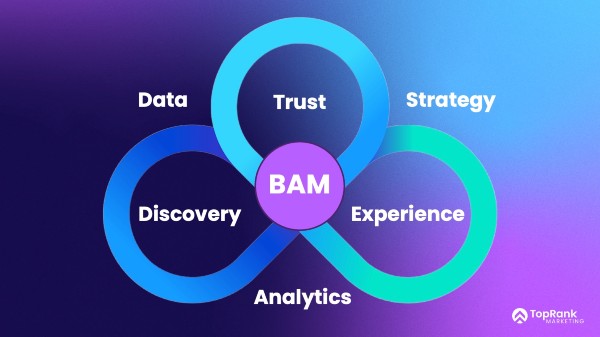
The "Best Answer Framework," developed by TopRank Marketing, serves as a unifying system for B2B brands aiming to become the most credible, specific, and useful answer to buyer inquiries. This framework bridges the gap between traditional SEO, AI search visibility, and effective content strategy.
6. Cultivating Belief: Publishing Content That Earns Trust
Visibility alone is insufficient if the content fails to build trust. In an era where AI content generation tools are widely accessible, the true differentiator lies in credibility. This is cultivated through content that is uniquely produced by your brand and reinforced by a consensus across media, conversations, and channels that establishes your brand as a source of truth.
Original research, firsthand expert perspectives, authentic customer stories, earned media coverage, and co-created content with respected industry voices are all forms of content that AI-generated homogeneity cannot replicate. This type of content is more likely to be cited by LLMs, earn the trust of buyers, and garner coverage from industry publications.
Ryan Leighty, Associate Director of Search at TopRank Marketing, observes, "AI can generate content that ranks. It cannot create content that only your brand could have written. That gap is where trust gets built." The goal extends beyond simply answering questions to building consensus, providing LLMs with the evidence needed to select your content and empowering buyers with the decision confidence to act.
7. Maintaining Technical Excellence: The Unwavering Foundation
The advent of AI search has not diminished the importance of technical SEO fundamentals. A well-structured, fast, crawlable, and mobile-optimized website remains the essential infrastructure upon which all other search optimization efforts are built. AI systems are incapable of surfacing content they cannot reliably access and parse.
Regular audits of page speed, crawlability, schema markup, and mobile performance are critical. Specialized SEO tools should be employed to evaluate contextual relevance at the page level. Technical SEO functions as the underlying foundation of a digital presence; while it may not be the direct driver of success, a compromised technical infrastructure will invariably lead to failure.
8. Prioritizing E-E-A-T: Resonating with Humans and AI
Google’s E-E-A-T framework – Experience, Expertise, Authoritativeness, and Trustworthiness – was designed to identify content worthy of surfacing. The same signals that satisfy these criteria are increasingly being adopted by LLMs when determining authoritative sources.
E-E-A-T audits can illuminate key opportunities, such as highlighting human authorship and internal expertise, citing original data, and making credentials readily visible. Genuine expertise is consistently cited when buyers actively seek answers, solidifying its role in both human and AI-driven information discovery.
9. Adapting to the Evolving SERP: A Strategic Imperative
Google’s revamped search interface, integrating Generative UI, AI Mode, and information agents, is already reshaping user behavior and search outcomes. Brands cannot afford to delay their adaptation strategies. This necessitates a renewed focus on bottom-of-funnel content where purchase intent is high, investing in signals that help AI systems identify your brand as a trusted source, and diligently tracking AI search traffic separately due to increasingly fragmented attribution models.
10. Compounding Authority: The Integrated Power of Citations, Content, and Influence
While being cited by credible sources remains fundamental, its effectiveness in 2026 is amplified when integrated into a holistic authority strategy. For LLM visibility, the value of links from other websites is surpassed by credible citations from authoritative sources, although links can still drive direct traffic. Third-party citations, internal linking, and earned media coverage collectively signal credibility to both search engines and AI systems.
Creating unique content that is inherently citable, particularly content that AI systems or competitors cannot easily replicate, remains a powerful strategy. Integrating topic-themed original research with thought leadership, collaborating with authoritative industry influencers for validation, securing media placements in trusted publications, and driving social conversations through influencer and social media marketing, all while maintaining a consistent internal linking structure, creates a compounding effect of authority. Investing in differentiated authority now provides a significant advantage over competitors relying on generic AI-driven advice.
Conclusion: Embracing a Unified Strategy for the AI Search Era
The pervasive frustration surrounding Google’s transformation of digital search is understandable. However, the fundamental logic of search visibility – being findable, credible, and useful – has not changed. The B2B brands poised to thrive in 2026 and beyond will be those that treat search visibility, AI search presence, and content credibility as a unified strategy, rather than disparate workstreams.
Adopting a data-informed, integrated approach focused on creating multi-channel content experiences designed to build trust, encourage citation, and foster decision confidence is the key differentiator between those struggling with the AI search revolution and those achieving genuine impact. This holistic approach is the essence of becoming a "Best Answer Brand." The future of search is here, and it demands a strategic, integrated, and human-centric approach to content and visibility.