The landscape of online shopping is undergoing a seismic shift, driven by the rapid integration of artificial intelligence (AI) into search and discovery platforms. For e-commerce marketers, this evolution presents an unprecedented opportunity to connect with consumers who may not yet have a clearly defined product in mind. The traditional concept of "intent" in marketing, once focused on broad categories like "purchase intent" or "informational intent," is now being refined with a granularity previously unimaginable, thanks to AI’s ability to process complex, nuanced queries. This article explores how businesses can leverage this new era of AI-powered intent to drive engagement and conversions.
Understanding the Nuance of AI-Driven Intent
For decades, marketing strategies have revolved around understanding what a potential customer wants. The term "intent" has been a cornerstone of this endeavor, encompassing phrases like "purchase intent," signifying a shopper’s readiness to buy, and "informational intent," indicating a desire to learn more about a product or service. These established frameworks primarily targeted prospects based on their discernible needs, often inferred from their search queries or browsing behavior.
However, the advent and proliferation of generative AI tools, such as OpenAI’s ChatGPT, Google’s Gemini, and Anthropic’s Claude, have fundamentally altered the nature of consumer inquiry. Unlike the concise, keyword-driven searches of traditional search engines, AI chatbots facilitate more verbose and context-rich interactions. A typical web search query might consist of around four words, aiming for direct relevance. In stark contrast, a study by Semrush in 2026 highlighted that ChatGPT queries average approximately 23 words, demonstrating a significantly deeper level of detail and exploration.
Consider the example of a shopper looking for a coffee grinder. In a traditional search engine, this individual might enter a simple phrase like "small simple coffee grinder." This query effectively communicates the core requirements: compactness and ease of use. However, when interacting with an AI chatbot, the same individual might articulate their needs with far greater specificity. They could ask, "I’m looking for a quiet coffee grinder for a small apartment that works well for pour-over brewing and doesn’t make a mess." This more elaborate query provides a wealth of contextual information—noise level, apartment size, brewing method preference, and a desire for minimal cleanup.
While the optimal product for both scenarios might ultimately be a conical burr grinder, the AI-powered query offers a significantly richer vein of opportunity for marketers. It illuminates not just what the shopper needs, but also the specific context and constraints surrounding their purchase decision. This allows marketers to move beyond generic product descriptions and tailor their messaging to address precise pain points and use cases, thereby increasing the likelihood of a successful conversion.
The Rise of Product Intent Clusters: A New Framework for AI Engagement
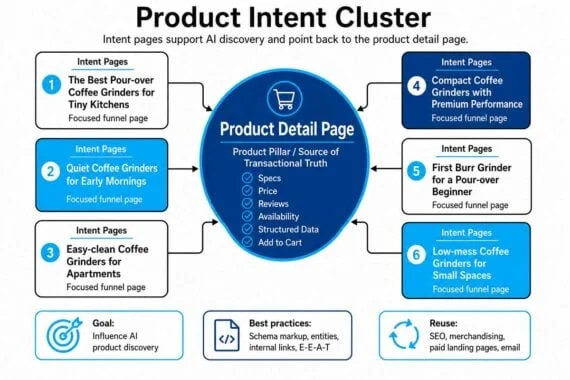
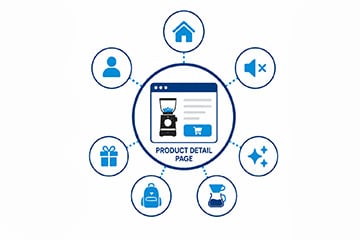
This enhanced understanding of shopper intent has paved the way for a new strategic approach: "product intent clusters." These clusters can be visualized as a hub-and-spoke model, with the central product detail page (PDP) serving as the core. Radiating outwards are various "intent pages," each meticulously crafted to address a specific shopper scenario or a cluster of related needs.
These product intent clusters bear a resemblance to traditional SEO topic clusters, which aim to establish authority and relevance around a particular subject. However, the focus of product intent clusters is more granular, zeroing in on specific information, practical use cases, and distinct customer journeys that collectively guide a shopper towards a particular product. The PDP, as the authoritative source of truth for a product, remains central. It houses critical information such as specifications, pricing, customer reviews, availability, and structured data essential for driving conversions. Crucially, the PDP is designed to be rankable, extractable, and understandable by AI entities.
The intent pages within a cluster serve as the crucial supporting content. They are designed to answer the detailed, context-rich questions that AI chatbots are increasingly fielding. For instance, instead of a broad query like "best coffee grinders for pour-over," a more effective intent page would target a specific scenario, such as "best pour-over coffee grinders for tiny kitchens." Such a page would acknowledge the shopper’s need for pour-over quality while also addressing constraints like limited counter space, a desire for quiet operation, and ease of cleaning.
The structure of these intent pages is paramount. They should not only provide valuable information but also guide the shopper towards a purchase decision. This involves:
- Addressing Specific Pain Points: Directly answering the nuanced questions posed by AI queries, such as the need for a quiet grinder in a small apartment.
- Highlighting Relevant Features: Emphasizing product attributes that align with the specific use case, such as the grind consistency for pour-over or the compact design for small kitchens.
- Providing Use-Case Scenarios: Illustrating how the product fits into the shopper’s lifestyle and addresses their particular needs.
- Facilitating Comparison: Offering insights into how the product stacks up against alternatives within the specific context of the intent page.
- Linking Strategically to the PDP: Directing users to the product detail page for purchase, offering clear calls to action.
To ensure these intent pages are discoverable and understandable by AI, they must adhere to established SEO best practices. This includes implementing Schema.org structured data markup, utilizing relevant entities, and building robust internal linking strategies. While these pages must be readable and valuable for human consumers, their ultimate purpose is to effectively communicate with AI bots, enabling them to surface the most relevant product information in response to complex queries. The goal is to create a comprehensive network of dozens, or even hundreds, of these intent pages per product, effectively mapping out every conceivable shopper scenario.
The AI Unlock: Democratizing Content Creation and Optimization
The strategic creation and maintenance of a vast array of detailed intent pages would have been an insurmountable challenge for most e-commerce marketing teams prior to the widespread adoption of generative AI. The labor-intensive process of researching, outlining, writing, optimizing, and continuously updating content for niche use cases, such as "the best pour-over coffee grinders for tiny kitchens," was often deemed too costly and the potential return on investment too uncertain. The narrow scope of each use case made it difficult to justify the significant resources required.
However, the current AI landscape has fundamentally changed this calculus. Automation and generative AI tools now empower marketers to produce and maintain an almost limitless volume of high-quality intent pages with unprecedented efficiency and precision. These AI models can be carefully and precisely prompt-engineered to generate content that is not only relevant but also adheres to specific stylistic and informational requirements.
Furthermore, AI can play a crucial role in identifying the very topics that should form the basis of these intent pages. By feeding structured customer feedback—such as support tickets, product reviews, and frequently asked questions—into a generative AI platform, marketers can uncover latent needs and emerging use cases. This data-driven approach ensures that the content created is directly aligned with what customers are actually asking for, or struggling with, even if they express it in less-than-explicit terms.
In essence, generative AI acts as a powerful enabler for a more sophisticated and personalized approach to e-commerce marketing. When shoppers are unsure of their exact needs, they are increasingly turning to AI for guidance. The creation of comprehensive product intent clusters provides these AI systems with a structured and rich dataset, enabling them to accurately connect a shopper’s evolving needs with the most appropriate product offerings and, ultimately, a willingness to purchase.
Broader Implications for the E-commerce Ecosystem
The strategic implementation of product intent clusters, fueled by AI, has profound implications for the broader e-commerce ecosystem.
For Marketers:
This shift necessitates a move away from a purely product-centric view towards a more consumer-centric approach. Marketers will need to develop a deep understanding of their customer journeys and anticipate the nuanced questions shoppers will pose to AI. The ability to leverage AI for content generation and optimization will become a core competency, allowing teams to scale their efforts significantly. The focus will be on creating value-driven content that genuinely assists shoppers, rather than simply promoting products.
For AI Developers and Platforms:
The success of AI in e-commerce hinges on the quality and structure of the data it can access. Platforms that can effectively ingest and interpret complex product information, user reviews, and contextual data will gain a significant advantage. The development of more sophisticated AI models capable of understanding subtle intent and providing personalized recommendations will be crucial. Furthermore, transparency in how AI surfaces products will become increasingly important to build consumer trust.
For Consumers:
The AI-driven approach promises a more personalized and efficient shopping experience. Shoppers will be able to get answers to highly specific questions, discover products that precisely match their unique needs, and make more informed purchasing decisions. This could lead to greater satisfaction and reduced buyer’s remorse. However, it also raises questions about potential biases in AI algorithms and the need for consumers to critically evaluate the information presented to them.
For the E-commerce Platform:
E-commerce platforms will need to adapt their infrastructure to support the ingestion and indexing of a vast array of intent-focused content. The integration of AI-powered search and recommendation engines will become standard. The ability to analyze user behavior and feedback at a granular level will be essential for optimizing product offerings and marketing strategies.
Challenges and Future Considerations
While the opportunities presented by AI in e-commerce are substantial, several challenges need to be addressed. The accuracy and reliability of AI-generated content are paramount. Marketers must implement robust review and editing processes to ensure factual correctness and brand consistency. Furthermore, the ethical implications of AI-driven marketing, including data privacy and algorithmic bias, require careful consideration and proactive mitigation strategies.
The long-term success of this approach will also depend on the evolving capabilities of AI. As AI models become more sophisticated, they may be able to infer intent with even greater accuracy, potentially reducing the need for extensive manual content creation. However, the human element of understanding nuanced needs and crafting compelling narratives will likely remain invaluable.
In conclusion, the integration of AI into the e-commerce landscape marks a pivotal moment for marketers. By embracing the concept of product intent clusters and leveraging generative AI for content creation and optimization, businesses can forge deeper connections with consumers, drive engagement, and ultimately achieve greater success in an increasingly complex and dynamic digital marketplace. The ability to anticipate and cater to the nuanced needs of shoppers, even when they themselves are unsure of what they want, is the new frontier in e-commerce marketing.