The Bill and Melinda Gates Foundation recently unveiled its inaugural “Goalkeepers” report, a comprehensive data-driven analysis titled Goalkeepers 2017, designed to track and accelerate progress toward the United Nations Sustainable Development Goals (SDGs). This initiative serves as both a diagnostic tool and a call to action, utilizing rigorous data visualization and storytelling to identify urgent global problems, measure the efficacy of current solutions, and disseminate best practices across borders. Central to the 2017 findings is the critical issue of maternal mortality, a metric that remains one of the most poignant indicators of a nation’s healthcare infrastructure and social equity. By synthesizing data from the Bill and Melinda Gates Foundation and UNICEF, the report provides a nuanced look at how targeted interventions, particularly in developing nations like Ethiopia, are drastically altering the trajectory of global health.
The Foundation of the Goalkeepers Initiative
The Goalkeepers report was established to bridge the gap between high-level global aspirations and the practical, ground-level realities of international development. In 2015, world leaders committed to 17 Sustainable Development Goals aimed at ending poverty, fighting inequality, and stopping climate change by 2030. The Goalkeepers initiative focuses specifically on the indicators related to health and poverty. The 2017 report highlights that while the world has seen unprecedented improvements in the human condition over the last quarter-century, future progress is not guaranteed.
The report’s methodology involves a sophisticated blend of information design, utilizing text, imagery, video, and interactive charts to make complex datasets accessible to policymakers and the general public alike. This approach is intended to combat “complacency” by showing that while the challenges are immense, they are solvable through sustained investment and political will.
Maternal Mortality: A Devastating Global Burden
One of the most sobering metrics addressed in the report is maternal mortality. Defined as the death of a woman while pregnant or within 42 days of termination of pregnancy from any cause related to or aggravated by the pregnancy or its management, it remains a primary focus of global health experts. Bill and Melinda Gates have characterized maternal mortality as the most efficient way to devastate a community, noting that the loss of a mother places surviving children in immediate and long-term danger.
According to UNICEF data cited in the analysis, approximately 302,530 maternal deaths occurred globally in 2015 alone. This translates to a global maternal mortality ratio (MMR) of 168.7 deaths per 100,000 live births. The implications of these deaths extend far beyond the individual loss; the death of a mother often leads to a “multiplier effect” of misfortune, where surviving children are less likely to receive adequate nutrition, education, or healthcare, thereby perpetuating the cycle of poverty.
Chronology of Progress: From MDGs to SDGs
The fight against maternal mortality is best understood through the lens of the Millennium Development Goals (MDGs), which governed international development from 1990 to 2015. MDG 5 specifically aimed to reduce the maternal mortality ratio by three-quarters. While many countries fell short of the exact target, the global MMR declined by approximately 44% during this period.
In 2016, the transition to the Sustainable Development Goals (SDGs) raised the stakes. SDG Target 3.1 aims to reduce the global maternal mortality ratio to less than 70 per 100,000 live births by 2030. The Goalkeepers 2017 report serves as an early assessment of this transition, highlighting that achieving this goal will require a significant acceleration of current trends, particularly in high-burden regions such as Sub-Saharan Africa and Southern Asia.
Case Study: Ethiopia’s Strategic Success
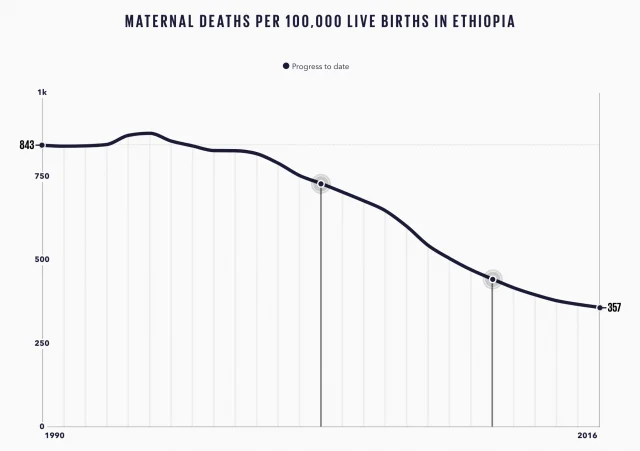
A centerpiece of the Goalkeepers 2017 report is the success story of Ethiopia. In 1990, Ethiopia had one of the highest maternal mortality ratios in the world, with 843 deaths per 100,000 live births. By 2015, this figure had plummeted to 357 per 100,000. This represents a reduction of more than 50%, a feat achieved through a combination of political commitment and innovative healthcare delivery.
The primary driver of Ethiopia’s success was the implementation of the Health Extension Program (HEP) launched in 2003. This program involved the training and deployment of over 38,000 female health extension workers who were stationed in rural villages. These workers provided essential maternal and child health services, including prenatal care, immunization, and education on hygiene and nutrition. By bringing healthcare directly to the doorsteps of those in need, Ethiopia successfully bypassed the barriers of distance and cost that often prevent rural women from seeking care.
Comparative Global Data and Regional Disparities
While Ethiopia provides a model for progress, a broader look at UNICEF’s maternal mortality datasets reveals stark regional disparities. In developed regions, the MMR is often as low as 12 per 100,000 live births. In contrast, Sub-Saharan Africa continues to bear the heaviest burden, accounting for roughly 66% of all maternal deaths globally.
The UNICEF data identifies several key factors that contribute to these disparities:
- Access to Skilled Birth Attendants: In many high-mortality regions, a significant percentage of births still occur without the assistance of a trained midwife or doctor.
- Emergency Obstetric Care: The “Three Delays” model—delay in seeking care, delay in reaching a facility, and delay in receiving adequate treatment—remains a major hurdle.
- Adolescent Pregnancy: Complications from pregnancy and childbirth are a leading cause of death among girls aged 15–19 in developing countries.
- Economic Status: Data shows that women in the poorest 20% of households are significantly less likely to have access to life-saving interventions compared to those in the richest 20%.
Official Responses and Strategic Implications
The release of the Goalkeepers report has prompted responses from various international bodies. UNICEF officials have emphasized that the data must be used to drive “equity-based” investments. This means focusing resources not just on where the most people are, but where the most vulnerable people are located.
Bill and Melinda Gates have reiterated that the progress seen in countries like Ethiopia is “proof of concept” that the SDGs are achievable. However, they also warn that a potential reduction in global health funding from donor nations could stall or even reverse these gains. The report suggests that if funding levels remain stagnant, the world could see an additional 4 million deaths by 2030 that were otherwise preventable.
From a policy perspective, the implications are clear: data transparency is essential. The use of platforms like Google Data Studio to visualize UNICEF and WHO statistics allows for a more granular understanding of where interventions are working. Analysts argue that the next phase of the fight against maternal mortality must involve better “vital statistics” registration systems, as many maternal deaths in rural areas still go unrecorded, leading to an underestimation of the problem.
Broader Impact: The Future of Maternal Health
The findings of the Goalkeepers 2017 report suggest that the global community is at a crossroads. The “easy” gains—those achieved through simple interventions like vaccinations and basic hygiene education—have largely been realized. The next stage of reduction will require more complex and expensive systemic changes, such as building robust surgical capacities for cesarean sections and improving blood bank infrastructure to treat postpartum hemorrhage, the leading cause of maternal death.
Furthermore, the report underscores the importance of female empowerment. In regions where women have more agency over their reproductive health and greater access to education, maternal mortality rates tend to drop more rapidly. This suggests that maternal health is not merely a medical issue, but a socio-economic one.
As the world looks toward 2030, the Goalkeepers initiative will continue to serve as a vital annual check-up. The data from 2017 confirms that while the road to ending maternal mortality is long, the map is becoming clearer. By studying the “stories behind the data”—from the health extension workers in Ethiopia to the statisticians at UNICEF—the global community can refine its strategies and ensure that no mother has to lose her life while bringing new life into the world. The ultimate goal is a world where the maternal mortality ratio is not just low, but negligible, regardless of geography or economic status.