The world of Google Ads search query targeting is currently experiencing a significant period of evolution, marked by widespread hype and, understandably, considerable confusion. Marketers are grappling with a shifting paradigm that includes concepts like “keywordless targeting,” the intricacies of “close variants,” the deprecation of Dynamic Search Ads, and the increasing prominence of AI-driven solutions such as AI Max for Search and Shopping campaigns. This confluence of changes has led to a cacophony of conflicting advice and sentiment, with pronouncements ranging from outright dismissal of broad match as “terrible” to emphatic endorsements of AI Max as an indispensable tool.
This article aims to demystify the current state of Google Ads search targeting by dissecting the functionalities of broad match and AI Max. We will explore their similarities, delineate their crucial differences, and provide a framework for advertisers to make informed decisions about which features best suit their specific Search campaign objectives.
The Common Ground: Why AI Max and Broad Match Can Appear Similar
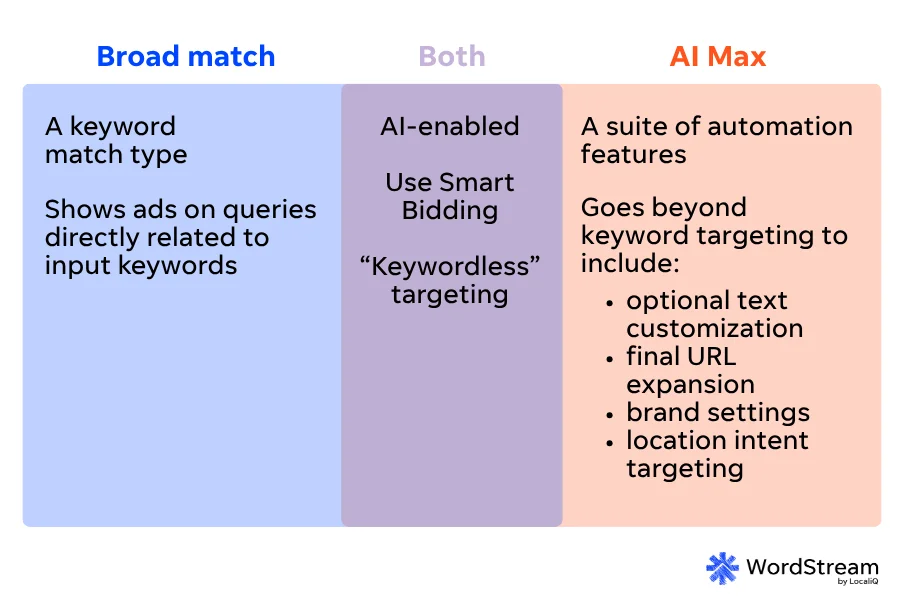
At their core, both broad match and AI Max for Search represent sophisticated, automated approaches to search query targeting. A fundamental requirement for both is the utilization of Smart Bidding strategies. Their shared objective is to expand an advertiser’s reach beyond the confines of precise keyword matching, enabling the discovery of new and potentially valuable search queries that might otherwise be missed.
These automated systems leverage a diverse array of signals to inform their participation in ad auctions and determine bidding strategies. These signals include, but are not limited to, the content of the advertiser’s landing pages, the creative elements of their ad copy, and other keywords present within the same ad group.
The reliance on artificial intelligence is a defining characteristic of both broad match and AI Max. This necessitates a period of data ingestion and learning. Consequently, during the initial stages of implementation, advertisers are likely to observe a range of search terms in their reports that may appear generic, irrelevant, or even nonsensical. The efficacy of these AI-powered tools is directly correlated with the quality and quantity of conversion data they receive. The more data available, the faster the system can learn to identify valuable queries and user segments, distinguishing them from those that are unlikely to yield desired outcomes.
The learning curve for these AI models is not dictated by a fixed timeframe. Campaigns that consistently generate a high volume of daily conversions, for instance, can achieve a significant understanding of optimal targeting within a day or two, with continuous learning occurring as market dynamics evolve. Conversely, campaigns with very low conversion volumes, such as a few per month, may not accumulate sufficient data to optimize effectively, potentially leading to advertiser frustration and premature deactivation.
While both broad match and AI Max are designed to cast a wide net in terms of query eligibility, they are not without their limitations. Crucially, both respect the negative keywords established by the advertiser. However, the effectiveness of negative keyword implementation can be complex, as a significant portion (estimated between 50-80%) of search terms may fall into an “Other search terms” category. This underscores the importance of careful consideration before applying negative keywords, as they could inadvertently exclude valuable traffic.
Key Distinctions: What Sets AI Max and Broad Match Apart
While the “keywordless” aspect of broad match and AI Max might suggest a degree of overlap, their functionalities diverge significantly in other critical areas.
Broad match, in its essence, is a specific keyword matching type. It instructs Google Ads to serve ads for queries that are related to the specified keyword. AI Max for Search Campaigns, on the other hand, is a more comprehensive suite of automation features. It encompasses keywordless targeting but extends further to include optional text customization, final URL expansion, brand settings, and location intent targeting.
Text Customization and AI Brief
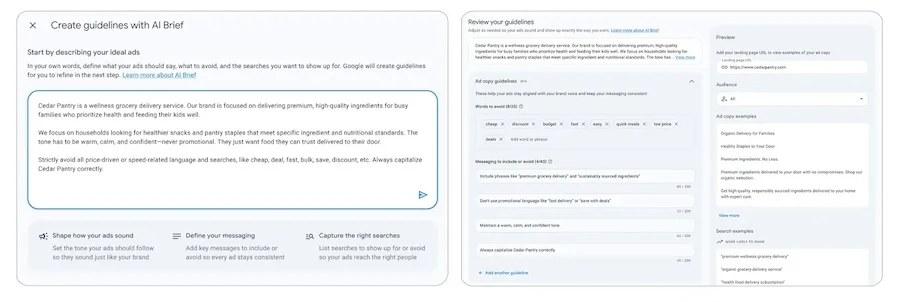
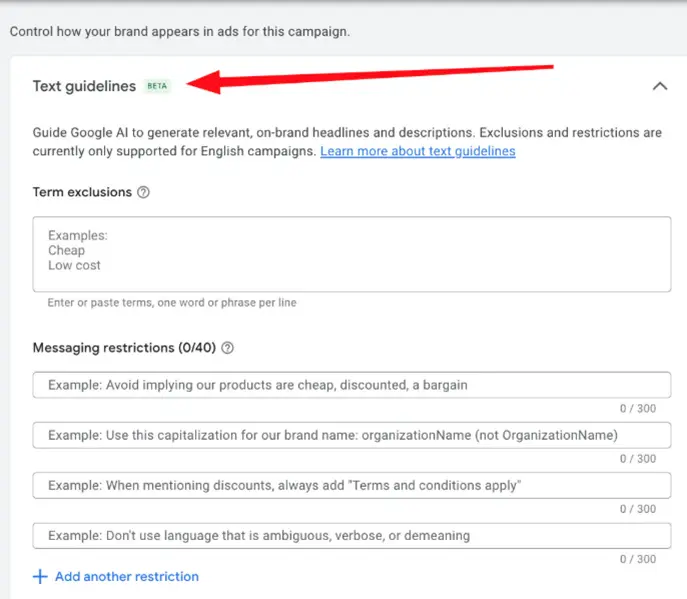
A notable differentiator is AI Max’s capability for text customization. When enabled alongside keywordless targeting, Google’s AI can dynamically generate headlines and descriptions. While it can draw upon the existing 15 headlines and four descriptions provided for Responsive Search Ads (RSAs), AI Max has demonstrated the ability to produce a far wider array of ad copy variations. Some of these generated texts may closely resemble or be identical to existing ad assets, while others can be more experimental. The recent introduction of features like “AI Brief” and “text disclaimers” is anticipated to further refine and improve the effectiveness of this text customization. These enhancements aim to provide advertisers with greater clarity and control over the AI-generated content.
Final URL Expansion
Both Performance Max (PMax) campaigns and AI Max campaigns offer the option of final URL expansion. This feature allows Google to direct users to any relevant page on an advertiser’s website, rather than solely to the designated final URL. In AI Max for Search, and now also in AI Max for Shopping, enabling final URL expansion necessitates having text customization activated. A key advantage of AI Max over PMax in this regard is the provision of detailed landing page reporting. This allows advertisers to precisely track where their paid traffic was directed by final URL expansion and to analyze the performance of those specific landing pages.
Brand Settings
The control over brand inclusions and exclusions, previously compatible with broad match, has now been integrated into AI Max. This means that to leverage brand settings effectively, advertisers must utilize AI Max’s keywordless targeting. This feature is particularly beneficial for established brands and competitors. Brand settings allow advertisers to ensure their ads appear for searches related to their brand name and those of their competitors, while also enabling them to exclude their ads from appearing for irrelevant brand-related queries. The effective use of brand settings is often observed to be more pronounced with larger budgets and more mature brand presence.
Location Intent Targeting
AI Max introduces an innovative location intent targeting feature at the ad group level. This allows for a more nuanced approach to reaching specific audiences. For instance, an advertiser targeting US-based users interested in Toronto hotels can set their overall campaign location to the United States, while configuring the ad group’s intent settings to focus on Toronto. This enables keywords like “hotel” or “5-star hotels” to be matched with users who explicitly demonstrate an interest in Toronto-specific accommodations, even if their search queries don’t directly include the city name. AI-powered location intent can recognize implicit locational references, such as “Kensington Market” or “Skydome,” as being within Toronto.
Enhanced Search Term Reporting
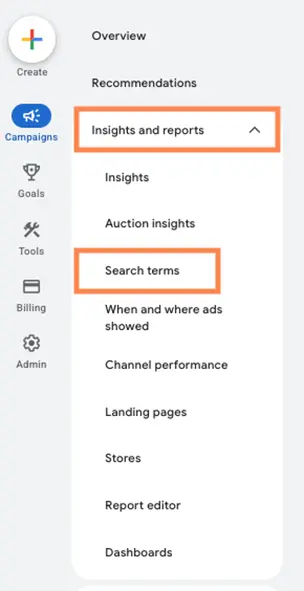
A significant advantage of AI Max over traditional broad match is its enhanced search term reporting. While broad match does not provide visibility into which specific RSA headline was served alongside a particular search query, AI Max’s detailed reports offer this crucial insight. Advertisers can view the exact search term, the specific headlines that appeared with it, and the landing page to which the user was directed. Close monitoring of this granular data during the initial weeks of AI Max implementation is essential to identify and address any unintended AI behaviors.
AI Max vs. Broad Match: Making the Strategic Choice
Considering the comprehensive suite of AI Max-exclusive features, including brand settings, text customization, and AI Brief, the recommendation has shifted towards adopting AI Max as the preferred alternative to broad match keywords. Broader query targeting demonstrates a higher propensity for conversions when complemented by tailored ad copy and, if necessary, a customized landing page. AI Max is demonstrably better equipped to achieve this synergy than broad match, particularly in emerging AI-centric formats like Ads in AI Overviews and Ads in AI Mode.
| Capability | Broad Match | AI Max |
|---|---|---|
| Runs in Search campaigns | ✔️ | ✔️ |
| Uses Smart Bidding | ✔️ | ✔️ |
| Expands reach beyond exact keyword wording | ✔️ | ✔️ |
| Matches based on search intent | ✔️ | ✔️ |
| Works with negative keywords | ✔️ | ✔️ |
| Aims to drive more conversions | ✔️ | ✔️ |
| Requires keywords as primary targeting method | ✔️ | 🔲 Optional—can also use keywordless signals |
| Discovers searches beyond provided keywords | 🔲 Limited to keyword intent expansion | ✔️ More aggressively uses AI to discover new queries |
| “Keywordless” targeting | 🔲 Targets keywords beyond input, but base keywords needed | ✔️ |
| Uses landing page content as a targeting signal | 🔲 | ✔️ |
| Uses website content to find new opportunities | 🔲 | ✔️ |
| Automatically customizes ad copy | 🔲 | ✔️ |
| Automatically selects the most relevant landing page | 🔲 | ✔️ |
| Final URL Expansion | 🔲 | ✔️ |
| Text customization/generative AI assets | 🔲 | ✔️ |
| Additional AI-driven query matching controls | 🔲 | ✔️ |
| Locations of Interest controls | 🔲 | ✔️ |
| Higher level of automation | 🔲 Moderate | ✔️ High |
| Greater advertiser control | ✔️ | 🔲 Lower due to automation |
| Best for advertisers wanting tighter control | ✔️ | 🔲 |
| Best for advertisers seeking maximum reach and discovery | 🔲 Somewhat | ✔️ |
For advertisers who have successfully utilized broad match keywords and are experiencing positive campaign performance, the logical next step is to rigorously test AI Max. There may be untapped queries that are currently inaccessible due to a lack of appropriate assets or landing pages. AI Max’s text customization and final URL expansion capabilities are well-suited to address these limitations.
Advertisers employing phrase match keywords with an impression share of 50% or higher, who are satisfied with their current performance and aiming for scalability, can confidently transition directly to AI Max, bypassing broad match altogether.
For those operating with exact match keywords in a similar positive performance scenario, the recommendation is to introduce a single broad match keyword into their ad groups. After allowing for one to two conversion cycles to assess performance, advertisers can then decide whether to advance to AI Max or revert to exact match.
When testing AI Max, it is advisable to implement it within an existing, well-performing campaign rather than initiating a new one. AI systems, including AI Max, require substantial data to learn effectively. Leveraging the historical data of an established campaign provides a stronger foundation for AI Max’s learning process.
It is critical to emphasize that AI Max should not be viewed as a solution for underperforming campaigns. AI is an amplifier, not a problem solver. A campaign with a solid foundation and positive performance metrics is well-positioned to benefit from AI Max’s enhancements. Conversely, a poorly performing campaign is unlikely to see improvement and may even experience a decline in results with AI Max. Addressing the root causes of performance issues should be the priority before exploring AI Max.
Furthermore, neither AI Max nor broad match can achieve optimal results without robust bid strategies and accurate conversion tracking. The absence of essential data, such as offline conversion tracking for lead generation campaigns, will inevitably hinder the achievement of desired outcomes.
Conclusion: AI Max Represents the Future of Search Targeting
While broad match and AI Max share similarities in their ambition to broaden search query reach, their functional differences are profound. Broad match is a keyword matching type, whereas AI Max is a comprehensive ecosystem of AI-driven features designed for both Search and Shopping campaigns. AI Max for Search extends beyond keywordless targeting to include AI-powered text customization with AI briefing capabilities, final URL expansion, brand settings, location intent targeting, and enhanced search term reporting. AI Max for Shopping, a more recent development, integrates text customization, final URL expansion, and format selection alongside existing Standard Shopping campaign functionalities. Given its advanced capabilities and alignment with Google’s strategic direction towards AI-first advertising, AI Max is positioned as the more advanced and ultimately more effective solution for advertisers seeking to maximize their reach and performance in the evolving digital advertising landscape.

 Basiran
 Lina Irawan